
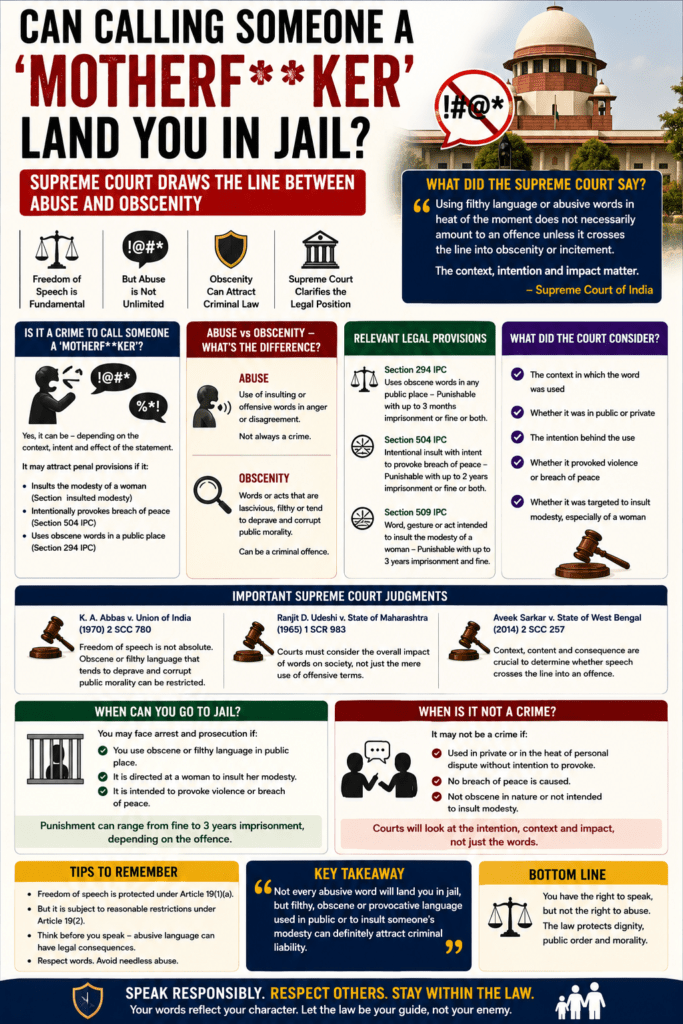
Case Details
Case Title: Mani @ Subramaniyam v. State Rep. by the Deputy Superintendent of Police
Court: Supreme Court of India
Case No.: Criminal Appeal No. 3241 of 2026 (Arising out of SLP (Crl.) No. 4516 of 2025)
Date of Judgment: 17 July 2026
Coram: Justice Sanjay Karol and Justice Vipul M. Pancholi
Neutral Citation: 2026 INSC 719
Relevant Provisions: Sections 294(b), 326 and 506(ii) of the Indian Penal Code, 1860; Section 3(2)(va) of the SC/ST (Prevention of Atrocities) Act, 2015.
A Heated Argument, One Abusive Word, and a Criminal Case
People often lose their temper during arguments. Whether it’s a road rage incident, a property dispute, or a neighbourhood quarrel, abusive language is unfortunately common.
But can using a filthy abuse like “motherf****ker” send you to jail for obscenity?
The Supreme Court of India has now answered this important legal question. In a significant judgment, the Court clarified that merely using abusive or vulgar language—even highly offensive words—does not automatically amount to the criminal offence of obscenity.
This judgment is important because it clearly explains the difference between vulgar language and legal obscenity, a distinction that many people often misunderstand.
What Was the Case About?
The case arose from a dispute over agricultural land in Tamil Nadu.
During the altercation, the accused allegedly abused the complainant by using the word “motherf****ker” and also assaulted him with a billhook, causing serious injuries. Based on these allegations, he was convicted for:
- Causing grievous hurt (Section 326 IPC),
- Using obscene words in a public place (Section 294(b) IPC), and
- Criminal intimidation (Section 506(ii) IPC).
The accused challenged his conviction before the Supreme Court.
What Does Section 294 IPC Actually Punish?
Section 294 of the Indian Penal Code (now substantially replaced under the Bharatiya Nyaya Sanhita for future cases) punishes:
- Obscene acts in public places; or
- Singing, reciting, or uttering obscene words in or near a public place,
provided that such acts cause annoyance to others.
The key word here is “obscene.”
The law does not punish every rude or offensive word.
What Is ‘Obscenity’ in Law?
The Supreme Court explained that obscenity has a specific legal meaning.
For words or expressions to be considered obscene, they must generally:
- be lascivious,
- appeal to prurient (sexual) interests, and
- have the tendency to deprave or corrupt the minds of people exposed to them.
If these elements are absent, the offence of obscenity is not made out merely because the language is crude or offensive.
Is Every Abusive Word Obscene?
The Supreme Court answered this with a clear No.
The Court observed that words may be:
- abusive,
- vulgar,
- insulting,
- offensive,
- uncivil, or
- profane,
yet still not qualify as obscene under criminal law.
Simply because society considers a word offensive does not mean criminal liability automatically follows.
Why Did the Court Say ‘Motherf****ker’ Is Not Automatically Obscene?
The Court held that although the expression is undoubtedly offensive and uncivilised, it does not by itself satisfy the legal ingredients of obscenity.
The Bench observed that there was nothing on record to show that the word:
- appealed to sexual desires,
- aroused prurient interest,
- corrupted public morality, or
- possessed the characteristics necessary to constitute obscenity.
The Court also noticed another important fact.
There was no evidence that the alleged words caused annoyance to other persons in a public place, which is a mandatory ingredient of Section 294(b) IPC.
Therefore, the conviction under Section 294(b) IPC could not be sustained.
Context Matters More Than the Word Itself
One of the biggest takeaways from the judgment is that courts cannot decide criminal liability merely by looking at a single abusive word in isolation.
They must examine:
- where the words were spoken,
- why they were spoken,
- the surrounding circumstances,
- whether they were uttered publicly,
- whether they caused annoyance to others, and
- whether they possess the legal characteristics of obscenity.
In other words, context is as important as the language itself.
What About Criminal Intimidation?
The Supreme Court also set aside the conviction under Section 506(ii) IPC.
The Court held that merely using threatening language during a quarrel does not automatically amount to criminal intimidation.
To constitute the offence, the prosecution must establish that the threat was intended to cause alarm or compel the victim to do or refrain from doing something.
Since these essential ingredients were missing, the conviction for criminal intimidation was also set aside.
What Conviction Was Upheld?
Although the accused succeeded regarding the offences of obscenity and criminal intimidation, the Supreme Court upheld his conviction under Section 326 IPC for causing grievous hurt.
Medical evidence established that the complainant had suffered multiple injuries, including a fractured nasal bone caused by a dangerous weapon.
However, considering the appellant’s advanced age (about 70 years), medical condition, and the circumstances of the case, the Court modified the sentence to imprisonment till the rising of the court along with a fine of ₹50,000.
Why Is This Judgment Important?
This judgment is significant because it prevents the criminal law from being misused in every verbal altercation.
The Supreme Court has reaffirmed that:
- criminal statutes must be interpreted strictly;
- not every offensive expression amounts to a criminal offence;
- courts must distinguish between bad manners and criminal obscenity.
This protects citizens from unnecessary prosecution while ensuring that genuinely obscene conduct remains punishable.
Key Takeaways
- Calling someone a “motherf****ker” does not automatically constitute the offence of obscenity under Section 294 IPC.
- Obscenity requires something more than vulgar or abusive language.
- The prosecution must establish that the words were lascivious, appealed to prurient interests, or had the tendency to deprave or corrupt.
- Section 294 IPC also requires proof that the obscene act or words caused annoyance to others in a public place.
- Every abusive word cannot be treated as a criminal offence merely because it is offensive.
Frequently Asked Questions (FAQs)
Can abusive language alone amount to obscenity?
No. The Supreme Court has clarified that abusive or vulgar language alone is not enough. The legal ingredients of obscenity must also be satisfied.
Can I still face criminal action for abusing someone?
Yes. Depending on the facts, abusive language may attract other offences such as criminal intimidation, intentional insult, defamation, or other provisions of criminal law.
Does this judgment permit people to use abusive language?
No. The Court has not approved abusive behaviour. It has only clarified that offensive language does not automatically satisfy the legal requirements of the offence of obscenity.
Why is this judgment important?
It ensures that criminal law is applied only where the legal ingredients of an offence are actually present, preventing unnecessary prosecutions based solely on abusive language.
Conclusion
The Supreme Court’s decision in Mani @ Subramaniyam v. State Rep. by the Deputy Superintendent of Police reinforces a fundamental principle of criminal jurisprudence: every offensive act is not necessarily a criminal offence. While abusive expressions like “motherf****ker” are undoubtedly rude, offensive, and socially unacceptable, the law demands something more before branding them as obscene. By drawing a clear distinction between vulgarity and legal obscenity, the Court has ensured that criminal law remains a tool for punishing genuine offences—not every heated exchange or moment of anger.