
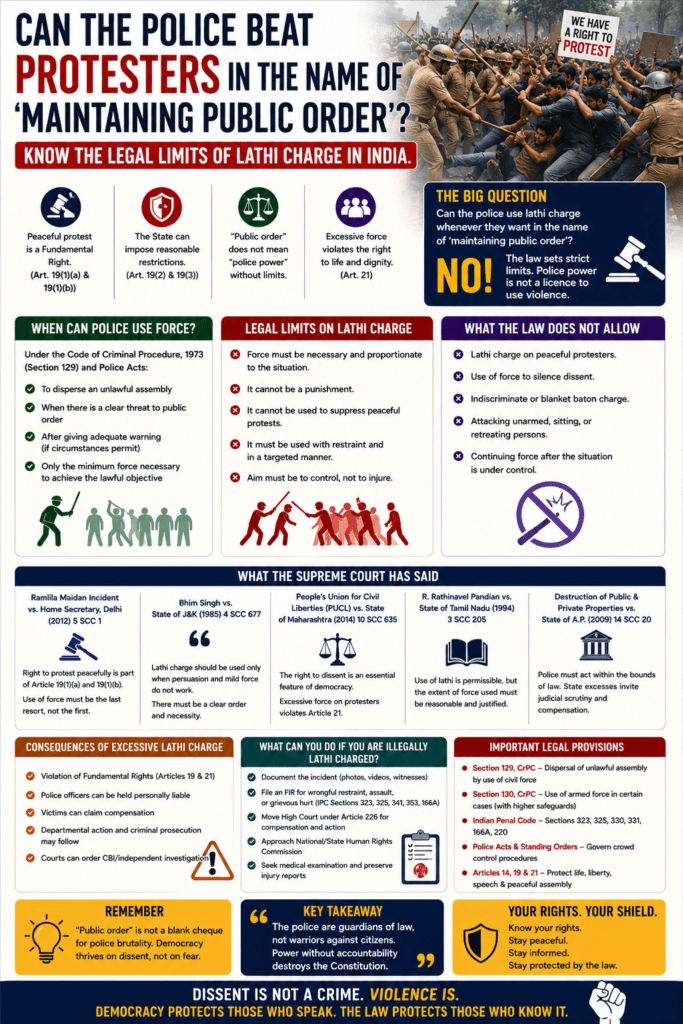
- Introduction
- Does the Police Have Power to Use Force?
- Is Every Protest Illegal?
- When Can Police Use Physical Force?
- What Does "Proportionate Force" Mean?
- Is Lathi Charge Specifically Mentioned in Law?
- Can the Police Use Force Against Students?
- When Does Police Force Become Illegal?
- Can Victims Challenge Excessive Force?
- Jurisprudence Behind the Law
- Landmark Supreme Court Principles
- Myth vs Reality
- Frequently Asked Questions
- Key Takeaways
- Conclusion
Introduction
Every few months, videos of police using lathis, tear gas, water cannons, or physical force against protesting students, workers, farmers, or citizens circulate across social media.
The police often justify such action by saying:
“We were maintaining law and order.”
This raises an important constitutional question:
- Can the police use physical force whenever they want?
- Is every lathi charge legal?
- How much force is legally permissible?
- What happens if excessive force is used?
- Can victims claim compensation?
The answer lies in the Constitution, criminal procedure, judicial precedents, and the doctrine of proportionality.
Does the Police Have Power to Use Force?
Yes—but only within the limits prescribed by law.
Police officers are empowered to maintain:
- public order;
- public peace;
- safety of citizens;
- protection of life and property; and
- enforcement of lawful orders.
However, these powers are not unlimited.
Every use of force must satisfy constitutional and statutory requirements.
Is Every Protest Illegal?
Absolutely Not.
Peaceful protest is a recognised constitutional right flowing from:
- Article 19(1)(a) – Freedom of speech and expression.
- Article 19(1)(b) – Right to assemble peacefully and without arms.
- Article 19(1)(c) – Right to form associations.
These rights are fundamental.
However, they are subject to reasonable restrictions under Article 19(2) and Article 19(3), including interests of:
- public order;
- sovereignty and integrity of India;
- security of the State; and
- other constitutionally recognised grounds.
When Can Police Use Physical Force?
Force may become legally justifiable where it is necessary to:
- disperse an unlawful assembly;
- prevent violence;
- protect life;
- prevent serious damage to public property;
- stop imminent criminal acts; or
- execute lawful duties where resistance is encountered.
But necessity alone is not enough.
The force must also be:
- lawful;
- necessary;
- reasonable; and
- proportionate.
What Does “Proportionate Force” Mean?
This is the most important legal principle.
The police cannot use more force than reasonably required to control the situation.
For example:
- A peaceful group sitting on the road ordinarily does not justify indiscriminate baton charges.
- If protesters begin attacking people, setting vehicles on fire, or causing serious violence, the police may use greater force to restore order—but even then, only to the extent reasonably necessary.
Courts examine whether the response matched the actual threat.
Is Lathi Charge Specifically Mentioned in Law?
Indian law does not give the police a blanket licence to “lathi charge.”
The police derive powers to disperse unlawful assemblies and maintain public order under the applicable criminal procedure and police laws. The method adopted must still comply with constitutional requirements.
Operational manuals and standing orders in different States may regulate crowd-control techniques, but they cannot override constitutional guarantees.
Can the Police Use Force Against Students?
Students are not immune from lawful police action.
At the same time, they cannot be treated differently merely because they are students.
The same legal standards apply:
- Was the assembly lawful?
- Was there violence?
- Was there an imminent threat?
- Was force necessary?
- Was the force proportionate?
The answer depends on the facts of each incident—not on the identity of the protesters.
When Does Police Force Become Illegal?
Police action may become unlawful if it is:
- excessive;
- arbitrary;
- malicious;
- retaliatory;
- disproportionate;
- unsupported by law; or
- in violation of constitutional safeguards.
Even where the police have the authority to intervene, the manner of intervention can still be unconstitutional.
Can Victims Challenge Excessive Force?
Yes.
A person alleging excessive or unlawful police force may have several remedies, depending on the facts.
1. Writ Petition
The High Court under Article 226 or the Supreme Court under Article 32 may be approached where fundamental rights are violated.
2. Compensation
Constitutional courts have awarded public law compensation in appropriate cases involving unlawful State action and violation of fundamental rights.
3. Criminal Proceedings
Where the facts disclose criminal offences, police personnel may also face criminal liability, subject to the applicable legal requirements.
4. Departmental Inquiry
Complaints may lead to disciplinary proceedings against erring officials.
5. Human Rights Commission
Complaints can be filed before the National Human Rights Commission (NHRC) or the relevant State Human Rights Commission.
Jurisprudence Behind the Law
1. Rule of Law
Police officers are subject to the Constitution and the law.
No officer enjoys unlimited discretion.
2. Doctrine of Proportionality
State action restricting fundamental rights must:
- pursue a legitimate objective;
- be suitable to achieve that objective;
- be necessary; and
- impose the least restrictive burden reasonably possible.
This principle has become central to constitutional adjudication in India.
3. Article 21
The right to life includes:
- dignity;
- bodily integrity;
- protection against arbitrary violence;
- fair treatment by the State.
4. Article 19
Freedom to protest is a constitutional right.
Reasonable restrictions may be imposed, but restrictions cannot be arbitrary or excessive.
Landmark Supreme Court Principles
The Supreme Court has consistently held that:
- State force must be fair, reasonable, and proportionate.
- Fundamental rights cannot be curtailed by arbitrary executive action.
- Police accountability is an essential component of the rule of law.
Important decisions include:
- Maneka Gandhi v. Union of India – Procedure affecting liberty must be fair, just, and reasonable.
- D.K. Basu v. State of West Bengal – Safeguards against abuse of police power.
- Anita Thakur v. State of Jammu & Kashmir (2016) – The Supreme Court awarded compensation after finding that excessive force was used against peaceful protesters, emphasising that police action must remain proportionate.
- Mazdoor Kisan Shakti Sangathan v. Union of India (2018) – Recognised the importance of the right to peaceful protest while balancing competing public interests.
These decisions reinforce that maintenance of public order cannot become a justification for arbitrary or excessive use of force.
Myth vs Reality
| Myth | Reality |
|---|---|
| Police can lathi charge any protest whenever they want. | False. The use of force must be authorised by law, necessary, and proportionate. |
| Every protest is illegal. | Incorrect. Peaceful assembly is protected under Article 19 of the Constitution, subject to reasonable restrictions. |
| If protesters violate the law, police can use unlimited force. | False. Even against unlawful assemblies, only reasonable and proportionate force may be used. |
| Victims of police excess have no remedy. | Wrong. Courts, human rights commissions, compensation claims, criminal proceedings, and departmental action may all be available depending on the facts. |
| Videos alone always prove police misconduct. | Incorrect. Videos are important evidence but courts evaluate them along with medical records, official reports, witness testimony, and the surrounding circumstances. |
Frequently Asked Questions
Can the police lathi charge peaceful protesters?
Not merely because they are protesting. Whether force is lawful depends on the facts, including whether there was a genuine threat to public order and whether the response was proportionate.
Can students file a case against the police?
Yes. If they believe excessive or unlawful force was used, they may pursue appropriate legal remedies.
Can courts award compensation?
Yes. Constitutional courts have granted compensation in appropriate cases involving violation of fundamental rights by State authorities.
Is every police action during a protest illegal?
No. Police are legally empowered to maintain public order. The legality depends on whether the action was authorised by law and proportionate to the situation.
Key Takeaways
- Police have the legal authority to maintain public order, but not an unrestricted licence to use force.
- The Constitution requires every use of force to be lawful, necessary, reasonable, and proportionate.
- Peaceful protest is a protected fundamental right under Article 19, subject to reasonable restrictions.
- Excessive force may give rise to constitutional, civil, criminal, and disciplinary consequences.
- Courts carefully examine the facts of each incident before deciding whether police action was justified.
Conclusion
The Constitution does not ask the police to remain passive in the face of violence, nor does it permit them to act without limits. The true legal balance lies between maintaining public order and protecting individual liberty.
Whether a lathi charge or other use of force is justified cannot be answered by slogans or assumptions. The real legal test is whether the action had a lawful basis, responded to a genuine threat, and remained proportionate throughout. If the police exceed those limits, the law provides remedies. If they act within them, their actions may be legally sustained.
In a constitutional democracy, public order and fundamental rights are not opposing values—they must coexist, and the law requires the State to protect both.