
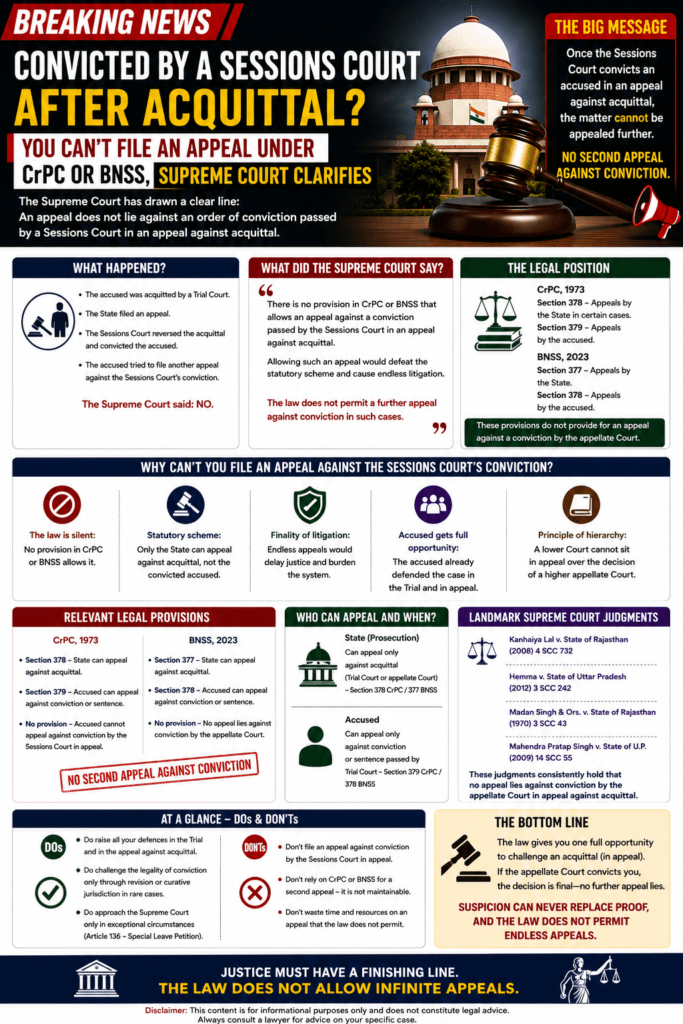
The Supreme Court settles an important procedural question: When a Sessions Court reverses an acquittal and convicts an accused in appeal, the remedy is Revision—not another Appeal.
Case Details
Case Title: Vishnu Kumar Gupta v. State of Madhya Pradesh & Another
Case No.: Special Leave Petition (Criminal) No. 13891 of 2025
Citation: 2026 INSC (Citation awaited/official report awaited)
Date of Judgment: 30 July 2026
Bench:
- Hon’ble Justice Prasanna B. Varale
- Hon’ble Justice Aravind Kumar
A Landmark Judgment on Criminal Appeals
In a significant judgment that settles an important question of criminal procedure, the Supreme Court has ruled that an accused cannot file a statutory appeal under Section 374 of the Code of Criminal Procedure, 1973 (CrPC) or Section 415 of the Bharatiya Nagarik Suraksha Sanhita, 2023 (BNSS) against a conviction recorded by a Sessions Court while exercising appellate jurisdiction.
Instead, the Court clarified that the only legal remedy available is to file a Criminal Revision before the High Court.
This judgment removes the confusion that existed in several High Courts regarding the correct remedy after a Sessions Court reverses an acquittal.
What Was the Dispute?
The accused was initially tried before the Judicial Magistrate First Class (JMFC).
After the trial, the Magistrate acquitted him.
The complainant challenged the acquittal before the Sessions Court by filing an appeal under Section 378 CrPC (now Section 419 BNSS).
The Sessions Court reversed the acquittal and convicted the accused for the first time.
Naturally, the accused approached the High Court by filing an appeal under Section 374 CrPC.
However, the High Court dismissed the appeal as not maintainable.
The issue eventually reached the Supreme Court.
The Important Legal Question
The Supreme Court examined one crucial question:
Can an accused file an appeal under Section 374 CrPC (Section 415 BNSS) against a conviction recorded by a Sessions Court while deciding an appeal against acquittal?
The Court answered:
No.
What Did the Supreme Court Hold?
The Court categorically held that:
An appeal under Section 374 CrPC (corresponding to Section 415 BNSS) is maintainable only against a conviction recorded by the court that actually conducted the trial.
Since the Sessions Court was exercising appellate jurisdiction and did not conduct the trial, its conviction cannot be challenged through another statutory appeal.
Therefore,
No second appeal lies.
Only a Revision Petition can be filed before the High Court.
Why Did the Court Reach This Conclusion?
The Supreme Court closely examined the language of Section 374 CrPC.
The provision permits an appeal against a conviction recorded “on a trial held by” the concerned court.
The Court explained that these words are extremely important.
A Sessions Court deciding an appeal has not conducted any trial.
It merely re-examines the judgment passed by the trial court.
Therefore, it cannot be treated as a court that has “held the trial.”
Consequently, Section 374 cannot be invoked.
Appeal Is a Continuation of Trial—But Only to a Limited Extent
The appellant argued that courts have repeatedly held that:
“An appeal is a continuation of the trial.”
Therefore, according to him, a conviction by the Sessions Court should also be treated as one passed “on a trial.”
The Supreme Court rejected this argument.
The Bench clarified that although appellate proceedings continue the judicial process,
they do not transform the appellate court into the trial court.
The doctrine of continuation merely explains procedural continuity.
It does not alter the nature of the jurisdiction exercised by the appellate court.
Supreme Court Declares Earlier High Court View Incorrect
While deciding the issue, the Supreme Court specifically disagreed with the judgment of the Himachal Pradesh High Court in:
Arun Sharma v. State of Himachal Pradesh (2019).
That judgment had held that since an appeal is a continuation of trial, a Sessions Court’s conviction after reversing an acquittal should be treated as a conviction “on a trial.”
The Supreme Court declared that reasoning legally unsustainable.
Then What Is the Correct Remedy?
The Court made the legal position crystal clear.
If the Sessions Court reverses an acquittal and convicts the accused,
the accused must approach the High Court through:
- Section 397 read with Section 401 CrPC, or
- Section 438 read with Section 442 BNSS.
In simple words,
the remedy is Criminal Revision—not Criminal Appeal.
Difference Between Appeal and Revision
Many litigants confuse these two remedies.
Here’s the difference:
| Appeal | Revision |
|---|---|
| Statutory right | Discretionary jurisdiction |
| Court re-examines facts and law | Court mainly examines legality, jurisdiction and correctness |
| Wider powers | Limited supervisory powers |
| Available only where statute permits | Invoked where appeal is unavailable |
This judgment reinforces that every conviction does not automatically carry a right of appeal.
Relevant Legal Provisions
Under the Code of Criminal Procedure, 1973
- Section 374 – Appeals from convictions
- Section 378 – Appeal against acquittal
- Section 397 – Revisional powers
- Section 401 – High Court’s revisional jurisdiction
Under the Bharatiya Nagarik Suraksha Sanhita, 2023
- Section 415 – Appeals from convictions
- Section 419 – Appeal against acquittal
- Section 438 – Calling for records in revision
- Section 442 – High Court’s revisional powers
Why Is This Judgment Important?
This ruling has significant practical implications.
It:
- settles conflicting views across High Courts;
- clarifies the procedural remedy after reversal of acquittal;
- prevents filing of legally non-maintainable appeals;
- saves litigants from unnecessary delay and dismissal of proceedings;
- ensures proper application of CrPC as well as BNSS.
For criminal lawyers, this judgment is particularly important because choosing the wrong remedy could result in loss of valuable time and may even affect limitation.
Practical Example
Imagine this situation:
- A Magistrate acquits an accused.
- The complainant files an appeal before the Sessions Court.
- The Sessions Court reverses the acquittal and convicts the accused.
Can the accused file another appeal before the High Court?
No.
The accused must file a Criminal Revision challenging the Sessions Court’s judgment.
Final Takeaway
The Supreme Court has now settled the law beyond doubt.
A conviction recorded by a Sessions Court while hearing an appeal against acquittal cannot be challenged through an appeal under Section 374 CrPC or Section 415 BNSS.
The proper and only statutory remedy is a Criminal Revision under Section 397 read with Section 401 CrPC or Section 438 read with Section 442 BNSS.
The decision is a timely clarification that reinforces the distinction between trial jurisdiction and appellate jurisdiction, ensuring that criminal procedural law is applied consistently across the country.