
- Introduction
- Can a Court Transfer a Case Merely Because a Party Wants It?
- Why Do Courts Examine So Many Factors?
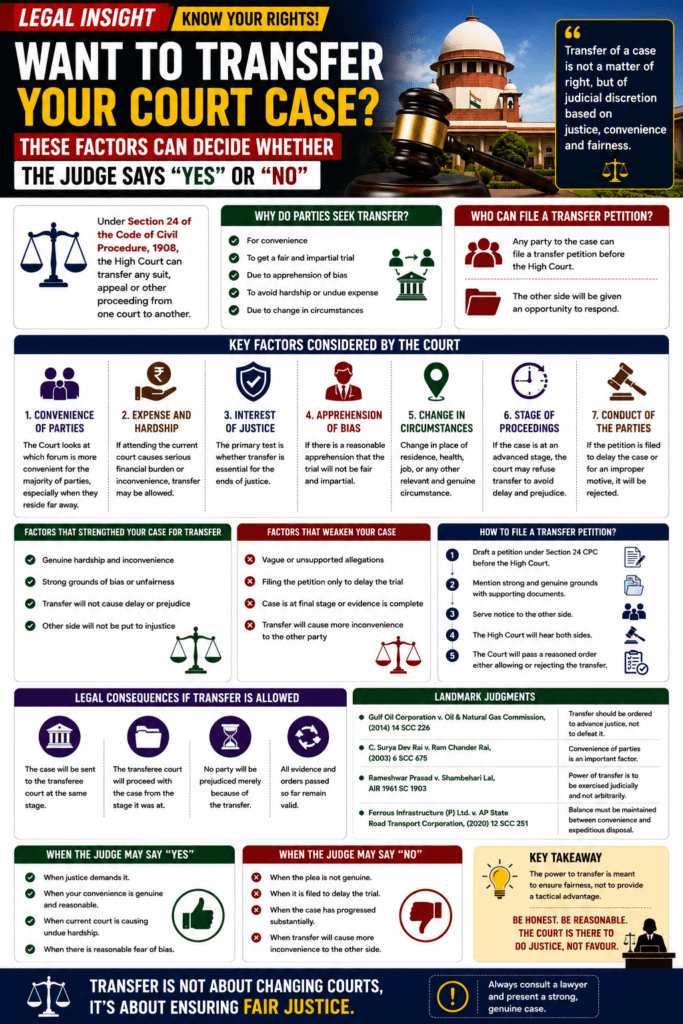
- The Most Important Factors Considered by Courts
- 1. Whether a Fair Trial Is Possible
- 2. Reasonable Apprehension of Bias
- 3. Convenience of the Parties
- 4. Convenience of Witnesses
- 5. Availability of Evidence
- 6. Interest of Justice
- 7. Balance of Convenience
- 8. Safety and Security
- 9. Possibility of Forum Shopping
- 10. Delay in Filing the Transfer Petition
- 11. Stage of the Proceedings
- 12. Nature of the Case
- 13. Welfare of Children
- 14. Public Confidence in the Judicial Process
- 15. Whether the Application Is Genuine
- Legal Provisions Governing Transfer
- Jurisprudence Behind Transfer of Cases
- Landmark Supreme Court Judgments
- Myth vs Reality
- Frequently Asked Questions
- Key Takeaways
- Conclusion
Introduction
Many people believe that if they are unhappy with a court or find it inconvenient to attend hearings, they can simply ask for their case to be transferred.
The law is not that simple.
A transfer petition is not granted merely because one party prefers another court. Indian courts treat the power to transfer a case as an extraordinary judicial power, which is exercised only when it is necessary to ensure justice.
Whether it is a civil suit, criminal trial, matrimonial dispute, commercial litigation, or family matter, the court carefully examines several factors before deciding whether the case should remain where it is or be transferred elsewhere.
In this article, we explain every important factor that courts consider while deciding transfer petitions, along with the relevant legal provisions, landmark judgments, and practical guidance.
Can a Court Transfer a Case Merely Because a Party Wants It?
No.
The law requires the applicant to establish valid legal grounds.
A transfer petition should demonstrate that continuing the proceedings before the existing court would seriously affect the administration of justice or cause substantial hardship.
The burden lies on the person seeking the transfer.
Why Do Courts Examine So Many Factors?
The transfer of a case affects:
- the opposite party;
- witnesses;
- judicial administration;
- court workload;
- public confidence in the justice system.
Therefore, courts balance the interests of both sides, rather than favouring one litigant.
The central question always remains:
“Will transferring the case better serve the interests of justice?”
The Most Important Factors Considered by Courts
1. Whether a Fair Trial Is Possible
This is the most important consideration.
If there is a genuine possibility that justice may not be done, the court may transfer the matter.
However, the apprehension must be reasonable and supported by facts, not merely based on suspicion or assumptions.
2. Reasonable Apprehension of Bias
Courts carefully examine whether there is a real likelihood of bias.
Examples may include:
- personal relationship with parties;
- demonstrated prejudice;
- circumstances affecting judicial impartiality.
Merely losing interim applications or receiving adverse orders does not establish bias.
3. Convenience of the Parties
Courts assess:
- place of residence;
- travelling distance;
- age;
- health;
- employment;
- financial capacity.
The convenience of both parties is considered—not just the applicant.
4. Convenience of Witnesses
Sometimes witnesses are located in another city or State.
If most witnesses would face unnecessary hardship, the court may consider transferring the case.
This is particularly relevant where numerous witnesses are to be examined.
5. Availability of Evidence
The court also considers:
- where documents are located;
- where electronic evidence exists;
- where the cause of action substantially arose.
Transfer should not make the trial more difficult.
6. Interest of Justice
Even where no single factor is decisive, the court possesses broad discretion to transfer a matter whenever it is necessary to secure the ends of justice.
This remains the guiding principle.
7. Balance of Convenience
The court compares the inconvenience likely to be caused to each party.
For example:
- Will transferring the case reduce overall hardship?
- Or will it merely shift the inconvenience from one party to another?
The court seeks a fair balance.
8. Safety and Security
If a party or witness faces:
- intimidation;
- threats;
- violence;
- local influence;
the court may consider transferring the proceedings.
9. Possibility of Forum Shopping
Courts strongly discourage forum shopping.
A litigant cannot seek transfer merely because another court is perceived to be more favourable.
Transfer petitions filed for tactical advantage are generally rejected.
10. Delay in Filing the Transfer Petition
Timing is also important.
If a party participates in the proceedings for years and then suddenly seeks transfer without a convincing explanation, the court may view the request with caution.
11. Stage of the Proceedings
Courts also consider:
- whether evidence has begun;
- whether witnesses have already been examined;
- whether arguments are nearing completion.
If substantial progress has already been made, transfer may not be appropriate unless compelling reasons exist.
12. Nature of the Case
Different categories of cases may require different considerations.
For example:
- matrimonial disputes;
- commercial suits;
- criminal trials;
- child custody matters;
- family disputes.
The nature of the litigation often influences the court’s approach.
13. Welfare of Children
In custody and matrimonial matters, the welfare of minor children is an important consideration.
The court may examine:
- schooling;
- health;
- caregiving responsibilities;
- travel difficulties.
14. Public Confidence in the Judicial Process
Justice should not only be fair—it should also appear fair.
Where public confidence may reasonably be affected, courts may order transfer to preserve the integrity of the judicial process.
15. Whether the Application Is Genuine
The court also asks an important practical question:
“Is this application filed to obtain justice, or merely to delay the proceedings?”
If the transfer petition appears to be frivolous or filed to obstruct the trial, it is likely to be dismissed.
Legal Provisions Governing Transfer
Civil Cases
Section 24 of the Code of Civil Procedure, 1908
The High Court and District Court may transfer, withdraw, or assign civil proceedings pending before subordinate courts.
Criminal Cases
The Bharatiya Nagarik Suraksha Sanhita, 2023 (BNSS) provides for transfer of criminal cases.
Important provisions include:
- Section 528 BNSS – Power of the High Court to transfer criminal cases and appeals.
- Section 529 BNSS – Power of the Sessions Judge to transfer criminal cases within the Sessions Division.
Where transfer between different States is required, the Supreme Court exercises the relevant statutory jurisdiction.
Jurisprudence Behind Transfer of Cases
The law governing transfer reflects a careful balance between two competing principles.
Fairness
Every litigant deserves an impartial hearing before an independent court.
Judicial Efficiency
Frequent transfers without good reason would delay proceedings, inconvenience witnesses, and undermine judicial discipline.
Therefore, transfer remains an exceptional remedy, exercised only where justice genuinely requires it.
Landmark Supreme Court Judgments
Maneka Sanjay Gandhi v. Rani Jethmalani (1979) 4 SCC 167
The Supreme Court held that transfer cannot be granted merely because a party feels uncomfortable. There must be a reasonable apprehension that justice may not be be done.
Kulwinder Kaur v. Kandi Friends Education Trust (2008) 3 SCC 659
The Court emphasised that transfer powers should be exercised whenever necessary to achieve the ends of justice, while avoiding misuse.
Sumita Singh v. Kumar Sanjay (2001) 10 SCC 41
The Supreme Court observed that in matrimonial disputes, the convenience of the wife is an important consideration, though every case depends upon its own facts.
Nahar Singh Yadav v. Union of India (2011) 1 SCC 307
The Court reiterated that preserving public confidence in the fairness of judicial proceedings is a significant consideration while deciding transfer petitions.
Myth vs Reality
| Myth | Reality |
|---|---|
| I can transfer my case because the court is far away. | Not necessarily. Distance is only one of several factors considered. |
| If I lose a few applications, I can allege bias and seek transfer. | Incorrect. Adverse judicial orders alone do not establish bias. |
| Transfer petitions are routinely allowed. | False. Courts scrutinise them carefully and grant them only where justified. |
| The convenience of only the applicant matters. | Wrong. Courts consider the convenience of all parties and witnesses. |
| Transfer can be sought at any time without explanation. | Incorrect. Delay and the stage of the proceedings are relevant considerations. |
Frequently Asked Questions
Can inconvenience alone justify transfer?
Usually not. The court considers inconvenience along with other relevant circumstances.
Does the court consider financial hardship?
Yes. Genuine financial constraints affecting participation in the proceedings may be relevant.
Can a transfer petition be rejected even if the parties live in different States?
Yes. The court weighs all circumstances before exercising its discretion.
Is bias easy to prove?
No. Allegations of bias must be supported by credible material creating a reasonable apprehension that justice may not be done.
Is transfer a matter of right?
No. It is a discretionary judicial remedy granted only when justified by law and the facts of the case.
Key Takeaways
- Transfer of a case is not automatic.
- The paramount consideration is the interests of justice.
- Courts examine multiple factors, including fairness, convenience, safety, evidence, witnesses, delay, and public confidence.
- Section 24 CPC governs transfer of civil cases, while Sections 528 and 529 BNSS govern transfer powers in criminal matters.
- Transfer petitions filed merely to delay proceedings or engage in forum shopping are generally rejected.
Conclusion
A transfer petition is one of the most important procedural safeguards in the Indian legal system. It ensures that no litigant is denied justice because of bias, undue hardship, safety concerns, or other exceptional circumstances. At the same time, courts are equally careful to prevent misuse of this remedy.
The decision to transfer a case is never based on a single factor. Instead, courts undertake a holistic assessment of fairness, convenience, judicial efficiency, and the overall interests of justice. If you are considering filing or opposing a transfer petition, understanding these factors can significantly improve your ability to present a strong legal case before the competent court.