
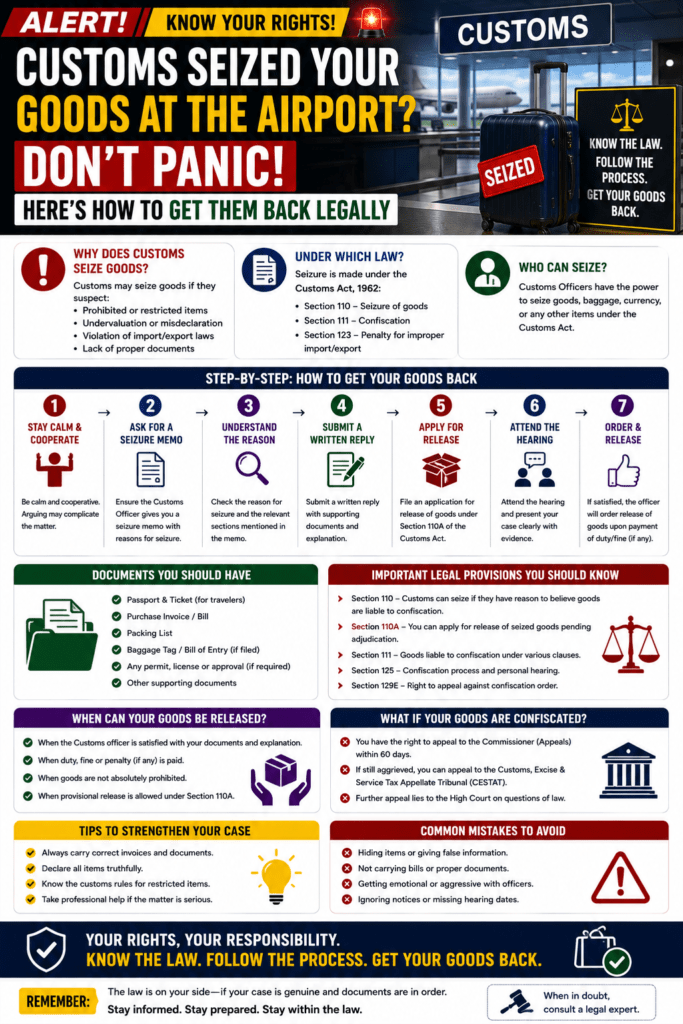
- Introduction
- What Is the Difference Between Seizure and Confiscation?
- Can Customs Confiscate Any Goods They Want?
- Common Reasons for Customs Confiscation
- Can Customs Confiscate Gold, Cash, Electronics or Luxury Goods?
- What Is the Legal Procedure Before Confiscation?
- Can You Get the Goods Back?
- What Is Redemption Fine?
- Can Customs Also Impose a Penalty?
- What If the Confiscation Is Illegal?
- Can You Appeal Against the Confiscation Order?
- Important Provisions Under the Customs Act, 1962
- Jurisprudence Behind Customs Confiscation
- Myth vs Reality
- Frequently Asked Questions
- Practical Tips
- Key Takeaways
- Conclusion
Introduction
You have just landed at an international airport.
As you collect your luggage and approach the exit, a Customs Officer stops you for inspection.
A few minutes later, you are told:
“These goods are being seized and may be confiscated under the Customs Act.”
For most people, this is shocking. Many immediately assume that their belongings are gone forever.
That is not always true.
The Customs Department certainly has the legal power to seize and confiscate goods in appropriate cases. However, that power is not unlimited. The law also provides important safeguards, including the right to receive notice, explain your case, participate in adjudication, file an appeal, and, in many cases, redeem the goods by paying a redemption fine.
This article explains what confiscation means, when Customs can confiscate goods, your legal rights, the remedies available, and how you can challenge an illegal confiscation.
What Is the Difference Between Seizure and Confiscation?
Many people use these terms interchangeably, but they are legally different.
Seizure
Seizure means the Customs Department temporarily takes possession of goods because it believes there may have been a violation of the Customs Act, 1962.
Ownership is not automatically lost.
Confiscation
Confiscation is a legal order passed after adjudication declaring that the goods stand forfeited to the Government because of a violation of the Customs Act.
Only after following the prescribed legal procedure can confiscation ordinarily take place.
Can Customs Confiscate Any Goods They Want?
No.
Customs officers must act strictly in accordance with the Customs Act, 1962.
Confiscation cannot be arbitrary or based merely on suspicion.
The department must establish that the goods fall within one or more provisions permitting confiscation under the Act.
Common Reasons for Customs Confiscation
Goods may be liable to confiscation where there is, for example:
- concealment of dutiable or prohibited goods;
- non-declaration or false declaration;
- attempted smuggling;
- import or export in violation of law;
- misdeclaration of value, quantity, or description;
- prohibited imports;
- breach of baggage rules;
- violation of licence or regulatory requirements.
Each case depends upon its own facts.
Can Customs Confiscate Gold, Cash, Electronics or Luxury Goods?
Yes, if the statutory conditions are satisfied.
Items commonly involved in customs proceedings include:
- gold;
- foreign currency;
- luxury watches;
- mobile phones;
- electronic devices;
- commercial quantities of goods;
- precious stones;
- prohibited articles.
However, mere possession of valuable goods does not automatically justify confiscation.
What Is the Legal Procedure Before Confiscation?
The Customs Department must ordinarily follow due process.
This generally includes:
Step 1 – Seizure (where justified)
The goods may first be seized.
Step 2 – Show Cause Notice
A notice is generally issued explaining:
- the allegations;
- the provisions invoked;
- the proposed confiscation;
- the proposed penalty.
The notice enables the affected person to defend themselves.
Step 3 – Opportunity of Hearing
The affected person has the right to:
- file a written reply;
- produce documents;
- explain the facts;
- seek a personal hearing.
This reflects the principle of natural justice.
Step 4 – Adjudication
The adjudicating authority passes a reasoned order after considering the material on record.
Only then can confiscation ordinarily be ordered.
Can You Get the Goods Back?
Yes, in many cases.
The Customs Act empowers the adjudicating authority, in appropriate cases, to permit redemption of confiscated goods on payment of a redemption fine, in addition to applicable duty and penalty where required.
This is known as the option to redeem confiscated goods.
However, this option is not available in every case, especially where the goods are absolutely prohibited by law.
What Is Redemption Fine?
A redemption fine is an amount paid to recover confiscated goods where the law permits redemption.
It is different from:
- customs duty; and
- penalty.
A person may, depending on the facts, have to pay:
- duty;
- redemption fine; and
- penalty.
Each serves a different legal purpose.
Can Customs Also Impose a Penalty?
Yes.
Apart from confiscating the goods, the Customs Department may impose monetary penalties where the law permits.
The penalty depends on:
- the nature of the violation;
- the conduct of the person;
- the statutory provisions involved.
What If the Confiscation Is Illegal?
If you believe the confiscation is arbitrary or contrary to law, you have legal remedies.
Possible grounds include:
- absence of evidence;
- violation of natural justice;
- no proper notice;
- denial of hearing;
- incorrect application of law;
- procedural irregularities;
- arbitrary exercise of power.
Every case depends upon its own facts.
Can You Appeal Against the Confiscation Order?
Absolutely.
The Customs Act provides a structured appellate mechanism.
Depending upon the nature of the order, appeals may lie before:
- the Commissioner (Appeals);
- the Customs, Excise and Service Tax Appellate Tribunal (CESTAT);
- the High Court on substantial questions of law (where provided);
- the Supreme Court in appropriate cases.
Appeals must generally be filed within the prescribed limitation period.
Important Provisions Under the Customs Act, 1962
Some of the significant provisions include:
- Section 110 – Seizure of goods.
- Section 111 – Goods liable to confiscation (imports).
- Section 113 – Goods liable to confiscation (exports).
- Section 124 – Notice and opportunity of hearing before confiscation or penalty.
- Section 125 – Option to pay a redemption fine in lieu of confiscation where permissible.
- Sections 128 onwards – Appellate remedies under the Customs Act.
These provisions collectively ensure that confiscation is subject to statutory safeguards and judicial scrutiny.
Jurisprudence Behind Customs Confiscation
Customs law seeks to balance two important objectives.
Protecting National Interests
The Government has a legitimate interest in preventing:
- smuggling;
- illegal imports;
- prohibited goods;
- customs duty evasion.
Protecting Individual Rights
At the same time, confiscation directly affects a person’s property and commercial interests.
Therefore, Customs authorities must:
- follow the statute;
- observe natural justice;
- act fairly;
- pass reasoned orders.
Confiscation cannot be based merely on suspicion or arbitrary discretion.
Myth vs Reality
| Myth | Reality |
|---|---|
| Once Customs seizes my goods, I will never get them back. | False. Many confiscation orders permit redemption, and adverse orders can be challenged through appeals. |
| Customs can confiscate goods without giving me a chance to explain. | Incorrect. Except where the law expressly provides otherwise, the Customs Act generally requires notice and an opportunity of hearing before confiscation. |
| Seizure and confiscation are the same thing. | Wrong. Seizure is temporary possession; confiscation is a final legal consequence following adjudication. |
| Every confiscated item is permanently lost. | False. In many cases, redemption on payment of a redemption fine is legally available. |
| Only expensive goods can be confiscated. | Incorrect. Liability depends on the violation of law, not merely on the value of the goods. |
Frequently Asked Questions
Can Customs confiscate goods without any notice?
Ordinarily, no. Before confiscation or imposition of penalty, the Customs Act generally requires a show cause notice and an opportunity of hearing, subject to statutory exceptions.
Can I challenge the confiscation?
Yes. You can file an appeal through the appellate mechanism provided under the Customs Act.
What if I accidentally failed to declare an item?
Each case depends on its facts. The authorities will consider the nature of the goods, the explanation offered, and the applicable statutory provisions before passing an order.
Can confiscated goods be released?
In many cases, yes. The adjudicating authority may permit redemption on payment of a redemption fine, where the law allows.
Can Customs impose both a penalty and confiscation?
Yes. Depending on the facts and the applicable provisions, both consequences may follow.
Practical Tips
If your goods have been seized or confiscated:
- Remain calm and cooperate with the officers.
- Obtain copies of all documents, including the seizure memo and notices.
- Preserve invoices, bills, import documents, and proof of ownership.
- Reply to the show cause notice within the prescribed time.
- Attend the personal hearing.
- Seek legal advice before making admissions or waiving rights.
- File an appeal promptly if an adverse order is passed.
Key Takeaways
- Customs has statutory powers to seize and confiscate goods, but only in accordance with the Customs Act, 1962.
- Seizure and confiscation are legally distinct concepts.
- Before confiscation, affected persons generally have the right to notice and an opportunity of hearing.
- In many cases, confiscated goods may be redeemed on payment of a redemption fine.
- Every confiscation order is open to judicial scrutiny through the appellate process.
Conclusion
Having your goods seized or confiscated at the airport can be stressful, but it does not mean you are without legal protection. The Customs Act provides a carefully balanced framework that enables authorities to prevent smuggling and enforce import laws while simultaneously protecting individuals through procedural safeguards, hearings, reasoned orders, and appellate remedies.
If your goods have been confiscated, act promptly. Understand the allegations, respond to the show cause notice, preserve your documents, and use the legal remedies available under the Customs Act. In many cases, timely legal action can make the difference between permanently losing your property and successfully recovering it.