
- Introduction
- What Is the Customs Act, 1962?
- Why Is the Customs Act Important?
- What Does the Customs Department Do?
- What Goods Are Generally Allowed Into India?
- What Goods Are Restricted?
- What Goods Are Completely Prohibited?
- Can You Bring Gold Into India?
- Can You Carry Foreign Currency?
- Can Customs Open Your Luggage?
- What Happens If You Fail to Declare Goods?
- Important Powers of Customs Officers
- Important Provisions of the Customs Act
- What Are Your Rights During Customs Proceedings?
- Can You Challenge an Illegal Customs Action?
- Jurisprudence Behind the Customs Act
- Landmark Supreme Court Judgments
- Myth vs Reality
- Frequently Asked Questions
- Practical Tips for International Travellers
- Key Takeaways
- Conclusion
Introduction
Imagine returning to India after an international trip.
You have bought a new iPhone, a luxury watch, some gold jewellery, chocolates, cosmetics, medicines, and a few expensive gifts for your family.
As you walk towards the airport exit, a Customs Officer stops you and asks:
“Do you have anything to declare?”
Most people immediately wonder:
- Can Customs check my luggage?
- What items are allowed?
- Can Customs confiscate my belongings?
- Will I have to pay customs duty?
- Can I bring gold, electronics, medicines, or cash into India?
The answer lies in one important legislation—
The Customs Act, 1962.
The Customs Act is one of India’s most significant economic and border-control laws. It governs the import and export of goods, collection of customs duties, prevention of smuggling, confiscation of prohibited goods, and regulation of international trade.
This guide explains everything you need to know about the Customs Act in simple language.
What Is the Customs Act, 1962?
The Customs Act, 1962 is the principal law governing:
- import of goods into India;
- export of goods from India;
- levy and collection of customs duties;
- powers of Customs officers;
- seizure and confiscation of goods;
- prevention of smuggling;
- penalties and prosecution for customs violations.
Its primary objective is to regulate cross-border movement of goods while protecting India’s economy, public health, national security, and revenue.
Why Is the Customs Act Important?
Every day, millions of goods enter and leave India.
Without customs laws:
- prohibited items could enter the country;
- dangerous goods could circulate freely;
- taxes could be evaded;
- smuggling would increase;
- national security could be compromised.
The Customs Act provides a legal framework to regulate international trade and enforce compliance.
What Does the Customs Department Do?
The Customs Department is responsible for:
- examining imported and exported goods;
- collecting customs duty;
- preventing smuggling;
- detecting undervaluation and misdeclaration;
- enforcing baggage rules;
- confiscating prohibited goods;
- investigating customs offences.
Customs officers have statutory powers, but they must exercise them in accordance with law.
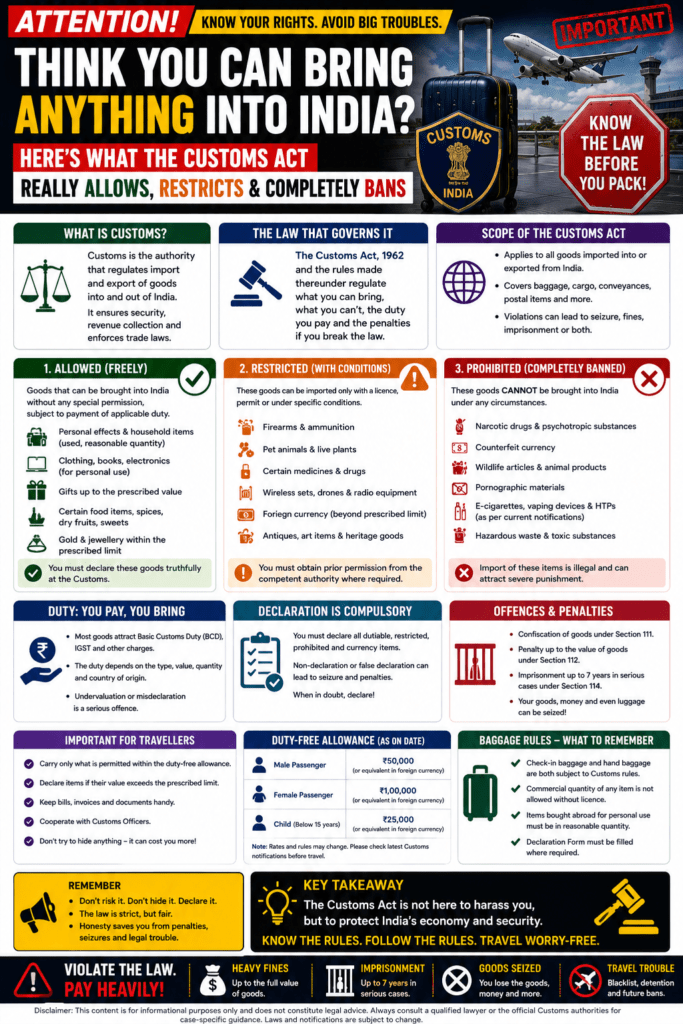
What Goods Are Generally Allowed Into India?
Most goods are legally importable, subject to compliance with applicable laws and payment of customs duty where required.
Common examples include:
- clothing;
- books;
- personal effects;
- laptops;
- mobile phones;
- cameras;
- cosmetics;
- household items;
- gifts within applicable limits;
- jewellery, subject to applicable rules;
- medicines in accordance with applicable regulations.
Being “allowed” does not necessarily mean duty-free. Customs duty may still be payable.
What Goods Are Restricted?
Restricted goods are not prohibited, but they require compliance with statutory conditions such as licences, permits, or approvals.
Examples may include:
- certain firearms (where lawfully permitted);
- satellite communication devices;
- certain medicines and pharmaceutical products;
- drones (subject to applicable regulations);
- wildlife-related products;
- radio equipment;
- specific chemicals;
- agricultural products;
- certain seeds and plants.
The applicable regulatory regime varies depending on the product.
What Goods Are Completely Prohibited?
Some goods cannot ordinarily be imported or exported because of public policy, security, or statutory prohibition.
Examples include:
- narcotic drugs and psychotropic substances (except where lawfully authorised);
- counterfeit currency;
- obscene material prohibited by law;
- endangered wildlife products prohibited under applicable legislation;
- child sexual abuse material;
- certain hazardous substances;
- prohibited arms and ammunition;
- counterfeit goods violating intellectual property rights;
- goods specifically prohibited under Indian law or international obligations.
The list changes from time to time depending on government notifications and other applicable laws.
Can You Bring Gold Into India?
Yes, but subject to the applicable customs rules, eligibility conditions, baggage regulations, and payment of customs duty where required.
Failure to comply with declaration requirements or duty obligations may result in:
- seizure;
- confiscation;
- penalty;
- prosecution in serious cases.
Can You Carry Foreign Currency?
Yes, but certain declarations may be mandatory depending upon:
- the amount;
- the nature of the currency;
- applicable regulations issued under customs and foreign exchange laws.
Travellers should always verify the latest declaration requirements before travelling.
Can Customs Open Your Luggage?
Yes.
Customs officers are legally empowered to examine baggage where authorised by law.
However, their actions must be:
- lawful;
- reasonable;
- proportionate;
- consistent with statutory safeguards.
What Happens If You Fail to Declare Goods?
Failure to declare goods may have serious consequences depending on the facts.
Possible outcomes include:
- payment of customs duty;
- penalty;
- seizure;
- confiscation;
- prosecution in serious cases involving fraud or smuggling.
Every case depends on its facts.
Important Powers of Customs Officers
The Customs Act authorises officers to:
- inspect baggage;
- examine imported and exported goods;
- search persons, premises, and conveyances where legally permissible;
- seize goods;
- confiscate goods after due process;
- issue show cause notices;
- investigate customs violations;
- arrest in cases where the statute permits.
These powers are subject to statutory safeguards and judicial review.
Important Provisions of the Customs Act
Some key provisions include:
- Section 11 – Power to prohibit import or export of specified goods.
- Section 77 – Declaration by passengers regarding baggage.
- Section 79 – Bona fide baggage exemptions, subject to applicable rules.
- Section 110 – Seizure of goods.
- Section 111 – Goods liable to confiscation (imports).
- Section 113 – Goods liable to confiscation (exports).
- Section 124 – Notice and opportunity of hearing before confiscation or penalty.
- Section 125 – Redemption fine in lieu of confiscation where permissible.
- Sections 128 onwards – Appellate remedies.
What Are Your Rights During Customs Proceedings?
If Customs initiates proceedings against you, you generally have the right to:
- receive a show cause notice;
- understand the allegations;
- inspect relevant material where legally permissible;
- submit a written reply;
- produce supporting documents;
- seek a personal hearing;
- receive a reasoned adjudication order;
- file an appeal against an adverse order.
Natural justice remains an important feature of customs adjudication.
Can You Challenge an Illegal Customs Action?
Yes.
If Customs acts arbitrarily or contrary to law, legal remedies may include:
- replying to the show cause notice;
- participating in adjudication;
- filing a statutory appeal before the Commissioner (Appeals);
- approaching the Customs, Excise and Service Tax Appellate Tribunal (CESTAT);
- invoking the jurisdiction of the High Court in appropriate cases;
- approaching the Supreme Court where permitted by law.
The appropriate remedy depends on the facts and the statutory scheme.
Jurisprudence Behind the Customs Act
The Customs Act seeks to balance two important public interests.
Protecting the Nation
The Act safeguards:
- national security;
- public health;
- economic interests;
- revenue collection;
- prevention of smuggling.
Protecting Individual Rights
At the same time, customs powers are not absolute.
Authorities must:
- follow statutory procedure;
- observe principles of natural justice;
- act fairly and reasonably;
- provide opportunities to affected persons before imposing serious civil consequences.
Landmark Supreme Court Judgments
Collector of Customs v. D. Bhoormull (1974) 2 SCC 544
The Supreme Court held that customs authorities may rely on circumstantial evidence in appropriate cases, but findings must still rest on legally acceptable material.
Mohinder Singh Gill v. Chief Election Commissioner (1978) 1 SCC 405
Although not a customs decision, this landmark judgment established that administrative and quasi-judicial orders must stand or fall on the reasons recorded in the order itself—a principle frequently applied in customs adjudication.
CCE v. Brindavan Beverages (2007) 5 SCC 388
The Supreme Court emphasised that a show cause notice forms the foundation of adjudication, and authorities cannot travel beyond the allegations contained in the notice.
Myth vs Reality
| Myth | Reality |
|---|---|
| I can bring any item into India if it is for personal use. | False. Personal use does not exempt prohibited or restricted goods from legal requirements. |
| Customs can confiscate my luggage without following any procedure. | Incorrect. The Customs Act generally requires statutory procedure, including notice and an opportunity of hearing before confiscation or penalty. |
| Everything bought abroad is duty-free. | Wrong. Customs duty depends on applicable baggage rules, exemptions, and the nature and value of the goods. |
| Only commercial importers need to worry about Customs. | False. International passengers are also subject to customs laws. |
| If Customs seizes my goods, I have no remedy. | Incorrect. The Act provides adjudication, appeals, and other legal remedies. |
Frequently Asked Questions
Can Customs stop me at the airport?
Yes. Customs officers may examine passengers and baggage in accordance with the Customs Act.
Is every imported item subject to customs duty?
Not necessarily. The applicable duty depends on the nature of the goods, baggage rules, exemptions, and relevant notifications.
Can Customs confiscate undeclared goods?
Yes, where the statutory conditions are satisfied.
Can I challenge a customs penalty?
Yes. The Customs Act provides a complete appellate mechanism against adverse orders.
Is carrying gold illegal?
No. However, it must comply with applicable customs laws, declaration requirements, and duty obligations.
Practical Tips for International Travellers
Before travelling to India:
- Check the latest baggage rules.
- Keep invoices for expensive purchases.
- Declare goods whenever legally required.
- Do not carry prohibited items.
- Preserve receipts and travel documents.
- Cooperate with Customs officials.
- Seek legal advice promptly if proceedings are initiated.
Key Takeaways
- The Customs Act, 1962 regulates imports, exports, baggage, customs duty, and prevention of smuggling.
- Goods may be allowed, restricted, or prohibited, depending on statutory provisions and regulatory requirements.
- Customs officers possess significant powers, but those powers are subject to legal safeguards and judicial review.
- Travellers enjoy important procedural rights, including notice, hearing, and statutory appeals.
- Understanding customs rules before travelling can prevent unnecessary delays, penalties, and confiscation.
Conclusion
The Customs Act, 1962 is much more than a law about collecting taxes at airports. It is a comprehensive legal framework that protects India’s borders, regulates international trade, prevents smuggling, and safeguards public interests. At the same time, it recognises that individuals and businesses are entitled to fairness, transparency, and due process.
Whether you are an international traveller, an importer, an exporter, or simply bringing personal belongings into India, understanding the Customs Act can save you from avoidable legal complications. The best approach is simple: know the rules, make truthful declarations, preserve your documents, and exercise your legal rights whenever required.