
Case Details
Case Title: Directorate of Enforcement v. Poonam Malik
Case No.: Special Leave Petition (Criminal) Diary No(s). 25221 of 2026
Date of Judgment: 31 July 2026
Coram:
- Hon’ble Mr. Justice Dipankar Datta
- Hon’ble Mr. Justice Sheel Nagu
Impugned Judgment: Delhi High Court
A Major Relief Against Arbitrary ED Action
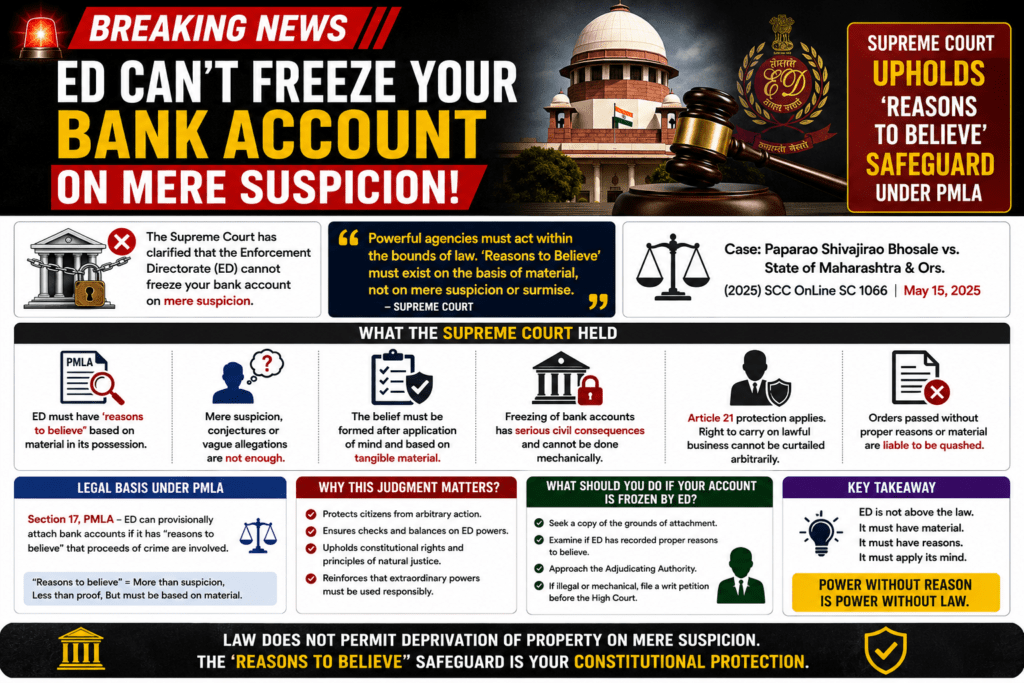
In an important judgment protecting the constitutional rights of citizens, the Supreme Court has affirmed that the Enforcement Directorate (ED) cannot freeze bank accounts merely because it suspects money laundering.
The Court upheld the Delhi High Court’s ruling that before freezing a bank account under Section 17(1A) of the Prevention of Money Laundering Act, 2000 (PMLA), the ED must first have “reasons to believe” based on tangible material. Mere suspicion is not enough.
The judgment strengthens procedural safeguards under the PMLA and sends a clear message that investigative powers must be exercised strictly in accordance with law.
What Was the Case About?
The case concerned Poonam Malik, whose two bank accounts were frozen by the Enforcement Directorate during an investigation relating to the alleged Sterling Biotech Limited bank fraud involving more than ₹5,000 crore.
Interestingly:
- Poonam Malik was not named in the FIR.
- She was not named in the ECIR.
- Her husband was also not an accused.
Despite this, the ED froze her bank accounts by issuing an order stating:
“It is suspected that amounts involved in money laundering are lying in the above-mentioned bank accounts.”
The freezing order did not record any “reasons to believe” as required under the statutory framework.
How Did the Matter Reach the Supreme Court?
The Adjudicating Authority under the PMLA upheld the freezing order.
However, the Appellate Tribunal set aside the freezing, holding that the action did not comply with the mandatory requirements of law.
The Enforcement Directorate then challenged the Tribunal’s decision before the Delhi High Court.
The Delhi High Court dismissed the ED’s appeal and held that the freezing order was illegal.
Aggrieved by the High Court’s decision, the ED approached the Supreme Court.
The Supreme Court refused to interfere and affirmed the reasoning of the Delhi High Court.
Can the ED Freeze a Bank Account Merely on Suspicion?
The Supreme Court’s answer is an emphatic No.
The Court agreed with the Delhi High Court that Section 17(1A) cannot be interpreted independently from Section 17(1) of the PMLA.
Although Section 17(1A), which deals with freezing of property or bank accounts, does not expressly use the words “reasons to believe,” the Court held that those words are implicit because freezing is merely an alternative to seizure.
If seizure requires “reasons to believe,” freezing cannot be subjected to a lower standard.
Understanding Section 17 of the PMLA
Section 17 empowers the ED to conduct:
- search,
- seizure,
- and, where seizure is not practicable, freezing of property or bank accounts.
Under Section 17(1), the authorised officer must record “reasons to believe” that:
- a person has committed an offence under PMLA; and
- proceeds of crime are concealed in a particular place or property.
Section 17(1A) permits freezing where physical seizure is not practical.
The Supreme Court clarified that this does not dilute the statutory safeguards.
Why ‘Reasons to Believe’ Are So Important
The expression “reasons to believe” is not an empty formality.
It requires the investigating agency to possess objective material that justifies its action.
It cannot be:
- mere suspicion,
- conjecture,
- assumptions,
- or speculative allegations.
The Court observed that freezing someone’s bank account seriously affects their financial life.
Therefore, such drastic action must be backed by legally sustainable reasons.
Suspicion Cannot Replace Satisfaction
The ED’s freezing order merely stated:
“It is suspected…”
The Supreme Court found this legally insufficient.
Suspicion may justify further investigation.
However, it cannot justify freezing a citizen’s bank account, which directly affects property rights and day-to-day financial transactions.
The statutory requirement is “reasons to believe,” not “reasons to suspect.”
This distinction is crucial.
Article 300A: Right to Property Also Matters
One of the most significant aspects of the Delhi High Court’s judgment, now approved by the Supreme Court, concerns Article 300A of the Constitution of India.
Article 300A provides:
No person shall be deprived of his property save by authority of law.
A bank balance is recognised as property.
Freezing a bank account prevents a person from accessing and using their money.
Therefore, such action directly interferes with the constitutional right to property.
The Court held that if statutory safeguards are ignored, the freezing order becomes unconstitutional.
Why This Judgment Is Important
This decision has far-reaching consequences.
It reinforces that:
- ED cannot exercise its powers arbitrarily.
- Investigative agencies must comply with statutory safeguards.
- Bank accounts cannot be frozen merely because someone’s name appears during an investigation.
- Constitutional protections continue to operate even during money laundering investigations.
- Citizens remain protected against arbitrary deprivation of property.
What Does This Mean for Citizens?
If your bank account has been frozen by the ED, this judgment makes it clear that:
- the ED must possess legally sustainable “reasons to believe”;
- such reasons must exist before exercising the power under Section 17;
- freezing orders based merely on suspicion can be challenged before the appropriate forum;
- courts will examine whether the statutory requirements have been complied with.
This judgment therefore strengthens judicial scrutiny over coercive actions taken under the PMLA.
Key Takeaways
- Mere suspicion is not enough to freeze a bank account under the PMLA.
- The ED must record “reasons to believe” before exercising powers under Section 17.
- Section 17(1A) must be read harmoniously with Section 17(1).
- Freezing is simply an alternative to seizure and cannot be subjected to a lower legal standard.
- Arbitrary freezing of bank accounts violates statutory safeguards and may also infringe Article 300A of the Constitution.
- The Supreme Court has reaffirmed that even powerful investigative agencies must act within the limits prescribed by law.
Conclusion
The Supreme Court’s decision in Directorate of Enforcement v. Poonam Malik is a significant reaffirmation of the rule of law. While the PMLA grants the Enforcement Directorate extensive powers to investigate money laundering offences, those powers are not absolute. They must be exercised responsibly, transparently, and strictly in accordance with statutory safeguards.
By holding that “reasons to believe” are mandatory before freezing a bank account, the Court has struck an important balance between effective financial investigations and the constitutional rights of individuals. The judgment serves as a reminder that procedural safeguards are not technical hurdles—they are fundamental protections against arbitrary state action.