
- Introduction
- What Is a Summary Suit?
- Why Was Order 37 Introduced?
- Which Law Governs Summary Suits?
- Which Cases Can Be Filed as a Summary Suit?
- Which Cases Cannot Be Filed Under Order 37?
- Why Is a Summary Suit So Powerful?
- What Is "Leave to Defend"?
- What Is a Triable Issue?
- What Happens If Leave to Defend Is Rejected?
- Can the Court Grant Conditional Leave?
- What Is the Procedure of a Summary Suit?
- Why Do Businesses Prefer Summary Suits?
- Can a Summary Suit Be Filed for a Cheque Bounce?
- Can Interest Be Claimed?
- Limitation Period
- Jurisprudence Behind Summary Suits
- Landmark Supreme Court Judgments
- Myth vs Reality
- Frequently Asked Questions
- Practical Tips
- Key Takeaways
- Conclusion
Introduction
Suppose you lent someone ₹10 lakh.
Or you supplied goods to a company.
Or you received a cheque that later bounced.
You have all the documents proving your claim.
Yet, when you approach the court, you are told that an ordinary civil suit may take several years.
This is exactly why the law provides a Summary Suit.
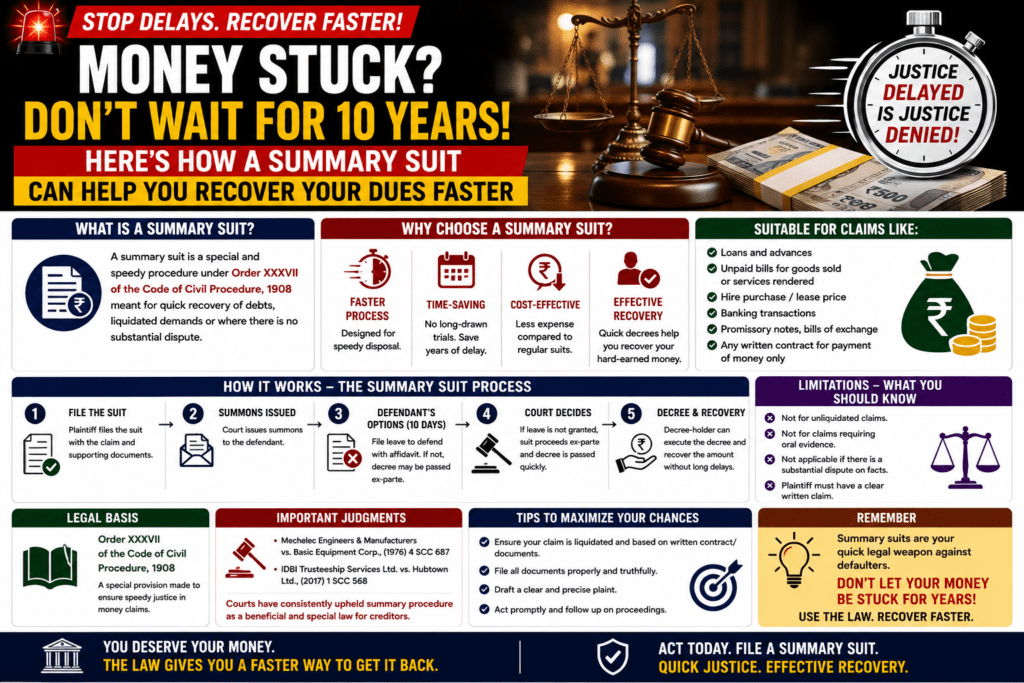
A Summary Suit is a special and speedy legal procedure designed to help a person recover money in clear and straightforward cases where the defendant has no genuine defence.
Unlike an ordinary civil suit, the defendant cannot automatically contest the case. Before defending, they must first obtain leave to defend from the court by showing that they have a real and substantial defence.
This makes a Summary Suit one of the most powerful legal remedies for recovering money based on written documents.
What Is a Summary Suit?
A Summary Suit is a special civil proceeding governed by Order XXXVII of the Code of Civil Procedure, 1908 (CPC).
It is intended for cases where the claim is based on written and reliable documents, making a lengthy trial unnecessary unless the defendant discloses a genuine defence.
The philosophy is simple:
A person with no real defence should not be permitted to delay justice merely by filing a written statement full of vague denials.
Why Was Order 37 Introduced?
Civil litigation often becomes time-consuming because defendants raise frivolous or dishonest defences.
Order XXXVII was enacted to:
- ensure speedy justice;
- discourage false defences;
- protect honest creditors;
- reduce unnecessary trials;
- improve commercial certainty.
It strikes a balance between fairness and efficiency.
Which Law Governs Summary Suits?
Summary suits are governed by:
- Order XXXVII of the Code of Civil Procedure, 1908.
Even after the enactment of the Commercial Courts Act, 2015, Order XXXVII continues to apply, particularly in eligible money recovery cases.
Which Cases Can Be Filed as a Summary Suit?
Not every civil dispute qualifies.
Order XXXVII generally applies to claims arising from:
1. Bills of Exchange
2. Promissory Notes
3. Cheques
4. Written Contracts
For example:
- unpaid invoices;
- loan agreements;
- supply agreements;
- consultancy agreements;
- service contracts;
- written acknowledgements of debt.
5. Guarantees
Where liability arises from a written guarantee.
Which Cases Cannot Be Filed Under Order 37?
Generally, the summary procedure is not appropriate for:
- property disputes;
- partition suits;
- injunction suits;
- matrimonial disputes;
- succession disputes;
- declaration suits;
- suits involving complicated factual controversies requiring detailed evidence.
Why Is a Summary Suit So Powerful?
The biggest advantage is that:
The defendant cannot automatically file a written statement and contest the case.
Instead, they must first seek leave to defend.
If the court finds that the defence is merely illusory, sham, or intended to delay the proceedings, leave may be refused and the plaintiff may obtain a decree without a full-fledged trial.
What Is “Leave to Defend”?
This is the heart of Order XXXVII.
When a summary suit is instituted:
- The defendant is served with summons.
- The defendant enters appearance.
- The plaintiff serves summons for judgment.
- The defendant applies for leave to defend.
- The court examines whether there is a genuine, substantial, or triable defence.
The court may:
- grant unconditional leave;
- grant conditional leave (for example, by directing deposit of money or security);
- refuse leave altogether.
What Is a Triable Issue?
A triable issue is a real dispute requiring evidence and adjudication.
Examples include:
- forgery of signatures;
- disputed execution of the agreement;
- payment already made;
- absence of consideration;
- fraud;
- limitation;
- novation of contract.
A vague denial is generally insufficient.
What Happens If Leave to Defend Is Rejected?
If the court concludes that the defendant has no genuine defence, it may:
- refuse leave to defend; and
- pass a decree in favour of the plaintiff.
This is what makes a summary suit much faster than an ordinary civil suit.
Can the Court Grant Conditional Leave?
Yes.
If the court finds that the defence is plausible but not very strong, it may grant leave subject to conditions, such as:
- depositing part of the claimed amount;
- furnishing security;
- complying with other reasonable conditions.
This discourages frivolous litigation while protecting genuine defences.
What Is the Procedure of a Summary Suit?
Step 1 – Filing of Plaint
The plaintiff files the suit specifically under Order XXXVII CPC.
Step 2 – Service of Summons
The defendant is served.
Step 3 – Entry of Appearance
The defendant must enter appearance within the prescribed period.
Step 4 – Summons for Judgment
The plaintiff seeks judgment.
Step 5 – Leave to Defend Application
The defendant explains why a trial is necessary.
Step 6 – Court’s Decision
The court may:
- decree the suit;
- grant unconditional leave;
- grant conditional leave.
Why Do Businesses Prefer Summary Suits?
Businesses often rely upon:
- invoices;
- purchase orders;
- written contracts;
- acknowledgements;
- bank records;
- dishonoured cheques.
Since these are documentary claims, Order XXXVII provides a faster and more efficient recovery mechanism.
Can a Summary Suit Be Filed for a Cheque Bounce?
Yes, in appropriate circumstances.
A dishonoured cheque may give rise to:
- criminal proceedings under Section 138 of the Negotiable Instruments Act, 1881; and/or
- a civil summary suit for recovery of money under Order XXXVII CPC, if the statutory requirements are met.
Both remedies may coexist.
Can Interest Be Claimed?
Yes.
Depending on:
- the contract;
- statutory provisions;
- trade usage;
- equitable principles,
the plaintiff may claim interest before, during, and after the suit, subject to the court’s discretion and applicable law.
Limitation Period
The limitation period depends on the nature of the underlying transaction and is governed by the Limitation Act, 1963.
Delay may defeat an otherwise valid claim.
Jurisprudence Behind Summary Suits
Order XXXVII is founded on an important legal principle:
Where documentary evidence clearly establishes liability, the defendant should not be permitted to prolong litigation through frivolous or sham defences.
However, the law also protects genuine defendants.
If a real dispute exists, the court grants leave and the matter proceeds to trial.
Thus, the summary procedure balances:
- speedy justice; and
- procedural fairness.
Landmark Supreme Court Judgments
Mechelec Engineers & Manufacturers v. Basic Equipment Corporation (1976) 4 SCC 687
This landmark judgment laid down the principles governing grant or refusal of leave to defend and clarified when unconditional or conditional leave should be granted.
IDBI Trusteeship Services Ltd. v. Hubtown Ltd. (2017) 1 SCC 568
The Supreme Court revisited and refined the principles relating to leave to defend, holding that leave depends on the nature and credibility of the defence raised by the defendant.
This judgment is now one of the leading authorities on Order XXXVII CPC.
Sunil Enterprises v. SBI Commercial & International Bank Ltd. (1998) 5 SCC 354
The Supreme Court reiterated that leave should be granted where substantial triable issues exist but not where the defence is illusory or intended merely to delay the proceedings.
Myth vs Reality
| Myth | Reality |
|---|---|
| Every money recovery case can be filed as a Summary Suit. | False. Only claims falling within Order XXXVII CPC qualify. |
| The defendant can always contest the suit immediately. | Incorrect. They must first obtain leave to defend from the court. |
| Summary Suits guarantee an immediate decree. | Wrong. If the defendant discloses a genuine triable issue, the court may permit a full trial. |
| Only banks can file Summary Suits. | False. Any eligible person or business can institute a summary suit if the legal requirements are satisfied. |
| A Summary Suit replaces criminal proceedings for cheque bounce. | Incorrect. Civil recovery and criminal prosecution under the Negotiable Instruments Act are separate remedies and may proceed simultaneously where permissible. |
Frequently Asked Questions
Is a Summary Suit faster than an ordinary civil suit?
Generally, yes. The special procedure under Order XXXVII is designed to reduce unnecessary delay.
Can oral agreements form the basis of a Summary Suit?
Ordinarily, no. The claim should arise from the categories recognised under Order XXXVII, such as written contracts, negotiable instruments, or written guarantees.
Can the defendant file a written statement without leave?
No. Leave to defend is the gateway to contesting the suit.
Can the court reject a false defence?
Yes. If the defence is sham, illusory, or frivolous, leave may be refused.
Can a Summary Suit be converted into an ordinary suit?
If leave to defend is granted and the matter requires evidence, the proceedings continue in accordance with the procedure prescribed by law.
Practical Tips
If you are planning to file a Summary Suit:
- Preserve the original written contract.
- Keep invoices, emails, bank records, and acknowledgements.
- Issue any required legal notice where appropriate.
- Calculate limitation carefully.
- Clearly plead that the suit is under Order XXXVII CPC.
- Anticipate possible defences and address them with documents.
Key Takeaways
- A Summary Suit is a special procedure under Order XXXVII CPC for speedy recovery of money based on specified written instruments and contracts.
- The defendant cannot contest the suit as a matter of right and must first obtain leave to defend.
- Courts refuse leave where the defence is frivolous, sham, or intended merely to delay the proceedings.
- Summary suits are particularly effective for commercial transactions, dishonoured cheques, written contracts, and debt recovery.
- The procedure promotes swift justice while safeguarding defendants who disclose genuine triable issues.
Conclusion
When your claim is supported by clear written documents, the law does not require you to endure years of avoidable litigation. Order XXXVII of the Code of Civil Procedure provides a powerful and efficient mechanism for recovering money where the defendant lacks a real defence. By limiting unnecessary trials and requiring leave to defend, it strengthens commercial confidence and ensures that justice is not defeated by delay.
If you have a legally enforceable written claim, understanding the scope and procedure of a Summary Suit can significantly improve your chances of obtaining timely relief.