
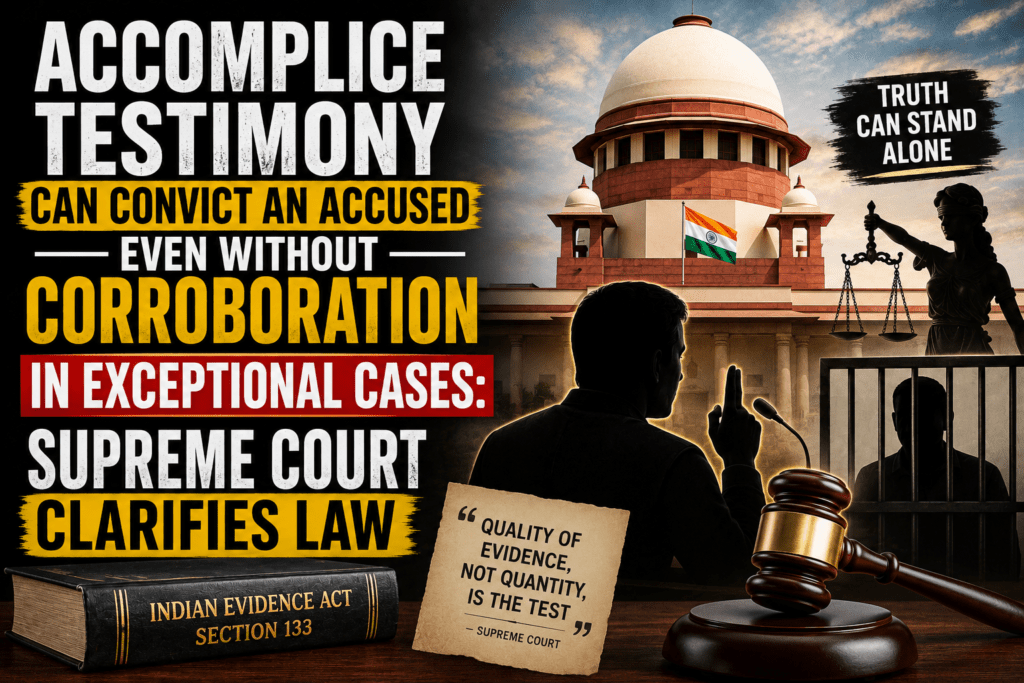
The Supreme Court has delivered an important judgment clarifying the evidentiary value of an accomplice’s testimony in criminal trials. The Court held that although courts generally seek corroboration of an approver’s statement, there is no absolute rule of law requiring independent corroboration in every case. If the testimony of the approver is found to be credible, trustworthy, and truthful, it can form the basis of a conviction even without independent corroboration.
The ruling came in the case of Gopi Chand @ Pappu v. State (NCT of Delhi), where the Court examined the legal principles governing the testimony of an accomplice who turns approver.
Understanding the Basics: Who Is an Approver?
In criminal law, an approver is a person who was involved in the commission of a crime but is granted pardon by the prosecution in exchange for providing truthful evidence against the other accused persons.
An approver is essentially an accomplice who agrees to disclose the entire truth regarding the offence, including his own involvement, to assist the court in uncovering the complete conspiracy or criminal transaction.
Approver testimony often becomes crucial in cases involving:
Murder conspiracies
Organized crime
Terror-related offences
Economic offences
Corruption cases
Gang-related crimes
Since such crimes are usually committed secretly, direct evidence is often unavailable, making insider testimony extremely valuable.
What Does the Law Say?
Section 133 of the Indian Evidence Act, 1872
Section 133 states that:
An accomplice shall be a competent witness against an accused person, and a conviction is not illegal merely because it proceeds upon the uncorroborated testimony of an accomplice.
This provision clearly recognizes that an accomplice can be a valid witness and that a conviction based solely on such testimony is legally permissible.
Illustration (b) to Section 114
However, the law also introduces an important safeguard.
Illustration (b) to Section 114 permits the Court to presume that:
An accomplice is unworthy of credit unless he is corroborated in material particulars.
Thus, while Section 133 allows conviction based on an accomplice’s testimony alone, Section 114 advises caution and prudence.
The Supreme Court explained that these two provisions must be read together.
What Did the Supreme Court Hold?
A Bench comprising Justice Pamidighantam Sri Narasimha and Justice Manoj Misra observed that corroboration is generally desirable but not mandatory in every case.
The Court clarified that:
Corroboration is a rule of prudence, not a rule of law.
Courts can rely on an uncorroborated approver’s testimony if it inspires confidence.
The testimony must appear truthful and consistent with the surrounding circumstances.
The court must record reasons explaining why such testimony is reliable.
Can an Approver Convict Others While Minimizing His Own Role?
One of the major issues before the Court was whether the approver’s testimony becomes unreliable if he does not fully incriminate himself.
The Court answered this question in the negative.
According to the Court:
The testimony need not be completely self-destructive.
The witness is not required to exaggerate his own involvement.
What matters is whether he gives a complete and truthful account of the crime.
The Court held that an approver’s testimony cannot be rejected merely because he implicates co-accused persons more than himself.
If the testimony substantially reveals his own participation and truthfully narrates the criminal events, it remains admissible and credible.
Principles Summarized by the Supreme Court
The Court laid down the following important principles:
- Corroboration Is Not Mandatory
An approver’s evidence can be relied upon even without corroboration if the Court is satisfied that it is safe to do so.
- Corroboration Is a Rule of Prudence
Courts ordinarily look for corroboration because accomplices may have motives to falsely implicate others.
- Corroboration Can Be Direct or Circumstantial
Supporting evidence may come from:
Eyewitness testimony
Documentary evidence
Recovery of articles
Scientific evidence
Forensic reports
Circumstantial evidence
- Corroboration Must Come from Independent Sources
Generally, one approver’s statement cannot be used to corroborate another approver.
- Every Detail Need Not Be Corroborated
The law does not require independent proof of every single fact stated by the approver.
Only material particulars need corroboration when such corroboration is considered necessary.
Facts of the Case
The case arose from a shocking double murder committed in Delhi in 1984.
According to the prosecution:
A group of persons conspired to steal a truck.
They hired the vehicle under the pretext of transporting goods.
The truck driver and cleaner were subsequently murdered.
One of the accused later turned approver and disclosed the entire conspiracy.
The prosecution heavily relied upon the approver’s testimony.
Why Did the Supreme Court Trust the Approver?
The accused argued that:
The approver’s statement was self-serving.
It lacked sufficient corroboration.
Therefore, it could not be relied upon.
The Supreme Court rejected these arguments.
The Court noted that the approver:
Admitted his own participation in the events.
Described how he physically restrained one of the victims.
Did not completely absolve himself of responsibility.
The Court further found significant corroborative evidence including:
Recovery of the stolen truck.
Identification of the vehicle.
Forensic evidence.
Identification of the deceased persons.
Circumstances matching the approver’s version.
Accordingly, the Court held that the testimony was reliable and trustworthy.
Relief Granted by the Supreme Court
While upholding the conviction, the Court took note of an important fact.
The appellant had already undergone approximately 18 years of imprisonment.
Relying upon the Constitution Bench decision in Union of India v. V. Sriharan, the Court modified the sentence and granted the benefit of remission.
As a result:
Conviction was maintained.
Sentence was reduced to the period already undergone.
The appellant was directed to be released.
Why This Judgment Matters
This decision is significant because it strikes a balance between two competing concerns:
Protecting the Rights of the Accused
The Court recognized that accomplices may have incentives to falsely implicate others in order to secure pardon.
Therefore, courts must exercise caution while evaluating such evidence.
Ensuring Serious Crimes Do Not Go Unpunished
At the same time, the Court acknowledged that many conspiracies and organized crimes can only be exposed through insider testimony.
Insisting upon rigid corroboration in every case could make prosecution of serious offences nearly impossible.
The judgment therefore reinforces that the ultimate test is not merely corroboration but credibility, truthfulness, and reliability.
Conclusion
The Supreme Court has clarified that while corroboration of an approver’s testimony remains a well-established rule of judicial prudence, it is not an inflexible legal requirement. If the testimony of an accomplice is found to be truthful, trustworthy, and consistent with the surrounding circumstances, a court may safely base a conviction upon it even in the absence of independent corroboration.
The ruling strengthens the principle that criminal courts must focus on the overall reliability of evidence rather than mechanically applying technical rules. At the same time, it preserves the safeguard that accomplice testimony should be scrutinized carefully before being accepted.
For criminal trials involving conspiracies, organized crimes, and complex offences, this judgment provides important guidance on how courts should assess the evidence of approvers and accomplices.