
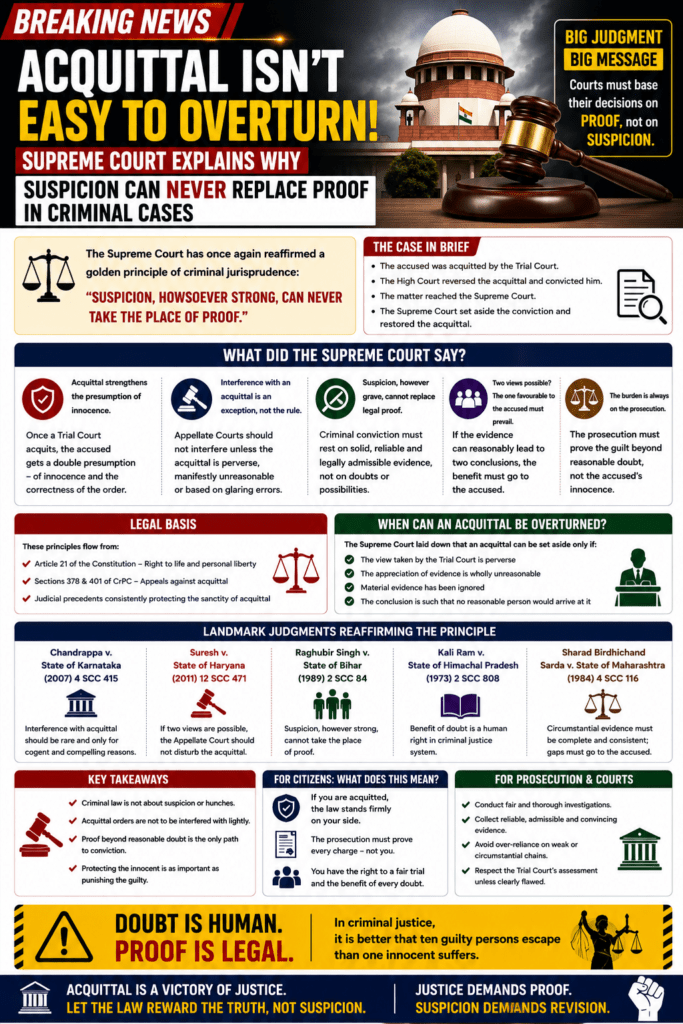
- Can Someone Be Convicted Simply Because the Crime Looks Obvious? Supreme Court Says "Absolutely Not"
- Why Is This Judgment Important?
- What Were the Facts of the Case?
- Can Every Acquittal Be Challenged?
- Why Did the Supreme Court Restore the Acquittal?
- What About the Recovery of the Weapon?
- Suspicion Cannot Replace Proof
- Presumption of Innocence Becomes Stronger After Acquittal
- Why Didn't the Supreme Court Convict Despite the Brutal Murder?
- Important Legal Principles Reaffirmed by the Supreme Court
- Why This Judgment Matters
- Conclusion
Case Title: Khalil Pasha & Ors. v. Abdul Rasheed & Anr.
Neutral Citation: 2026 INSC 754
Case No.: Criminal Appeal arising out of Special Leave Petition (Criminal) No. 1115 of 2023
Date of Judgment: 28 July 2026
Bench: Justice J.B. Pardiwala and Justice K. Vinod Chandran
Can Someone Be Convicted Simply Because the Crime Looks Obvious? Supreme Court Says “Absolutely Not”
One of the fundamental principles of Indian criminal law is that every accused person is presumed innocent unless proven guilty beyond reasonable doubt.
This principle becomes even stronger when a Trial Court has already acquitted the accused.
In a significant judgment delivered on 28 July 2026, the Supreme Court reaffirmed that courts cannot convict a person merely because a heinous crime has been committed or because suspicion points towards the accused.
The Court restored the acquittal of six persons accused of murder after finding that the prosecution failed to prove the case through reliable evidence.
The judgment is an important reminder that criminal courts decide cases on evidence—not emotions, assumptions or public outrage.
Why Is This Judgment Important?
Murder cases often involve intense public emotions.
When a brutal crime occurs, people naturally expect punishment.
However, criminal courts do not punish people simply because a crime has taken place.
They punish only when the prosecution proves the guilt of the accused beyond reasonable doubt.
The Supreme Court observed that while the murder in this case was undoubtedly brutal, the evidence produced by the prosecution was not trustworthy enough to sustain a conviction.
What Were the Facts of the Case?
The case related to an incident that allegedly occurred on 14 February 1988.
According to the prosecution:
- there was an earlier quarrel between one of the accused and the deceased;
- later that evening, several accused allegedly formed an unlawful assembly;
- they assaulted the deceased with deadly weapons;
- the injured man later died in the hospital.
The Trial Court, after examining the evidence, acquitted all the accused.
The deceased’s brother challenged the acquittal before the Bombay High Court through a criminal revision.
Eventually, the matter reached the Supreme Court.
Can Every Acquittal Be Challenged?
Yes.
An acquittal can be challenged before a higher court.
However, appellate and revisional courts exercise this power with great caution.
The reason is simple.
Once a Trial Court acquits an accused, the law presumes that the acquittal is correct unless there are compelling reasons to interfere.
Therefore, higher courts normally interfere only when:
- the Trial Court ignored important evidence,
- the findings are completely perverse,
- the judgment is illegal,
- or there has been a serious miscarriage of justice.
Why Did the Supreme Court Restore the Acquittal?
After re-examining the entire evidence, the Supreme Court found several serious weaknesses in the prosecution case.
1. The Alleged Motive Was Weak
The prosecution claimed that a quarrel earlier in the day provided the motive for the murder.
However, the evidence itself contradicted this theory.
One witness claimed that the dispute arose because the deceased had refused to whitewash the accused’s house.
During cross-examination, the same witness admitted that the deceased was not even engaged in whitewashing work.
This significantly weakened the alleged motive.
2. Eyewitnesses Were Not Reliable
The prosecution relied upon three eyewitnesses.
The Supreme Court agreed with the Trial Court that their testimonies were not trustworthy.
The Court noticed several inconsistencies:
- witnesses contradicted each other,
- each gave a different version,
- important independent witnesses were never examined,
- their conduct after witnessing the murder appeared unnatural.
The Court also observed that although the witnesses allegedly saw a seriously injured man lying on the road, none of them informed the police immediately or took him to the hospital.
Such conduct raised serious doubts regarding their presence at the scene.
3. The Alleged Dying Declaration Was Unreliable
One of the strongest pieces of evidence in murder cases is often a dying declaration.
A dying declaration is a statement made by a person regarding the cause of his death before he dies.
However, the Supreme Court found major contradictions here.
Different witnesses claimed that the deceased made the dying declaration:
- inside the auto-rickshaw,
- in the hospital,
- before different persons.
Medical evidence also created doubts regarding whether the deceased was even conscious enough to make such statements.
The doctors themselves gave conflicting versions.
One doctor stated that the injured never regained consciousness.
Another stated that he was conscious several hours later.
The Court held that these inconsistencies made the alleged dying declaration unsafe to rely upon.
What About the Recovery of the Weapon?
The prosecution also relied upon recovery of the weapon under Section 27 of the Indian Evidence Act, 1872.
The recovered weapon contained human blood.
However, the Supreme Court clarified an important legal principle.
Recovery of a weapon alone does not automatically prove guilt.
Unless the recovery is supported by other reliable evidence connecting the accused to the crime, it cannot by itself lead to conviction.
In this case:
- no eyewitness properly connected the weapon to the assault,
- the blood was only identified as human blood,
- the prosecution failed to establish that it belonged to the deceased.
Therefore, the recovery alone was insufficient.
Suspicion Cannot Replace Proof
Perhaps the most important observation in the judgment is that strong suspicion is never a substitute for legal proof.
The Court observed that although a brutal murder had undoubtedly taken place, the prosecution failed to establish who committed it.
The Bench made it clear that criminal courts cannot convict someone merely because the evidence creates suspicion.
The prosecution must establish guilt beyond reasonable doubt.
Presumption of Innocence Becomes Stronger After Acquittal
The Supreme Court reiterated another settled principle of criminal law.
Every accused begins a criminal trial with the presumption of innocence.
When the Trial Court acquits the accused, this presumption becomes even stronger.
Therefore, appellate courts should interfere only when the Trial Court’s view is wholly unreasonable or impossible to sustain.
If two views are reasonably possible from the evidence, the one favouring the accused must prevail.
Why Didn’t the Supreme Court Convict Despite the Brutal Murder?
The Court acknowledged that a gruesome murder had occurred and sympathised with the deceased’s family.
However, it emphasised that courts cannot punish individuals merely because someone must be held responsible.
Justice cannot be based on assumptions or sympathy.
It must rest upon legally admissible and reliable evidence.
The Court observed that convicting innocent persons merely to solve a crime would itself amount to a grave injustice.
Important Legal Principles Reaffirmed by the Supreme Court
This judgment reiterates several well-settled principles of criminal jurisprudence:
- Every accused is presumed innocent until proven guilty.
- An acquittal further strengthens this presumption.
- Suspicion, however strong, can never replace proof beyond reasonable doubt.
- A dying declaration must inspire complete confidence before it can be relied upon.
- Recovery of a weapon under Section 27 of the Evidence Act alone is insufficient for conviction unless corroborated by reliable evidence.
- If two reasonable views are possible from the evidence, the view favourable to the accused must be adopted.
- Appellate courts should interfere with acquittals only in exceptional cases.
Why This Judgment Matters
This decision reinforces one of the most cherished safeguards in criminal law—that it is better for guilty persons to escape than for an innocent person to be wrongly convicted.
The judgment reminds investigating agencies that a conviction cannot rest upon weak investigations, contradictory witnesses or incomplete evidence.
It also reassures citizens that courts will not uphold criminal prosecutions unless the prosecution satisfies the strict standard of proof required by law.
Conclusion
The Supreme Court’s decision in Khalil Pasha & Ors. v. Abdul Rasheed & Anr., 2026 INSC 754 is a powerful reaffirmation of the rule of law.
Although the Court recognised that a brutal homicide had taken place, it refused to convict merely because the offence was grave. Instead, it insisted on what every criminal prosecution demands—credible, reliable and legally admissible evidence proving guilt beyond reasonable doubt.
The judgment sends a clear message: criminal courts exist to punish the guilty, but equally to protect the innocent. When evidence leaves room for reasonable doubt, the benefit must always go to the accused, even in the most serious offences.