
- Case Details
- Step 1: Investigating Officer Must Apply for TIP
- Step 2: TIP Should Normally Be Conducted Inside Jail
- Step 3: Jail Authorities Must Be Informed Immediately
- Step 4: Preserve the Accused's Appearance
- Step 5: Witnesses Must Never See the Accused Before TIP
- Step 6: Judicial Magistrate Should Conduct the TIP
- Step 7: Mix the Accused With Similar Looking Persons
- Step 8: Witnesses Must Identify Independently
- Step 9: Change the Position of the Accused
- Step 10: Magistrate Must Record Every Detail
- Step 11: Defence May Verify Compliance Before Commencement
Case Details
Case Title: Kanhai & Others v. State of Uttar Pradesh
Court: Allahabad High Court
Case No.: Criminal Appeal No. 1470 of 1987
Date Reserved: 06 July 2026
Date Delivered: 29 July 2026
Neutral Citation: Not Assigned
Coram: Hon’ble Justice Santosh Rai
Background of the Case
The prosecution alleged that on 21 February 1985, the complainant was travelling on a bicycle carrying containers of desi ghee when four unknown persons allegedly robbed him after threatening him with a knife.
Since the FIR was lodged against unknown persons, the prosecution’s entire case depended upon whether the complainant could later identify the accused.
The accused were subsequently arrested and subjected to a Test Identification Parade (TIP).
The Trial Court convicted all the accused under Section 392 IPC.
However, before the Allahabad High Court, the surviving accused challenged the conviction primarily on the ground that the identification proceedings were fundamentally unreliable.
Why Did the High Court Doubt the Test Identification Parade?
Justice Santosh Rai identified several serious deficiencies that undermined the prosecution’s case.
These included:
- The TIP was conducted more than 42 days after the accused were sent to jail.
- No explanation was offered for this delay.
- The accused were strangers to the complainant.
- Independent witnesses associated with the TIP failed to identify the surviving accused.
- No stolen property was recovered.
- No weapon was recovered from the accused.
- No independent eyewitness supported the prosecution.
According to the Court, these cumulative defects destroyed the evidentiary value of the identification proceedings.
What Is the Purpose of a Test Identification Parade (TIP)?
The Court reiterated the settled legal position that a Test Identification Parade is not substantive evidence.
Its purpose is simply:
- to test the memory of witnesses;
- to verify whether they can identify previously unknown offenders;
- to provide corroboration to the witness’s identification during trial.
The substantive evidence always remains the identification made before the Court during trial.
However, where the accused were strangers, courts generally expect such dock identification to be supported by a properly conducted TIP.
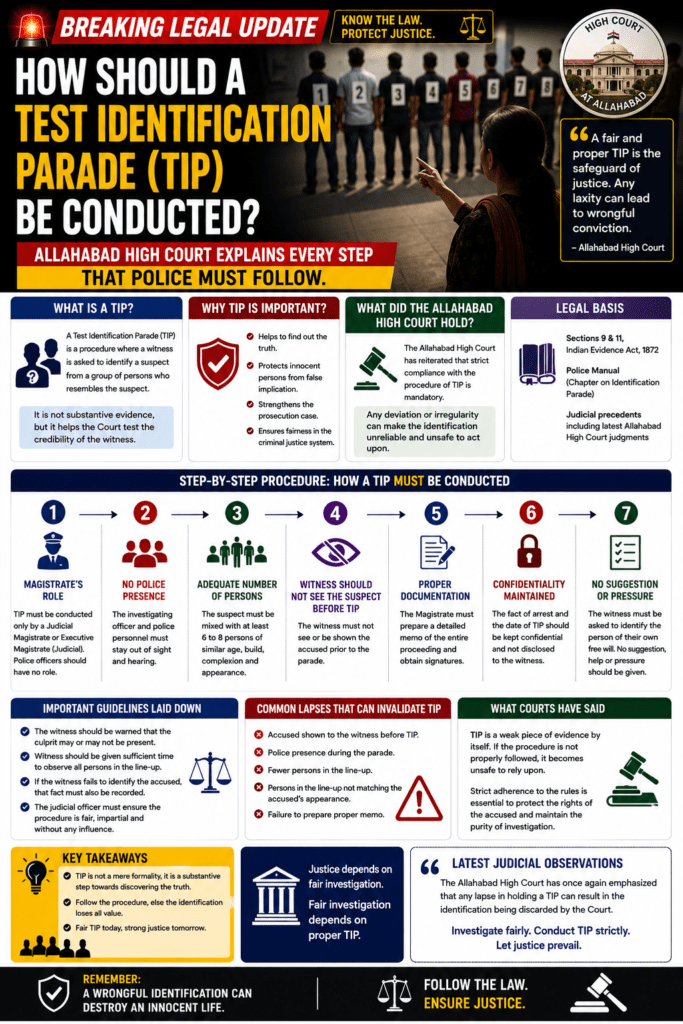
Allahabad High Court Explains the Step-by-Step Procedure for Conducting a TIP
One of the most valuable parts of the judgment is the Court’s detailed explanation of how a Test Identification Parade should be conducted under the U.P. Police Regulations and the U.P. Jail Manual.
According to the Court, the following safeguards must be followed:
Step 1: Investigating Officer Must Apply for TIP
Once the accused is sent to judicial custody, the Investigating Officer should promptly move an application requesting the Magistrate to conduct a Test Identification Parade.
Step 2: TIP Should Normally Be Conducted Inside Jail
The parade should ordinarily be held inside the jail premises and not at the police station, so as to prevent unnecessary exposure of the accused.
Step 3: Jail Authorities Must Be Informed Immediately
The police should immediately inform the Jail Superintendent that the accused is required to participate in a Test Identification Parade.
Step 4: Preserve the Accused’s Appearance
The Jail Superintendent must ensure that the accused:
- does not shave;
- does not alter hairstyle;
- does not grow or remove beard or moustache;
- does not change appearance;
- wears similar clothes as at the time of arrest.
This prevents manipulation of identity.
Step 5: Witnesses Must Never See the Accused Before TIP
The Court emphasized that this is perhaps the most important safeguard.
Police must ensure:
- witnesses do not see the accused before the parade;
- accused are never shown to witnesses;
- unnecessary production of accused before witnesses is avoided.
Prior exposure substantially reduces the reliability of a TIP.
Step 6: Judicial Magistrate Should Conduct the TIP
The identification proceedings should ordinarily be conducted by a Judicial Magistrate.
Police officers should not participate in the identification exercise.
Step 7: Mix the Accused With Similar Looking Persons
The accused must be placed among several persons having similar:
- age,
- height,
- complexion,
- build,
- clothing,
- general appearance.
This ensures fairness.
Step 8: Witnesses Must Identify Independently
Each witness must:
- enter separately;
- identify independently;
- not communicate with other witnesses.
This avoids influence or tutoring.
Step 9: Change the Position of the Accused
After every witness:
- the accused should be allowed to change position;
- the Magistrate should record whether such change occurred.
This ensures identification is based on memory rather than position.
Step 10: Magistrate Must Record Every Detail
The Magistrate should record:
- names of dummy persons;
- objections raised by accused;
- changes of position;
- conduct of witnesses;
- whether identification was immediate or hesitant.
Proper documentation is essential for credibility.
Step 11: Defence May Verify Compliance Before Commencement
Before the parade begins:
- defence counsel (if present);
- prosecuting inspector,
may verify whether safeguards have been followed.
However, they cannot participate in the identification itself.
Delay in Conducting TIP Can Seriously Damage the Prosecution
The High Court observed that unexplained delay creates a real possibility that:
- the accused may have been shown to witnesses beforehand;
- memory of witnesses fades;
- fairness of identification becomes doubtful.
Since the prosecution failed to explain why the parade was delayed by more than 42 days, the Court held that the evidentiary value of the TIP stood substantially weakened.
Independent Witnesses Failed to Identify the Accused
The Court found another serious defect.
Although two independent witnesses participated in the TIP:
- one identified only the deceased accused,
- the other also failed to identify the surviving appellants.
Neither identified Kanhai or Kallu.
Thus, the identification proceedings themselves failed to corroborate the complainant’s version.
No Recovery of Looted Property or Weapon
The prosecution also failed to recover:
- the looted ghee,
- cash,
- grocery items,
- knife or weapon.
The Court observed that there was no independent evidence connecting the appellants with the alleged robbery.
What Did the Supreme Court Say About Test Identification Parade?
Justice Santosh Rai relied upon several landmark Supreme Court decisions.
1. Budhsen v. State of U.P. (1970) 2 SCC 128
The Supreme Court held that identification in Court is substantive evidence, while TIP merely provides corroboration.
2. State of H.P. v. Lekh Raj (2000) 1 SCC 247
The Court held that where the accused were previously unknown, identification for the first time in Court is inherently weak unless supported by an earlier TIP.
3. Malkhansingh v. State of M.P. (2003) 5 SCC 746
The Supreme Court reiterated that:
- TIP is only corroborative evidence;
- failure to conduct TIP does not automatically invalidate prosecution;
- however, where accused are strangers, courts generally look for corroboration before relying upon dock identification.
High Court Extends Benefit of Doubt
Considering:
- delayed TIP,
- procedural violations,
- failure of independent witnesses,
- absence of recovery,
- lack of corroboration,
the Allahabad High Court held that the prosecution had failed to establish the identity of the accused beyond reasonable doubt.
Accordingly, the Court:
- allowed the appeal;
- set aside the conviction under Section 392 IPC;
- acquitted the surviving appellants;
- discharged their bail bonds.
Key Takeaways from the Judgment
The decision reinforces several important legal principles:
- A Test Identification Parade is only corroborative evidence and not substantive evidence.
- Unexplained delay in holding a TIP significantly reduces its evidentiary value.
- Police must ensure that witnesses never see the accused before the parade.
- A TIP should ordinarily be conducted by a Judicial Magistrate inside jail.
- The accused must be mixed with persons of similar appearance to ensure fairness.
- Failure to follow mandatory safeguards can seriously weaken the prosecution’s case.
- Where the accused were strangers, conviction based solely on delayed or defective identification may not be sustainable.
Conclusion
The Allahabad High Court’s judgment serves as a valuable procedural guide on how a Test Identification Parade should be conducted. While courts have consistently held that TIP is not substantive evidence, this decision highlights that its fairness and reliability are crucial where the prosecution depends upon the identification of previously unknown accused persons.
By systematically outlining the procedural safeguards under the U.P. Police Regulations and Jail Manual, the Court has reinforced that criminal investigations must not only seek convictions but must also ensure fairness, transparency, and protection against mistaken identity. Where these safeguards are ignored, the benefit of doubt must necessarily go to the accused—a principle that lies at the heart of criminal jurisprudence.