
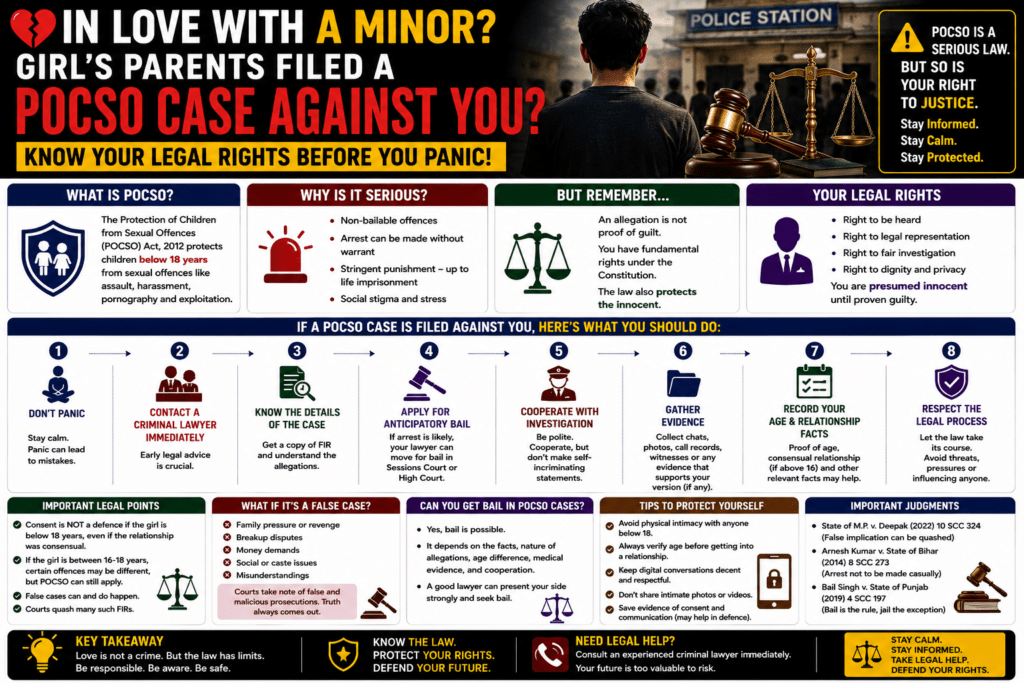
- Introduction
- What Is POCSO?
- Who Is a "Child" Under POCSO?
- Does the Girl's Consent Matter?
- So Is Every Teenage Relationship a POCSO Case?
- What If the Girl's Parents Filed the FIR Because They Opposed the Relationship?
- What Did the Supreme Court Say About Romantic Relationships?
- The Girl's Age Can Become the Most Important Issue
- What Documents Are Relevant for Determining Age?
- What If the Girl's Parents Have Given the Wrong Age?
- What If the Girl Is Now an Adult?
- What If She Ran Away From Home Voluntarily?
- What If She Says "I Want to Marry Him"?
- What If There Was No Force or Threat?
- Can You Get Bail in a POCSO Case Arising From a Romantic Relationship?
- What If the Age Itself Is Disputed?
- Can Anticipatory Bail Be Granted?
- What Evidence Can Help the Defence?
- Can the POCSO FIR Be Quashed?
- Can Parents' Opposition to the Relationship Prove That the FIR Is False?
- What Are the Possible Legal Remedies?
- What About Section 29 of POCSO?
- What If the Girl Herself Supports the Boy?
- What If She Later Turns Against the Boy?
- What If the Parents Force Her to Give a Statement?
- Important Supreme Court Warning: Don't Turn a Bail Hearing Into a Mini-Trial
- What Should You Do Immediately After a POCSO FIR?
- What You Should NOT Do
- Myth vs Reality
- Frequently Asked Questions
- Can a boyfriend be booked under POCSO if the relationship was consensual?
- Can a girl's parents file a POCSO case against her boyfriend?
- Can I get bail in a POCSO case?
- Can a POCSO FIR be quashed?
- What if the girl's age is actually above 18?
- Does marriage between the accused and the girl end a POCSO case?
- Key Takeaways
- Conclusion: Love Is Not a Defence—But Neither Is an FIR a Conviction
Introduction
You are in a relationship.
You both like each other.
You talk regularly. You meet each other. You may even have plans to marry.
Then suddenly, everything changes.
The girl’s parents discover the relationship.
They strongly oppose it.
And then you receive the news:
“A POCSO case has been registered against you.”
For many young people, this is terrifying.
The immediate questions are:
- Can a romantic relationship result in a POCSO case?
- Does the girl’s consent matter?
- What if she willingly came with me?
- What if she told her parents that she loves me?
- What if we were planning to marry?
- Can I get anticipatory bail?
- Can the FIR be quashed?
- What if her parents have falsely shown her age as below 18?
The answer requires one very important distinction:
A romantic relationship and a legally permissible sexual relationship are not necessarily the same thing under Indian law.
The Protection of Children from Sexual Offences Act, 2012 (POCSO Act) defines a child as a person below 18 years of age.
Therefore, the first and most important question in a POCSO case arising from a relationship is:
How old was the girl on the date of the alleged incident?
What Is POCSO?
POCSO stands for the Protection of Children from Sexual Offences Act, 2012.
It is a special legislation enacted to protect children from:
- sexual assault;
- penetrative sexual assault;
- aggravated sexual assault;
- sexual harassment;
- child sexual abuse material and related offences.
The Act also establishes Special Courts for trying such offences.
The basic legislative idea is simple:
Children require special protection from sexual exploitation and abuse.
Who Is a “Child” Under POCSO?
This is perhaps the most important point in a romantic-relationship POCSO case.
Under Section 2(d) of POCSO:
A child means a person below 18 years of age.
Therefore, if the girl was below 18 at the relevant time, the fact that she voluntarily agreed to the relationship does not by itself create a defence to an offence under POCSO.
This is because POCSO does not create an adult-style defence of consent for sexual acts with a child.
Does the Girl’s Consent Matter?
This is where most people become confused.
Suppose a 17-year-old girl says:
“I love him.”
Suppose she says:
“I went with him voluntarily.”
Suppose she says:
“I wanted to marry him.”
Those facts may be highly relevant to the overall factual and legal assessment of the case, particularly at stages such as bail, investigation and quashing, depending upon the allegations and evidence.
But they do not automatically erase the statutory age requirement under POCSO.
The Supreme Court has expressly cautioned that when the victim is below 18, whether the alleged sexual act arose from a romantic relationship does not, by itself, remove the offence from the statutory framework.
So Is Every Teenage Relationship a POCSO Case?
Not necessarily.
This requires careful analysis.
There is an important difference between:
A genuine romantic relationship between adolescents
and
A case involving exploitation, coercion, manipulation, force, threats, abduction or sexual abuse.
Courts must examine the actual allegations and evidence.
The fact that a POCSO FIR has been registered does not mean that the accused is automatically guilty.
An FIR is an accusation—not a conviction.
What If the Girl’s Parents Filed the FIR Because They Opposed the Relationship?
This situation has received increasing judicial attention.
In its 2026 judgment in State of Uttar Pradesh v. Anurudh, the Supreme Court took note of judicial concerns regarding POCSO cases arising from young people’s consensual relationships and observed that there have been instances where the law has been used by families opposing relationships between young people. The Court also referred to concerns about young boys languishing in jail in such circumstances.
The Court went further and directed attention to the possibility of legislative consideration of a “Romeo-Juliet clause” for genuine adolescent relationships, as well as mechanisms to deal with misuse of protective laws.
But there is an important warning:
This does not mean that a Romeo-Juliet exception currently exists in Indian POCSO law.
The Supreme Court discussed the possibility of legislative reform; it did not create a statutory exemption from POCSO.
What Did the Supreme Court Say About Romantic Relationships?
The jurisprudence contains two important principles which must be read together.
Principle 1: Consent Does Not Automatically Defeat POCSO
In In Re: Right to Privacy of Adolescents, the Supreme Court dealt with a case involving a minor and made it clear that sexual intercourse with a person below 18 cannot be treated as lawful merely because the relationship is described as romantic.
Therefore:
“She loved me” is not, by itself, a complete legal defence to a POCSO allegation.
Principle 2: Courts Must Also Be Alert to Misuse
The Supreme Court’s later discussion in State of Uttar Pradesh v. Anurudh (2026) recognised that POCSO has, in some cases, been invoked in the context of genuine relationships between young people, including where families oppose the relationship.
The Court referred to factors that may deserve consideration in appropriate cases, including:
- the nature of the relationship;
- the surrounding circumstances;
- the conduct of both parties;
- the victim’s statement;
- the age of the parties;
- whether the relationship was genuinely consensual;
- whether there were allegations of coercion, intimidation or exploitation.
But these considerations do not rewrite the statutory definition of a child.
The Girl’s Age Can Become the Most Important Issue
Suppose the FIR says that the girl was:
17 years and 6 months old.
But you have documents suggesting that she was actually:
18 years and 2 months old.
That difference can completely change the legal framework.
If the person was not a “child” under POCSO on the date of the alleged offence, the foundational age requirement for invoking POCSO may fail.
Therefore, age must be examined carefully and lawfully.
What Documents Are Relevant for Determining Age?
Age may be established through legally recognised documents and evidence.
The Supreme Court has repeatedly emphasised the statutory hierarchy contained in Section 94 of the Juvenile Justice (Care and Protection of Children) Act, 2015, which includes:
- school/matriculation certificate;
- birth certificate from the competent local authority; and
- medical age determination only in the circumstances contemplated by the statute.
In State of Uttar Pradesh v. Anurudh (2026), the Supreme Court held that the bail court cannot conduct a mini-trial into the correctness of age documents. The final determination of disputed age is ordinarily a matter for trial.
What If the Girl’s Parents Have Given the Wrong Age?
This can become a serious defence issue.
For example:
- school record says one date of birth;
- birth certificate says another;
- Aadhaar or other records show another age;
- the FIR mentions a different age.
The defence should not simply argue:
“The parents are lying.”
Instead, the defence should collect and place the best legally admissible age documents before the appropriate court.
The question is:
What was the legally provable age on the date of the alleged offence?
What If the Girl Is Now an Adult?
This is another common misconception.
Suppose the alleged incident occurred when she was 17.
She turns 18 later.
The fact that she is now an adult does not automatically erase an offence allegedly committed when she was a child.
The relevant question remains the person’s age at the time of the alleged act.
What If She Ran Away From Home Voluntarily?
This may be an important factual circumstance, but it does not automatically end a POCSO case.
The court may examine:
- her statement;
- her age;
- whether there was force;
- whether there was inducement;
- whether there was coercion;
- whether there was exploitation;
- the nature of the relationship;
- the conduct of the accused.
A voluntary departure from home may be relevant, but it is not an automatic statutory defence to POCSO.
What If She Says “I Want to Marry Him”?
Again, this is an important factual circumstance, but marriage plans do not automatically legalise sexual activity with a person below 18.
The law treats the age requirement seriously.
The Supreme Court has held that where the victim was below 18, the romantic nature of the relationship cannot by itself negate the statutory offence.
What If There Was No Force or Threat?
This can be important.
If the prosecution itself shows circumstances such as:
- long-standing relationship;
- voluntary communications;
- mutual affection;
- voluntary meetings;
- voluntary departure;
- absence of threats;
- absence of violence;
- consistent statements supporting the relationship,
those circumstances may become relevant to the assessment of the prosecution case, particularly for bail and other appropriate relief.
However, they do not automatically nullify POCSO merely because the child allegedly consented.
Can You Get Bail in a POCSO Case Arising From a Romantic Relationship?
Yes, bail is legally possible.
A POCSO allegation does not mean that bail is automatically prohibited.
The court considers factors including:
- nature and gravity of allegations;
- age of the victim;
- prima facie material;
- role attributed to accused;
- period of custody;
- possibility of tampering;
- possibility of influencing witnesses;
- possibility of absconding;
- criminal antecedents;
- stage of investigation/trial.
The Supreme Court has reiterated that ordinary bail principles remain relevant in POCSO matters, although the seriousness of the offence and the victim’s age are critical considerations.
What If the Age Itself Is Disputed?
This can become particularly important at the bail stage.
The Supreme Court’s 2026 judgment in State of Uttar Pradesh v. Anurudh clarified an important limitation:
A bail court cannot conduct a mini-trial to conclusively determine disputed age documents.
The bail court may examine the available material and form a prima facie view, but a detailed evidentiary determination generally belongs to the trial process.
This distinction is extremely important.
Can Anticipatory Bail Be Granted?
Depending upon the statutory provisions invoked, the facts, and the applicable procedural law, an accused may seek appropriate pre-arrest protection where legally maintainable.
However, POCSO cases are serious offences and the court examines such applications carefully.
The application should not merely say:
“We were in love.”
It should place the entire factual picture before the court, including relevant documentary and electronic material.
What Evidence Can Help the Defence?
Potentially relevant material may include:
- genuine WhatsApp conversations;
- SMS messages;
- emails;
- photographs;
- call records, where lawfully obtained;
- social media communications;
- travel records;
- CCTV footage;
- location records, where lawfully available;
- school records;
- birth records;
- evidence showing the nature and duration of the relationship;
- statements of relevant witnesses.
But there is one very important rule:
Never manufacture, alter or delete evidence.
Manipulating electronic evidence can create entirely new legal problems.
Can the POCSO FIR Be Quashed?
In appropriate cases, yes.
The High Court possesses inherent constitutional/statutory jurisdiction to prevent abuse of process and secure the ends of justice, subject to the applicable procedural law and the facts of the case.
However, quashing is not automatic merely because the parties were in love.
The court may examine:
- whether the allegations are inherently improbable;
- whether the statutory ingredients are absent;
- whether the age requirement is not satisfied;
- whether the prosecution is manifestly malicious;
- whether the material on record makes continuation of proceedings an abuse of process;
- whether exceptional circumstances justify interference.
Can Parents’ Opposition to the Relationship Prove That the FIR Is False?
Not automatically.
Parents may genuinely complain because they believe their child has been sexually exploited.
At the same time, if evidence demonstrates that criminal proceedings were initiated for an ulterior purpose, such circumstances can become relevant to appropriate legal remedies.
The correct approach is to prove the factual circumstances, not merely label the FIR as “false.”
What Are the Possible Legal Remedies?
Depending on the stage of the case, remedies may include:
1. Anticipatory Bail
Where legally maintainable, seek protection from arrest.
2. Regular Bail
If arrested, apply for regular bail before the competent court.
3. Challenge the Age Material
Where legally justified, challenge unreliable or contradictory age evidence through the appropriate procedure.
4. Quashing Petition
In exceptional cases, approach the High Court seeking quashing of the FIR/proceedings.
5. Discharge
After the investigation/charge-sheet stage, seek discharge where the statutory ingredients are not made out and the applicable procedural law permits.
6. Trial
If the matter proceeds, challenge the prosecution case through cross-examination and defence evidence.
What About Section 29 of POCSO?
Section 29 creates a statutory presumption regarding certain POCSO offences once a person is prosecuted for specified offences under Sections 3, 5, 7 or 9.
The provision states that the Special Court shall presume commission/abetment/attempt unless the contrary is proved.
This makes the defence strategy particularly important.
The accused should not assume that:
“The girl says she loved me, so the case will automatically end.”
The prosecution and defence must be examined through the statutory framework and evidence.
What If the Girl Herself Supports the Boy?
Her statement can be extremely important evidence.
If she states that:
- she knew the accused;
- they were in a relationship;
- she voluntarily met him;
- there was no force or threat;
- the relationship was consensual;
the defence may rely upon such material as legally permissible.
But again, if she was below 18, her consent does not by itself legalise conduct prohibited by POCSO.
What If She Later Turns Against the Boy?
The case does not automatically end or become false merely because her statement changes.
The court may examine:
- the earlier statement;
- subsequent statement;
- circumstances of the change;
- independent evidence;
- electronic evidence;
- medical evidence;
- witness testimony.
The credibility of the evidence ultimately becomes a matter for the appropriate court.
What If the Parents Force Her to Give a Statement?
If there is a genuine allegation that a statement was obtained through coercion, pressure or influence, the issue should be brought before the appropriate court through proper legal proceedings.
The accused should never personally threaten or pressure the girl to change her statement.
That can seriously damage the defence and may create additional criminal consequences.
Important Supreme Court Warning: Don’t Turn a Bail Hearing Into a Mini-Trial
The Supreme Court’s 2026 decision in State of Uttar Pradesh v. Anurudh reaffirmed that the bail court cannot conduct a mini-trial or conclusively adjudicate disputed evidence.
Therefore, a bail application should focus on:
- prima facie case;
- custody;
- nature of allegations;
- age material;
- conduct;
- risk of tampering;
- flight risk;
- criminal antecedents;
- other recognised bail factors.
A detailed determination of disputed evidence belongs to the trial.
What Should You Do Immediately After a POCSO FIR?
If you discover that a POCSO FIR has been registered against you:
1. Do not panic.
An FIR is not a conviction.
2. Do not contact the girl to influence her.
This can create serious complications.
3. Preserve all genuine evidence.
Do not delete chats or photographs.
4. Collect age-related documents.
Birth certificate, school records and other relevant documents may become crucial.
5. Obtain the FIR and understand the exact sections.
Do not rely only on what someone tells you.
6. Seek immediate legal advice.
POCSO proceedings involve serious consequences and strict statutory provisions.
7. Examine bail immediately.
Do not wait until the situation becomes more complicated.
8. Examine whether quashing/discharge is legally available.
This depends entirely upon the facts and stage of proceedings.
What You Should NOT Do
Never:
❌ threaten the girl or her parents;
❌ ask the girl to change her statement;
❌ delete WhatsApp chats;
❌ manufacture screenshots;
❌ create fake documents;
❌ contact prosecution witnesses;
❌ abscond merely because an FIR has been registered;
❌ post the girl’s identity or private information on social media;
❌ assume that “she consented” automatically defeats POCSO.
Myth vs Reality
| MYTH | REALITY |
|---|---|
| “She loved me, so POCSO cannot apply.” | Not necessarily. If she was below 18, consent does not by itself defeat POCSO. |
| “Her parents filed the FIR, so it is automatically false.” | False. The court examines the evidence and circumstances. |
| “If she voluntarily left home, the POCSO case is over.” | No. Voluntary departure may be relevant but does not automatically eliminate POCSO liability. |
| “If she turns 18 now, the old POCSO offence disappears.” | Incorrect. The relevant age is generally her age when the alleged offence occurred. |
| “A POCSO FIR means immediate conviction.” | Absolutely not. The prosecution must establish the case according to law. |
| “A romantic relationship can never be considered by a court.” | Incorrect. Courts can consider the surrounding circumstances, conduct and relationship where legally relevant, particularly at bail and other stages. |
| “The Supreme Court has already created a Romeo-Juliet exception in India.” | False. The Supreme Court has discussed the possibility of legislative reform; it has not created such an exemption. |
| “The bail court can decide disputed age documents finally.” | No. The Supreme Court has cautioned against conducting a mini-trial at the bail stage. |
Frequently Asked Questions
Can a boyfriend be booked under POCSO if the relationship was consensual?
Yes, if the alleged conduct falls within a POCSO offence and the girl was below 18. The fact of consent does not automatically create a statutory defence.
Can a girl’s parents file a POCSO case against her boyfriend?
A complaint can be made by persons who come to know of an alleged POCSO offence, and POCSO contains mandatory reporting provisions. The police then investigate whether the ingredients of the alleged offences are made out.
Can I get bail in a POCSO case?
Yes. Bail is legally possible, although POCSO cases are serious and courts carefully examine the statutory allegations and circumstances.
Can a POCSO FIR be quashed?
In appropriate exceptional circumstances, the High Court may exercise its jurisdiction to prevent abuse of process and secure the ends of justice. However, romantic involvement alone does not guarantee quashing.
What if the girl’s age is actually above 18?
If the prosecution cannot establish that she was below 18 on the date of the alleged offence, the foundational requirement for POCSO may fail. The issue must, however, be determined according to the applicable statutory rules and evidence.
Does marriage between the accused and the girl end a POCSO case?
No automatic rule exists that marriage extinguishes a POCSO offence. The criminal case must be assessed according to the applicable law and the facts.
Key Takeaways
Remember These 7 Points
- POCSO protects persons below 18 years of age.
- Consent of a child does not automatically defeat a POCSO allegation.
- The age of the girl on the date of the alleged offence is critical.
- A romantic relationship may be relevant to the factual assessment, but it is not itself a statutory defence.
- The Supreme Court has recognised concerns about misuse of POCSO in genuine adolescent relationships.
- The Supreme Court has also made clear that courts cannot simply disregard the statutory age threshold because a relationship was romantic.
- If falsely implicated, the accused has legal remedies including bail, discharge and, in appropriate cases, quashing.
Conclusion: Love Is Not a Defence—But Neither Is an FIR a Conviction
A POCSO case arising out of a romantic relationship is one of the most sensitive situations in criminal law.
The law has two important objectives:
First: children must be protected from sexual exploitation.
Second: criminal law must not be permitted to become a weapon for settling personal scores.
The Supreme Court’s recent jurisprudence reflects this difficult balance. While the Court has reaffirmed that the statutory protection of children cannot simply be diluted by calling a relationship “romantic”, it has simultaneously recognised that genuine adolescent relationships and allegations of misuse deserve careful judicial attention.
Therefore, if you are facing a POCSO case because of a relationship, do not rely upon a single sentence such as “she consented” or “her parents are against us.”
The real legal questions are:
What was her age? What exactly is alleged? What evidence exists? What was the nature of the relationship? What do her statements say? Were there allegations of force, coercion or exploitation? And do the ingredients of the offences actually exist?
Those questions should be examined carefully and legally.
A POCSO allegation is serious—but an allegation is not the same as guilt. The correct defence begins with understanding the FIR, preserving evidence, establishing the relevant age, and choosing the appropriate legal remedy at the earliest stage.