
- 1. First Question: How Old Was the Girl on the Date of the Alleged Incident?
- 2. Does the Consent of a Minor Make Sexual Relations Legal?
- 3. Then Why Does the Girl's Statement Matter in a Bail Application?
- 4. What If the Girl Says in Her Statement That She Consented?
- 5. Can the Court Grant Bail Merely Because the Girl Says “I Consented”?
- 6. What Is the Difference Between Bail and Quashing?
- 7. What If the Girl Was 17 and in a Genuine Relationship With the Accused?
- 8. What Is the “Romeo-Juliet” Clause?
- 9. What Has the Supreme Court Said About Adolescent Relationships?
- 10. Does the Girl's Statement Before the Magistrate Help in Bail?
- 11. What About Section 29 of the POCSO Act?
- 12. What About Section 30 of the POCSO Act?
- 13. What Factors Can Strengthen a Bail Application in Such a POCSO Case?
- 14. Does Love Affair Automatically Mean Bail Should Be Granted?
- 15. What If the Girl Herself Wants the Accused to Be Released on Bail?
- 16. What If the Girl Says That Her Parents Filed the POCSO Case Against Her Will?
- 17. Can Bail Be Granted Even Though the Girl Was Below 18?
- 18. What Are the General Principles for Granting Bail?
- 19. What If the Accused and the Girl Subsequently Married?
- 20. Can the FIR Be Quashed Because the Girl Says It Was Consensual?
- 21. Myth vs Reality
- MYTH 1: “If the girl says she consented, POCSO cannot apply.”
- MYTH 2: “Once POCSO is registered, bail is impossible.”
- MYTH 3: “A love affair automatically guarantees bail.”
- MYTH 4: “If the girl went voluntarily, the accused is automatically innocent.”
- MYTH 5: “The Romeo-Juliet exception already exists in POCSO.”
- MYTH 6: “The victim's later statement automatically ends the case.”
- 22. What Should You Do If a POCSO Case Has Been Filed Against You and the Girl Says It Was Consensual?
- Step 1 — Determine her exact age
- Step 2 — Obtain and examine the FIR
- Step 3 — Examine the victim's statements
- Step 4 — Examine the medical and forensic material
- Step 5 — Preserve electronic evidence
- Step 6 — Examine the circumstances of the relationship
- Step 7 — Apply for bail
- Step 8 — Strictly comply with bail conditions
- 23. What Should Not Be Done?
- 24. The Most Important Legal Distinction
- 25. Final Takeaway
- Frequently Asked Questions (FAQs)
- Can bail be granted in a POCSO case if the girl says she consented?
- Does a minor's consent have legal value under POCSO?
- Can a 17-year-old girl consent to a sexual relationship under POCSO?
- Can the girl's statement help the accused get bail?
- Does a love affair mean the POCSO case is false?
- Can POCSO proceedings be quashed because the victim wants to marry the accused?
- What is the Romeo-Juliet clause in POCSO?
- Can a POCSO case be quashed if the prosecution has failed to establish the victim's age?
The girl says she went willingly.
She says she was in love with the accused.
She says there was no force or threat.
She even says that she consented to the physical relationship.
But there is a POCSO case.
So the obvious question is:
If the girl herself says that everything happened with her consent, can the accused still get bail in a POCSO case?
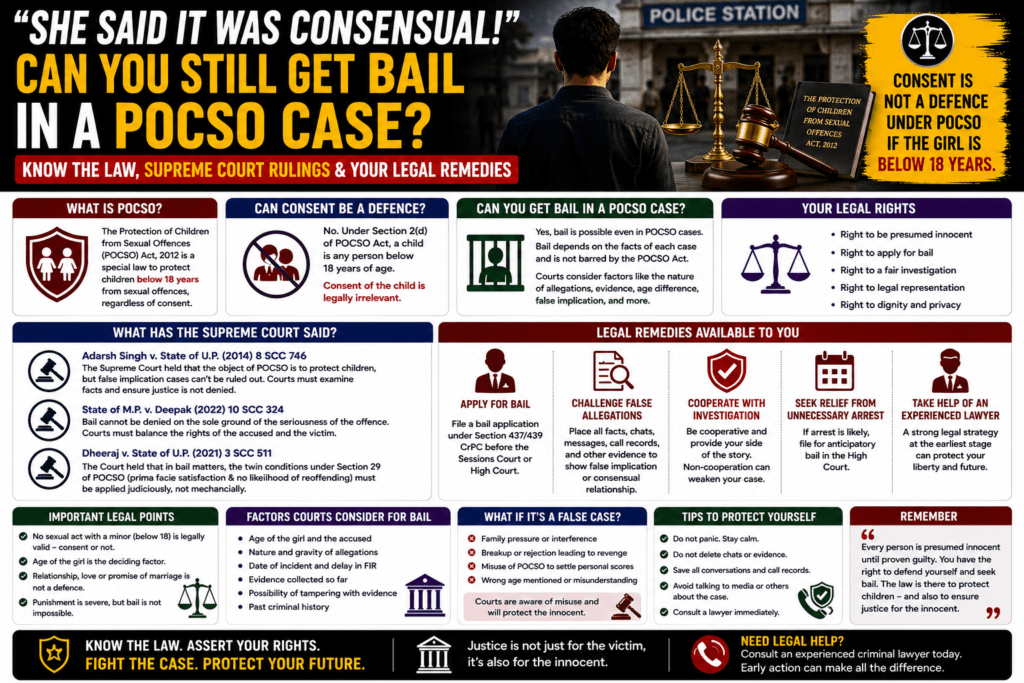
The answer is yes, bail can be granted in an appropriate POCSO case — but the girl’s consent does not automatically make the alleged sexual act legal if she was below 18 years of age.
This distinction is extremely important.
Under the Protection of Children from Sexual Offences Act, 2012 (“POCSO Act”), a child means a person below 18 years of age. The statute therefore does not recognise the consent of a child in the same manner as the consent of an adult.
At the same time, bail is not the same as acquittal.
The Court deciding bail is required to examine the overall circumstances of the case. The statement of the girl that the relationship was voluntary may be relevant to that assessment, particularly where the case involves a genuine adolescent relationship, a small age difference, absence of coercion, inconsistencies in the prosecution case or other circumstances creating doubt at the bail stage.
Recent Supreme Court jurisprudence has specifically recognised the need to consider the difficult problem of genuine adolescent relationships and has even suggested consideration of a “Romeo-Juliet” clause, although such an exception has not been incorporated into the POCSO Act by Parliament.
1. First Question: How Old Was the Girl on the Date of the Alleged Incident?
This is often the starting point of the entire POCSO case.
The question is not:
“How old is the girl today?”
The relevant question is:
“How old was she when the alleged sexual act took place?”
If she was 18 years or older, POCSO ordinarily does not apply merely because the relationship was later opposed by her family.
If she was below 18 years, she falls within the statutory definition of “child” under Section 2(d) of the POCSO Act.
Therefore, the accused and the prosecution may have fundamentally different positions depending upon the determination of age.
2. Does the Consent of a Minor Make Sexual Relations Legal?
Generally, no.
This is one of the most important principles under POCSO.
The POCSO Act was enacted specifically to protect children from sexual offences.
Therefore, if the prosecution establishes that the person was a child and that the prohibited sexual act occurred, the fact that the child says:
“I consented.”
does not ordinarily operate as a complete defence to criminal liability under POCSO.
A recent Delhi High Court decision reiterated that the minority of the prosecutrix makes consent legally irrelevant to the offence itself, although the prosecution must still establish the foundational facts constituting the alleged offence.
So the legal position can be stated simply:
Consent may be relevant to bail.
Consent does not automatically become a defence to the POCSO offence.
That distinction should never be overlooked.
3. Then Why Does the Girl’s Statement Matter in a Bail Application?
This is where the issue becomes more nuanced.
A bail Court is not conducting a full trial.
The Court does not finally determine guilt or innocence at the stage of bail.
Instead, it examines the available material and considers questions such as:
- whether there are reasonable grounds to believe that the accused committed the offence;
- the nature and gravity of the allegations;
- the age of the victim;
- the nature of the relationship;
- the victim’s statements;
- medical and forensic evidence;
- the conduct of the accused;
- the stage of investigation;
- possibility of tampering with evidence;
- possibility of influencing witnesses;
- possibility of absconding; and
- other circumstances relevant to the grant of bail.
Therefore, the girl’s statement that:
“I went voluntarily.”
or
“I was in a relationship with him.”
may form one part of the overall bail assessment.
It does not automatically decide the case.
4. What If the Girl Says in Her Statement That She Consented?
The exact contents of her statement become extremely important.
There is a substantial difference between a statement saying:
“He forcibly assaulted me.”
and one saying:
“I was in a relationship with him, I went with him voluntarily and there was no force.”
The second statement may become relevant to the defence while seeking bail, particularly where it is supported by other circumstances.
For example:
- the parties were in a relationship;
- there is a small age difference;
- the girl voluntarily accompanied the accused;
- there is no allegation of force or threat;
- there is no immediate complaint;
- the girl repeatedly stayed with the accused voluntarily;
- the prosecution evidence contains contradictions;
- the accused has no criminal antecedents;
- investigation is substantially complete; or
- the medical and forensic evidence does not support the allegation of forcible assault.
But each case must be examined independently.
5. Can the Court Grant Bail Merely Because the Girl Says “I Consented”?
No automatic rule exists.
The Court cannot simply say:
“The girl consented, therefore the accused is entitled to bail.”
At the same time, the Court is also not required to completely ignore the girl’s statement.
The correct approach is to examine the statement along with the entire prosecution material.
A recent Delhi High Court decision specifically distinguished between quashing a POCSO prosecution and granting bail. The fact that a victim describes a relationship as consensual does not automatically justify quashing the proceedings, but bail involves a different assessment based upon the circumstances and evidence.
This distinction is extremely important.
6. What Is the Difference Between Bail and Quashing?
Many people confuse these two remedies.
Bail
Bail means:
“The accused can remain out of custody while the criminal proceedings continue, subject to conditions.”
It does not mean that the accused has been declared innocent.
Quashing
Quashing means that the High Court exercises its extraordinary jurisdiction to terminate the criminal proceedings in appropriate circumstances.
The threshold and considerations are therefore different.
A Court may say:
“The prosecution should continue, but the accused can remain on bail.”
Therefore:
Bail ≠ Acquittal
and
Bail ≠ Quashing of FIR
7. What If the Girl Was 17 and in a Genuine Relationship With the Accused?
This is one of the most difficult situations under the present legal framework.
Suppose:
- the girl is 17;
- the accused is 19 or 20;
- they were in a genuine romantic relationship;
- she voluntarily accompanied him;
- there is no allegation of force;
- both were communicating with each other;
- the relationship was known to friends or family;
- and the girl herself says that the relationship was consensual.
Legally, because she was below 18, POCSO can still apply to sexual acts covered by the statute.
However, those circumstances may be highly relevant to the question of bail, depending on the evidence and facts of the case.
Courts have increasingly confronted the difficult issue of adolescent relationships that become criminal cases after family opposition.
8. What Is the “Romeo-Juliet” Clause?
The expression “Romeo-Juliet clause” has gained attention in recent POCSO jurisprudence.
The idea is broadly to create a limited legal protection for genuine adolescent relationships involving persons close in age, so that the stringent provisions intended to protect children from sexual exploitation do not unnecessarily criminalise every consensual adolescent relationship.
The Supreme Court, in its judgment dated 9 January 2026, referred to the possibility of introducing a Romeo-Juliet clause and a mechanism to address misuse of child-protection laws in appropriate circumstances. However, the Court did not itself amend the POCSO Act to create such an exception.
This means:
As of now, there is no general statutory Romeo-Juliet exception under the POCSO Act.
Therefore, lawyers should not argue that:
“They were close in age, therefore POCSO does not apply.”
That proposition is legally unsafe.
The proper argument is more nuanced:
The relationship, age difference, absence of coercion and the victim’s own statement are relevant circumstances while considering bail and the overall evidentiary picture, but they do not automatically extinguish statutory liability under POCSO.
9. What Has the Supreme Court Said About Adolescent Relationships?
The Supreme Court has recognised that POCSO is a protective legislation and must be enforced to protect children from sexual exploitation.
At the same time, the Court has also acknowledged the difficult consequences that can arise when the statute is applied to genuine adolescent relationships.
In its January 2026 judgment, the Supreme Court specifically referred to the possibility of introducing a Romeo-Juliet clause to exempt genuine adolescent relationships from the stronghold of the law, while also addressing misuse of such laws for settling personal scores.
This is significant because it shows that the judiciary is conscious of the distinction between:
Child sexual exploitation
and
Genuine adolescent relationships.
But until Parliament introduces an appropriate statutory mechanism, Courts must apply the existing statutory framework.
10. Does the Girl’s Statement Before the Magistrate Help in Bail?
It can be extremely important.
The statement of the victim recorded before the Magistrate can form a significant part of the material considered by the Court.
If the statement indicates:
- voluntary association;
- absence of force;
- romantic relationship;
- voluntary travel;
- continued association;
- absence of threats; or
- a materially different version from the FIR,
the defence may rely upon those circumstances in seeking bail.
However, the Court will also examine whether the statement is:
- consistent;
- credible;
- supported by other evidence;
- contradicted by medical evidence;
- contradicted by digital evidence;
- affected by subsequent developments; or
- materially different from the prosecution case.
Therefore, one sentence in the statement cannot ordinarily be examined in isolation.
11. What About Section 29 of the POCSO Act?
This is another important aspect.
Section 29 creates a statutory presumption in prosecutions for specified offences under the POCSO Act.
However, the presumption does not mean:
“The moment an FIR is registered, the accused is automatically presumed guilty.”
The recent jurisprudence has clarified that the prosecution must first establish the foundational facts necessary for invoking the statutory presumption.
The Delhi High Court, relying upon the Supreme Court’s recent decision in Debraj Dutta v. State of West Bengal, observed that Section 29 does not arise automatically merely because a POCSO case has been registered. The prosecution must first establish the foundational facts constituting the alleged offence.
This can be an important point in an appropriate bail case.
12. What About Section 30 of the POCSO Act?
Section 30 deals with the presumption concerning culpable mental state in offences under the Act where such mental state is required.
Again, the statutory presumption is not equivalent to saying that every accused is automatically guilty upon registration of an FIR.
The defence can place appropriate material before the Court concerning the factual foundation of the allegations and the circumstances of the alleged offence.
Recent judicial decisions have emphasised that the statutory presumptions are rebuttable and that the foundational facts remain important.
13. What Factors Can Strengthen a Bail Application in Such a POCSO Case?
Where the victim herself states that the relationship was voluntary, the following circumstances may become relevant, depending upon the facts:
1. Age of the victim
The precise age on the date of the alleged incident is crucial.
2. Age difference between the parties
A small age difference may be relevant to the Court’s assessment of the nature of the relationship.
3. Nature of the relationship
Whether the parties were genuinely in a relationship may be examined through the available material.
4. Voluntary conduct
Whether the victim voluntarily accompanied or remained with the accused may be relevant.
5. Victim’s statement
Statements under the applicable provisions of criminal procedure and POCSO may be important.
6. Absence of coercion
If the prosecution material itself does not disclose force, threat or intimidation, that may be relevant at the bail stage.
7. Delay in lodging the FIR
Delay can be a relevant circumstance, although it is not automatically fatal to the prosecution.
8. Medical evidence
The Court may consider the available medical material.
9. Digital evidence
Chats, calls, photographs, location information and other electronic evidence may sometimes provide context regarding the relationship.
Such material must, however, be lawfully obtained and properly proved.
10. Conduct of the accused
Previous compliance with investigation and absence of criminal antecedents may support the bail request.
11. Stage of investigation
If investigation is substantially complete and custodial interrogation is no longer necessary, that may be relevant.
14. Does Love Affair Automatically Mean Bail Should Be Granted?
No.
This is another common misconception.
A “love affair” is not a magic word that automatically results in bail.
The Supreme Court has previously cautioned against treating a claimed love affair as sufficient by itself to disregard the age of a very young victim in a POCSO/sexual offence case. In X (Minor) v. State of Jharkhand, the Supreme Court interfered with a bail order where the High Court had relied upon the alleged love affair despite the victim being about 13 years old.
This demonstrates why age matters enormously.
A case involving a 13-year-old cannot simply be equated with every case involving an older adolescent close to 18.
15. What If the Girl Herself Wants the Accused to Be Released on Bail?
The girl’s present position can be relevant, but it does not automatically control the criminal proceedings.
POCSO offences involve statutory protections for children.
The prosecution cannot necessarily be withdrawn merely because the victim later says:
“I do not want the case.”
or:
“I want him to be released.”
However, her statement and conduct may be relevant material for the Court while considering bail, depending upon the facts.
The Court must independently assess the case under the statutory framework.
16. What If the Girl Says That Her Parents Filed the POCSO Case Against Her Will?
This can become an important factual circumstance.
In some cases, the accused may contend that:
- the parties were in a genuine relationship;
- the girl’s family opposed the relationship;
- the FIR was lodged because of family pressure;
- the girl voluntarily accompanied the accused;
- she subsequently returned voluntarily;
- and her own statements do not support the allegations of force.
Such circumstances can be placed before the Court.
But the defence should avoid making unsupported allegations against the family.
The proper approach is to rely upon objective material and the victim’s own statements.
17. Can Bail Be Granted Even Though the Girl Was Below 18?
Yes.
There is no blanket statutory prohibition against granting bail merely because the case is under POCSO.
The Court still applies the general principles governing bail while taking into account the special nature of the POCSO Act.
A recent Jammu & Kashmir High Court decision expressly observed that there is no statutory bar to grant of bail in a POCSO case and that each case must be considered on its own facts and circumstances, while also taking Sections 29 and 30 into account.
Therefore:
POCSO case ≠ automatic denial of bail.
But:
POCSO case = Court must apply greater statutory and factual scrutiny.
18. What Are the General Principles for Granting Bail?
The Court may consider factors such as:
- prima facie case;
- nature and gravity of the offence;
- severity of punishment;
- possibility of absconding;
- character and antecedents of the accused;
- possibility of repeating the offence;
- possibility of influencing witnesses;
- possibility of tampering with evidence; and
- whether the administration of justice may be affected.
The Delhi High Court, while considering a POCSO bail application in 2026, referred to these established principles and also considered the special considerations arising from Section 29 of POCSO.
19. What If the Accused and the Girl Subsequently Married?
This issue requires considerable caution.
Marriage after the alleged incident does not automatically erase a POCSO offence allegedly committed when the girl was a child.
Similarly, the birth of a child or continuation of the relationship does not retrospectively legalise conduct that was criminalised by the statute.
However, subsequent conduct may, depending upon the case, be placed before the Court as one of the circumstances relevant to bail.
Recent judicial decisions have recognised this distinction: subsequent marriage or continuing relationship does not retrospectively legalise the alleged offence, although such circumstances may sometimes be relevant to a limited bail assessment.
20. Can the FIR Be Quashed Because the Girl Says It Was Consensual?
Not automatically.
This is a much higher threshold.
If the victim was below 18 and the allegations disclose the ingredients of a POCSO offence, the High Court ordinarily cannot simply create a consent-based exception that Parliament has not enacted.
A recent Delhi High Court decision declined to create such an exception merely because the victim described the relationship as consensual, emphasising that the statutory age of 18 remains significant.
However, in an appropriate case involving:
- doubtful age;
- absence of foundational facts;
- material contradictions;
- demonstrable abuse of process;
- allegations that do not constitute the offence;
- or other exceptional circumstances,
appropriate relief may be sought under the Court’s extraordinary jurisdiction.
21. Myth vs Reality
MYTH 1: “If the girl says she consented, POCSO cannot apply.”
REALITY:
If she was below 18, her consent does not ordinarily make the sexual act legally permissible under POCSO.
MYTH 2: “Once POCSO is registered, bail is impossible.”
REALITY:
Wrong. Bail can be granted in appropriate POCSO cases. The Court considers the facts, evidence, age, nature of allegations and other bail factors.
MYTH 3: “A love affair automatically guarantees bail.”
REALITY:
No. The nature and age of the relationship and the entire prosecution material must be examined.
MYTH 4: “If the girl went voluntarily, the accused is automatically innocent.”
REALITY:
Voluntary movement or association may be relevant evidence, but it does not automatically answer every ingredient of a POCSO offence.
MYTH 5: “The Romeo-Juliet exception already exists in POCSO.”
REALITY:
Not presently as a statutory general exception. The Supreme Court has suggested consideration of such a clause for genuine adolescent relationships, but the POCSO Act has not thereby been amended.
MYTH 6: “The victim’s later statement automatically ends the case.”
REALITY:
No. A later statement can be important evidence, but criminal proceedings do not automatically disappear merely because the victim changes or clarifies her position.
22. What Should You Do If a POCSO Case Has Been Filed Against You and the Girl Says It Was Consensual?
If you are facing such a case, the first step should be not to contact or pressure the girl or her family.
Instead:
Step 1 — Determine her exact age
Collect and examine the legally relevant age documents.
Step 2 — Obtain and examine the FIR
Understand exactly what allegations have been made.
Step 3 — Examine the victim’s statements
The statements recorded during investigation and before the Magistrate can be crucial.
Step 4 — Examine the medical and forensic material
Check whether the available scientific evidence supports or contradicts the allegations.
Step 5 — Preserve electronic evidence
Relevant lawful material such as chats, emails, call records or other communications should be preserved and produced through proper legal channels.
Step 6 — Examine the circumstances of the relationship
The defence should identify objective evidence showing the nature of the relationship, if relevant.
Step 7 — Apply for bail
The bail application should present the relevant facts in a legally structured manner rather than simply stating:
“It was a love affair.”
Step 8 — Strictly comply with bail conditions
If bail is granted, every condition should be followed.
23. What Should Not Be Done?
This is equally important.
The accused should not:
- threaten the girl;
- contact her repeatedly;
- pressure her to change her statement;
- ask friends to contact her;
- delete relevant communications;
- fabricate evidence;
- influence witnesses;
- post details about the victim on social media; or
- attempt to negotiate the case through threats or pressure.
Apart from creating additional legal problems, such conduct can seriously damage a bail application.
24. The Most Important Legal Distinction
The entire issue can be understood through three separate questions:
Question 1: Was the girl below 18?
If yes, she is a “child” for purposes of POCSO.
Question 2: Does her consent make the alleged POCSO offence lawful?
Generally, no.
Question 3: Can her statement about a voluntary relationship be relevant to bail?
Yes, depending upon the facts and the totality of circumstances.
This is the legally accurate way of understanding the issue.
25. Final Takeaway
If a girl below 18 states that she was in love with the accused and that the sexual relationship was consensual, that statement does not automatically erase the applicability of POCSO.
But it also does not mean that bail is automatically impossible.
The Court must consider the entire factual and evidentiary picture.
The defence may rely upon circumstances such as:
the precise age of the girl + age difference + nature of relationship + victim’s statements + absence of coercion + medical evidence + digital evidence + delay + conduct of the accused + stage of investigation + possibility of tampering with evidence + other relevant circumstances.
The recent Supreme Court jurisprudence is particularly significant because it recognises the difficult boundary between protecting children from sexual exploitation and dealing appropriately with genuine adolescent relationships, while also making clear that the judiciary cannot simply rewrite the POCSO Act by creating a general consent exception.
Therefore, the correct legal position is:
A minor’s consent is not a complete defence to a POCSO offence, but the victim’s statement that the relationship was voluntary can, in an appropriate case, be a relevant circumstance while the Court considers bail.
And one final point is crucial:
Every POCSO bail case turns on its own facts.
A case involving a 13-year-old cannot automatically be compared with a case involving two adolescents who are close in age and were allegedly in a genuine relationship. The nature of the allegations, the evidence and the precise circumstances must be examined carefully.
Frequently Asked Questions (FAQs)
Can bail be granted in a POCSO case if the girl says she consented?
Yes. Bail can be granted depending upon the facts and circumstances. However, her consent does not automatically make the alleged sexual act lawful if she was below 18.
Does a minor’s consent have legal value under POCSO?
A minor’s consent does not ordinarily operate as a defence to criminal liability for sexual acts covered by POCSO.
Can a 17-year-old girl consent to a sexual relationship under POCSO?
For purposes of POCSO, a person below 18 is a child. Therefore, the statute does not recognise consent in the same manner as it does for an adult.
Can the girl’s statement help the accused get bail?
It can be relevant, particularly where the statement supports a voluntary relationship and is consistent with other circumstances. But it is only one factor in the bail assessment.
Does a love affair mean the POCSO case is false?
No. A relationship may exist and POCSO may still apply if the victim was below 18.
Can POCSO proceedings be quashed because the victim wants to marry the accused?
Not automatically. Marriage or a continuing relationship does not retrospectively legalise an alleged POCSO offence.
What is the Romeo-Juliet clause in POCSO?
It refers to a proposed legal exception for genuine adolescent relationships involving persons close in age. The Supreme Court has suggested consideration of such a mechanism, but there is presently no general statutory Romeo-Juliet exception in the POCSO Act.
Can a POCSO case be quashed if the prosecution has failed to establish the victim’s age?
The determination of age can be fundamental to the applicability of POCSO. Where age is genuinely disputed or foundational facts are absent, the defence may raise the issue before the appropriate Court.