
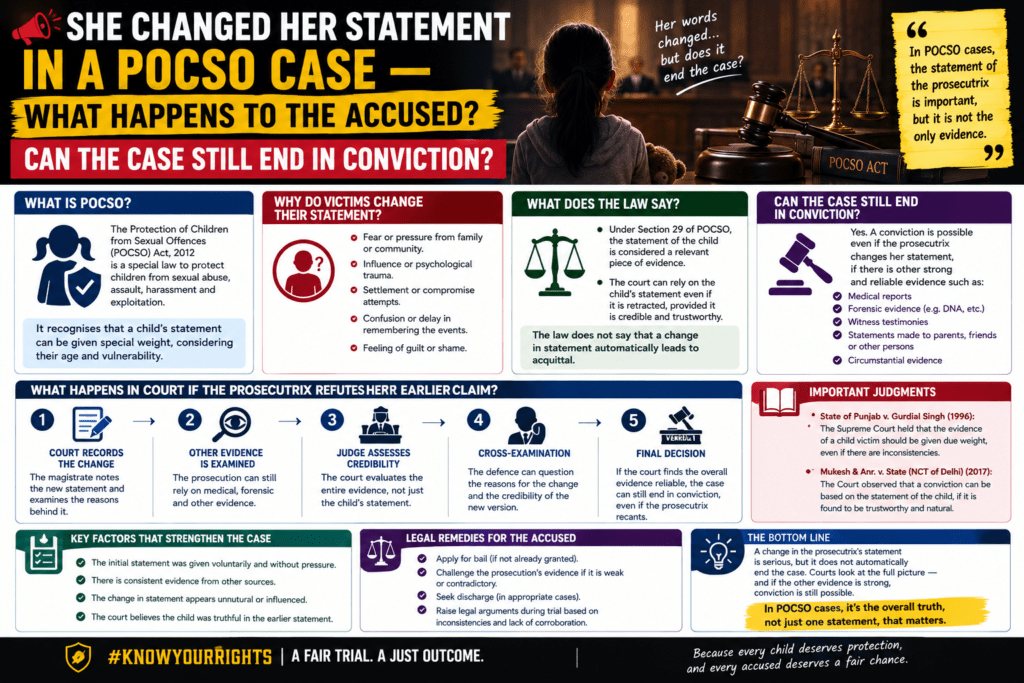
A POCSO case can take a completely different turn when the prosecutrix/child victim does not support the prosecution case during trial, contradicts her earlier statement, says that the incident did not happen as alleged, or states that she was in a relationship with the accused.
But does that automatically mean the accused will be acquitted?
Not necessarily.
The answer depends upon the nature of the earlier statements, the testimony given before the Court, medical and forensic evidence, the evidence of other witnesses, proof of age, the circumstances in which the statement changed, and whether the prosecution has otherwise established the foundational facts necessary to invoke the presumptions under the POCSO Act.
This distinction is extremely important because a hostile prosecutrix does not automatically terminate a POCSO prosecution, but neither does the mere registration of a POCSO case automatically establish the guilt of the accused.
What Does It Mean When the Prosecutrix “Refutes” the Prosecution Case?
In simple terms, it means that during investigation the prosecutrix may have made allegations against the accused, but when she later appears before the Trial Court, she may:
- deny the allegations;
- say that the accused did not sexually assault her;
- say that she was voluntarily accompanying the accused;
- deny portions of her FIR or previous statement;
- contradict her statement recorded before the Magistrate;
- say that the allegations were made because of pressure from parents or family members;
- refuse to identify the accused;
- state that the relationship was consensual; or
- give a version substantially different from the prosecution’s case.
Such a witness may be treated as a hostile witness, subject to the Court permitting the party calling the witness to cross-examine her.
However, the legal position is more nuanced than simply saying:
“The girl has turned hostile, therefore the accused is acquitted.”
That is not the law.
POCSO Law Is Different From Ordinary Criminal Cases
The first thing to understand is the fundamental purpose of the Protection of Children from Sexual Offences Act, 2012.
POCSO protects a child, meaning a person below 18 years of age. Therefore, where the victim was legally a child at the time of the alleged incident, her statement that the relationship was “consensual” does not by itself make conduct that constitutes an offence under POCSO legally consensual.
This is one of the most important distinctions in cases involving alleged romantic relationships between a minor and an accused.
The Act contains special provisions concerning the recording of a child’s statement, medical examination, Special Courts and statutory presumptions. Sections 29 and 30 are particularly significant because they concern presumptions after the prosecution establishes the necessary foundational facts.
Can the Prosecutrix Turn Hostile in a POCSO Case?
Yes.
A witness may depart from an earlier version during trial. The prosecution can seek permission of the Court to cross-examine its own witness where the legal requirements for treating the witness as hostile are satisfied.
But “hostile” does not mean that the entire testimony becomes worthless.
The Court is required to examine the evidence carefully and determine which portions, if any, are reliable.
The Supreme Court has emphasized that permission to cross-examine one’s own witness is an exceptional judicial step and should not be granted mechanically merely because there are minor discrepancies. A material departure or genuine element of hostility is relevant.
The Most Important Question: What Did She Say Before and What Did She Say in Court?
The Court will generally examine the entire evidentiary record.
For example:
Version 1
The FIR alleges sexual assault.
The statement before the Magistrate supports the allegation.
Medical evidence supports the occurrence.
Other witnesses corroborate material circumstances.
The prosecutrix later changes her version in Court.
Version 2
The FIR makes allegations.
The prosecutrix subsequently denies them.
Her statement before the Magistrate does not support the prosecution.
Medical and forensic evidence do not support the allegation.
Other witnesses also fail to establish the prosecution story.
These two situations are legally very different.
In the first situation, the prosecution may still have a substantial case despite the prosecutrix becoming hostile.
In the second, the prosecution may face serious difficulty in proving the charge beyond reasonable doubt.
Does a Hostile Prosecutrix Automatically Mean Acquittal?
No.
This is perhaps the biggest misconception surrounding POCSO cases.
A prosecution case does not necessarily collapse merely because the child victim does not support the prosecution during trial.
The Court may consider:
- the FIR;
- statement recorded during investigation;
- statement before the Magistrate;
- testimony before the Special Court;
- medical examination;
- DNA/FSL evidence;
- electronic evidence;
- call-detail records;
- messages and chats;
- CCTV footage;
- recovery evidence;
- evidence of parents and other witnesses;
- evidence regarding age;
- conduct of the parties; and
- other circumstances proved during trial.
If reliable evidence independently establishes the prosecution case, the Court can still proceed against the accused.
The Delhi High Court has recently reiterated that a victim’s testimony can be sufficient for conviction when it is found reliable and credible. It has also emphasized that the Section 29 presumption operates only after the prosecution establishes the necessary foundational facts.
What If the Prosecutrix Completely Denies the Allegation?
This is a much stronger situation for the defence—but again, not an automatic acquittal.
Suppose the prosecutrix tells the Court:
“Nothing happened between us.”
If this statement is credible and there is no other reliable evidence proving the alleged offence, the prosecution may be unable to establish the charge.
The fundamental criminal-law principle remains:
The prosecution must prove the case beyond reasonable doubt.
The POCSO presumptions do not mean that every accused must prove his innocence immediately merely because an FIR has been registered.
What Is the Role of Section 29 POCSO?
Section 29 creates a statutory presumption in relation to specified offences under the POCSO Act.
But it is important to understand the sequence.
The prosecution first has to establish the foundational facts necessary for the presumption to arise.
The Supreme Court’s decision in Sambhubhai Raisangbhai Padhiyar v. State of Gujarat, reported as (2025) 2 SCC 399, is particularly important on this point. The principle has subsequently been applied by Courts dealing with POCSO cases.
The Delhi High Court has similarly explained that the prosecution must first establish the foundational facts and that, thereafter, the presumption can be rebutted by exposing gaps in the prosecution case, demonstrating improbabilities, cross-examining prosecution witnesses or leading appropriate defence evidence.
Therefore:
FIR + POCSO allegation ≠ automatic conviction
and
Hostile prosecutrix ≠ automatic acquittal
The Court has to examine the entire evidence.
What Happens If the Prosecutrix Says “It Was Consensual”?
This is particularly important in cases involving alleged romantic relationships.
If the prosecutrix was below 18 years of age at the time of the alleged sexual act, the argument that she “consented” does not, by itself, provide a complete defence to an offence falling within POCSO.
The legal question is not merely:
“Did she consent?”
The Court must first determine:
Was she a child on the date of the alleged occurrence?
If she was below 18, the statutory scheme of POCSO becomes applicable where the ingredients of the alleged offence are established.
However, her subsequent testimony that no sexual act occurred, or that the prosecution allegations are false, may have significant evidentiary consequences depending upon the rest of the prosecution case.
Age of the Prosecutrix Becomes Extremely Important
In many POCSO cases, the first major issue is not even consent.
It is:
Was the prosecutrix actually below 18 years on the date of the alleged offence?
The prosecution has to establish age in accordance with law.
The Supreme Court has recently emphasized the importance of proper determination of the victim’s age in POCSO bail proceedings and has directed that age-related medical material be properly prepared and placed before the Court.
Therefore, in an appropriate case, the defence may examine:
- birth certificate;
- school records;
- admission records;
- municipal records;
- other statutory age documents;
- medical age assessment, where legally relevant; and
- inconsistencies concerning the date of birth.
The exact evidentiary hierarchy depends upon the applicable law and facts.
What If Her Earlier Statement Supports the Prosecution but Her Court Testimony Does Not?
This is one of the most frequently misunderstood situations.
A previous statement does not automatically become substantive evidence merely because it was recorded by police or before a Magistrate.
The Court has to examine the rules of evidence applicable to that particular statement and the manner in which it can legally be used.
The defence can challenge:
- contradictions;
- omissions;
- improvements;
- inconsistencies;
- circumstances surrounding the making of the statement;
- tutoring or influence, where supported by evidence;
- delay;
- inconsistencies with medical evidence; and
- contradictions with objective evidence.
Therefore, merely producing an earlier statement does not necessarily mean that the Court must accept the earlier version as true.
Can the Prosecution Cross-Examine the Prosecutrix?
Yes, where the Court permits it in accordance with the law governing hostile witnesses.
The purpose is to test why the witness has departed from the earlier version and to confront her with legally permissible contradictions.
But the Court does not mechanically accept everything said during cross-examination.
The evidence has to be assessed as a whole.
The Supreme Court has cautioned against mechanically declaring witnesses hostile and has emphasized that there should be a genuine basis for such a course.
Can the Court Still Convict the Accused Even If the Prosecutrix Turns Hostile?
Yes, in an appropriate case.
Suppose:
- the prosecutrix changes her statement;
- but the medical evidence strongly corroborates the prosecution;
- electronic evidence supports the prosecution;
- independent witnesses establish relevant circumstances;
- her earlier version is legally usable and reliable; and
- other evidence establishes the foundational facts.
The Court can assess whether the prosecution has nevertheless proved the case beyond reasonable doubt.
A recent Delhi High Court decision illustrates this principle: the Court found that the prosecution case could survive despite the child victim turning hostile because the initial complaint and statement were supported by medical and forensic evidence and other witnesses.
Therefore, the defence cannot simply rely upon the word “hostile”. It must examine the entire evidentiary chain.
But Can the Accused Be Acquitted When the Prosecutrix Refutes the Allegations?
Absolutely, if the prosecution ultimately fails to prove the charge beyond reasonable doubt.
If:
- the prosecutrix does not support the allegation;
- her earlier statements are materially contradicted;
- there is no reliable corroboration;
- medical evidence does not support the prosecution case;
- forensic evidence is absent or inconclusive;
- independent witnesses do not support the prosecution;
- age is not properly established; and
- the remaining evidence does not establish the ingredients of the offence,
the Court may conclude that the prosecution has failed to discharge its burden.
A recent Supreme Court decision has reiterated that the Section 29 presumption cannot simply be invoked without first establishing the foundational facts.
What About Allegations That the Prosecutrix Was Pressured to Turn Hostile?
This is also important.
The Court will not automatically accept the defence argument that the prosecutrix voluntarily changed her statement.
Similarly, the Court will not automatically accept the prosecution’s assertion that she was pressured.
There must be evidence.
The Court may examine:
- communications between the parties;
- conduct of the accused;
- family circumstances;
- threats or inducements;
- attempts to influence witnesses;
- statements made before the Court;
- surrounding circumstances; and
- other objective evidence.
If witness intimidation or tampering is established, it can have serious consequences for the accused, including adverse consideration in bail proceedings and possible independent criminal proceedings.
Can a POCSO Case Be Quashed Because the Prosecutrix No Longer Supports It?
This requires considerable caution.
POCSO offences are generally treated as serious offences involving the protection of children and are not ordinarily treated as purely private disputes.
Therefore, a compromise or subsequent change of heart does not automatically result in quashing.
However, constitutional courts have, in exceptional factual circumstances, examined whether continuation of proceedings would serve the ends of justice, particularly where the evidence itself makes conviction highly improbable. The Supreme Court has in an appropriate recent case considered the prosecutrix’s affidavit and the remote possibility of conviction while exercising its extraordinary jurisdiction.
But this should not be misunderstood as creating a general rule that every POCSO case can be compromised.
Each case depends upon its facts, the offence alleged, the age of the victim, the evidence available and the stage of proceedings.
What Should the Accused Do If the Prosecutrix Has Refuted the Allegation?
The accused should not assume that the case is automatically over.
A proper legal strategy normally requires examination of the entire record.
1. Obtain the complete charge-sheet
Do not rely merely upon the FIR.
Examine:
- statements;
- medical documents;
- FSL reports;
- age documents;
- electronic evidence;
- seizure memos;
- site plan;
- supplementary charge-sheet; and
- other prosecution material.
2. Compare every version
Prepare a chronological comparison of:
FIR → police statement → Magistrate statement → medical history → Court testimony.
Material contradictions can become extremely important.
3. Examine age evidence carefully
The date of birth must be examined in accordance with the applicable statutory framework.
4. Examine the medical and forensic evidence
Determine whether it actually supports the alleged offence or whether it is neutral/inconsistent with the prosecution story.
5. Consider the effect of the hostile testimony
The precise portions of the testimony that favour the defence should be identified rather than merely stating that the witness has turned hostile.
6. Consider bail or other appropriate relief
Where the evidence has substantially weakened because of the prosecutrix’s testimony, that development may become relevant in a bail application, depending on the stage and circumstances of the case.
7. Consider discharge, quashing or trial remedies where legally maintainable
The appropriate remedy depends upon the procedural stage and the evidence available.
Does the Prosecutrix’s Statement Alone Decide the Case?
No.
Her evidence can be extremely important, and a credible victim’s testimony can, in an appropriate case, sustain a conviction without independent corroboration.
The Supreme Court’s jurisprudence recognizes that the testimony of a sexual-assault victim can be sufficient where it is reliable and trustworthy.
But the reverse proposition is equally important:
The Court cannot dispense with the requirement of proving the prosecution case merely because the case is under POCSO.
The statutory presumption under Section 29 becomes relevant only after the prosecution establishes the necessary foundational facts.
Myth vs Reality
| Myth | Reality |
|---|---|
| “If the prosecutrix turns hostile, the accused is automatically acquitted.” | Not necessarily. The Court can rely upon other legally admissible evidence. |
| “If the girl says she consented, the POCSO case automatically ends.” | If she was below 18, consent does not by itself legalise conduct constituting an offence under POCSO. |
| “Once Section 29 is applied, conviction is guaranteed.” | No. Foundational facts must first be established and the accused can rebut the presumption. |
| “The FIR itself proves the offence.” | An FIR is not, by itself, proof of guilt. |
| “A previous statement automatically overrides the testimony in Court.” | No. Its evidentiary use depends upon the applicable rules of evidence and circumstances. |
| “A hostile witness’s entire testimony must be discarded.” | No. The Court may assess which portions are reliable and legally usable. |
| “A POCSO case can always be compromised if the victim changes her statement.” | No. POCSO offences are serious and compromise does not automatically terminate proceedings. |
| “A minor can legally consent to sexual activity merely because she voluntarily entered the relationship.” | Voluntary relationship and legal consent are not the same thing under POCSO. |
The Bottom Line
A prosecutrix refuting the prosecution case can be a very significant development, but it is not a magic formula for either conviction or acquittal.
The real question is:
After the prosecutrix’s testimony is assessed along with the FIR, previous statements, medical evidence, forensic evidence, age proof and other prosecution material, has the prosecution still proved the ingredients of the alleged POCSO offence beyond reasonable doubt?
If the answer is yes, the case may continue despite the prosecutrix turning hostile.
If the answer is no, and the prosecution is left with serious contradictions, missing foundational facts or unreliable evidence, the accused can legitimately seek the benefit of doubt or other appropriate relief.
The most important point is that Section 29 POCSO does not eliminate the prosecution’s obligation to establish the foundational facts of the alleged offence. That distinction can become decisive in a POCSO trial.
Frequently Asked Questions — POCSO & Hostile Prosecutrix
Can a POCSO case continue if the victim turns hostile?
Yes. The case can continue if other admissible evidence supports the prosecution case.
Can an accused be acquitted if the prosecutrix denies the allegations?
Yes, where the prosecution ultimately fails to prove the charge beyond reasonable doubt.
Does consent of a minor matter in a POCSO case?
A minor’s willingness does not, by itself, constitute a legal defence to conduct that falls within the POCSO Act.
Can Section 29 POCSO be invoked immediately after registration of an FIR?
No. The prosecution must first establish the necessary foundational facts before the statutory presumption operates.
Can a hostile prosecutrix’s earlier statement be used against the accused?
It may have evidentiary relevance depending on the nature of the statement and the manner in which the law permits it to be proved or used. It is not automatically substantive proof merely because it was previously recorded.
What is the strongest defence when the prosecutrix has changed her version?
There is no single formula. The defence ordinarily examines the contradictions between the FIR, previous statements and Court testimony, age proof, medical/forensic evidence and the overall reliability of the prosecution case.