
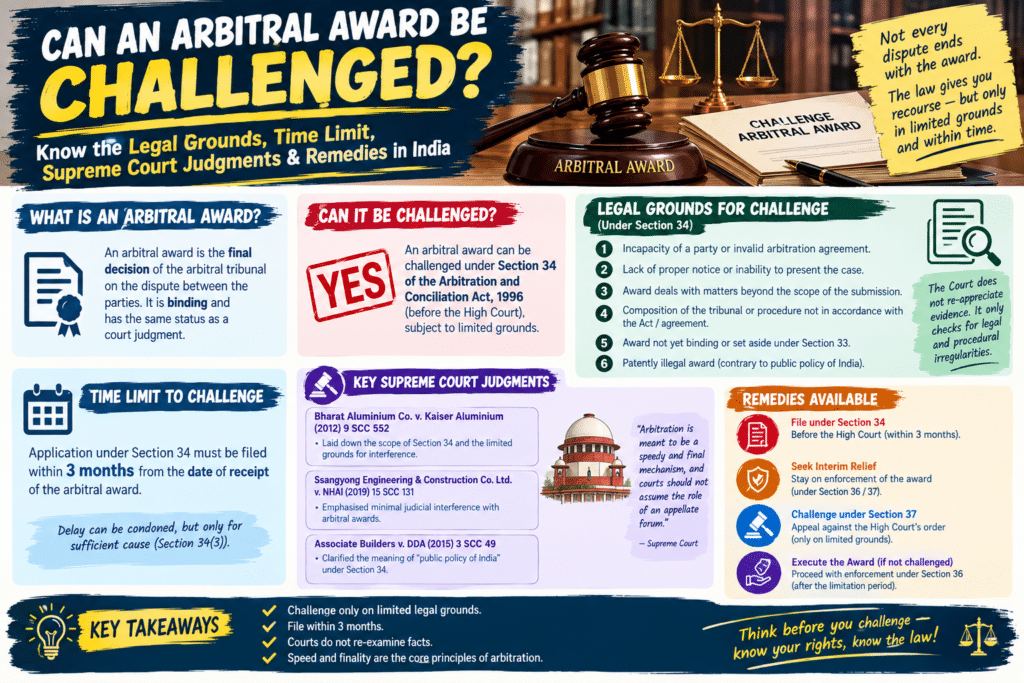
Lost an arbitration case? Ordered to pay crores under an arbitral award? Or received an award that appears legally wrong? Don’t assume you have to accept it without question.
An arbitral award can be challenged before a Court in India. However, the law does not permit a party to challenge an award simply because it disagrees with the arbitrator’s findings or believes that the arbitrator reached the wrong conclusion.
The challenge must fall within the grounds recognised by the Arbitration and Conciliation Act, 1996, particularly Section 34.
This distinction is extremely important. A strong challenge identifies a legally recognised defect in the award; a weak challenge merely repeats the arguments already made before the arbitrator.
So, can an arbitral award be challenged? What are the grounds for setting aside an arbitral award? How much time do you have? Can the Court modify the award? Does filing a challenge stop recovery? What has the Supreme Court held?
This article explains the law in simple language, with practical examples, important judgments, remedies and frequently asked questions.
Quick Answer: Can an Arbitral Award Be Challenged in India?
Yes. An arbitral award can generally be challenged under Section 34 of the Arbitration and Conciliation Act, 1996, on specific statutory grounds.
A challenge may be possible where, for example:
- the arbitration agreement was invalid;
- a party was not given proper notice or a fair opportunity to present its case;
- the award decides matters beyond the scope of arbitration;
- the Tribunal was not constituted in accordance with the applicable law or agreement;
- the award conflicts with the statutory test of public policy of India;
- a domestic award suffers from patent illegality appearing on its face, where Section 34(2A) applies.
However, an error of fact, an ordinary error of law or disagreement with the arbitrator’s interpretation is not automatically sufficient to set aside an award.
The exact ground, applicable law, limitation period and nature of the arbitration must be examined before filing a challenge.
1. What Is an Arbitral Award?
An arbitral award is the decision delivered by an Arbitral Tribunal to resolve a dispute referred to arbitration.
It may determine issues relating to:
- unpaid contractual amounts;
- breach of contract;
- damages and compensation;
- interest;
- liquidated damages;
- termination of a contract;
- counterclaims;
- costs of arbitration;
- other reliefs within the Tribunal’s jurisdiction.
For example, suppose a contractor claims ₹2 crore from a government department for unpaid bills. The department disputes the claim and argues that the contractor failed to complete the work within the contractual period.
After considering the pleadings, documents, evidence and arguments, the arbitrator awards ₹1.5 crore to the contractor.
If the department believes that the award suffers from a legally recognised defect, it may consider a challenge under Section 34.
The important question is not merely whether the award is favourable or unfavourable. It is whether the award can be challenged on a ground recognised by law.
2. Which Court Can Set Aside an Arbitral Award?
Section 34 provides the statutory remedy for challenging an arbitral award.
The application must be filed before the legally competent Court under the Act. The correct forum depends upon the nature of the arbitration, the definition of “Court” under Section 2(1)(e), the seat of arbitration and the applicable jurisdictional rules.
It is not correct to assume that every challenge must be filed before the High Court. In some cases, the competent Court may be a District Court; in others, it may be a High Court exercising original jurisdiction.
Before filing, the following should be checked:
- the juridical seat of arbitration;
- the nature of the award;
- the territorial and subject-matter jurisdiction;
- whether the arbitration is domestic or an international commercial arbitration seated in India;
- whether any special statutory provision applies.
Filing before the wrong forum can create serious procedural and limitation problems.
3. What Is Section 34 of the Arbitration and Conciliation Act, 1996?
Section 34 is the principal statutory provision for seeking the setting aside of an arbitral award in India.
It provides that recourse against an arbitral award may be taken only by an application to set aside the award in accordance with Section 34.
This reflects the legislative intention to minimise unnecessary judicial interference in arbitration.
The Court does not ordinarily conduct a fresh trial, re-examine every document or substitute its own findings merely because another interpretation is possible.
The purpose is to examine whether the award falls within the limited grounds recognised by the Act.
Why is Section 34 so important?
Because an arbitral award is generally final and binding under Section 35, subject to the statutory remedies available under the Act.
A party dissatisfied with the award must therefore identify the appropriate legal ground and act within the prescribed period.
4. What Are the Grounds for Challenging an Arbitral Award?
This is the most important part of any Section 34 challenge.
The grounds are limited. Each ground must be supported by the record and the applicable legal principles.
Ground 1: Invalid Arbitration Agreement
An arbitral award may be challenged where the arbitration agreement was invalid under the law applicable to it or a party lacked the legal capacity required to enter into it.
For example:
- the alleged arbitration agreement was never validly concluded;
- the agreement was legally invalid;
- the relevant party lacked capacity;
- the award rests on an arbitration agreement that does not bind the challenging party.
However, simply denying the existence of an arbitration agreement is not enough. The objection must be supported by the agreement, documents and relevant facts.
Ground 2: Lack of Proper Notice or Opportunity to Present Your Case
A party must receive a fair opportunity to present its case.
A challenge may arise where a party was not given proper notice of the appointment of the arbitrator or the proceedings, or was otherwise unable to present its case.
Examples may include:
- material notices were not properly served;
- a party was denied a meaningful opportunity to file its defence;
- relevant evidence was excluded in circumstances causing serious procedural unfairness;
- a hearing was conducted without a legally adequate opportunity to participate.
Not every procedural irregularity will invalidate an award. The nature of the irregularity and its effect on the party’s opportunity to present its case must be examined.
Ground 3: Award Beyond the Scope of Arbitration
An arbitrator derives authority from the arbitration agreement and the disputes referred to the Tribunal.
A challenge may arise where the award decides matters beyond the scope of the submission to arbitration.
For example, if the Tribunal decides a distinct dispute that was never referred to it and is outside its authority, the affected portion may be vulnerable to challenge.
Where the part that exceeds jurisdiction can be separated from the valid portion, the Court may consider partial setting aside in accordance with the statutory framework and applicable precedent.
Ground 4: Improper Constitution of the Arbitral Tribunal
The appointment and composition of the Tribunal must comply with the arbitration agreement and the applicable law.
Issues may arise where:
- the appointment procedure was not followed;
- the Tribunal was constituted contrary to the parties’ valid agreement;
- an arbitrator was legally ineligible;
- mandatory requirements concerning independence and impartiality were violated.
The legal consequences depend upon the nature of the defect. Some appointment irregularities may be waived under the Act, while statutory ineligibility under Section 12(5) is governed by a stricter framework.
Important Supreme Court judgment: Bhadra International (India) Pvt. Ltd. v. Airports Authority of India
In 2026 INSC 6, decided on 5 January 2026, the Supreme Court examined the consequences of an arbitrator’s ineligibility and the ability to challenge the resulting award.
The judgment explains that where an arbitrator is legally ineligible under Section 12(5), the issue can have consequences for the Tribunal’s authority. After an award has been passed, such ineligibility may be raised in a Section 34 challenge, subject to the applicable legal principles. The judgment also addresses waiver and the relevant statutory requirements.
This authority is particularly important where an award was delivered by an arbitrator whose appointment is alleged to be legally invalid.
Ground 5: Conflict with the Public Policy of India
Section 34 permits a challenge where the Court finds that the award conflicts with the public policy of India, as narrowly defined by the Act.
The statutory explanation includes circumstances involving:
- fraud or corruption affecting the making of the award;
- contravention of the fundamental policy of Indian law;
- conflict with the most basic notions of morality or justice.
The test is not whether the Court would have reached the same conclusion as the arbitrator.
A party must establish a defect that satisfies the statutory standard. The public-policy ground cannot be used as a general invitation to reconsider the entire dispute.
Ground 6: Patent Illegality Appearing on the Face of a Domestic Award
Section 34(2A) recognises patent illegality as an additional ground for setting aside certain domestic arbitral awards.
This ground applies to a domestic award other than an international commercial arbitration award.
Patent illegality is not the same as an ordinary legal error.
Depending on the facts and applicable precedent, it may arise where the award contains a serious legal defect apparent on its face, such as a finding that is fundamentally inconsistent with the governing contract or a defect going to the root of the award.
However, the statutory proviso expressly provides that an award shall not be set aside merely because there has been an erroneous application of law or a reappreciation of evidence.
A party cannot therefore turn every disputed interpretation of a contract into patent illegality.
5. Can an Arbitral Award Be Challenged Because the Arbitrator Made a Wrong Decision?
This is one of the most common questions.
The answer is: not automatically.
Suppose the arbitrator interprets a contractual clause in a manner that favours the claimant, while the respondent believes that another interpretation is better.
If the arbitrator’s interpretation is a reasonable one within the scope of the agreement and the law, the Court will not ordinarily interfere merely because another view is possible.
However, the position may be different if the award:
- ignores a binding contractual provision in a manner that satisfies the applicable legal test;
- grants relief outside the Tribunal’s jurisdiction;
- contains a defect falling within Section 34;
- is affected by a recognised ground of public policy;
- suffers from patent illegality where that ground applies.
The distinction is crucial.
A Section 34 petition should identify the legal defect in the award—not simply repeat the arguments that failed before the arbitrator.
6. Can the Court Reconsider Evidence Under Section 34?
Ordinarily, Section 34 is not an appeal on facts.
The Court does not normally reweigh the evidence, reconsider witness credibility or substitute its own view merely because it considers another interpretation preferable.
In MMTC Ltd. v. Vedanta Ltd., (2019) 4 SCC 163, the Supreme Court reiterated the limited scope of interference with arbitral awards.
In Ssangyong Engineering & Construction Co. Ltd. v. National Highways Authority of India, (2019) 15 SCC 131, the Court explained the restricted scope of public-policy review and the statutory treatment of patent illegality.
These judgments remain important when determining whether a proposed Section 34 ground is legally sustainable.
7. What Is the Time Limit for Challenging an Arbitral Award?
Limitation is one of the most critical aspects of a Section 34 challenge.
Under Section 34(3), an application must ordinarily be made within three months from the date the party received the arbitral award, subject to the statutory rules concerning a request under Section 33.
If the Court is satisfied that sufficient cause prevented the party from applying within the three-month period, it may entertain the application within a further period of 30 days, but not thereafter.
In practical terms, this means:
- the ordinary period is three months;
- a limited additional period of up to 30 days may be available if the statutory requirements are met;
- the additional period is not an unrestricted extension;
- parties should not assume that a Court can condone any length of delay.
The precise computation depends on the facts, service of the award and any relevant Section 33 request.
Practical advice
Do not wait until the last few days to prepare a Section 34 petition. Obtaining the complete award, organising the arbitration record, identifying the grounds and preparing the petition can take time.
A weak or incomplete filing can create further legal complications.
8. Does Filing a Section 34 Petition Automatically Stop Enforcement?
No. Filing a challenge does not, by itself, make the award unenforceable.
This is a particularly important point for a party facing recovery proceedings.
Section 36 provides the enforcement framework.
Where a Section 34 application has been filed, the award does not automatically become unenforceable merely because the challenge is pending. The party seeking protection must separately seek a stay of the award’s operation, and the Court may impose conditions in accordance with the law.
For example, a Court may consider a stay application in which the applicant explains:
- the grounds of challenge;
- the risk of enforcement during the challenge;
- the financial and practical consequences;
- whether conditions should be imposed.
The outcome depends on the facts and applicable legal principles.
Do not assume that a Section 34 petition alone prevents the successful party from pursuing enforcement.
9. Can the Court Modify an Arbitral Award or Only Set It Aside?
This area of arbitration law has seen a significant Supreme Court development.
In ** Gayatri Balasamy v. ISG Novasoft Technologies Ltd., 2025 INSC 605**, decided on 30 April 2025, a Constitution Bench of the Supreme Court considered whether Courts exercising powers under Sections 34 and 37 could modify an arbitral award.
The Court recognised a limited power to sever an invalid part of an award where legally permissible. It also clarified that this does not give Courts a general power to rewrite an award on its merits.
The judgment distinguishes between:
- setting aside an award;
- setting aside a separable portion;
- modifying an award on its merits;
- correcting certain clerical, typographical or computational errors;
- exercising the Supreme Court’s constitutional powers in exceptional circumstances.
The important practical lesson is that the Court does not have a general licence to recalculate the merits of an award simply because one party considers the amount excessive or inadequate.
A party must identify the appropriate statutory ground and understand the limits of the Court’s powers.
10. Can Only Part of an Arbitral Award Be Challenged?
Yes, in appropriate cases.
Suppose an award grants:
- ₹50 lakh as principal;
- ₹10 lakh as interest;
- ₹2 lakh as costs.
If a legally sustainable challenge affects only a separable part of the award, the Court may consider partial setting aside in accordance with Section 34 and the principles explained in Gayatri Balasamy.
However, the valid and invalid portions must be legally and practically separable. If the relevant findings are inseparable or interdependent, partial setting aside may not be possible.
This is why the petition should identify the specific paragraphs, findings, claims or reliefs being challenged and explain why the alleged defect affects them.
11. Can an Arbitrator’s Ineligibility Be Raised for the First Time After the Award?
The answer depends upon the nature of the alleged ineligibility and the applicable legal principles.
In Bhadra International (India) Pvt. Ltd. v. Airports Authority of India, 2026 INSC 6, the Supreme Court examined the effect of statutory ineligibility under Section 12(5), including the possibility of challenging an award on that basis.
The judgment is important because it distinguishes statutory ineligibility from an ordinary complaint about an arbitrator’s conduct or a procedural objection that may be subject to waiver.
Where Section 12(5) applies, the Act permits waiver only through an express agreement in writing made after disputes have arisen.
A party should not assume that simply participating in arbitration necessarily cures every form of statutory ineligibility. Equally, the precise appointment history, correspondence, participation and any alleged waiver must be examined.
12. Can an Interim Award Be Challenged?
Yes, an interim award may be challengeable where it qualifies as an arbitral award under the Act and the applicable requirements are met.
The legal position is different from an ordinary procedural order passed during arbitration.
For example, a Tribunal may issue an interim award deciding a substantive issue or liability before the entire dispute is concluded. Such an award may have independent legal consequences.
By contrast, an ordinary procedural order or an order rejecting a preliminary objection may not be immediately challengeable under Section 34.
In Bhadra International, the Supreme Court discussed the consequences of statutory ineligibility in relation to an award, including an interim award.
Before filing, it is essential to identify whether the impugned decision is legally an award or merely an interim procedural order.
13. What If the Arbitrator Rejects Your Jurisdiction Objection?
Suppose a party argues before the Tribunal that it has no jurisdiction, but the arbitrator rejects the objection and continues the proceedings.
Can the party immediately approach the High Court?
Not ordinarily.
Section 16 contains a specific framework for jurisdictional objections. Where the Tribunal rejects a plea that it lacks jurisdiction, the statutory scheme generally requires the proceedings to continue, with the objection capable of being raised in a challenge to the final award under Section 34, if the circumstances justify it.
The Supreme Court has repeatedly emphasised that arbitration challenges should not ordinarily be split into repeated proceedings at every procedural stage.
The exact remedy depends on the nature of the order. Section 37 provides for certain appeals, including in the specific circumstances set out in the provision.
A party should therefore distinguish between an order accepting a jurisdictional objection and an order rejecting it.
14. Can You Challenge a Foreign Arbitral Award Under Section 34?
This distinction is extremely important.
Section 34 is principally the remedy for setting aside awards governed by Part I of the Arbitration and Conciliation Act, including awards made in arbitrations seated in India.
A foreign award that falls within Part II of the Act is generally dealt with through the recognition and enforcement framework, including Section 48.
The legal remedies and grounds are not identical.
Therefore, before filing a challenge, determine:
- where the arbitration is legally seated;
- whether the award is a domestic award or a foreign award;
- which part of the Arbitration Act applies;
- which Court has jurisdiction;
- whether the proposed remedy is setting aside or resisting enforcement.
Choosing the wrong statutory route can be fatal to the challenge.
15. What Happens If the Section 34 Petition Is Allowed?
If the Court finds that a ground under Section 34 is established, it may set aside the award, or the relevant separable portion where legally permissible.
The consequences depend on the nature of the defect and the Court’s order.
Possible consequences include:
- the award, or a separable part, being set aside;
- the parties having to pursue further proceedings in accordance with law;
- the possibility of fresh arbitration where legally appropriate;
- the dispute being remitted to the Tribunal in the limited circumstances contemplated by Section 34(4);
- further proceedings arising from an appeal under Section 37.
Section 34(4) allows the Court, in appropriate circumstances and on a party’s request, to adjourn the setting-aside proceedings to give the Tribunal an opportunity to resume proceedings or take action that may eliminate the grounds for setting aside.
This is not an automatic right to obtain a second hearing or rewrite the award.
16. What Happens If the Section 34 Petition Is Dismissed?
If the challenge fails, the award generally remains in force, subject to any further remedy available under law.
The successful party may pursue enforcement in accordance with Section 36.
A party aggrieved by a decision under Section 34 may consider an appeal under Section 37, if the statutory requirements are satisfied.
However, Section 37 is not a general invitation to reargue the entire dispute. The appellate Court is also bound by the statutory limits governing interference with arbitral awards.
17. Can a Section 34 Order Be Appealed?
Section 37 provides for appeals from specified orders under the Arbitration and Conciliation Act.
This includes an appeal from an order setting aside or refusing to set aside an arbitral award under Section 34, subject to the statutory framework.
The right of appeal depends on the precise order and provision involved.
A party should therefore check:
- whether the order falls within Section 37;
- the competent appellate forum;
- the limitation period;
- whether any further interim relief is required;
- the grounds that can lawfully be raised.
A further appeal or constitutional remedy should not be assumed to be available as a matter of right in every case.
18. Important Supreme Court Judgments on Challenging Arbitral Awards
The following judgments are particularly relevant to Section 34 challenges.
1. Gayatri Balasamy v. ISG Novasoft Technologies Ltd. — 2025 INSC 605
Principle: The Supreme Court clarified the limited powers of Courts under Sections 34 and 37 concerning partial setting aside, severance and modification of arbitral awards.
Why it matters: It explains why a Court cannot generally rewrite an award on the merits, while recognising limited powers in specified circumstances.
2. Bhadra International (India) Pvt. Ltd. v. Airports Authority of India — 2026 INSC 6
Principle: The Supreme Court examined statutory ineligibility of an arbitrator under Section 12(5), waiver and the consequences for an award.
Why it matters: It is especially relevant where the validity of the arbitrator’s appointment is challenged.
3. Ssangyong Engineering & Construction Co. Ltd. v. National Highways Authority of India — (2019) 15 SCC 131
Principle: The Supreme Court explained the limited scope of public-policy review and patent illegality under the amended Arbitration Act.
Why it matters: It helps distinguish a genuine statutory defect from an ordinary disagreement with the arbitrator’s findings.
4. MMTC Ltd. v. Vedanta Ltd. — (2019) 4 SCC 163
Principle: The Supreme Court reiterated the limited scope of judicial interference with arbitral awards.
Why it matters: A Section 34 Court is not supposed to substitute its own view merely because it prefers another interpretation of the evidence or contract.
5. Project Director, National Highways Authority of India v. M. Hakeem — (2021) 9 SCC 1
Principle: The judgment emphasised the limits of the Section 34 Court’s power to modify an award.
Why it matters: It remains relevant when read with the later Constitution Bench decision in Gayatri Balasamy, which clarified the limited exceptions and the power of severance.
6. Bhaven Construction v. Executive Engineer, Sardar Sarovar Narmada Nigam Ltd. — (2022) 1 SCC 75
Principle: The Supreme Court emphasised restraint in invoking constitutional jurisdiction to bypass the remedies and structure of the Arbitration Act.
Why it matters: It supports the principle that parties should ordinarily follow the statutory remedies available under arbitration law.
19. Myth vs Reality: Challenging an Arbitral Award
| Myth | Reality |
|---|---|
| Every arbitral award can be appealed. | Section 34 permits a challenge only on recognised statutory grounds. |
| If the arbitrator made a mistake, the award must be set aside. | An ordinary error is not automatically sufficient. |
| A Section 34 petition stops recovery. | Enforcement is not automatically stayed merely because the petition is filed. |
| The Court can rehear the entire arbitration. | Section 34 is not an ordinary appeal on facts. |
| The Court can freely change the amount awarded. | The Court’s powers are limited; Gayatri Balasamy recognises specific, narrow exceptions. |
| A party can file a challenge whenever it wants. | Section 34(3) prescribes a strict limitation framework. |
| Every defect in the appointment of an arbitrator is automatically waived by participation. | Statutory ineligibility under Section 12(5) has specific rules concerning waiver. |
| Foreign awards are challenged in the same way as domestic awards. | The applicable remedies differ; Part II and Section 48 may govern foreign awards. |
| The High Court can always intervene during arbitration. | Judicial intervention is restricted and must fit within the applicable statutory or exceptional legal framework. |
20. Practical Checklist Before Filing a Section 34 Petition
Before challenging an arbitral award, check the following:
- Obtain the complete signed award and confirm when it was received.
- Calculate the Section 34 limitation period immediately.
- Identify the correct Court and jurisdiction.
- Read the arbitration agreement and appointment provisions.
- Review the Statement of Claim, Statement of Defence and counterclaims.
- Collect relevant documents, evidence and procedural orders.
- Identify the exact statutory ground under Section 34.
- Separate genuine legal defects from mere disagreement with factual findings.
- Examine whether any part of the award is separable.
- Consider whether a separate stay application is necessary.
- Check whether Section 37 or another remedy may subsequently apply.
- Obtain legal advice before the limitation period expires.
A focused petition built around the award’s actual legal defects is generally more useful than a lengthy petition that repeats every argument made during arbitration.
Frequently Asked Questions (FAQs)
Can an arbitral award be challenged in India?
Yes. An arbitral award governed by Part I of the Arbitration and Conciliation Act can generally be challenged under Section 34 on the grounds recognised by the Act.
What is the time limit to challenge an arbitral award?
Ordinarily, three months from receipt of the award, subject to the statutory provisions concerning Section 33. The Court may allow a further period of up to 30 days on sufficient cause, but not thereafter.
Can an arbitral award be challenged because the arbitrator interpreted the contract incorrectly?
Not merely because another interpretation is possible. The challenge must satisfy a recognised ground under Section 34, such as a legally sustainable jurisdictional defect or patent illegality where applicable.
Does filing a Section 34 petition stop execution of the award?
No. Filing the petition does not automatically make the award unenforceable. A separate application seeking a stay may be necessary.
Can the Court modify an arbitral award?
The Court’s powers are limited. The Constitution Bench decision in Gayatri Balasamy recognises limited powers concerning severance and certain corrections, but not a general power to rewrite the award on its merits.
Can an award be set aside because the arbitrator was ineligible?
Potentially, yes. Section 12(5), the appointment history, the nature of the ineligibility and the statutory waiver requirements must be examined.
Can only one part of an award be challenged?
Yes, in appropriate circumstances. Partial setting aside may be possible if the invalid portion is legally and practically separable from the rest.
Can a foreign arbitral award be challenged under Section 34?
The statutory route is different. Foreign awards governed by Part II are generally subject to the recognition and enforcement framework, including Section 48, rather than the ordinary Section 34 setting-aside process.
What happens if the Section 34 petition is dismissed?
The award generally remains in force, and the successful party may pursue enforcement subject to applicable law. An appeal under Section 37 may be available where the statutory requirements are met.
Can an award be challenged after the limitation period?
Section 34(3) imposes a strict time limit. The Court may allow only the additional period permitted by the provision. A party should not assume that delay can always be condoned.
Final Word: Do Not Challenge an Award Without Identifying the Legal Ground
An unfavourable arbitral award can have serious financial and commercial consequences. It may require payment of substantial sums, interest and costs, and it may be followed by enforcement proceedings.
But an award is not beyond legal scrutiny.
The Arbitration and Conciliation Act provides a statutory remedy under Section 34 where a recognised ground exists. The challenge must, however, be prepared carefully, filed before the competent Court and brought within the prescribed limitation period.
The most important questions are:
What is the exact defect in the award? Which statutory ground applies? Is the challenge within time? Is a stay of enforcement required? And what remedy is legally available at this stage?
Answering these questions before filing can help avoid unnecessary litigation and focus the challenge on the issues that actually matter.
Need Legal Assistance to Challenge an Arbitral Award?
If you have received an adverse arbitral award, are facing enforcement proceedings, wish to challenge the appointment of an arbitrator, or need to assess whether the award suffers from patent illegality, procedural unfairness or a jurisdictional defect, the award and complete arbitration record should be examined promptly.
A timely review can help identify the appropriate remedy, limitation requirements and grounds that may be legally sustainable.