
- 1. Is it legal for one person to call for a nationwide protest in India?
- 2. Which constitutional provisions protect the right to call for a protest?
- 3. Can an individual call for a protest across all States without taking permission from the Central Government?
- 4. What legal obligations does a person have when calling for a nationwide protest?
- 5. Can police detain or arrest a person merely for calling a nationwide protest?
- 6. What criminal provisions may become relevant during a protest?
- 7. What happens if the police deny permission for the protest?
- 8. Important Supreme Court judgments on the right to protest
- 9. What if a protest organiser is arrested or detained?
- 10. What legal remedies are available if the police unlawfully stop a protest or detain the organiser?
- 11. Myth vs Reality: Calling for a nationwide protest
- 12. Frequently Asked Questions
- Can one person call for a Bharat Bandh or nationwide strike?
- Can a person announce a protest on social media without police permission?
- Can police detain a person before the protest even begins?
- Can a person be arrested if the protest is peaceful but permission was not obtained?
- Can the organiser be held responsible if participants turn violent?
- Can a High Court protect a person who wants to organise a peaceful protest?
- 13. Conclusion: A nationwide protest is not illegal merely because one person calls for it
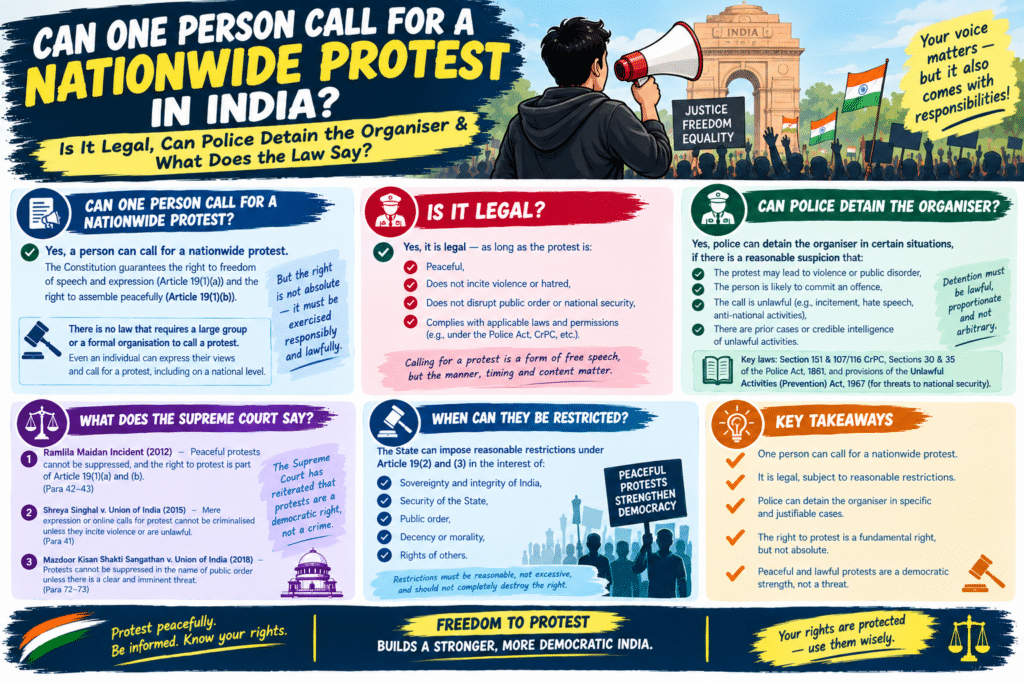
Can an individual call upon people across India to protest against a government decision, a public policy, an alleged injustice or any other issue of public importance? Can the police stop the protest, arrest its organiser or take action merely because the call has been made without permission?
These questions matter in a democracy where people increasingly use social media, public meetings and peaceful demonstrations to express disagreement with government policies and demand accountability.
The short answer is that an individual can generally call for a peaceful nationwide protest in India. It is not automatically illegal merely because the call comes from one person or is directed at people across several States. However, the legality of the proposed gathering and the organiser’s responsibilities depend on the nature of the protest, applicable local laws, police permissions where required, prohibitory orders and the conduct of the participants.
The Constitution protects peaceful dissent. It does not give anyone an unrestricted licence to cause violence, obstruct essential services, damage property or deliberately disobey a lawful order.
This article explains the law in simple language, including the constitutional right to protest, the responsibilities of a protest organiser, when police can intervene, the possibility of detention or arrest, important Supreme Court judgments and the remedies available if the authorities act unlawfully.
1. Is it legal for one person to call for a nationwide protest in India?
Yes, as a general rule. An individual does not need to be a political leader, a member of a political party or the head of a registered organisation to express a demand and invite people to join a peaceful protest.
For example, an individual may publicly call upon people in Delhi, Mumbai, Kolkata, Chennai and other cities to participate in a peaceful demonstration against a public policy or an alleged injustice.
Such a call may be made through social media, a press statement, a public appeal, a meeting or other lawful means of communication.
The important distinction is between:
- Calling for a protest: Expressing a view and inviting people to participate peacefully.
- Organising a physical protest: Arranging a gathering, march, public meeting, venue, timing and other practical details.
- Participating in a protest: Joining the gathering and complying with applicable laws and lawful directions.
These activities are related, but they are not legally identical.
A peaceful appeal for people to assemble does not automatically become a criminal offence simply because it attracts attention or criticises the government. At the same time, an organiser cannot assume that a single announcement authorises every proposed gathering throughout India.
India has different local police regulations, public-place restrictions and administrative arrangements. Permission or intimation requirements, where applicable, must be assessed for the relevant place and event.
2. Which constitutional provisions protect the right to call for a protest?
The right to protest is principally derived from the following constitutional protections.
Article 19(1)(a): Freedom of speech and expression
Article 19(1)(a) protects the right of citizens to express their opinions, criticise public policies, raise grievances and communicate their demands.
A peaceful call for a nationwide protest may fall within this protection, depending on its content and circumstances.
The freedom to express disagreement is important because democratic participation does not end with voting in an election.
Article 19(1)(b): Right to assemble peacefully and without arms
Article 19(1)(b) protects citizens’ right to assemble peacefully and without arms.
It is particularly relevant when a protest involves a physical gathering, demonstration, march or public meeting.
However, the right is subject to reasonable restrictions imposed by law in the interests of the sovereignty and integrity of India and public order under Article 19(3).
Article 19(1)(c): Freedom of association
Article 19(1)(c) protects the right to form associations and unions.
It may be relevant when people establish a temporary committee, campaign group or organisation to coordinate a peaceful protest. An individual does not, however, need to create a formal association before expressing a public demand.
Article 21: Protection of life and personal liberty
Article 21 protects life and personal liberty. It becomes relevant when police action involves detention, arrest or other restrictions on an individual’s liberty.
It does not create immunity from lawful arrest, but the State must act according to law and respect applicable constitutional safeguards.
Important: The Constitution does not expressly use the words “right to protest” as a separate standalone fundamental right. Rather, peaceful protest is protected through constitutional freedoms, particularly Articles 19(1)(a) and 19(1)(b), subject to lawful restrictions.
3. Can an individual call for a protest across all States without taking permission from the Central Government?
There is no general rule that every individual must obtain blanket permission from the Central Government merely to announce or advocate a peaceful nationwide protest.
However, a distinction must be made between making a nationwide appeal and holding physical events in different places.
A person may publish an appeal inviting citizens across India to participate. If the person then arranges public meetings, rallies, processions or demonstrations, the applicable State laws, police regulations, venue conditions and restrictions must be examined.
For example, a protest organised at a public road in Delhi may be governed by the applicable Delhi Police requirements. A separate gathering in another State may be governed by that State’s laws and local administrative orders.
There is no automatic nationwide permission merely because the organiser has obtained approval for one event.
Likewise, there is no universal rule that every peaceful gathering, in every possible location and circumstance, requires the same kind of permission. The answer depends on the governing law, the place, the scale and nature of the event, and any applicable restrictions.
Practical advice: Before announcing specific venues and timings for a coordinated nationwide demonstration, the organiser should identify the local authority responsible for each event and verify the applicable requirements.
4. What legal obligations does a person have when calling for a nationwide protest?
The organiser’s responsibilities depend on the role they actually perform. A person who merely expresses an opinion is not automatically responsible for every independent act committed by someone who reads or shares that opinion.
However, a person who actively organises a demonstration should take reasonable steps to ensure that the proposed event complies with applicable law.
A. Keep the protest peaceful
The purpose of the protest should be communicated clearly. Organisers should discourage violence, threats, assault, vandalism and attacks on public officials or members of the public.
A peaceful protest does not become unlawful merely because its message is strongly worded or critical of those in power. Its content and conduct must be assessed under the applicable law.
B. Check local permission and venue requirements
If permission is required for the proposed meeting, march, use of a public road, loudspeaker or other activity, the organiser should apply to the appropriate authority in accordance with the applicable procedure.
The application should accurately state the venue, timing, expected attendance and nature of the event.
An organiser should not assume that permission for one location extends to another State or city.
C. Check for prohibitory orders
The organiser should check whether a valid order restricts assemblies or other activities at the proposed location.
Section 163 of the Bharatiya Nagarik Suraksha Sanhita, 2023 (BNSS) empowers specified Executive Magistrates to issue written orders in urgent cases involving, among other things, a risk to public tranquillity, human safety or public order.
An order may apply to a particular individual, persons in a specified area or the public generally within a particular place or area. Its exact wording, duration, legal basis and territorial scope matter.
A person should not ignore an applicable order merely because the proposed protest is peaceful.
D. Avoid obstructing public roads and essential services
Organisers should consider traffic movement, emergency access, public transport, nearby businesses, hospitals and the rights of residents.
There is a difference between a regulated demonstration that causes some inconvenience and an event that unlawfully prevents others from using public spaces or essential facilities.
The Supreme Court has emphasised that the rights of protesters must be balanced against the rights of other members of the public.
E. Communicate lawful instructions to participants
Organisers should explain the permitted venue, route, timing and applicable conditions to participants. If the assembly is lawfully ordered to disperse, the circumstances and legal basis of that direction should be assessed promptly.
Participants should not be encouraged to use force or deliberately violate a lawful order.
F. Do not encourage criminal conduct
A protest call should not become an instruction to commit violence, destroy property, assault individuals, threaten people or engage in other unlawful conduct.
The legal consequences depend on the precise words used, the surrounding circumstances, the organiser’s conduct and the applicable offence. Merely criticising the government or demanding a change in policy is not, by itself, proof of a criminal offence.
5. Can police detain or arrest a person merely for calling a nationwide protest?
Not automatically. A person should not be treated as guilty of a criminal offence merely for expressing a peaceful political opinion or inviting people to assemble peacefully.
However, detention, preventive action or arrest may be legally possible in particular circumstances, provided the statutory requirements are met.
The distinction between police intervention, preventive detention in ordinary policing, and formal arrest is important. These expressions should not be treated as interchangeable.
Situation 1: The person only announces a peaceful protest
Suppose a person posts a public message inviting citizens across India to participate in a peaceful demonstration against a government policy.
If the appeal does not itself violate a law and there are no other lawful grounds for coercive action, the mere announcement should not automatically justify detention or arrest.
The authorities must have a lawful basis for restricting the person’s liberty.
Situation 2: The proposed protest is at a restricted location
Suppose the organiser announces a march in an area where a valid and applicable prohibitory order restricts such gatherings.
The police may take lawful steps to enforce the order, prevent a breach of public order or disperse an assembly where the statutory conditions are satisfied.
The organiser may challenge an unlawful or disproportionate restriction. But the organiser should not assume that the restriction can simply be ignored.
Situation 3: The organiser knowingly encourages violence
If the evidence establishes that a person has intentionally encouraged or participated in conduct amounting to a criminal offence, the authorities may investigate and take action under the applicable criminal law.
Whether the words amount to a punishable offence depends on their content, context, intention where legally relevant, and the statutory ingredients of the alleged offence.
A general appeal for peaceful protest must not be equated with an appeal to commit violence.
Situation 4: The person disobeys a lawful order to disperse
The BNSS contains provisions dealing with the dispersal of unlawful assemblies and assemblies likely to disturb public peace.
Under Section 148 BNSS, specified authorities may command an unlawful assembly, or an assembly of five or more persons likely to disturb public peace, to disperse. If the statutory conditions are met and the assembly does not disperse, further action, including arrest where legally authorised, may follow.
The legality of the action depends on the circumstances, the authority exercising the power and compliance with the law.
Situation 5: The police believe preventive action is necessary
The BNSS also provides powers relating to the prevention of cognizable offences and arrest in circumstances prescribed by law. These powers are not a general licence to detain any person whose views the authorities dislike.
A genuine, legally sustainable basis is necessary. The nature of the suspected offence, the material available and the safeguards governing the action must be considered.
The central principle is this: Police can act to prevent a legally identifiable threat or enforce a valid restriction, but the constitutional right to peaceful dissent cannot be displaced by an arbitrary decision to suppress criticism.
6. What criminal provisions may become relevant during a protest?
The exact provisions depend on what has actually happened. Calling for a protest, participating in a peaceful assembly, disobeying an order and engaging in violence are legally different situations.
The following provisions may be relevant in an appropriate case:
| Provision | Why it may matter |
|---|---|
| Articles 19(1)(a) and 19(1)(b), Constitution | Protect freedom of expression and peaceful assembly, subject to constitutional restrictions. |
| Article 19(2) and Article 19(3) | Permit specified reasonable restrictions on speech and assembly. |
| Section 163, BNSS | Enables specified Magistrates to issue orders in urgent cases of nuisance or apprehended danger. |
| Section 148, BNSS | Deals with dispersal of unlawful assemblies and certain assemblies likely to disturb public peace. |
| Section 189, Bharatiya Nyaya Sanhita, 2023 (BNS) | Addresses unlawful assembly and related conduct. |
| Section 223, BNS | May be relevant where the ingredients of disobedience to an order duly promulgated by a public servant are established. |
| Applicable local police laws and rules | May regulate permissions, routes, venues, loudspeakers and public gatherings. |
These provisions should not be applied mechanically. For instance, an organiser does not become guilty under the unlawful-assembly provisions simply because they announced a peaceful protest. The statutory requirements must be satisfied on the facts.
Similarly, whether disobedience under Section 223 BNS is made out depends on the applicable order, the alleged disobedience and the other legal ingredients of the offence.
7. What happens if the police deny permission for the protest?
A refusal of permission does not automatically establish that the organiser has committed a criminal offence. Equally, a person cannot assume that the protest may proceed regardless of a valid restriction.
The organiser should first examine the written refusal, the reasons given, the applicable rules and whether an alternative venue or time is available.
Depending on the circumstances, the organiser may:
- Submit a representation seeking reconsideration.
- Request permission for an alternative location, route or timing.
- Seek clarification of the restrictions imposed.
- Challenge an arbitrary, discriminatory or disproportionate refusal before the appropriate court.
- Comply with the applicable legal process while pursuing the challenge.
In Himat Lal K. Shah v. Commissioner of Police, Ahmedabad, the Supreme Court recognised that public meetings on streets may be regulated, including through prior-permission requirements where legally justified. At the same time, restrictions cannot be arbitrary or inconsistent with the constitutional right to assemble.
The correct approach is therefore neither that the police can prohibit every protest at will nor that every protest must be permitted at any place chosen by the organiser.
8. Important Supreme Court judgments on the right to protest
The following decisions explain the constitutional principles governing peaceful assembly, regulation of public places and the limits of police powers.
A. Himat Lal K. Shah v. Commissioner of Police, Ahmedabad
Citation: (1973) 1 SCC 227
This is an important Supreme Court decision on public meetings and the right to assemble.
The Court recognised the State’s authority to regulate meetings on public streets in the interests of public order. However, the regulation must be reasonable and cannot confer arbitrary discretion to deny the exercise of a constitutional right.
Why it matters: A person calling for a protest cannot claim an absolute right to use every public street or location. Conversely, the authorities cannot treat permission powers as an unrestricted means of suppressing peaceful demonstrations.
B. In Re: Ramlila Maidan Incident
Citation: (2012) 5 SCC 1
The Supreme Court considered the constitutional implications of police action against people gathered at Ramlila Maidan.
The judgment discusses the relationship between peaceful assembly, personal liberty, the role of the State and the limits on the use of police force.
Why it matters: The State’s responsibility to maintain public order must be exercised consistently with fundamental rights. Police intervention is not beyond judicial scrutiny merely because authorities invoke public order.
C. Mazdoor Kisan Shakti Sangathan v. Union of India
Citation: (2018) 17 SCC 324
The Supreme Court examined restrictions on demonstrations in the vicinity of Parliament and the competing interests of protesters, residents and the public.
The Court recognised the fundamental right to peaceful protest while emphasising the need to balance that right with the rights of others.
Why it matters: The right to protest does not mean that one group can completely extinguish the rights of another. At the same time, regulation should aim to balance competing rights rather than eliminate the right to peaceful demonstration altogether.
D. Amit Sahni v. Commissioner of Police
Citation: (2020) 10 SCC 439
This case arose from the prolonged occupation of a public road during the Shaheen Bagh protest.
The Supreme Court explained that public ways cannot be occupied indefinitely in a manner that prevents their ordinary use by the public. The right to protest must be exercised consistently with the rights of other citizens.
Why it matters: A nationwide protest campaign must account for public access, traffic, the use of public spaces and the interests of people who are not participating in the demonstration.
E. Anuradha Bhasin v. Union of India
Citation: (2020) 3 SCC 637
The Supreme Court examined restrictions imposed in Jammu and Kashmir, including restrictions affecting communication and movement.
The judgment discusses constitutional review, proportionality and the requirement that restrictions imposed by the State must have a legal basis and be open to appropriate scrutiny.
Why it matters: Restrictions affecting protest-related speech, communication or movement cannot be assessed solely by referring to public order. Their legal basis, scope and proportionality are relevant.
These judgments must be applied to the facts of the particular case. None creates an unrestricted right to hold a protest anywhere, at any time, without regard to applicable law.
9. What if a protest organiser is arrested or detained?
If a person is detained or arrested in connection with a proposed protest, the immediate question is whether the action has a lawful basis and whether the required procedural safeguards have been followed.
The person or their lawyer should establish:
- The legal provision invoked by the police.
- Whether the person has been formally arrested or is being subjected to some other restriction on liberty.
- The reasons for the action and the material relied upon, to the extent legally available.
- Whether an applicable prohibitory order exists and covers the person, conduct and location concerned.
- Whether the requirements of the BNSS and the constitutional safeguards have been followed.
- Whether the person has been produced before the competent Magistrate within the constitutionally and statutorily prescribed period, where applicable.
Article 22 of the Constitution provides safeguards relating to arrest and detention, including protections concerning communication of grounds of arrest and production before a Magistrate, subject to the applicable constitutional provisions and exceptions.
A person should not assume that every police interaction amounts to an arrest. Nor should the authorities be permitted to disguise a substantial restriction on liberty merely by giving it another label.
The facts, duration and legal basis of the restriction matter.
10. What legal remedies are available if the police unlawfully stop a protest or detain the organiser?
The appropriate remedy depends on whether the dispute concerns refusal of permission, an allegedly unlawful prohibitory order, police action at the protest site, an arrest or a continuing restriction on liberty.
A. Representation to the competent authority
Where permission has been refused or conditions appear unreasonable, the organiser may submit a written representation to the relevant police authority or competent administrative officer.
The representation should identify the event, proposed venue, purpose, expected attendance and the specific relief requested. Where feasible, it may propose safeguards or an alternative venue.
B. Writ petition before the High Court
Article 226 of the Constitution empowers High Courts to issue appropriate writs and directions in cases involving infringement of legal or fundamental rights.
Depending on the facts, a person may challenge an arbitrary refusal, an unlawful restriction, or police action that infringes constitutional rights. The court may examine the legality and proportionality of the State’s action and grant appropriate relief.
A writ petition does not automatically suspend an order or authorise the protest to proceed. Interim relief must be sought and granted where appropriate.
C. Habeas corpus in cases of unlawful detention
Where a person is unlawfully detained, a habeas corpus petition may be available before the appropriate court. The court can examine the legality of the detention and grant relief in accordance with law.
This remedy is particularly important where the person is allegedly confined or prevented from leaving without a valid legal basis.
D. Bail or other criminal-court remedies
If the organiser has been arrested in connection with an alleged offence, the person may seek bail or pursue other remedies available under the BNSS and the applicable law.
The appropriate application and forum depend on the alleged offence, the stage of the proceedings and the circumstances of the arrest.
E. Challenge to a prohibitory order
Where an order under Section 163 BNSS is alleged to be unlawful or excessive, an affected person may consider the statutory procedure for seeking alteration or rescission of the order and, where appropriate, judicial review.
The challenge should focus on the legal authority, material circumstances, scope, duration and proportionality of the order.
11. Myth vs Reality: Calling for a nationwide protest
Myth 1: Only political parties or registered organisations can call for a protest.
Reality: An individual can generally express a demand and invite people to participate in a peaceful protest. A formal organisation is not a universal precondition for exercising freedom of expression.
Myth 2: Calling for a protest in every State is automatically a criminal offence.
Reality: The geographical reach of a peaceful appeal does not, by itself, make it criminal. The content of the appeal, the organiser’s conduct and the applicable law matter.
Myth 3: Once an individual calls for a nationwide protest, no permission is required anywhere.
Reality: A nationwide announcement is not a substitute for any permission, notification or compliance required for the physical events in particular locations.
Myth 4: Police can arrest anyone merely for criticising the government.
Reality: Criticism and peaceful dissent are constitutionally protected. Arrest or detention requires a lawful basis and compliance with the applicable safeguards.
Myth 5: If a protest is peaceful, it can be held anywhere.
Reality: Peaceful assembly is protected, but reasonable restrictions on the time, place and manner of a protest may be lawful. Public roads and other public spaces cannot automatically be occupied without regard to the rights of others.
Myth 6: If the police refuse permission, the organiser has no remedy.
Reality: An arbitrary or unlawful refusal may be challenged through a representation or appropriate judicial proceedings. However, filing a challenge does not itself suspend the refusal.
Myth 7: The organiser is automatically responsible for every unlawful act committed by any participant.
Reality: Criminal liability depends on the applicable offence and the evidence connecting the person to it. Organising, encouraging, joining or assisting unlawful conduct may have consequences where the legal requirements are met, but liability should not be presumed merely from the existence of a protest call.
12. Frequently Asked Questions
Can one person call for a Bharat Bandh or nationwide strike?
An individual may advocate a peaceful nationwide protest or call upon people to participate in a lawful campaign. However, a Bharat Bandh or strike can raise additional legal questions, particularly where coercion, threats, violence, forced closure of businesses or obstruction of essential services is involved. The legality depends on the conduct and the applicable law; a peaceful appeal should not be equated automatically with unlawful coercion.
Can a person announce a protest on social media without police permission?
A peaceful announcement or appeal is generally protected expression. Permission requirements usually concern the actual event or regulated activity, rather than every expression of support for a cause. However, the content of the message and applicable law must be considered, and a social-media announcement does not exempt an organised gathering from local requirements.
Can police detain a person before the protest even begins?
Preventive action may be legally possible in circumstances authorised by law, but it cannot be justified merely by dislike of the person’s views. The authorities must satisfy the relevant statutory requirements and respect applicable constitutional safeguards. Whether a particular detention is lawful depends on the facts and the legal basis invoked.
Can a person be arrested if the protest is peaceful but permission was not obtained?
The answer is not automatic. The applicable local law, the nature of the event, any valid order, the person’s conduct and the legal basis for the police action must be examined. A failure to obtain a required permission may have consequences, but it does not mean that every form of arrest is automatically lawful or necessary.
Can the organiser be held responsible if participants turn violent?
Potential liability depends on the organiser’s own conduct, the applicable offence and the evidence. Knowingly instigating, facilitating or participating in unlawful acts may attract criminal consequences where the statutory ingredients are established. An organiser is not automatically guilty of every independent act committed by every participant.
Can a High Court protect a person who wants to organise a peaceful protest?
A High Court may grant appropriate relief under Article 226 where the legal requirements are satisfied. It may examine a refusal of permission, a prohibitory order or alleged unlawful police action. The relief depends on the facts, the governing law and the balance of constitutional rights.
13. Conclusion: A nationwide protest is not illegal merely because one person calls for it
India’s constitutional framework protects peaceful expression, dissent and assembly. An individual can generally call upon people across the country to participate in a peaceful protest, even without being a political leader or heading a registered organisation.
However, the legal position changes when the appeal turns into a physical gathering. Organisers must consider applicable permission requirements, local restrictions, lawful prohibitory orders, public safety and the rights of other citizens.
The police may take action where the law authorises it, but the power to maintain public order is not a licence to suppress peaceful criticism. Similarly, the constitutional right to protest cannot be used to justify violence, coercion or deliberate disobedience of a lawful order.
The correct legal position is one of balance: peaceful dissent is protected, reasonable restrictions may be imposed, and both the organiser and the authorities remain accountable to the law.
Disclaimer: This article is intended for general legal information and educational purposes. It is not a substitute for legal advice on the facts of a particular protest, police order or criminal proceeding. Local rules and the applicable law should be checked before organising an event.