
- 1. What Is a Proclaimed Offender?
- 2. What Is the Difference Between a Proclaimed Person and a Proclaimed Offender?
- 3. Which Law Governs Proclaimed Offenders in India?
- 4. How Does a Court Declare Someone a Proclaimed Offender?
- 5. What Are the Legal Consequences of Being Declared a Proclaimed Offender?
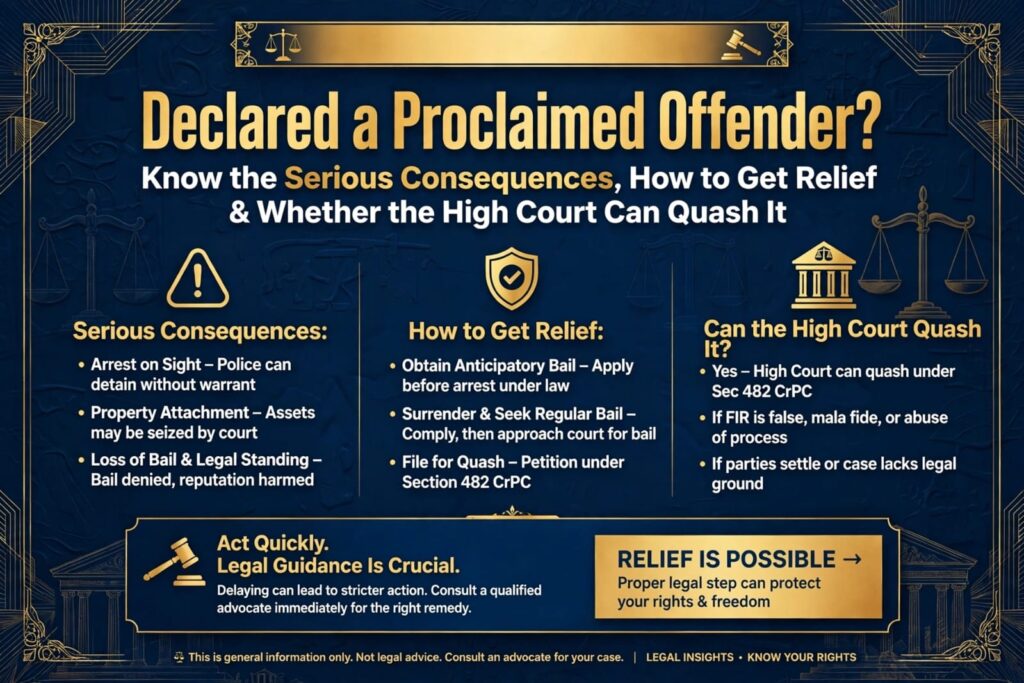
- 6. Can a Proclaimed Offender Order Be Quashed by the High Court?
- Ground 1: The offence does not fall within Section 84(4) BNSS
- Ground 2: The mandatory 30-day period was not provided
- Ground 3: The proclamation was not published in the prescribed manner
- Ground 4: No legally sustainable basis existed for issuing the proclamation
- Ground 5: The court failed to satisfy the requirements for declaring a proclaimed offender
- Ground 6: The order is otherwise an abuse of the process of court
- 7. What Is the Procedure to Get Rid of Proclaimed-Offender Status?
- 8. Important Supreme Court Judgments on Proclaimed Offenders
- 9. Can a Proclaimed Offender Get Bail?
- 10. Myth vs Reality: Proclaimed Offender
- 11. What Should You Do If You Have Been Declared a Proclaimed Offender?
- 12. Frequently Asked Questions (FAQs)
- Q1. What is the section for a proclaimed offender under BNSS?
- Q2. What is the punishment for being a proclaimed offender?
- Q3. Can the High Court quash a proclaimed-offender order?
- Q4. Can a proclaimed offender apply for anticipatory bail?
- Q5. Can a proclaimed offender's property be attached?
- Q6. Can a person be declared a proclaimed offender for any offence?
- Q7. Does appearing before the court automatically cancel the proclamation?
- Q8. Can a proclaimed offender's case be tried in their absence?
- Conclusion: Do Not Ignore a Proclamation—Examine Its Legality and Act Promptly
Can a proclaimed offender get bail? Can the police arrest you immediately? Can your property be attached? And can a proclaimed offender order be quashed by the High Court? Here is what Indian law says, the Supreme Court’s important rulings, and the legal remedies available.
Imagine discovering that a criminal court has declared you a proclaimed offender. You may be worried about arrest, attachment of property, a separate criminal case, or the effect on your pending bail application.
But an important question comes first: Was the proclamation legally issued, and were the mandatory statutory safeguards followed?
Indian law provides a procedure for declaring an accused person a proclaimed offender. The court must follow that procedure; a proclamation cannot lawfully be treated as a mere formality. At the same time, ignoring court proceedings or deliberately evading arrest can have serious consequences.
This article explains the meaning of a proclaimed offender, the difference between a proclaimed person and a proclaimed offender, the consequences under the new criminal laws, and the remedies available to challenge or get relief from such an order.
1. What Is a Proclaimed Offender?
A proclaimed offender is an accused person who has been formally declared as such by a competent court after the statutory requirements for proclamation have been fulfilled.
Under Section 84(4) of the Bharatiya Nagarik Suraksha Sanhita, 2023 (BNSS), a court may declare a person a proclaimed offender where the proclamation concerns an accused charged with an offence punishable with imprisonment for ten years or more, imprisonment for life, or the death penalty under the Bharatiya Nyaya Sanhita, 2023, or another applicable law, and the person fails to appear as required. The court must also conduct such inquiry as it considers appropriate.
The declaration is not supposed to follow automatically from the mere issuance of an arrest warrant. The statutory conditions must be met.
For example, if an accused deliberately avoids arrest despite a warrant and fails to appear in response to a legally issued proclamation, the court may initiate the prescribed process and, where the statutory requirements are satisfied, declare the accused a proclaimed offender.
However, being accused of a serious offence, having a non-bailable warrant against you, and being declared a proclaimed offender are three legally distinct situations.
2. What Is the Difference Between a Proclaimed Person and a Proclaimed Offender?
This distinction is extremely important because the terms are often used interchangeably, even though the law treats them differently.
| Proclaimed person | Proclaimed offender |
|---|---|
| A person against whom a court has issued a proclamation under Section 84(1) BNSS. | A person formally declared a proclaimed offender under Section 84(4) BNSS. |
| The person must satisfy the statutory conditions for a proclamation, including the existence of a warrant and absconding or concealment preventing its execution. | The additional statutory conditions relating to the nature of the offence, failure to appear, and the court’s inquiry must be satisfied. |
| A proclamation may be issued even where the offence does not fall within the specified categories attracting a proclaimed-offender declaration. | The formal declaration under Section 84(4) is restricted to the offences covered by that subsection. |
| The consequences depend on the particular proceedings and applicable law. | Additional consequences may follow, including the enhanced punishment under Section 209 BNS and the possibility of trial in absentia under Section 356 BNSS, subject to its conditions. |
Remember: A court cannot lawfully convert every proclaimed person into a proclaimed offender without satisfying the additional requirements of Section 84(4) BNSS.
3. Which Law Governs Proclaimed Offenders in India?
Since the new criminal laws came into force on 1 July 2024, the principal provisions are:
- Section 84 BNSS: Proclamation for a person absconding, including the procedure and the declaration of a proclaimed offender.
- Section 85 BNSS: Attachment of property of a person absconding.
- Section 209 Bharatiya Nyaya Sanhita, 2023 (BNS): Punishment for non-appearance in response to a proclamation under Section 84 BNSS.
- Section 356 BNSS: Inquiry, trial or judgment in absentia of a proclaimed offender, subject to statutory safeguards.
- Section 528 BNSS: Inherent powers of the High Court to give effect to orders under the Sanhita, prevent abuse of the process of a court, or otherwise secure the ends of justice.
For proceedings governed by the former Code of Criminal Procedure, 1973 (CrPC), the corresponding provision for proclamation was Section 82 CrPC. The applicable procedural law must be determined with reference to the dates and circumstances of the particular case; the new law should not automatically be applied retrospectively to every earlier proceeding.
4. How Does a Court Declare Someone a Proclaimed Offender?
The procedure under Section 84 BNSS is crucial. If the mandatory requirements are not followed, the legality of the proclamation and consequential proceedings may be challenged.
Step 1: A warrant must already have been issued
The court must have issued a warrant against the person concerned.
It must have reason to believe that the person has absconded or is concealing himself so that the warrant cannot be executed.
A mere allegation that an accused is unavailable is not, by itself, a substitute for the statutory conditions.
Step 2: The court issues a written proclamation
The court may issue a written proclamation requiring the person to appear at a specified place and time.
The appearance date must be at least 30 days from the date of publication of the proclamation.
This statutory period is significant. The person must be given the minimum period prescribed by law to comply.
Step 3: The proclamation must be published in the prescribed manner
Section 84(2) BNSS requires publication through the specified methods, including:
- Public reading at a conspicuous place in the town or village where the person ordinarily resides.
- Affixing a copy at a conspicuous part of the person’s house or homestead, or at another conspicuous place in that town or village.
- Affixing a copy at a conspicuous part of the courthouse.
The court may also direct publication in a local daily newspaper.
The statutory publication requirements matter. The case record should be examined to determine whether they were actually followed.
Step 4: The person fails to appear
If the person does not appear at the specified place and time, the court may consider the next statutory step.
Failure to appear does not dispense with the other requirements for a formal proclaimed-offender declaration.
Step 5: The court considers whether a proclaimed-offender declaration is legally permissible
Under Section 84(4) BNSS, the court must consider whether the accused is charged with an offence falling within the categories specified in that subsection and whether the statutory conditions have been fulfilled.
The court must make such inquiry as it considers appropriate before pronouncing the person a proclaimed offender.
A declaration under Section 84(4) cannot lawfully be made merely because a warrant remains unexecuted.
5. What Are the Legal Consequences of Being Declared a Proclaimed Offender?
The consequences can extend beyond the original criminal case.
A. Arrest and continued criminal proceedings
The police may take lawful steps to execute the outstanding warrant and produce the accused before the court. The underlying criminal case continues unless it is otherwise disposed of in accordance with law.
A proclaimed-offender declaration does not mean that the accused has been convicted of the original offence. It concerns the person’s status in the criminal process, not a final finding of guilt on the underlying charge.
B. A separate prosecution under Section 209 BNS
Section 209 BNS specifically addresses non-appearance in response to a proclamation issued under Section 84(1) BNSS.
The prescribed punishment is:
- Where the person fails to appear in response to the proclamation: imprisonment for up to three years, or fine, or both, or community service.
- Where the person has been declared a proclaimed offender under Section 84(4): imprisonment for up to seven years and liability to fine.
The exact charge and its applicability must be assessed on the facts and the statutory requirements. This is a separate legal consequence from the original criminal case.
C. Attachment of property
Under Section 85 BNSS, the court issuing the proclamation may order attachment of property belonging to the person in accordance with the statutory conditions.
Depending on the circumstances, attachment may concern movable or immovable property. The procedure, applicable safeguards and available remedies must be examined from the actual order and case record.
Attachment is not the same as automatic confiscation. The law contains provisions governing claims, release, sale and restoration of attached property. The appropriate remedy depends on the facts, the applicable provision and the stage of proceedings.
D. Trial in absentia under Section 356 BNSS
One of the most significant changes under the new criminal procedure is Section 356 BNSS, which permits inquiry, trial or judgment in absentia in specified circumstances.
Where a person declared a proclaimed offender has absconded to evade trial and there is no immediate prospect of arrest, the court may proceed in the person’s absence only after satisfying the statutory conditions and recording reasons in writing.
The section also provides safeguards concerning legal representation and participation in proceedings, subject to its terms.
Importantly, a proclaimed-offender declaration does not, by itself, mean that a trial in absentia can immediately begin. The requirements of Section 356 must independently be satisfied.
E. Anticipatory bail may become substantially more difficult
The Supreme Court has repeatedly taken a strict view of anticipatory-bail applications filed by accused persons who are absconding or have been declared proclaimed offenders.
In Lavesh v. State (NCT of Delhi), (2012) 8 SCC 730, the Supreme Court held that an absconding accused who had been declared a proclaimed offender was not entitled to anticipatory bail in the circumstances of that case.
In Prem Shankar Prasad v. State of Bihar, (2021) 14 SCC 529, the Supreme Court reiterated the serious difficulty in granting anticipatory bail to an accused declared a proclaimed offender.
These decisions do not mean that every procedural question in every case is automatically decided against the accused. They do, however, make it especially important to address the proclamation and the accused’s conduct before seeking anticipatory bail.
F. Practical and personal difficulties
A proclamation may create practical difficulties in dealing with pending criminal proceedings, warrants and property-related measures. The precise consequences depend on the orders passed and the applicable law.
It is important not to confuse these legal consequences with automatic disqualification from every government job, passport facility, financial service or civil right. Such consequences must be assessed under the specific law or rule said to apply.
6. Can a Proclaimed Offender Order Be Quashed by the High Court?
Yes. In an appropriate case, the legality of a proclamation or proclaimed-offender declaration can be challenged before the High Court. However, quashing is not automatic merely because the accused is willing to appear or because the declaration causes hardship.
A challenge may be maintainable where the order suffers from a material legal or procedural defect, or where interference is necessary to prevent abuse of the process of court or secure the ends of justice.
Possible grounds include the following.
Ground 1: The offence does not fall within Section 84(4) BNSS
This is one of the first issues to examine.
If the accused is alleged to have committed an offence that does not fall within the categories specified in Section 84(4), the court cannot lawfully declare the accused a proclaimed offender under that subsection merely because a proclamation under Section 84(1) has been issued.
The legal distinction between a proclaimed person and a proclaimed offender is therefore not merely technical. It may determine whether the additional consequences associated with the formal declaration can apply.
Ground 2: The mandatory 30-day period was not provided
Section 84(1) requires the proclamation to specify a time for appearance that is not less than 30 days from publication.
If the proclamation fixes an impermissibly short period, the legality of the subsequent proceedings may be open to challenge.
The actual publication date and the date fixed for appearance should be verified from the court record.
Ground 3: The proclamation was not published in the prescribed manner
The court record should be examined to determine whether the required modes of publication under Section 84(2) were followed.
A material failure to comply with mandatory publication requirements may provide a ground to challenge the proclamation or the consequential declaration.
The issue should be assessed on the actual record rather than on a bare assertion that the accused did not personally receive the proclamation.
Ground 4: No legally sustainable basis existed for issuing the proclamation
The court must have reason to believe that a person against whom a warrant has been issued has absconded or concealed himself so that the warrant cannot be executed.
Where the record demonstrates that the statutory foundation was absent, or the court proceeded on a legally impermissible basis, a challenge may be available.
However, whether a person was genuinely evading arrest is a fact-sensitive question. The court will examine the relevant record and circumstances.
Ground 5: The court failed to satisfy the requirements for declaring a proclaimed offender
A proclamation under Section 84(1) and a declaration under Section 84(4) are distinct legal steps.
Where the additional requirements for the latter were not satisfied, the formal declaration and any consequential proceedings based upon it may be challenged.
Ground 6: The order is otherwise an abuse of the process of court
In an appropriate case, the High Court may be approached under Section 528 BNSS or its constitutional jurisdiction where the order or consequential proceedings are demonstrably unlawful, or where intervention is required to secure the ends of justice.
The High Court does not ordinarily substitute its own factual assessment for that of the trial court merely because another view is possible. A strong challenge should identify the precise legal defect and support it with the court record.
7. What Is the Procedure to Get Rid of Proclaimed-Offender Status?
The appropriate remedy depends on whether the person has only been proceeded against under Section 84(1), has been formally declared a proclaimed offender under Section 84(4), or is also facing attachment or a separate prosecution.
Option 1: Approach the court that issued the proclamation
The accused may, through counsel, approach the issuing court with an appropriate application seeking recall, cancellation or other suitable relief where legally maintainable.
The application should identify the precise defect or the changed circumstances relied upon. If the person was unaware of the proceedings, the supporting explanation and available evidence should be placed before the court.
Merely filing an application does not automatically cancel the proclamation or suspend an outstanding warrant.
Option 2: Appear or surrender before the competent court
Where the proclamation is legally valid, the practical course may be to appear or surrender before the competent court and seek appropriate relief concerning the warrant, bail and further proceedings.
The application should explain the circumstances of non-appearance and demonstrate how future attendance can be secured.
The court will consider the seriousness of the allegations, the procedural history, the explanation offered and other relevant factors. Surrender does not guarantee bail.
Option 3: Seek quashing before the High Court
Where a substantial legal defect exists, the person may consider a petition under Section 528 BNSS and/or the appropriate constitutional jurisdiction of the High Court.
The petition should clearly identify the impugned order or orders, the statutory provisions breached, the relevant dates and the relief sought.
Depending on the facts, relief may be sought against the proclamation, the proclaimed-offender declaration, or consequential proceedings. Whether all or only part of the proceedings can be challenged will depend on the record and the legal basis for interference.
Option 4: Challenge property attachment separately where necessary
If the court has also attached property, the accused should examine the relevant attachment order and the statutory remedies available under the BNSS.
Quashing the proclamation and securing release of attached property are related but distinct issues. A person should not assume that one automatically disposes of every consequential property proceeding.
Option 5: Address any separate case under Section 209 BNS
If proceedings under Section 209 BNS have already been initiated, the accused must separately examine the charge, the procedural record and the available legal remedies.
Getting the proclamation set aside may materially affect a consequential case, but it should not be assumed that a separate prosecution automatically disappears without an appropriate legal order.
8. Important Supreme Court Judgments on Proclaimed Offenders
The following judgments are particularly relevant when considering proclaimed-offender status, warrants and bail. Decisions under the former CrPC remain important when interpreting materially corresponding provisions of the BNSS, subject to the statutory text and the facts of each case.
1. Lavesh v. State (NCT of Delhi), (2012) 8 SCC 730
Legal principle: The Supreme Court took a strict view of an anticipatory-bail application by an accused who was absconding and had been declared a proclaimed offender.
Why it matters: An accused should not assume that anticipatory bail will be available while deliberately evading the criminal process. The proclamation and the conduct leading to it can materially affect the bail decision.
2. Prem Shankar Prasad v. State of Bihar, (2021) 14 SCC 529
Legal principle: The Supreme Court reiterated the difficulty of granting anticipatory bail to a person declared a proclaimed offender in the circumstances before it.
Why it matters: This authority is relevant where an accused seeks anticipatory bail without first addressing an existing proclaimed-offender declaration. The facts and procedural posture of the case remain important.
3. Inder Mohan Goswami v. State of Uttaranchal, (2007) 12 SCC 1
Legal principle: The Supreme Court discussed the principles governing the issuance of non-bailable warrants and emphasised that such coercive process should be used judiciously.
Why it matters: A non-bailable warrant is not the same as a proclamation or a proclaimed-offender declaration. The legality of the initial warrant and the later proclamation should be examined separately where the facts justify doing so.
4. Rajeshbhai Laljibhai Patel v. State of Gujarat, Gujarat High Court, order dated 1 June 2026
Legal principle: The High Court considered the distinction between a proclaimed person under the general proclamation provision and a proclaimed offender under the additional statutory requirements applicable to serious offences under the former CrPC.
Why it matters: The decision illustrates why the nature of the offence and compliance with the statutory procedure must be examined before treating a person as a proclaimed offender. It arose under the former CrPC, and its application to a BNSS case requires consideration of the corresponding statutory text.
9. Can a Proclaimed Offender Get Bail?
The answer depends on the kind of bail sought, the procedural stage and the circumstances of the case.
Anticipatory bail: A person who is absconding or has been declared a proclaimed offender faces a serious legal obstacle, as reflected in Lavesh and Prem Shankar Prasad. An accused should obtain case-specific advice before deciding how to address the proclamation.
Regular bail after appearance or surrender: The accused may seek regular bail in accordance with the applicable law. The result depends on the allegations, the applicable bail provisions, the case record and the court’s assessment. Surrender does not create an automatic right to bail.
Bail where the proclamation itself is challenged: If there is a substantial legal defect, the accused may consider challenging the proclamation and seeking appropriate interim or consequential relief. The filing of a challenge does not, by itself, stay the warrant or proclamation.
10. Myth vs Reality: Proclaimed Offender
Myth 1: Anyone against whom a non-bailable warrant is issued automatically becomes a proclaimed offender.
Reality: No. A warrant, a proclamation under Section 84(1) BNSS and a declaration under Section 84(4) are distinct legal steps.
Myth 2: A proclaimed offender can never obtain bail.
Reality: The position is legally difficult, particularly for anticipatory bail, but the available remedy depends on the nature of the bail application, the procedural stage and the facts. Regular bail may be considered after appearance or surrender under the applicable law.
Myth 3: The court can declare every absconding accused a proclaimed offender.
Reality: The additional requirements of Section 84(4) BNSS must be satisfied for a formal proclaimed-offender declaration.
Myth 4: Once someone is declared a proclaimed offender, all their property automatically belongs to the Government.
Reality: No. Property attachment is governed by separate statutory provisions and procedures. Attachment is not synonymous with automatic confiscation.
Myth 5: A proclaimed-offender order can never be quashed.
Reality: A legally sustainable challenge may be available where the statutory requirements were not met or another recognised ground for High Court intervention exists. The result depends on the facts and the record.
Myth 6: Filing a quashing petition automatically stops arrest or attachment.
Reality: No. Unless the competent court grants appropriate interim relief or another legal basis operates, the existing order may continue to have effect.
11. What Should You Do If You Have Been Declared a Proclaimed Offender?
If you or a family member is facing such proceedings, avoid ignoring the matter or relying solely on informal assurances. Take the following steps:
- Obtain a certified copy of the warrant, proclamation and the order declaring the person a proclaimed offender, if passed.
- Check the relevant dates, particularly the publication date and the date fixed for appearance.
- Examine whether the required publication procedure was followed.
- Verify the offences alleged and whether they fall within Section 84(4) BNSS.
- Check whether property attachment or a separate Section 209 BNS case has also been initiated.
- Consult a criminal lawyer to assess whether the appropriate course is an application before the issuing court, appearance or surrender with a bail application, a High Court challenge, or a combination of legally appropriate remedies.
The correct strategy depends on the stage of the proceedings. An application seeking recall of an unlawful proclamation may require a different approach from a case in which the proclamation is valid but the accused now wishes to appear and seek bail.
12. Frequently Asked Questions (FAQs)
Q1. What is the section for a proclaimed offender under BNSS?
Section 84 BNSS governs the proclamation of a person absconding. Section 84(4) addresses the declaration of a proclaimed offender, subject to the conditions specified in that subsection.
Q2. What is the punishment for being a proclaimed offender?
Section 209 BNS provides punishment for non-appearance in response to a proclamation under Section 84(1) BNSS. The punishment may extend to three years, or fine, or both, or community service. Where the person has been declared a proclaimed offender under Section 84(4), the punishment may extend to seven years and the person is also liable to fine.
Q3. Can the High Court quash a proclaimed-offender order?
In an appropriate case, yes. The person must establish a legally recognised ground for interference, such as non-compliance with mandatory statutory requirements or another defect justifying the exercise of the High Court’s jurisdiction.
Q4. Can a proclaimed offender apply for anticipatory bail?
The application faces a serious obstacle where the person is absconding or has been declared a proclaimed offender. The Supreme Court’s decisions in Lavesh and Prem Shankar Prasad are important authorities on this issue. The facts and procedural stage must be carefully assessed.
Q5. Can a proclaimed offender’s property be attached?
Yes. Section 85 BNSS provides for attachment of property in accordance with the statutory requirements. Attachment and the eventual disposal or restoration of property are governed by separate provisions and procedures.
Q6. Can a person be declared a proclaimed offender for any offence?
No. The formal declaration under Section 84(4) BNSS is subject to the categories of offences and other conditions specified in that subsection. A proclamation under Section 84(1) is not, by itself, the same as a declaration under Section 84(4).
Q7. Does appearing before the court automatically cancel the proclamation?
Not necessarily. The person should seek appropriate orders from the competent court. The consequences for the warrant, proclamation, bail and any attachment must be addressed in accordance with law.
Q8. Can a proclaimed offender’s case be tried in their absence?
Section 356 BNSS permits trial in absentia in specified circumstances, subject to statutory conditions and safeguards. A proclaimed-offender declaration alone does not dispense with those requirements.
Conclusion: Do Not Ignore a Proclamation—Examine Its Legality and Act Promptly
Being declared a proclaimed offender can have serious consequences, including arrest, property attachment, separate prosecution and, in qualifying cases, trial in absentia. However, the law also prescribes conditions and procedures that courts must follow.
The first step is to establish exactly what order has been passed: a warrant, a proclamation under Section 84(1) BNSS, a formal declaration under Section 84(4), or an additional attachment or prosecution order.
If a mandatory statutory requirement has been breached, an appropriate challenge may be available before the issuing court or the High Court. If the proclamation is legally valid, a carefully planned appearance or surrender and an appropriate bail application may be the more suitable course.
The key is to act promptly, examine the court record and choose the remedy that fits the actual order—not to assume that every proclamation is invalid or that every proclaimed-offender declaration is beyond challenge.
Disclaimer: This article is for general legal information and educational purposes only. It is not a substitute for advice based on the facts, orders and procedural history of an individual case. The applicability of the BNSS, the former CrPC and the relevant bail provisions should be verified in each matter.