
- 1. What Is the MSME Act, 2006?
- 2. Who Is Eligible Under the MSME Act?
- 3. What Is Udyam Registration?
- 4. How to Register an MSME: Step-by-Step Procedure
- 5. Who Can Claim Benefits Under the MSME Act?
- 6. What Is a Delayed Payment Under the MSME Act?
- 7. What Is the Interest on Delayed Payment?
- 8. What Is the MSME Samadhaan Portal?
- 9. How to Recover Unpaid Dues Through the MSME Facilitation Council?
- 10. What Happens If the Buyer Refuses to Pay?
- 11. What Are the Legal Remedies Available to an MSME Supplier?
- 12. What Can a Buyer Do If an MSME Recovery Claim Is Filed Against It?
- 13. What Is the 75% Deposit Requirement Under Section 19?
- 14. Can a Contractual Arbitration Clause Override the MSME Act?
- 15. Important Case Laws on the MSME Act
- 1. Gujarat State Civil Supplies Corporation Ltd. v. Mahakali Foods Pvt. Ltd. (2023) 6 SCC 401
- 2. Silpi Industries v. Kerala State Road Transport Corporation (2021) 18 SCC 790
- 3. Mahakali Foods and the statutory pre-deposit requirement
- 4. M/s India Glycols Ltd. v. Micro and Small Enterprises Facilitation Council, Medchal–Malkajgiri
- 16. Myth vs Reality: MSME Act
- 17. Practical Checklist for an MSME Payment Dispute
- 18. Frequently Asked Questions (FAQs)
- Q1. What is the MSME Act in India?
- Q2. Who can file a case under the MSME Act?
- Q3. What is the maximum payment period under the MSME Act?
- Q4. What is the interest rate under the MSME Act?
- Q5. Can a trader register as an MSME?
- Q6. Can a buyer challenge an MSME award?
- Q7. Can MSME proceedings be initiated against a government department or public sector undertaking?
- Q8. Is MSME registration free?
- 19. Conclusion
Are you a small business owner, manufacturer, service provider, contractor, trader, or entrepreneur?
Additionally, are you struggling to recover money from a client or a large company?
This is relevant to the MSME Act in India MSME registration process and related provisions.
If you have supplied goods or rendered services and payment is delayed for months, act promptly. Moreover, you may face a legal notice or recovery claim under the MSME Act. This situation falls under the MSME Act in India MSME registration process MSME Samadhaan MSME delayed payment MSME payment recovery MSME Facilitation Council Section 15 MSME Act Section 16 MSME Act Section 18 MSME Act MSME Act legal remedies MSME Act interest rate MSME 75% deposit requirement.
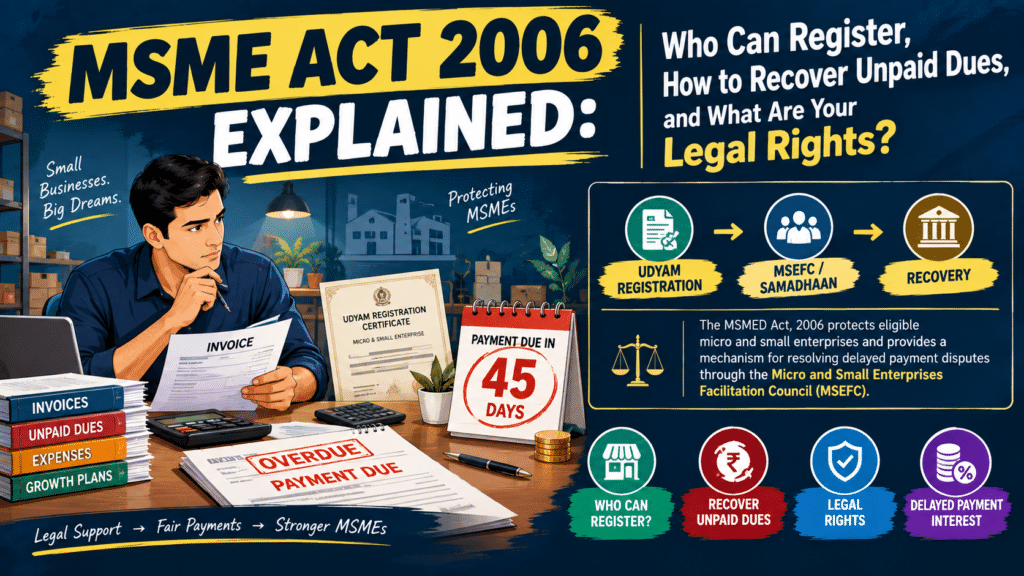
The Micro, Small and Medium Enterprises Development Act, 2006 (MSMED Act) was enacted to promote, develop, and protect micro, small, and medium enterprises in India. One of its most important features is the legal mechanism for recovering delayed payments from buyers.
This article explains the MSME Act in simple language, including who is eligible, how to register, what the law says about delayed payments, how to approach the MSME Facilitation Council, and what legal remedies are available to both suppliers and buyers.
1. What Is the MSME Act, 2006?
The Micro, Small and Medium Enterprises Development Act, 2006, commonly known as the MSME Act, is a central legislation that provides a legal and institutional framework for the development of micro, small, and medium enterprises.
The Act deals with matters such as:
- Classification and registration of MSMEs.
- Government support and measures for enterprise development.
- Protection against delayed payments to eligible micro and small suppliers.
- Interest on delayed payments.
- Dispute resolution through Micro and Small Enterprises Facilitation Councils.
- Statutory remedies for suppliers and buyers.
One of the most significant protections under the Act is that an eligible micro or small enterprise can seek recovery of outstanding dues through a statutory mechanism, even where the buyer disputes the payment.
Important: The delayed-payment provisions under Sections 15 to 23 primarily protect eligible micro and small enterprises. However, a medium enterprise does not automatically receive the same protection merely because it is registered as an MSME.
2. Who Is Eligible Under the MSME Act?
An enterprise is classified as micro, small, or medium based on a composite criterion involving investment in plant and machinery or equipment and annual turnover.
The revised classification came into effect on 1 April 2025.
Revised MSME classification
| Category | Investment limit | Annual turnover limit |
|---|---|---|
| Micro | ₹2.5 crore | ₹10 crore |
| Small | ₹25 crore | ₹100 crore |
| Medium | ₹125 crore | ₹500 crore |
The applicable limits must be considered together under the prescribed classification rules. The enterprise must satisfy the relevant investment and turnover criteria.
These classifications cover manufacturing and service enterprises. Trading enterprises may also obtain Udyam registration, subject to the applicable rules and the scope of benefits available to them.
3. What Is Udyam Registration?
Udyam Registration is the official registration system through which an eligible enterprise obtains recognition as an MSME.
It is an online process conducted through the Government of India’s official Udyam Registration Portal.
Registration generally requires details such as:
- Aadhaar of the proprietor or authorized person, as applicable.
- PAN details.
- GSTIN, where applicable.
- Business and enterprise details.
- Bank and other prescribed information.
The registration process is generally free on the official portal.
Official portal: https://udyamregistration.gov.in/
Be cautious of unofficial websites that charge money while claiming to be the only authorized MSME registration portal.
4. How to Register an MSME: Step-by-Step Procedure
The general process is as follows:
Step 1: Visit the official Udyam Registration Portal.
Step 2: Select the appropriate registration option for a new enterprise or an existing registered enterprise.
Step 3: Complete the required identity verification and enter the prescribed details.
Step 4: Provide business information, including the enterprise’s activity, address, bank details, and other required particulars.
Step 5: Submit the application after verifying the information.
Step 6: Obtain the Udyam Registration Number and certificate once registration is successfully completed.
Registration is important, but it does not automatically establish that every commercial dispute is covered by the MSME Act.
5. Who Can Claim Benefits Under the MSME Act?
The Act may be relevant to:
- Manufacturers supplying goods to companies or government departments.
- Service providers rendering eligible services to buyers.
- Small enterprises undertaking eligible contractual work.
- Micro and small businesses supplying products or services on credit.
- Eligible suppliers seeking recovery of unpaid invoices.
However, the timing and validity of registration matter.
A business cannot assume that obtaining Udyam registration after entering into a contract will automatically make earlier transactions eligible for the statutory delayed-payment mechanism.
In Gujarat State Civil Supplies Corporation Ltd. v. Mahakali Foods Pvt. Ltd., the Supreme Court explained that an enterprise must qualify as a supplier under the Act at the relevant time; registration obtained later does not retrospectively confer the same benefits on earlier transactions.
6. What Is a Delayed Payment Under the MSME Act?
However, delayed payment is one of the most important legal issues addressed by the MSMED Act. MSME Act in India MSME registration process MSME Samadhaan MSME delayed payment MSME payment recovery MSME Facilitation Council Section 15 MSME Act Section 16 MSME Act Section 18 MSME Act MSME Act legal remedies MSME Act interest rate MSME 75% deposit requirement.
Under Section 15, a buyer who purchases goods or receives services from an eligible micro or small supplier is required to make payment within the agreed period, subject to the statutory maximum.
The law provides:
- If there is a written agreement, the agreed payment period cannot exceed 45 days from the day of acceptance or deemed acceptance.
- If there is no written agreement specifying the payment period, the statutory payment date is generally calculated with reference to the appointed day under the Act.
The buyer cannot avoid the statutory payment obligation merely by inserting an excessively long payment period in a contract.
Example
Suppose a registered small enterprise supplies goods worth ₹10 lakh to a company.
The invoice is accepted, but the company does not pay within the legally applicable period.
The supplier may be entitled to claim the principal amount along with statutory interest, subject to the requirements of the Act and the facts of the transaction.
7. What Is the Interest on Delayed Payment?
Section 16 of the MSMED Act provides for compound interest with monthly rests at three times the bank rate notified by the Reserve Bank of India.
The interest becomes payable from the appointed day or the day immediately following the agreed payment date, as applicable under the Act.
This statutory interest is distinct from ordinary contractual interest.
The liability can become substantial where payment remains outstanding for a long period.
However, the precise amount depends on the applicable dates, the relevant bank rate, payments already made, and the legal basis of the claim.
8. What Is the MSME Samadhaan Portal?
The MSME Samadhaan Portal is an online platform through which eligible micro and small enterprises can initiate the process for seeking assistance regarding delayed payments.
It is intended to facilitate access to the statutory dispute-resolution mechanism.
A supplier should generally:
- Identify the outstanding invoices and the buyer.
- Verify its eligibility under the MSMED Act.
- Collect the relevant contract, purchase orders, invoices, and proof of delivery or service.
- Submit the prescribed information through the appropriate online mechanism.
- Pursue the matter before the concerned Micro and Small Enterprises Facilitation Council.
Filing information on a portal should not be confused with obtaining a final recovery order. The dispute-resolution process may involve further proceedings.
9. How to Recover Unpaid Dues Through the MSME Facilitation Council?
Section 18 of the MSMED Act provides the statutory mechanism for resolving disputes concerning amounts due under Section 17.
The broad procedure is as follows:
Stage 1: Reference to the Facilitation Council
An eligible party may refer a dispute regarding an amount due under Section 17 to the Micro and Small Enterprises Facilitation Council having jurisdiction under the Act.
Stage 2: Conciliation
The Council may conduct conciliation itself or refer the matter to an institution or center providing alternative dispute-resolution services.
The purpose is to explore whether the dispute can be settled amicably.
Stage 3: Arbitration
If conciliation fails and is terminated, the Council may either take up the dispute for arbitration itself or refer it to an appropriate institution or center for arbitration.
Stage 4: Arbitral Award
The arbitral tribunal considers the parties’ claims, documents, objections, and evidence and may pass an award in accordance with law.
Stage 5: Enforcement
An award may be enforced under the applicable provisions of the Arbitration and Conciliation Act, 1996, subject to the statutory requirements and any valid challenge.
10. What Happens If the Buyer Refuses to Pay?
However, a buyer’s failure to pay an eligible supplier can result in delayed payments.
Additionally, remedies under the MSME Act in India may support MSME payment recovery.
- Liability to pay the outstanding principal amount.
- Statutory compound interest under Section 16.
- Proceedings before the Micro and Small Enterprises Facilitation Council.
- An arbitral award directing payment.
- Enforcement proceedings if the award remains unpaid.
- Additional litigation costs and commercial consequences.
A buyer cannot assume that a dispute over quality, quantity, contractual performance, or an invoice automatically extinguishes the statutory payment obligation.
At the same time, a supplier’s claim is not automatically accepted merely because it has Udyam registration. The buyer may raise legally sustainable objections supported by documents and evidence.
11. What Are the Legal Remedies Available to an MSME Supplier?
An eligible supplier may consider the following remedies, depending on the nature of the dispute:
A. Written demand for payment
Send a formal demand identifying the invoices, outstanding principal, payment dates, and applicable statutory interest.
B. MSME Facilitation Council proceedings
Where the claim falls within the Act, a reference under Section 18 may be pursued before the appropriate Council.
C. Arbitration and enforcement
Where proceedings result in an award, the supplier may seek enforcement in accordance with the Arbitration and Conciliation Act, 1996.
D. Civil or commercial remedies
The availability of other remedies depends on the statutory framework, the nature of the claim, the contractual arrangement, and the stage of proceedings. Parallel proceedings should not be initiated without examining maintainability and the effect of the special statutory mechanism.
E. Interim protection
Where legally justified, a party may consider appropriate interim relief under the applicable arbitration law. The availability and forum depend on the stage and circumstances of the proceedings.
12. What Can a Buyer Do If an MSME Recovery Claim Is Filed Against It?
The buyer should not ignore a notice from the Facilitation Council or an arbitral tribunal.
A buyer may examine:
- Whether the supplier was eligible under the Act at the relevant time.
- Whether the supplier had the necessary registration when the contract or supply was entered into.
- Whether the goods were actually supplied or services rendered.
- Whether the invoices are genuine and supported by records.
- Whether the amount claimed has already been paid, adjusted, or disputed on a legally sustainable basis.
- Whether the Council has jurisdiction.
- Whether the claim is affected by limitation or other statutory objections.
- Whether a counterclaim is maintainable and supported by evidence.
A buyer challenging an award must also consider the statutory pre-deposit requirement under Section 19.
13. What Is the 75% Deposit Requirement Under Section 19?
Section 19 is particularly important for buyers who challenge an award passed in favor of an eligible supplier.
Where an application is made to set aside an award or order under the statutory framework, the buyer is generally required to deposit 75% of the amount awarded in the manner prescribed by the provision before the application is entertained.
The court or tribunal may order release of an appropriate portion of the deposit to the supplier, subject to the statutory conditions.
This requirement is a significant procedural consideration and should be examined before filing a challenge.
14. Can a Contractual Arbitration Clause Override the MSME Act?
The existence of an arbitration clause in a commercial contract does not automatically exclude the statutory mechanism under Section 18.
In Gujarat State Civil Supplies Corporation Ltd. v. Mahakali Foods Pvt. Ltd., the Supreme Court held that the statutory mechanism under the MSMED Act can prevail over an independently agreed arbitration procedure where the Act applies.
The Court also clarified that the Facilitation Council may act as an arbitrator after conciliation fails, notwithstanding the general restriction under Section 80 of the Arbitration and Conciliation Act, 1996.
The effect of the Act must be assessed with reference to the supplier’s eligibility and the nature of the dispute.
15. Important Case Laws on the MSME Act
1. Gujarat State Civil Supplies Corporation Ltd. v. Mahakali Foods Pvt. Ltd. (2023) 6 SCC 401
The Supreme Court clarified the relationship between the MSMED Act and the Arbitration and Conciliation Act, 1996.
The judgment recognized the overriding effect of the statutory mechanism under Chapter V of the MSMED Act and explained that an independent arbitration agreement does not necessarily prevent a qualifying supplier from invoking Section 18.
2. Silpi Industries v. Kerala State Road Transport Corporation (2021) 18 SCC 790
The Supreme Court considered the applicability of the MSMED Act to suppliers and the effect of registration obtained after the relevant contractual transactions.
The judgment is important for understanding why the timing of registration matters when claiming statutory protection.
3. Mahakali Foods and the statutory pre-deposit requirement
The statutory framework, read with Section 19, imposes a 75% deposit requirement in challenges to covered awards.
A buyer should carefully examine the requirement before filing proceedings to set aside an award.
4. M/s India Glycols Ltd. v. Micro and Small Enterprises Facilitation Council, Medchal–Malkajgiri
The Supreme Court emphasized the statutory remedy under the Arbitration and Conciliation Act, 1996 for challenging an award passed under the MSMED Act and cautioned against using writ proceedings to bypass the statutory pre-deposit requirement.
The applicability of this principle depends on the nature of the challenge and the relief sought.
16. Myth vs Reality: MSME Act
| Myth | Reality |
|---|---|
| Every business with Udyam registration can claim delayed-payment benefits. | The delayed-payment mechanism primarily protects eligible micro and small suppliers, subject to statutory conditions. |
| A buyer can agree to pay after 90 days. | A written payment agreement cannot extend the statutory period beyond 45 days. |
| MSME registration obtained today automatically covers all old invoices. | Registration timing and the date of the relevant transaction matter. |
| A buyer can ignore an MSME notice. | Ignoring proceedings may result in adverse orders and additional liability. |
| A contractual arbitration clause always bars MSME proceedings. | The statutory mechanism may override an inconsistent contractual arbitration procedure where the Act applies. |
| A buyer can challenge an award without depositing any amount. | Section 19 generally requires a 75% deposit in covered challenges. |
17. Practical Checklist for an MSME Payment Dispute
Before initiating proceedings, keep the following documents ready:
- Udyam Registration Certificate.
- Contract, work order, or purchase order.
- Invoices and account statements.
- Proof of delivery or completion of services.
- Correspondence with the buyer.
- Acknowledgment of invoices, where available.
- Details of part-payments and outstanding amounts.
- Calculation of statutory interest.
- Any notice, reply, or prior legal proceeding relating to the dispute.
The strength of an MSME recovery claim depends not only on registration but also on documentary proof of the underlying transaction and the amount due.
18. Frequently Asked Questions (FAQs)
Q1. What is the MSME Act in India?
The MSMED Act, 2006 is a central law for the development of micro, small, and medium enterprises. It also provides a statutory mechanism for delayed-payment disputes involving eligible micro and small suppliers.
Q2. Who can file a case under the MSME Act?
An eligible micro or small supplier may refer a dispute concerning an amount due under Section 17 to the appropriate Facilitation Council under Section 18.
Q3. What is the maximum payment period under the MSME Act?
Where a written agreement exists, the payment period cannot exceed 45 days from acceptance or deemed acceptance. Where there is no written agreement, the statutory appointed-day framework applies.
Q4. What is the interest rate under the MSME Act?
Section 16 provides for compound interest with monthly rests at three times the RBI-notified bank rate, subject to the statutory calculation.
Q5. Can a trader register as an MSME?
Trading enterprises may obtain Udyam registration subject to the applicable rules. However, registration alone does not establish entitlement to every benefit under the Act.
Q6. Can a buyer challenge an MSME award?
Yes. A buyer may pursue the applicable statutory remedy, including a challenge under Section 34 of the Arbitration and Conciliation Act, 1996, subject to limitation and the Section 19 deposit requirement.
Q7. Can MSME proceedings be initiated against a government department or public sector undertaking?
The applicability of the Act depends on the supplier’s eligibility, the transaction, and the statutory requirements. A government department or public sector undertaking is not automatically exempt merely because it is a public body.
Q8. Is MSME registration free?
Registration through the official Udyam Registration Portal is free.
19. Conclusion
The MSME Act, 2006 provides an important statutory framework for eligible micro and small enterprises, particularly where payments for goods supplied or services rendered remain outstanding.
However, the availability of relief depends on the enterprise’s classification, registration, timing of the transaction, supporting documents, and compliance with the statutory procedure.
Whether you are an MSME supplier seeking recovery of dues or a buyer responding to a claim, understanding the Act and acting within the prescribed legal framework is essential.
Legal Disclaimer: This article is for general informational and educational purposes only. It is not legal advice. The applicability of the MSMED Act depends on the facts, registration status, transaction dates, and relevant statutory provisions. Seek professional legal advice for a specific dispute.