
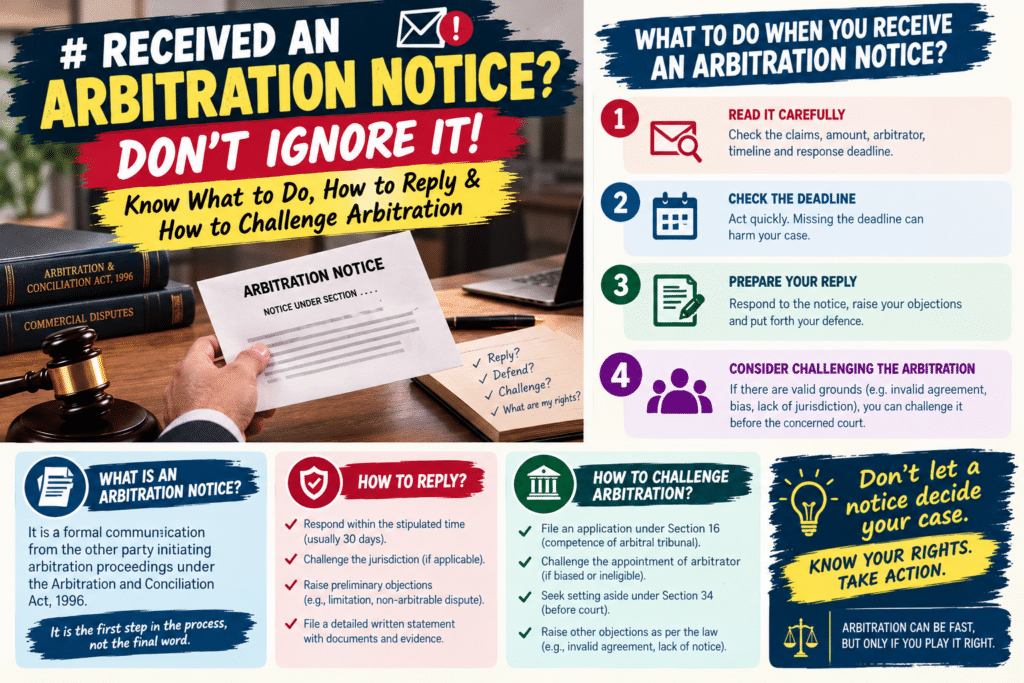
Have you suddenly received a notice invoking arbitration from a company, contractor, business partner, employer, landlord, customer, bank, or another contracting party?
Does the notice say that a dispute has arisen and that the sender intends to refer the matter to arbitration?
Has the other party already proposed or appointed an arbitrator?
Or has an arbitration institution sent you a notice asking you to participate in arbitral proceedings?
Do not ignore it.
An arbitration notice is not merely an ordinary legal notice. It can have important consequences for the commencement of arbitral proceedings, limitation, appointment of the arbitral tribunal and the future conduct of the dispute.
At the same time, receiving an arbitration notice does not mean that the other party automatically wins the dispute.
The notice can and should be examined carefully.
This article explains, in simple language, what to do after receiving an arbitration notice, what Section 21 of the Arbitration and Conciliation Act, 1996 means, whether you must reply, whether you can object to the arbitrator, how to challenge jurisdiction, when to approach the Court, and what happens if you simply ignore the notice.
1. What Is an Arbitration Notice?
An arbitration notice is generally a written communication by which one party informs the other that a dispute has arisen and seeks to invoke the arbitration agreement contained in their contract.
The notice may state:
- The existence of the contract;
- The arbitration clause;
- The dispute between the parties;
- The claims being raised;
- The amount claimed;
- The intention to refer the dispute to arbitration;
- The proposed arbitrator, where applicable;
- A request to participate in appointment of the arbitrator;
- A demand for nomination of an arbitrator;
- A time period for responding.
In many cases, the notice is referred to as a “Notice Invoking Arbitration”, “Arbitration Invocation Notice”, or “Section 21 Notice.”
2. Which Law Governs an Arbitration Notice in India?
Domestic arbitration in India is principally governed by the:
Arbitration and Conciliation Act, 1996.
Several provisions are particularly important when an arbitration notice is received.
Section 7
Deals with the arbitration agreement.
Section 9
Provides for interim measures by the Court.
Section 11
Deals with appointment of arbitrators in specified circumstances.
Section 12
Deals with disclosures and grounds relating to independence and impartiality of arbitrators.
Section 13
Provides a procedure for challenging an arbitrator, subject to the statutory scheme.
Section 16
Deals with the competence of the arbitral tribunal to rule on its own jurisdiction.
Section 21
Deals with commencement of arbitral proceedings.
Section 23
Deals with statements of claim and defence.
Section 29A
Deals with time-limit for making an arbitral award in applicable cases.
Section 34
Provides the statutory remedy for setting aside an arbitral award.
Understanding these provisions is important before responding to an arbitration notice.
3. I Have Received an Arbitration Notice. What Should I Do First?
The first rule is simple:
Do not ignore the notice.
Immediately obtain the following documents:
- The contract or agreement.
- The arbitration clause.
- The complete arbitration notice.
- Documents relied upon in the notice.
- Previous correspondence between the parties.
- Invoices, bills, purchase orders or work orders, where relevant.
- Any previous legal notices and replies.
- Any proposed arbitrator details.
- Any communication from an arbitral institution.
- Any Court order already passed between the parties.
Then determine:
What exactly is being claimed against you?
Is there actually an arbitration agreement?
Is the dispute covered by the arbitration clause?
Is the claim within limitation?
Has an arbitrator already been appointed?
Was the appointment made according to the contract and law?
These questions can fundamentally change your legal strategy.
4. Does Receiving an Arbitration Notice Mean That You Have Lost the Case?
Absolutely not.
An arbitration notice is not an arbitral award.
It is generally the beginning of the dispute-resolution process.
The claimant still has to establish:
- Its contractual entitlement;
- The existence of the alleged breach;
- The amount claimed;
- The legal basis of the claim;
- The arbitrability of the dispute;
- The validity of the arbitration agreement;
- And its case before the arbitral tribunal.
The recipient retains the right to contest the claim and raise legally available objections.
5. What Is Section 21 of the Arbitration Act?
Section 21 deals with the commencement of arbitral proceedings.
It provides, subject to the parties’ agreement, that arbitral proceedings in respect of a particular dispute commence when a request to refer that dispute to arbitration is received by the respondent.
This makes the date of receipt of the arbitration notice particularly important.
It may have consequences relating to:
- Limitation;
- Commencement of arbitration;
- Procedural history;
- Section 9 interim measures;
- Appointment of arbitrator;
- Other statutory timelines.
Therefore, do not casually ignore the date on which the notice was received.
6. Is a Section 21 Notice Mandatory?
This issue requires some care because the Supreme Court’s recent jurisprudence has clarified the position.
Section 21 identifies when arbitral proceedings are deemed to commence, ordinarily by reference to receipt of the request to refer the dispute to arbitration.
However, the Supreme Court has recently clarified that non-issuance of a Section 21 notice does not, by itself, automatically destroy an otherwise valid and arbitrable claim.
In Bhagheeratha Engineering Ltd. v. State of Kerala, the Supreme Court explained that Section 21 primarily serves the procedural purpose of identifying commencement, including for limitation purposes, and that failure to issue such notice is not necessarily fatal where the claim is otherwise valid and arbitrable.
Therefore, a party should not mechanically argue:
“There was no Section 21 notice, therefore the entire arbitration is automatically void.”
The legal position is more nuanced.
At the same time, where the circumstances show that the statutory procedure was materially bypassed, the issue can still become significant.
7. Why Is an Arbitration Notice Important If It Does Not Decide the Case?
Because the notice can serve several important legal functions.
It can:
- Identify the dispute;
- Put the opposite party on notice;
- Identify the intention to arbitrate;
- Help determine the commencement of proceedings;
- Become relevant to limitation;
- Trigger the contractual procedure for appointment of arbitrator;
- Give the recipient an opportunity to raise preliminary objections;
- Provide an opportunity to negotiate or settle;
- Prevent a party from later claiming that it had no knowledge of the dispute.
Therefore, the arbitration notice should be treated seriously.
8. What Should Your Reply to an Arbitration Notice Contain?
There is no universal reply.
The response should depend upon the facts and the legal position.
A properly drafted reply may address:
A. Preliminary objections
For example:
- No valid arbitration agreement exists;
- The arbitration clause is inapplicable;
- The notice has been issued by a person without authority;
- The dispute is outside the scope of the arbitration clause;
- The claim is barred by limitation;
- The contractual procedure for invocation has not been followed;
- The proposed appointment mechanism is contrary to the agreement or law.
B. Reply on merits
You may deny:
- Liability;
- Breach;
- Amount claimed;
- Alleged loss;
- Alleged termination;
- Alleged contractual default;
- Interest;
- Damages;
- Any other substantive claim.
C. Counterclaims
Where legally maintainable, the respondent may also assert its own claims against the claimant.
D. Reservation of rights
The reply should preserve all rights and objections that may appropriately be raised before the arbitral tribunal or Court.
9. Should You Admit or Deny the Claims in the Arbitration Notice?
Do not make casual admissions.
An arbitration notice may contain allegations regarding:
- Outstanding payments;
- Breach of contract;
- Delay;
- Defective performance;
- Termination;
- Damages;
- Interest;
- Loss of profit;
- Security deposit;
- Bank guarantees;
- Confidentiality;
- Non-compete obligations;
- Other contractual liabilities.
A careless statement in a reply can subsequently be relied upon against you.
The response should therefore distinguish between:
Facts that are admitted, facts that are denied, facts that are not admitted, and legal allegations that are disputed.
10. What If the Arbitration Notice Is Completely Wrong?
If the notice contains factually or legally incorrect allegations, respond specifically.
For example:
“The allegation that the respondent failed to perform its contractual obligations is denied.”
But a strong reply should ideally explain why.
For example:
- Payment had already been made;
- The claimant itself committed the breach;
- The work was completed;
- The alleged milestone was never contractually agreed;
- The claimant failed to provide necessary documents;
- The contract had already been terminated;
- The alleged invoice was disputed;
- The claim is barred by limitation.
The objective is not merely to say “wrong” but to create a legally coherent record.
11. What If the Other Party Has Already Appointed an Arbitrator?
This is one of the most important issues.
Do not automatically accept the appointment.
Examine:
- What does the arbitration clause say?
- Is the arbitration by a sole arbitrator or a three-member tribunal?
- Who has the contractual power to nominate the arbitrator?
- Was mutual consent required?
- Was the appointment made unilaterally?
- Does the appointer have an impermissible unilateral power?
- Is the proposed arbitrator independent and impartial?
- Has the statutory procedure been followed?
If the appointment mechanism itself is legally defective, appropriate objections or Court proceedings may be available.
12. Can One Party Unilaterally Appoint the Arbitrator?
Not every unilateral appointment is legally valid.
The Supreme Court has repeatedly emphasised the importance of independence and impartiality of arbitrators.
In cases involving unilateral appointment mechanisms, the validity of the appointment must be examined against the Arbitration Act and the applicable judicial precedents.
The classic Supreme Court line of authority includes:
- TRF Ltd. v. Energo Engineering Projects Ltd.
- Perkins Eastman Architects DPC v. HSCC (India) Ltd.
- Bharat Broadband Network Ltd. v. United Telecoms Ltd.
The precise validity of an appointment depends upon the contractual clause and the circumstances.
13. What If the Arbitrator Was Appointed Without Your Consent?
Do not simply remain silent.
If you believe the appointment is legally defective, consider raising the objection at the appropriate stage and in the manner prescribed by the Arbitration Act.
Depending on the circumstances, remedies may include:
- Objection before the tribunal;
- Challenge under Section 12/13;
- Jurisdictional objection under Section 16;
- Appropriate proceedings under Section 11;
- Challenge to the award under Section 34;
- Other appropriate judicial remedies in exceptional circumstances.
The correct remedy depends upon the nature of the defect.
14. What Is Section 16 of the Arbitration Act?
Section 16 embodies the principle of kompetenz-kompetenz.
In simple language:
The arbitral tribunal has the power to rule on its own jurisdiction.
This includes questions concerning:
- Existence of the arbitration agreement;
- Validity of the arbitration agreement;
- Scope of the tribunal’s jurisdiction;
- Whether the dispute falls within the arbitration clause;
- Certain objections concerning the tribunal’s jurisdiction.
Therefore, if you believe that the tribunal has no jurisdiction, you should not simply ignore the proceedings.
A properly framed jurisdictional objection may need to be raised before the arbitral tribunal in accordance with Section 16.
15. What If There Is No Arbitration Agreement?
This is a fundamental objection.
Arbitration is based on consent.
If there is no valid arbitration agreement between the parties, the other party cannot simply create an arbitration obligation by sending a notice.
The first question should therefore be:
“Where is the arbitration agreement?”
It may be contained in:
- A written contract;
- Purchase order;
- Agreement;
- Terms and conditions;
- Incorporation by reference;
- Exchange of communications;
- Other legally recognised form of arbitration agreement.
Section 7 of the Arbitration and Conciliation Act governs the concept of an arbitration agreement.
16. What If the Contract Contains an Arbitration Clause but the Dispute Is Not Covered by It?
The existence of an arbitration clause does not mean that every possible dispute between the parties must automatically go to arbitration.
The scope of the arbitration agreement must be examined.
For example, the clause may relate only to disputes:
- arising out of a particular agreement;
- concerning contractual performance;
- relating to specified obligations;
- arising during a particular period.
Whether a particular claim falls within the clause is ultimately a matter of contractual interpretation and arbitration law.
17. What If the Claim Is Time-Barred?
This is a very important objection.
The Limitation Act, 1963 applies to arbitrations subject to the Arbitration Act.
Section 43 of the Arbitration and Conciliation Act specifically deals with limitation.
The date of commencement under Section 21 can become relevant when determining limitation.
Therefore, after receiving an arbitration notice, immediately examine:
- When did the cause of action arise?
- When was the contract breached?
- When was the final bill raised?
- When was the claim rejected?
- Was there an acknowledgment of liability?
- Were there part-payments?
- Was there a valid extension or exclusion of limitation?
- When was the arbitration invoked?
A claim should not be assumed to be within limitation merely because an arbitration notice has been issued.
18. What If the Arbitration Notice Was Sent After Several Years?
This can raise a serious limitation objection.
In Bharat Sanchar Nigam Ltd. v. Nortel Networks (India) Pvt. Ltd., the Supreme Court emphasised that limitation principles apply to arbitration and that a stale claim cannot ordinarily be revived merely because a party subsequently invokes arbitration.
Similarly, in later decisions, the Supreme Court has stressed that a party cannot indefinitely postpone invocation of arbitration after the cause of action has accrued.
Therefore:
Old dispute + arbitration notice after several years = immediately examine limitation.
Do not assume that correspondence between the parties automatically keeps the limitation period alive.
19. Can You Approach the Court After Receiving an Arbitration Notice?
Yes, but the correct remedy depends upon the problem.
Different situations may require different remedies.
If you need urgent interim protection:
Section 9 may be relevant.
If the arbitrator has not been appointed:
Section 11 may be relevant, depending upon the circumstances.
If you dispute the tribunal’s jurisdiction:
Section 16 may be relevant.
If you challenge the arbitrator’s independence or eligibility:
Sections 12 and 13 may become relevant.
If an award has already been passed:
Section 34 may provide the statutory challenge mechanism.
The important point is:
Do not file a generic case simply because you have received an arbitration notice. Identify the actual legal defect first.
20. Can You Seek Interim Protection From the Court?
Yes.
Section 9 of the Arbitration and Conciliation Act permits a party to approach the Court for specified interim measures.
Depending upon the circumstances, interim relief may concern matters such as:
- Preservation of property;
- Protection of goods;
- Security for the amount in dispute;
- Injunction;
- Preservation of evidence;
- Protection against disposal of assets in appropriate circumstances;
- Other measures contemplated by Section 9.
However, the requirements of Section 9 and the applicable procedural conditions must be satisfied.
21. What Happens If You Ignore the Arbitration Notice?
Ignoring the notice is usually a bad strategy.
It may result in:
- The claimant proceeding with appointment steps;
- Appointment of an arbitrator according to the applicable mechanism;
- Court proceedings for appointment;
- Ex parte procedural orders in appropriate circumstances;
- Loss of an early opportunity to raise objections;
- Complications regarding limitation and jurisdiction;
- Adverse procedural consequences;
- Ultimately, an arbitral award.
An arbitration proceeding should not be treated like an ordinary demand notice that can simply be placed aside.
22. Can an Arbitration Proceed Ex Parte?
Yes, an arbitral tribunal may proceed in the absence of a party in appropriate circumstances, subject to the statutory framework and principles of natural justice.
However, ex parte does not automatically mean valid.
The tribunal must still act within its jurisdiction and comply with the applicable law and procedure.
A party that deliberately refuses to participate may make its own position considerably more difficult.
23. Can You Settle the Matter After Receiving an Arbitration Notice?
Yes.
Arbitration does not prevent settlement.
In fact, the receipt of an arbitration notice may provide an opportunity to explore:
- Full settlement;
- Partial settlement;
- Payment schedule;
- Withdrawal of claims;
- Mutual termination;
- Settlement of counterclaims;
- Consent terms.
However, any settlement should be documented carefully.
If arbitration proceedings have already commenced, appropriate steps should be taken before the tribunal to record the settlement and conclude the proceedings in accordance with law.
24. What If the Notice Is From an Arbitration Institution?
Sometimes the notice may not come directly from the claimant.
You may receive communication from an institution such as:
- Delhi International Arbitration Centre;
- Mumbai Centre for International Arbitration;
- Indian Council of Arbitration;
- Singapore International Arbitration Centre;
- Other institutional arbitration bodies.
In such cases, carefully examine:
- The institutional rules invoked;
- The arbitration agreement;
- The reference;
- The constitution of the tribunal;
- The time prescribed for response;
- The applicable fee;
- The procedural timetable.
Do not ignore an institutional arbitration notice simply because it comes from an institution rather than the opposing party.
25. What Is the Difference Between an Arbitration Notice and a Section 11 Petition?
They are different.
Arbitration Notice
Usually invokes the arbitration agreement and initiates the contractual/statutory process for arbitration.
Section 11 Petition
A judicial application seeking appointment of an arbitrator in circumstances covered by Section 11.
A party may first receive an arbitration notice and later receive a Court notice in a Section 11 petition if the appointment process fails.
The filing of a Section 11 petition does not itself replace the statutory concept of commencement under Section 21.
The Supreme Court’s recent decision in Regenta Hotels Pvt. Ltd. v. Hotel Grand Centre Point reaffirmed that, for the statutory purpose of commencement under Section 21, receipt of the request invoking arbitration is significant rather than the later filing of a Section 11 petition.
26. What Should You Do If the Notice Contains a Wrong Amount?
Do not merely state that the amount is “wrong.”
Prepare a reconciliation.
For example:
| Particular | Amount |
|---|---|
| Claim made by claimant | ₹50,00,000 |
| Amount actually payable | ₹20,00,000 |
| Amount already paid | ₹15,00,000 |
| Disputed amount | ₹15,00,000 |
| Interest claimed | Disputed |
| Damages | Disputed |
Then explain the contractual and factual basis for your calculation.
This can later become important evidence in the arbitration.
27. What If You Have Your Own Counterclaim?
Do not ignore your own claims merely because you have received a notice.
Depending on the arbitration agreement and procedural stage, you may have claims relating to:
- Damages;
- Refund;
- Delay;
- Defective performance;
- Security deposit;
- Retention money;
- Unpaid invoices;
- Contractual compensation;
- Other losses.
Counterclaims should be properly pleaded and supported by evidence.
A party should also consider limitation separately for its counterclaims.
28. What Are the Legal Consequences of Receiving an Arbitration Notice?
The major consequences may include:
1. Commencement of arbitration
Subject to the statutory framework and parties’ agreement, Section 21 may make receipt of the arbitration request the relevant commencement date.
2. Limitation consequences
The date of commencement can become important for limitation.
3. Appointment process
The notice may trigger the contractual mechanism for appointing an arbitrator.
4. Procedural obligations
The recipient may need to respond within the time prescribed by the contract, institution or tribunal.
5. Potential Court proceedings
Failure to agree on appointment may lead to proceedings under Section 11.
6. Jurisdictional objections
The respondent may need to raise objections concerning jurisdiction at the appropriate stage.
7. Risk of adverse award
Ignoring the proceedings may result in the matter proceeding without effective participation.
29. What Are the Most Common Grounds for Challenging Arbitration Proceedings?
Depending upon the facts, possible grounds may include:
- No valid arbitration agreement;
- Invalid arbitration clause;
- Dispute outside the scope of the clause;
- Claim barred by limitation;
- Improper invocation;
- Defective constitution of the tribunal;
- Impermissible unilateral appointment;
- Arbitrator’s ineligibility;
- Lack of jurisdiction;
- Non-arbitrability of the dispute;
- Failure to comply with agreed appointment procedure;
- Violation of principles of natural justice;
- Serious procedural irregularity.
Every objection must be tested against the actual contract and statutory framework.
30. Important Supreme Court Jurisprudence on Arbitration Notices
A. Adavya Projects Pvt. Ltd. v. M/s Vishal Structurals Pvt. Ltd. & Ors., 2025 INSC 507
This is an important Supreme Court judgment concerning Section 21, Section 11 and Section 16.
The Court examined the significance of an arbitration invocation notice, appointment of the tribunal, and the tribunal’s jurisdiction.
The decision explains that Section 21 concerns commencement of arbitral proceedings and that receipt of the request to refer the dispute is central to that statutory mechanism.
The Court also discussed the relationship between the tribunal’s jurisdiction under Section 16 and the existence of an arbitration agreement.
B. Regenta Hotels Pvt. Ltd. v. M/s Hotel Grand Centre Point, 2026 INSC 32
This recent Supreme Court judgment is particularly important.
The Court considered when arbitral proceedings commence for the purposes of Section 21 and Section 9.
The Court reaffirmed that receipt of a notice/request invoking arbitration is the statutory event that commences arbitral proceedings, rather than the later filing of a Section 11 petition.
This makes the date and proof of receipt of the arbitration notice particularly important.
C. Bhagheeratha Engineering Ltd. v. State of Kerala, 2026 SCC OnLine SC 5
The Supreme Court recently clarified an important aspect of Section 21.
The Court explained that the purpose of Section 21 is principally procedural and relates to identifying commencement of the dispute, including for limitation.
The absence of a Section 21 notice does not automatically make an otherwise valid and arbitrable claim fatal.
This is an important development because it prevents Section 21 from being treated as a rigid jurisdictional provision in every situation.
D. Bharat Sanchar Nigam Ltd. v. Nortel Networks India Pvt. Ltd., (2021) 5 SCC 738
This judgment is important for understanding limitation in arbitration.
The Supreme Court emphasised that arbitration cannot be used to revive stale claims.
A party receiving an arbitration notice after a substantial lapse of time should therefore immediately examine whether the underlying claim is time-barred.
E. Perkins Eastman Architects DPC v. HSCC (India) Ltd., (2020) 20 SCC 760
This is one of the leading judgments concerning unilateral appointment of arbitrators.
The Supreme Court examined the principle that a party interested in the outcome of the dispute cannot necessarily reserve to itself an unrestricted power to appoint a sole arbitrator.
The validity of any appointment clause should therefore be examined carefully.
F. TRF Ltd. v. Energo Engineering Projects Ltd., (2017) 8 SCC 377
The Supreme Court dealt with the principle of ineligibility of a person to act as arbitrator and the consequences for appointment powers flowing from such ineligibility.
The judgment forms part of the important jurisprudence concerning independence and impartiality in arbitral appointments.
31. Myth vs Reality: Arbitration Notice
| Myth | Reality |
|---|---|
| Receiving an arbitration notice means you have lost the case. | It is generally the beginning of the dispute-resolution process, not an award. |
| You should ignore the notice if the claim is false. | Ignoring proceedings can seriously prejudice your position. |
| The claimant can appoint any arbitrator it wants. | Appointment must comply with the contract and applicable arbitration law. |
| Every arbitration notice must contain every claim that can ever be raised. | Section 21 and Section 23 perform different procedural functions; later claims may be governed by the statutory framework and limitation rules. |
| Absence of a Section 21 notice automatically makes arbitration void. | Recent Supreme Court jurisprudence has clarified that non-issuance is not automatically fatal in every case. |
| Arbitration can never be challenged in Court. | Courts have defined statutory roles at different stages, including Sections 9, 11 and 34 proceedings. |
| A Section 11 petition is the beginning of arbitration. | Section 21 identifies commencement for statutory purposes. |
| If the dispute is old, an arbitration notice automatically revives it. | Limitation continues to apply to arbitration. |
| You must accept the arbitrator proposed by the other side. | The appointment mechanism and arbitrator’s eligibility must be examined. |
| You can raise every objection at any time. | Arbitration law contains specific stages and procedures for different objections. |
32. A Practical Checklist: You Received an Arbitration Notice—Now What?
Within the first few days:
1. Preserve the notice.
Keep the envelope, email, acknowledgment and attachments.
2. Find the arbitration clause.
Do not rely only on what the notice says.
3. Check the date of receipt.
This may become legally important.
4. Check limitation.
Identify when the alleged cause of action arose.
5. Verify the amount claimed.
Prepare your own calculation.
6. Examine the appointment clause.
Check whether the proposed appointment is lawful.
7. Collect the contract documents.
Include amendments, purchase orders, invoices, emails and correspondence.
8. Identify counterclaims.
Do not overlook claims that you may have against the claimant.
9. Consider interim relief.
If your property, assets, evidence or contractual rights are at immediate risk, examine Section 9 and other available remedies.
10. Respond within time.
Do not allow the matter to proceed merely because you did not respond.
33. When Should You Immediately Consult an Arbitration Lawyer?
Professional legal advice becomes particularly important where:
- The claim amount is substantial;
- The contract contains a complicated arbitration clause;
- The arbitration notice is issued after several years;
- An arbitrator has already been appointed;
- The appointment appears unilateral;
- You believe there is no arbitration agreement;
- The dispute is not covered by the arbitration clause;
- There is an urgent threat to property or assets;
- A Section 11 petition has already been filed;
- Proceedings before an arbitral tribunal have already commenced;
- You have substantial counterclaims;
- The claimant has invoked multiple contracts;
- A bank guarantee or security is at risk;
- You have received notice from an arbitral institution.
34. What Should You NOT Do After Receiving an Arbitration Notice?
Do not ignore it.
Do not casually admit liability.
Do not send an emotional reply.
Do not destroy or delete documents.
Do not assume that the proposed arbitrator is automatically valid.
Do not assume that every arbitration dispute must be decided by a civil court.
Do not wait until an award is passed before considering jurisdictional objections.
Do not assume that an old claim becomes valid merely because an arbitration notice has been issued.
Do not file multiple proceedings without understanding the statutory scheme.
35. Final Takeaway: An Arbitration Notice Is a Warning Bell, Not a Final Judgment
Receiving an arbitration notice can be intimidating, particularly when the notice contains a large monetary claim or threatens immediate legal action.
But the notice itself is not a determination of liability.
The correct approach is to:
Read the arbitration clause → check limitation → examine the notice → verify the claims → scrutinise the arbitrator appointment → identify jurisdictional objections → prepare your defence and counterclaims → consider interim protection where necessary → respond within the applicable time.
Arbitration is designed to provide an efficient mechanism for resolving contractual disputes, but efficiency does not mean that a respondent loses its legal rights.
A properly prepared response at the very beginning can sometimes be as important as the defence filed later before the arbitral tribunal.
Frequently Asked Questions About Arbitration Notices
1. What should I do after receiving an arbitration notice?
Immediately examine the arbitration agreement, the claims, limitation, appointment mechanism and documents relied upon. A timely legal response should generally be prepared rather than ignoring the notice.
2. Is an arbitration notice mandatory?
Section 21 provides the statutory mechanism for commencement of arbitral proceedings by receipt of a request to refer the dispute to arbitration, subject to the parties’ agreement. Recent Supreme Court jurisprudence has clarified that absence of such notice is not automatically fatal in every case.
3. Can I refuse arbitration?
If a valid arbitration agreement covers the dispute, simply refusing to participate does not necessarily stop the arbitration. However, legitimate objections regarding the agreement, jurisdiction, appointment, limitation or arbitrability may be available.
4. Can I challenge the arbitrator?
Yes, where legally permissible. The Arbitration Act contains provisions concerning disclosure, independence, impartiality and challenges to arbitrators.
5. What if the other party appointed the arbitrator without asking me?
The validity of the appointment depends on the arbitration clause and applicable law. A unilateral appointment may be challengeable in appropriate circumstances.
6. Can I challenge an arbitration notice in the High Court?
The appropriate remedy depends upon the nature of the objection. Sections 9, 11, 16, 34 and other provisions operate at different stages. A general challenge is not automatically maintainable merely because a notice has been received.
7. What happens if I do not reply to the arbitration notice?
The arbitration process may continue. Depending on the circumstances, the claimant may proceed with appointment and further arbitral steps, potentially leaving the respondent to defend itself later in a more difficult procedural position.
8. Can I settle after receiving an arbitration notice?
Yes. Parties can settle their disputes even after arbitration has been invoked, subject to appropriately recording and concluding the proceedings.
9. Can I raise a counterclaim?
A counterclaim may be available depending upon the arbitration agreement, applicable procedural law, limitation and the stage of proceedings.
10. Is an arbitration notice the same as a Court notice?
No. An arbitration notice is generally issued by a party or through an arbitral institution, whereas a Court notice is issued in judicial proceedings. However, an arbitration dispute may subsequently involve Court proceedings under provisions such as Sections 9, 11 or 34.