
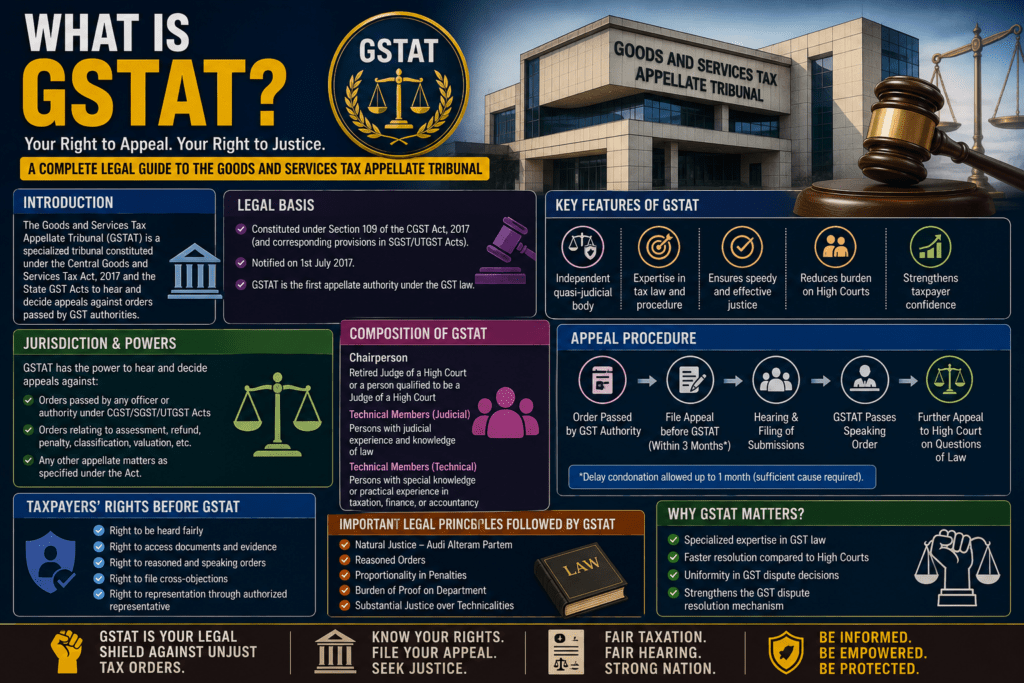
Introduction
Imagine receiving a GST order demanding ₹10 lakh, cancelling your GST registration, rejecting your refund, or imposing a heavy penalty.
You believe the order is unfair.
You ask yourself:
- Can I challenge this order?
- Which authority will hear my appeal?
- What is GSTAT?
- What powers does GSTAT have?
If you are a business owner, taxpayer, chartered accountant, or even a lawyer, these are some of the most important questions you should know.
The Goods and Services Tax Appellate Tribunal (GSTAT) is one of the most important institutions created under the GST law. It provides taxpayers with an independent forum to challenge orders passed by GST authorities before approaching the High Court.
In this article, we explain everything about GSTAT—its powers, jurisdiction, composition, appeal process, legal principles, and the rights of taxpayers—in simple language.
What Is GSTAT?
GSTAT stands for the Goods and Services Tax Appellate Tribunal.
It is a statutory appellate body established under the Central Goods and Services Tax Act, 2017 (CGST Act).
Its primary role is to hear appeals against certain orders passed by the First Appellate Authority under the GST laws.
In simple words:
If you are dissatisfied with the order of the GST Appellate Authority, GSTAT is generally the next forum where you can challenge that decision.
Why Was GSTAT Created?
Before GSTAT was established, taxpayers often faced uncertainty regarding appellate remedies.
The legislature created GSTAT to:
- provide specialised adjudication of GST disputes;
- ensure uniform interpretation of GST laws;
- reduce the burden on High Courts;
- provide quicker resolution of tax disputes;
- strengthen taxpayer confidence in the GST system.
Where Does GSTAT Fit in the Appeal Process?
Generally, the hierarchy is:
Proper Officer → First Appellate Authority → GSTAT → High Court (on substantial questions of law, where applicable) → Supreme Court (in appropriate cases).
This appellate structure ensures that disputes are examined by specialised forums before reaching constitutional courts.
Which Law Governs GSTAT?
The constitution, composition, and functioning of GSTAT are primarily governed by the CGST Act, 2017, particularly the provisions dealing with the Appellate Tribunal.
Rules framed under the Act and relevant notifications also govern its functioning.
What Powers Does GSTAT Have?
GSTAT has wide appellate powers.
Depending on the facts of the case, it may:
- confirm an order;
- modify an order;
- set aside an order;
- remand the matter for fresh consideration where permissible;
- grant appropriate relief in accordance with law.
The Tribunal independently examines both facts and law.
What Is the Jurisdiction of GSTAT?
GSTAT exercises appellate jurisdiction over disputes arising under the GST laws that are appealable under the statutory framework.
Its jurisdiction extends to matters such as:
- GST demand orders;
- tax liability disputes;
- classification disputes;
- valuation disputes;
- input tax credit issues;
- refund disputes;
- penalty matters;
- interest disputes;
- registration-related disputes, where appealable.
Its jurisdiction is defined by the statute, and not every GST-related decision is directly appealable to GSTAT.
Common GST Orders That Can Be Challenged Before GSTAT
Depending on the facts and the applicable provisions of the GST law, taxpayers may challenge orders relating to:
- demand of GST;
- levy of penalty;
- denial of input tax credit;
- rejection of refund claims;
- determination of tax liability;
- cancellation or revocation-related disputes where appealable;
- interest demands;
- classification of goods or services;
- valuation issues.
Whether a particular order is appealable depends upon the provisions of the GST law.
Can GSTAT Take Fresh Evidence?
Generally, GSTAT decides appeals based on the material available on record.
However, in appropriate circumstances and in accordance with the governing statutory provisions and procedural rules, additional material may be considered where legally permissible.
Is GSTAT a Court?
No.
This is a common misunderstanding.
GSTAT is a specialised statutory tribunal, not a civil court.
However, while deciding disputes, it performs important judicial functions and follows principles of fairness, natural justice, and due process.
Its proceedings are judicial in nature.
Can GSTAT Grant Relief to Taxpayers?
Yes.
If the Tribunal finds that the impugned order is contrary to law or facts, it may grant appropriate relief within the scope of its statutory powers.
The exact nature of the relief depends upon the case.
Can You Appeal Against a GSTAT Order?
Yes.
An order of GSTAT is not always final.
Subject to the provisions of the GST law, an appeal may lie to the High Court on substantial questions of law. In certain matters, further remedies before the Supreme Court may also be available in accordance with law.
The Jurisprudence Behind GSTAT
The GST Appellate Tribunal is founded on important legal principles.
1. Right to Appeal Promotes Fairness
A person affected by a tax order should have an opportunity to challenge it before an independent appellate forum.
This strengthens public confidence in tax administration.
2. Specialised Tribunals Improve Justice
GST law involves complex issues relating to taxation, accounting, classification, valuation, and input tax credit.
A specialised tribunal is better equipped to deal with such technical disputes.
3. Uniform Interpretation of GST Laws
One of GSTAT’s major objectives is to ensure consistency in the interpretation and application of GST laws across the country.
4. Natural Justice Is Fundamental
Every taxpayer deserves:
- a fair hearing;
- an impartial decision;
- reasoned orders; and
- an opportunity to present their case.
These principles remain central to GST adjudication.
Practical Tips Before Filing an Appeal Before GSTAT
Before filing an appeal:
- Carefully read the order you wish to challenge.
- Check the statutory limitation period.
- Arrange all relevant documents and evidence.
- Ensure compliance with the statutory pre-deposit requirements, wherever applicable.
- Obtain professional legal or tax advice, particularly in complex matters.
Timely preparation often improves the chances of a successful appeal.
Myth vs Reality
| Myth | Reality |
|---|---|
| GSTAT is the same as a civil court. | False. GSTAT is a specialised statutory tribunal created under the GST law. |
| Every GST order can be directly challenged before the High Court. | Incorrect. In many cases, the statutory appellate remedy before GSTAT must first be pursued, subject to recognised exceptions. |
| GSTAT only hears large corporate disputes. | Wrong. Any eligible taxpayer, whether an individual, partnership, MSME, or company, may approach GSTAT if the statutory requirements are met. |
| The Tribunal always supports the GST Department. | False. GSTAT is an independent adjudicatory body that decides disputes based on law and evidence. |
| If I lose before GSTAT, I have no further remedy. | Incorrect. Depending on the nature of the dispute and the applicable legal provisions, further appeals may lie to the High Court or the Supreme Court. |
Frequently Asked Questions (FAQs)
What is GSTAT?
GSTAT is the Goods and Services Tax Appellate Tribunal, a specialised appellate body that hears eligible appeals under the GST laws.
Who can file an appeal before GSTAT?
A person aggrieved by an appealable order under the GST law, and who satisfies the statutory requirements, may approach GSTAT.
Can GSTAT cancel a GST demand?
Yes. If the Tribunal finds that the demand is unsustainable in law or on facts, it may grant appropriate relief within its statutory powers.
Is GSTAT above the High Court?
No. GSTAT is a statutory tribunal. The High Courts exercise constitutional jurisdiction, and appeals on substantial questions of law may lie from GSTAT to the High Court where provided by law.
Is hiring a lawyer compulsory before GSTAT?
The law permits authorised representation in accordance with the GST framework. However, because GST disputes often involve technical and legal issues, professional assistance is generally advisable.
Key Takeaways
- GSTAT is the specialised appellate tribunal under the GST framework.
- It provides an independent forum to challenge eligible GST appellate orders.
- GSTAT has wide powers to examine facts and law and to grant appropriate relief.
- It plays a vital role in ensuring consistency, fairness, and specialised adjudication of GST disputes.
- Understanding the appellate process and limitation periods is essential to protecting your rights.
Conclusion
The Goods and Services Tax Appellate Tribunal (GSTAT) is one of the cornerstones of India’s GST dispute resolution system. It bridges the gap between departmental adjudication and constitutional courts by providing taxpayers with a specialised, independent, and expert forum to challenge adverse GST orders.
For businesses, professionals, and individual taxpayers, understanding GSTAT is not merely a matter of legal knowledge—it is essential for protecting financial interests and ensuring that tax disputes are decided fairly and in accordance with law.
Whether the dispute relates to tax demands, penalties, refunds, input tax credit, valuation, or classification, GSTAT plays a crucial role in ensuring that the GST regime remains transparent, accountable, and consistent.
If you receive an adverse GST order, remember that the law gives you a structured appellate remedy. Knowing how GSTAT works is often the first step towards successfully protecting your rights under the GST law.