
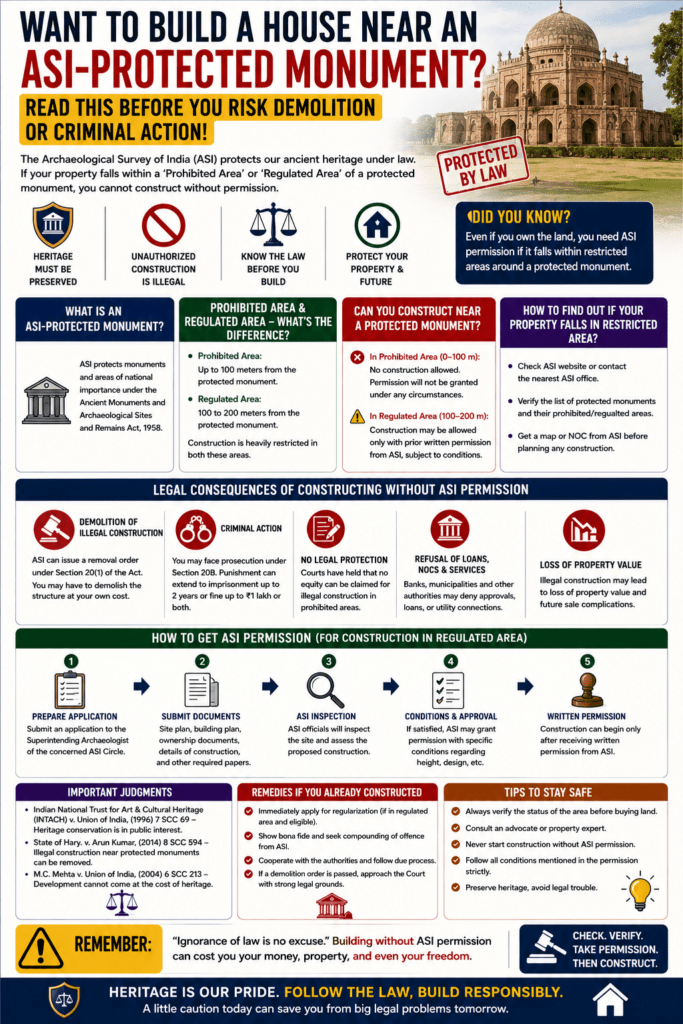
- Introduction
- What Is an ASI-Protected Monument?
- What Is the "Prohibited Area"?
- Can I Construct a House in the Prohibited Area?
- What About the Regulated Area?
- Why Does the Law Restrict Construction?
- Can the Municipal Corporation Approve My Building Plan?
- What If I Start Construction Without Permission?
- Can I Challenge ASI's Decision?
- Does Owning the Land Give Me an Absolute Right to Build?
- Can Existing Buildings Continue?
- Jurisprudence Behind Heritage Protection
- Practical Tips
- Myth vs Reality
- Frequently Asked Questions (FAQs)
- Landmark Judicial Principles
- Key Takeaways
- Conclusion
Introduction
You buy a piece of land.
You obtain ownership documents.
You prepare your building plans.
Just before construction begins, someone tells you:
“This land falls within the ASI prohibited area.”
Immediately, several questions arise:
- Can I still build my house?
- Does owning the land give me an automatic right to construct?
- Can the ASI stop my construction?
- Can the Municipal Corporation approve my building plan?
- Can my building be demolished?
Many landowners discover these restrictions only after investing substantial money.
The truth is simple:
Ownership of land does not automatically give you the right to construct if your property falls within a protected heritage zone.
Indian law places strict restrictions on construction near nationally protected monuments to preserve the country’s archaeological and cultural heritage.
What Is an ASI-Protected Monument?
An ASI-protected monument is a monument or archaeological site declared to be of national importance under the Ancient Monuments and Archaeological Sites and Remains Act, 1958 (AMASR Act).
These monuments are protected and maintained by the Archaeological Survey of India (ASI).
Examples include ancient temples, forts, mosques, tombs, caves, stepwells, archaeological remains, and historical structures notified by the Central Government.
What Is the “Prohibited Area”?
Under the AMASR Act, certain areas surrounding a protected monument receive special statutory protection.
Traditionally, the law recognised:
- a prohibited area immediately surrounding the protected monument; and
- a regulated area beyond it.
The statutory framework has evolved through amendments, and the applicable legal position depends on the current provisions of the Act and the nature of the proposed activity.
Can I Construct a House in the Prohibited Area?
Generally, No.
For a private individual, constructing a residential or commercial building within the prohibited area of an ASI-protected monument is generally not permissible, unless the applicable law specifically permits it.
Merely because you own the land does not mean that you have a legal right to construct on it.
Ownership rights remain subject to statutory restrictions enacted in the public interest.
What About the Regulated Area?
The regulated area is treated differently.
Construction may, depending on the facts and the applicable statutory provisions, require prior permission and compliance with heritage protection norms.
The nature of the work, the location, and the impact on the monument are important considerations.
Why Does the Law Restrict Construction?
The objective is not to inconvenience property owners.
The law seeks to protect:
- historical monuments;
- archaeological remains;
- underground heritage;
- cultural identity;
- structural safety of monuments;
- future archaeological discoveries.
Once destroyed, heritage cannot be recreated.
Can the Municipal Corporation Approve My Building Plan?
Not necessarily.
Even if a local authority is otherwise competent to sanction building plans, construction affecting a protected monument must also comply with the AMASR Act and other applicable laws.
Municipal approval alone does not override statutory heritage restrictions.
What If I Start Construction Without Permission?
The consequences can be serious.
Depending on the facts and the applicable law, authorities may:
- stop the construction;
- issue notices;
- direct removal of unauthorized work;
- initiate legal proceedings;
- impose statutory consequences provided by law.
Proceeding without the necessary permissions can also affect future transactions involving the property.
Can I Challenge ASI’s Decision?
Yes.
If you believe that:
- your property has been wrongly treated as falling within the restricted zone;
- the authority has acted arbitrarily;
- mandatory legal procedure has not been followed; or
- your application has been rejected unlawfully,
you may have appropriate legal remedies, including approaching the competent court or the High Court under Article 226 of the Constitution of India, depending on the facts.
Each case is fact-specific.
Does Owning the Land Give Me an Absolute Right to Build?
No.
Property rights in India are subject to reasonable restrictions imposed by law.
Examples include:
- municipal laws;
- environmental laws;
- coastal regulations;
- forest laws;
- airport height restrictions;
- defence restrictions;
- heritage protection laws.
Therefore, ownership is not an unrestricted licence to construct.
Can Existing Buildings Continue?
The legal position depends on several factors, including:
- when the structure was built;
- whether it was authorised;
- the applicable statutory provisions at the relevant time;
- subsequent amendments to the law.
Each case requires an independent legal examination.
Jurisprudence Behind Heritage Protection
The restrictions are based on important constitutional and public law principles.
1. National Heritage Belongs to Future Generations
Historic monuments are part of India’s cultural legacy.
The State acts as a trustee for future generations.
2. Public Interest Prevails
The law balances private property rights with the larger public interest in preserving national heritage.
3. Sustainable Development
Development must occur without permanently damaging irreplaceable historical assets.
4. Rule of Law
Even public authorities and private owners must comply with statutory heritage protections.
Practical Tips
✅ Verify whether your property falls within an ASI-protected zone before purchasing or constructing.
✅ Obtain all necessary approvals before commencing any work.
✅ Preserve copies of sanctioned plans and correspondence.
✅ Seek legal advice if heritage restrictions affect your property.
❌ Do not rely solely on municipal approval.
❌ Do not assume that ownership overrides heritage laws.
❌ Do not begin construction first and seek permission later.
Myth vs Reality
| Myth | Reality |
|---|---|
| I own the land, so I can build whatever I want. | False. Ownership is subject to statutory restrictions, including heritage protection laws. |
| Municipal approval is enough. | Incorrect. Compliance with the AMASR Act and other applicable laws is also necessary. |
| Every property near an ASI monument is completely unusable. | False. The legal position depends on whether the property falls within the prohibited or regulated area and the nature of the proposed work. |
| Construction without permission can always be regularised later. | Wrong. Unauthorized construction near protected monuments can attract serious legal consequences. |
| ASI restrictions violate property rights. | Incorrect. Courts have recognised that reasonable statutory restrictions to protect national heritage are legally permissible. |
Frequently Asked Questions (FAQs)
Can I build a house near an ASI-protected monument?
It depends on where the property is located and the applicable provisions of the AMASR Act. Construction within the prohibited area is generally not permitted for private individuals unless specifically authorised by law.
Does buying the land guarantee building permission?
No. Ownership and construction rights are separate legal issues.
Can ASI stop my construction?
Yes, where the law authorises such action.
Can I challenge ASI’s decision?
Yes. If you believe the action is unlawful or arbitrary, appropriate legal remedies may be available before the competent court or the High Court.
Can unauthorized construction be removed?
Depending on the applicable law and the facts, authorities may take action against unauthorized construction.
Landmark Judicial Principles
Indian courts have repeatedly emphasised that protection of monuments of national importance is a matter of public interest. While property rights deserve respect, they must coexist with statutory restrictions enacted to preserve India’s cultural and archaeological heritage.
The Supreme Court has consistently recognised that heritage conservation is an essential constitutional value and that authorities are expected to enforce the AMASR Act fairly while balancing competing interests in accordance with law.
Key Takeaways
- Construction near an ASI-protected monument is governed by the Ancient Monuments and Archaeological Sites and Remains Act, 1958.
- Land ownership does not automatically confer a right to construct.
- Construction within the prohibited area is generally not permissible for private persons unless specifically authorised under the applicable legal framework.
- Municipal approval alone is insufficient if heritage laws apply.
- If an authority acts arbitrarily or contrary to law, judicial remedies may be available.
Conclusion
Buying land near a historical monument can be an attractive investment, but it also comes with important legal responsibilities. India’s heritage laws are designed to preserve monuments of national importance for future generations, and those laws can significantly affect construction rights.
Before investing in construction, verify whether your property falls within an ASI-protected zone and understand the legal restrictions that apply. A careful legal assessment at the planning stage can save years of litigation, prevent financial loss, and ensure that development takes place in harmony with India’s priceless cultural heritage.
Remember: Owning the land gives you valuable rights—but those rights must always be exercised within the framework of the law protecting our shared national heritage.