
- Introduction
- What Is Unauthorized Construction?
- Can Someone Build Anything on Their Own Property?
- What Is a Legal Nuisance?
- What Should You Do First?
- Step 1: Check Whether the Construction Is Approved
- Step 2: File a Complaint Before the Municipal Authority
- Step 3: Seek an Immediate Injunction from the Civil Court
- Step 4: Approach the High Court
- Step 5: Criminal Remedies (Where Applicable)
- Can the Municipal Corporation Demolish the Construction?
- Can You Claim Compensation?
- Jurisprudence Behind the Law
- Important Supreme Court Principles
- Practical Tips
- Myth vs Reality
- Frequently Asked Questions (FAQs)
- Landmark Judicial Principles
- Key Takeaways
- Conclusion
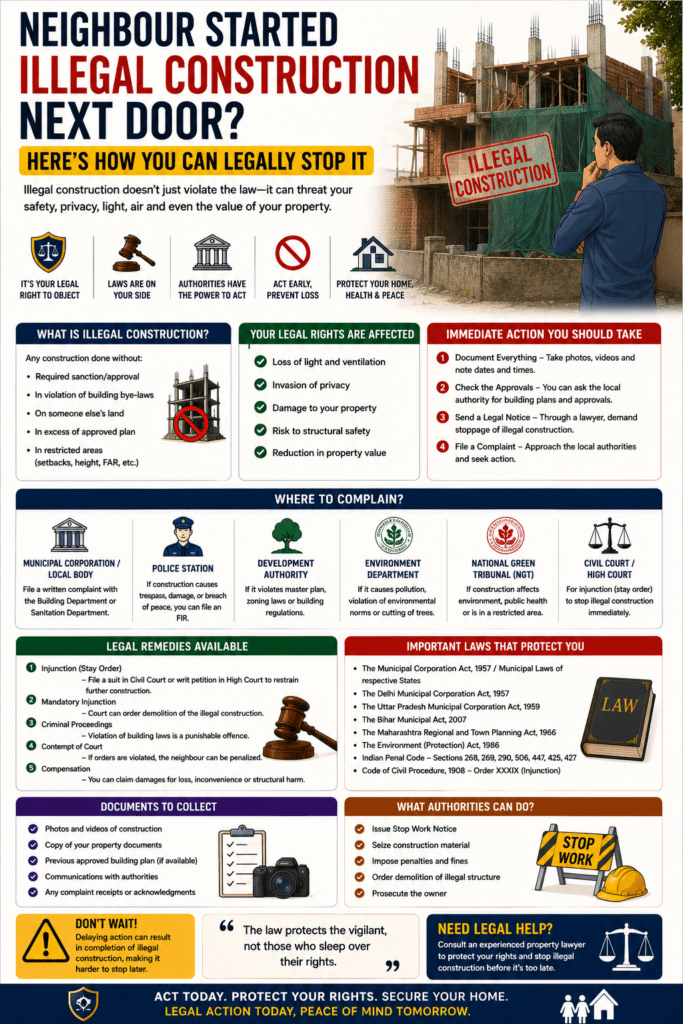
Introduction
You wake up one morning and find your neighbour has started constructing another floor.
No safety nets.
No approved plans displayed.
Construction debris falls into your property.
Your windows are blocked.
The noise starts at 7 AM.
Cracks begin appearing in your walls.
Water pipelines are damaged.
Despite repeated requests, the construction continues.
Many people think:
“It’s their property. They can build whatever they want.”
That is completely incorrect.
Owning a property does not give anyone the right to violate municipal laws, building bye-laws, safety regulations, or interfere with the legal rights of neighbouring property owners.
If the construction is unauthorized or creates nuisance, the law provides several effective remedies.
This guide explains everything you need to know.
What Is Unauthorized Construction?
Unauthorized construction means any construction carried out:
- without obtaining the required building sanction or permission;
- contrary to the sanctioned building plan;
- in violation of building bye-laws or zoning regulations;
- beyond the permissible height, floor area ratio (FAR), setbacks, or coverage;
- on public land or encroached land; or
- in violation of environmental, fire safety, or other statutory requirements.
Every State and Municipal Corporation has laws regulating construction activities.
Can Someone Build Anything on Their Own Property?
Absolutely Not.
Ownership of land is not an unrestricted licence to construct as one wishes.
Construction must comply with:
- municipal laws;
- sanctioned building plans;
- zoning regulations;
- fire safety norms;
- environmental laws;
- structural safety standards; and
- local building bye-laws.
Failure to comply may result in demolition, sealing, penalties, or prosecution under the applicable law.
What Is a Legal Nuisance?
A nuisance occurs when a person’s actions unreasonably interfere with another person’s use and enjoyment of their property.
Examples include:
- excessive dust;
- unbearable noise;
- vibrations causing cracks;
- blockage of sunlight or ventilation where protected by law;
- obstruction of common access;
- dumping construction material on public roads;
- damage to drainage systems;
- water leakage;
- falling debris;
- unsafe excavation threatening neighbouring structures.
Not every inconvenience is a legal nuisance. The interference must be substantial and unlawful.
What Should You Do First?
Before initiating litigation, gather evidence.
Collect:
- photographs;
- videos;
- dates of construction;
- details of workers;
- copies of approved plans, if available;
- names of witnesses;
- copies of complaints made.
Good evidence often determines the success of the case.
Step 1: Check Whether the Construction Is Approved
Many Municipal Corporations maintain records of sanctioned building plans.
You may:
- inspect available records where permitted;
- seek information through the Right to Information Act, 2005 where applicable;
- approach the municipal authority for verification.
Do not assume that every ongoing construction is illegal.
Step 2: File a Complaint Before the Municipal Authority
The first remedy is generally to approach the competent municipal authority.
Your complaint should include:
- property address;
- description of the unauthorized construction;
- photographs;
- request for inspection;
- request for immediate action.
The authority may:
- inspect the premises;
- issue notices;
- stop construction;
- seal the premises where authorised;
- order demolition of unauthorized portions;
- initiate prosecution where provided under the applicable municipal law.
Step 3: Seek an Immediate Injunction from the Civil Court
If the construction is causing immediate harm, you may institute a civil suit seeking:
- permanent injunction;
- mandatory injunction;
- temporary injunction restraining further construction.
If urgency is shown, the court may grant interim relief pending the suit.
Step 4: Approach the High Court
Where the municipal authority fails to perform its statutory duties or acts arbitrarily, a writ petition under Article 226 of the Constitution of India may, in appropriate cases, be maintainable before the High Court.
The High Court may direct the authority to consider the complaint and act in accordance with law.
Step 5: Criminal Remedies (Where Applicable)
If the facts disclose criminal offences—such as intentional damage to property, criminal intimidation, public obstruction, or other offences under the applicable criminal law—separate criminal remedies may also be available.
However, not every unauthorized construction amounts to a criminal offence.
The nature of the conduct will determine the appropriate remedy.
Can the Municipal Corporation Demolish the Construction?
Yes.
Where the construction is found to be unauthorized and the applicable law permits, the municipal authority may issue notices and, after following the prescribed procedure, order demolition, sealing, or other statutory action.
However, action must ordinarily comply with the principles of natural justice and the relevant municipal law.
Can You Claim Compensation?
Yes, in appropriate cases.
If the unauthorized construction has caused:
- structural damage;
- financial loss;
- property damage;
- loss of access;
- water seepage;
- other legally compensable injury,
a civil claim for damages may be maintainable depending on the facts.
Jurisprudence Behind the Law
The law regulating unauthorized construction is founded on important constitutional and public law principles.
1. Rule of Law
No person is above municipal law merely because they own property.
2. Planned Urban Development
Building regulations exist to protect public safety, infrastructure, traffic management, and urban planning.
3. Rights of Neighbours
Every property owner has a right to peaceful enjoyment of their property, subject to law.
4. Public Safety
Unauthorized structures may endanger occupants, neighbours, emergency services, and the public.
Important Supreme Court Principles
The Supreme Court has repeatedly emphasised that illegal and unauthorized constructions cannot ordinarily be regularised merely because substantial money has been spent or the construction has been completed.
Courts have consistently observed that planned development and adherence to municipal laws are matters of public interest.
Practical Tips
✅ Take photographs from the very beginning.
✅ File written complaints instead of only making oral requests.
✅ Preserve acknowledgment receipts.
✅ Obtain copies of municipal correspondence.
✅ Consult a lawyer promptly if the construction is progressing rapidly.
❌ Do not physically stop workers or resort to violence.
❌ Do not trespass onto the neighbour’s property.
❌ Do not remove construction material yourself.
Myth vs Reality
| Myth | Reality |
|---|---|
| It’s my property, so I can build whatever I want. | False. Construction must comply with municipal laws and sanctioned plans. |
| Only the Municipal Corporation can take action. | Incorrect. You may also seek civil remedies and, in appropriate cases, invoke the writ jurisdiction of the High Court. |
| Once a building is completed, nothing can be done. | False. Unauthorized construction may still be subject to statutory action, including demolition, depending on the applicable law and judicial orders. |
| Complaining will always stop the construction immediately. | Not necessarily. Authorities must follow the legal procedure before taking action. |
| Every construction dispute is a criminal case. | Incorrect. Many disputes involve civil and municipal remedies rather than criminal prosecution. |
Frequently Asked Questions (FAQs)
Can I stop my neighbour’s illegal construction?
Yes. You may complain to the municipal authority and, where appropriate, seek an injunction from the civil court.
Can the Municipal Corporation demolish unauthorized construction?
Yes, where authorised by the applicable municipal law and after following the prescribed procedure.
Can I approach the High Court directly?
In appropriate cases, particularly where the statutory authority fails to discharge its legal duties, a writ petition may be maintainable.
What if my house develops cracks because of the construction?
You may have remedies including claims for damages, injunction, and municipal action, depending on the evidence.
Can I claim compensation?
Yes, if you can establish legally recoverable loss caused by the unauthorized construction.
Landmark Judicial Principles
Indian courts have consistently taken a strict view against illegal construction.
Some leading decisions include:
- Friends Colony Development Committee v. State of Orissa (2004) – The Supreme Court stressed that planned development and compliance with building regulations are essential and that illegal constructions should not ordinarily be condoned.
- Shanti Sports Club v. Union of India (2009) – The Court reiterated that unauthorized constructions undermine planned urban development and that authorities must enforce the law.
- Dipak Kumar Mukherjee v. Kolkata Municipal Corporation (2013) – The Supreme Court held that courts should not encourage or legitimise unauthorized constructions and emphasised the duty of municipal authorities to act against violations.
These decisions make it clear that unauthorized construction is not merely a private dispute—it is also a matter of public interest affecting safety, urban planning, and the rule of law.
Key Takeaways
- Property ownership does not permit construction in violation of municipal laws.
- Unauthorized construction can be challenged before municipal authorities, civil courts, and, where appropriate, the High Court.
- Affected neighbours may seek injunctions, demolition of illegal portions, and compensation where legally justified.
- Collecting timely evidence and acting promptly greatly improves the chances of effective legal relief.
- Courts consistently uphold the importance of planned development and compliance with building regulations.
Conclusion
Unauthorized construction is not just an inconvenience—it can threaten safety, damage neighbouring properties, reduce access to light and air, and undermine planned urban development. Indian law provides several effective remedies, but they work best when invoked promptly and supported by proper evidence.
If you discover illegal construction in your neighbourhood, do not ignore it and do not take the law into your own hands. Document the violation, approach the municipal authority, and, if necessary, seek judicial intervention. Acting early can prevent irreversible damage and protect both your property rights and the larger public interest.