
Introduction
Imagine this situation.
You are one of the attesting witnesses to a Will.
After the death of the person who made the Will, one side in the family dispute approaches you.
They threaten you.
They emotionally pressure you.
Or they make you sign a written statement that is not completely true.
Months later, the probate case reaches court.
Now you want to tell the truth.
But you are worried:
- Can I change my earlier statement?
- Will the court believe me?
- Will I be punished?
- Will the Will automatically become invalid?
The answer is reassuring.
Indian law is concerned with discovering the truth.
If a previous statement was obtained through coercion, intimidation, fraud, undue influence, or other improper means, the witness should disclose the true facts before the court. The court will evaluate both versions and determine which is reliable.
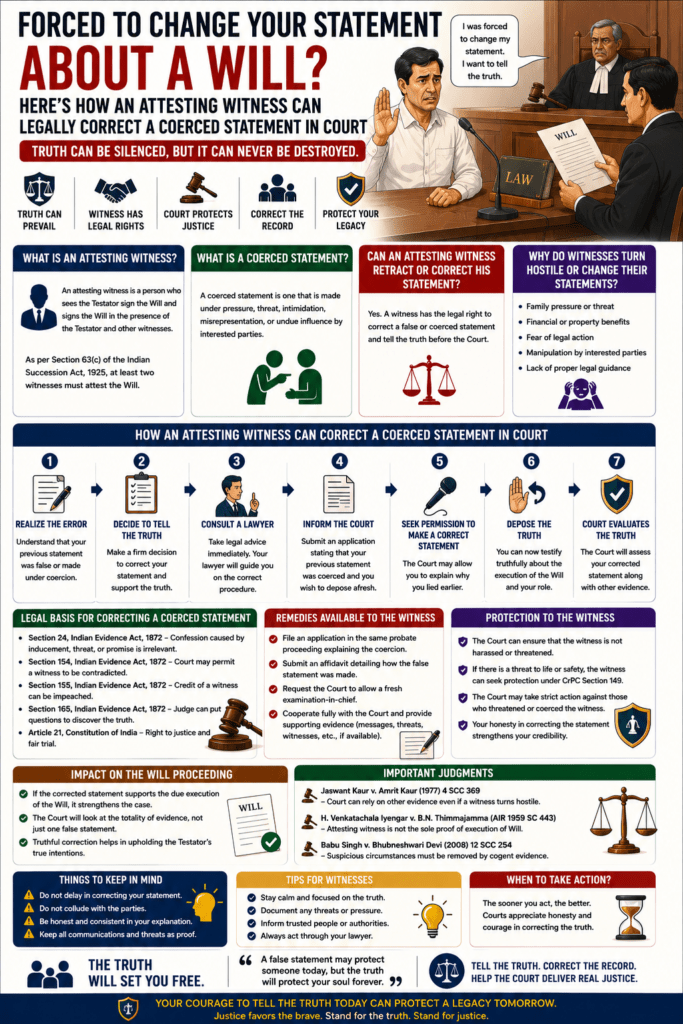
Can an Attesting Witness Withdraw an Earlier Statement?
Yes—but only through the proper legal process.
A witness cannot simply erase an earlier statement by sending another letter or affidavit and assume that the first one no longer exists.
Instead, when examined by the court, the witness should:
- disclose the earlier statement;
- explain why it was made;
- explain the circumstances of the alleged coercion or pressure; and
- give truthful evidence on oath.
The court will then evaluate the credibility of both versions.
What Does the Court Consider?
The court generally examines:
- whether coercion actually existed;
- whether there was intimidation or undue influence;
- whether the witness acted voluntarily;
- whether there is supporting evidence;
- whether the explanation is believable;
- whether other evidence supports or contradicts the witness.
The decision is based on the entire evidence, not merely on one document.
Does the Earlier Statement Automatically Become Invalid?
No.
An earlier statement does not automatically disappear.
Neither does the later statement automatically become true.
The court compares:
- both versions;
- documentary evidence;
- surrounding circumstances;
- testimony of other witnesses;
- conduct of the parties;
- probabilities of the case.
Ultimately, the court decides which version inspires confidence.
What Should the Witness Do Immediately?
If the witness genuinely believes that an earlier statement was obtained improperly, the following practical steps may be appropriate, depending on the facts:
1. Consult an Independent Lawyer
Obtain legal advice before making further statements.
2. Preserve Evidence
Keep records of:
- threatening messages;
- recordings, where lawfully available;
- emails;
- WhatsApp messages;
- witnesses to the intimidation;
- any other relevant material.
3. Tell the Truth Before the Court
The most important step is to give truthful evidence under oath and explain the circumstances in which the earlier statement was made.
4. Inform the Court About the Alleged Pressure
If coercion or intimidation is alleged, the witness should place those facts before the court.
5. Consider Separate Legal Remedies
If the facts disclose criminal intimidation, extortion, forgery, wrongful restraint, or similar offences, separate legal remedies may also be available, depending on the evidence and applicable law.
Can the Court Believe the Later Statement?
Yes.
There is no legal rule that the first statement must always be accepted or that the later statement must always be rejected.
The court evaluates:
- consistency;
- probability;
- corroboration;
- demeanour in court;
- surrounding circumstances;
- documentary evidence.
Will the Will Automatically Fail?
No.
Even if an attesting witness changes an earlier statement, the validity of the Will depends on whether the Will has been proved according to law.
The probate court examines:
- compliance with the Indian Succession Act;
- the testimony of attesting witnesses;
- surrounding circumstances;
- documentary evidence;
- whether suspicious circumstances, if any, have been satisfactorily explained.
Can the Witness Be Cross-Examined?
Yes.
If a witness changes an earlier version, cross-examination is expected.
The opposing party may question:
- why the earlier statement was made;
- when the witness decided to change it;
- whether there was actual coercion;
- whether the witness is now under different pressure.
The court ultimately decides which version is trustworthy.
What If the Witness Was Threatened?
If genuine threats exist, the witness should immediately:
- inform the court;
- seek legal advice;
- preserve evidence of intimidation;
- where appropriate, approach the police or other competent authorities if criminal offences are alleged.
Each case depends upon its own facts.
Jurisprudence Behind This Rule
The law seeks to protect both the truth and the integrity of judicial proceedings.
1. Truth Is the Primary Objective
The purpose of evidence is to help the court discover the truth.
2. Courts Decide Credibility
Courts—not private parties—determine which version of a witness is reliable.
3. Protection Against Witness Manipulation
The law discourages coercion, intimidation, and attempts to influence witnesses.
4. Fair Trial
Both sides receive an opportunity to test the witness through cross-examination.
Important Legal Principles
The law governing proof of Wills primarily comes from:
- Section 63 of the Indian Succession Act, 1925 (execution and attestation of Wills);
- the applicable provisions of the Bharatiya Sakshya Adhiniyam, 2023 (formerly the Indian Evidence Act, 1872), dealing with proof of documents, witness examination, cross-examination, and credibility.
The court assesses the evidence as a whole and is not bound to accept either the first or the later statement without scrutiny.
Practical Tips
✅ Always tell the truth when giving evidence.
✅ Never sign a statement without reading and understanding it.
✅ Keep copies of every statement you sign.
✅ Preserve evidence if you are being threatened or pressured.
✅ Inform your lawyer immediately if you believe your earlier statement was obtained improperly.
❌ Do not assume that writing a new affidavit automatically erases the earlier one.
❌ Do not give different versions without a truthful explanation.
❌ Do not conceal facts from the court.
Myth vs Reality
| Myth | Reality |
|---|---|
| I can simply withdraw my earlier statement by writing another letter. | False. The court must evaluate both statements and the explanation for the change. |
| If I change my statement, the Will automatically becomes invalid. | Incorrect. The validity of the Will depends on the totality of the evidence. |
| The court must always believe my first statement. | False. The court decides which version is credible after examining all the evidence. |
| A coerced statement can never be corrected. | Wrong. A witness should truthfully explain the circumstances before the court. |
| Changing a statement always means I committed a crime. | Not necessarily. The legal consequences depend on the facts, the reason for the change, and whether any false evidence was intentionally given. |
Frequently Asked Questions (FAQs)
Can I retract a statement obtained through coercion?
You cannot simply erase it, but you may explain the circumstances before the court and give truthful evidence on oath.
Will the court believe my new version?
The court will assess all the evidence and decide which version is reliable.
Will the probate case automatically fail?
No. The court decides whether the Will has been proved in accordance with law.
Can I be cross-examined?
Yes. The opposite party is entitled to question you about the change in your version.
What if I was threatened?
You should preserve evidence, seek legal advice, inform the court, and, where appropriate, consider the available legal remedies if criminal conduct is involved.
Landmark Judicial Principles
Indian courts have consistently held that probate proceedings are concerned with discovering whether the Will has been duly executed and proved. The court is not expected to accept or reject a witness merely because the witness changes a version. Instead, credibility is judged on the basis of the entire evidence.
Important Supreme Court decisions include:
- H. Venkatachala Iyengar v. B.N. Thimmajamma (1959) – Explained the burden of proving a Will and the role of surrounding circumstances.
- Jaswant Kaur v. Amrit Kaur (1977) – Held that suspicious circumstances must be satisfactorily explained before probate can be granted.
- Bharpur Singh v. Shamsher Singh (2009) – Reiterated that probate courts evaluate the totality of the evidence while determining whether the Will has been duly proved.
These judgments reinforce the principle that the court seeks the truth—not merely the first or the last version of a witness.
Key Takeaways
- A witness who claims that an earlier statement was obtained through coercion should disclose the true facts before the court.
- The earlier statement does not automatically disappear, nor does the later statement automatically prevail.
- The court decides which version is credible after examining all the evidence.
- The validity of the Will depends on compliance with the law and the overall evidence, not on one statement in isolation.
- If coercion or intimidation actually occurred, additional legal remedies may also be available depending on the facts.
Conclusion
Probate cases often involve family disputes, emotional pressure, and conflicting versions of events. An attesting witness who has signed or made an earlier statement under alleged coercion should not panic or attempt to privately “cancel” that statement. The correct legal course is to appear before the court, explain the circumstances honestly, and allow the judicial process to determine the truth.
Indian law recognises that witnesses can be influenced or intimidated. That is why courts evaluate the complete body of evidence, the credibility of the witness, and the surrounding circumstances before deciding whether a Will has been duly proved.
In probate litigation, the truth spoken on oath before the court carries far greater weight than pressure exerted behind closed doors.