- Introduction
- Is the Right to Protest Mentioned in the Constitution?
- Does This Mean I Can Protest Anywhere?
- Can Citizens Hold a Sit-In Protest (Dharna)?
- Can the Police Stop a Protest?
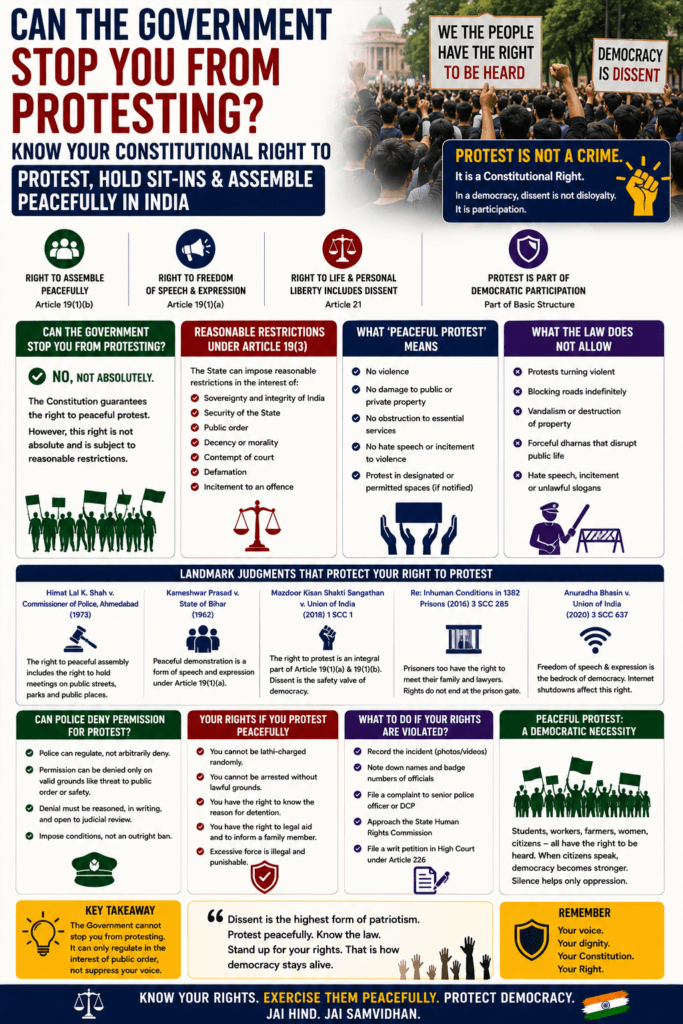
- What Are "Reasonable Restrictions"?
- Does Section 144 Automatically Ban Every Protest?
- Can the Police Lathi Charge Peaceful Protesters?
- Can Students Protest?
- What If My Right to Protest Is Violated?
- Jurisprudence Behind the Right to Protest
- Landmark Supreme Court Judgments
- Myth vs Reality
- Frequently Asked Questions
- Key Takeaways
- Conclusion
Introduction
Whenever citizens protest against a government decision, a university policy, rising prices, unemployment, or any public issue, one question repeatedly arises:
“Do citizens actually have a legal right to protest?”
Many people believe that:
- protests are illegal;
- police can stop any gathering at any time;
- permission from the government is always mandatory; or
- once Section 144 is imposed, every form of protest becomes automatically unlawful.
These assumptions are only partly true.
The Indian Constitution recognises the right to peaceful protest as an essential feature of democracy, but that right is not absolute. Like many constitutional freedoms, it exists alongside reasonable restrictions imposed in the interests of public order, security, and the rights of others.
This article explains where the law draws that line.
Is the Right to Protest Mentioned in the Constitution?
The Constitution does not expressly use the words “right to protest.”
However, the Supreme Court has repeatedly recognised that the right to peaceful protest flows from several Fundamental Rights.
These include:
Article 19(1)(a)
Freedom of speech and expression.
Every citizen has the right to express opinions peacefully.
Article 19(1)(b)
Right to assemble peacefully without arms.
This is the constitutional foundation of public demonstrations, marches, dharnas, and peaceful sit-ins.
Article 19(1)(c)
Right to form associations and unions.
This protects collective action by citizens.
Does This Mean I Can Protest Anywhere?
No.
This is one of the biggest misconceptions.
Although citizens have the right to protest, they do not have an unrestricted right to protest at any place, at any time, or in any manner they choose.
The State may regulate:
- the location of a protest;
- traffic management;
- public safety;
- noise levels;
- duration;
- crowd size;
- security arrangements.
Such regulation is constitutionally permissible provided it is reasonable and not arbitrary.
Can Citizens Hold a Sit-In Protest (Dharna)?
Yes, Peacefully.
A peaceful sit-in protest is generally protected by the Constitution.
However, the protection depends upon several factors:
- whether the gathering is peaceful;
- whether it remains unarmed;
- whether it obstructs essential public services;
- whether it creates serious public disorder;
- whether lawful restrictions have been imposed.
A peaceful protest does not automatically become illegal merely because it criticises the government.
Can the Police Stop a Protest?
Yes—but only in accordance with law.
The police have a statutory duty to maintain:
- public order;
- public safety;
- security;
- free movement of traffic; and
- protection of life and property.
If there is a genuine threat to public order, authorities may regulate, restrict, or, in appropriate circumstances, disperse an assembly.
However, every restriction must satisfy constitutional standards.
What Are “Reasonable Restrictions”?
Article 19 itself allows the State to impose reasonable restrictions in specified circumstances, including:
- public order;
- sovereignty and integrity of India;
- security of the State;
- morality;
- decency;
- other constitutionally recognised grounds.
The key word is “reasonable.”
Restrictions cannot be:
- arbitrary;
- excessive;
- discriminatory; or
- disproportionate.
Does Section 144 Automatically Ban Every Protest?
No.
An order under Section 163 of the Bharatiya Nagarik Suraksha Sanhita, 2023 (BNSS) (which corresponds to the former Section 144 CrPC) empowers an Executive Magistrate to issue urgent preventive directions in appropriate circumstances.
However:
- such orders are subject to judicial review;
- they must be based on objective material;
- they cannot be imposed mechanically or indefinitely;
- their necessity and proportionality may be challenged before the courts.
The mere existence of an order does not place executive action beyond constitutional scrutiny.
Can the Police Lathi Charge Peaceful Protesters?
Not merely because they are protesting.
If force is used, courts examine questions such as:
- Was the assembly peaceful?
- Was there violence?
- Was there a real threat to public order?
- Was force genuinely necessary?
- Was the force proportionate?
Even where police intervention is justified, excessive force may still be unlawful.
Can Students Protest?
Absolutely.
Students enjoy the same constitutional rights as every other citizen.
However, they are equally bound by the same constitutional limitations.
Neither students nor the police stand above the law.
What If My Right to Protest Is Violated?
Several legal remedies may be available, depending on the facts.
1. Writ Petition
A person may approach the High Court under Article 226 or, in appropriate cases, the Supreme Court under Article 32 for enforcement of fundamental rights.
2. Compensation
Where constitutional rights are violated through unlawful State action, courts have, in appropriate cases, awarded public law compensation.
3. Human Rights Commission
Complaints may be filed before the National Human Rights Commission (NHRC) or the State Human Rights Commission.
4. Civil and Criminal Remedies
Depending on the facts, additional civil or criminal remedies may also be available.
Jurisprudence Behind the Right to Protest
The constitutional philosophy is simple:
Democracy Requires Dissent
Peaceful disagreement is not a threat to democracy—it is one of its defining features.
Public Order Also Matters
The Constitution protects both:
- the right to protest; and
- the right of the public to safety, movement, and normal civic life.
The law therefore seeks to balance competing rights.
Doctrine of Proportionality
Restrictions must:
- pursue a legitimate objective;
- be necessary;
- impair rights as little as reasonably possible; and
- remain proportionate to the situation.
Landmark Supreme Court Judgments
Himat Lal K. Shah v. Commissioner of Police (1973)
The Supreme Court held that the State cannot impose a blanket prohibition on public meetings. While the government may regulate the use of public streets, it cannot extinguish the right to hold public meetings altogether.
Mazdoor Kisan Shakti Sangathan v. Union of India (2018)
The Court recognised that the right to peaceful protest is an important constitutional right but observed that it must coexist with the rights of other citizens.
Amit Sahni v. Commissioner of Police (Shaheen Bagh Case) (2020)
The Supreme Court held that public ways and public spaces cannot be occupied indefinitely in a manner that seriously disrupts the rights of others. At the same time, the judgment reaffirmed that peaceful protest remains a constitutional right and that appropriate spaces should ordinarily be made available.
Anita Thakur v. State of Jammu & Kashmir (2016)
The Supreme Court held that police action must remain proportionate and awarded compensation where excessive force had been used against protesters.
Myth vs Reality
| Myth | Reality |
|---|---|
| There is no right to protest in India. | False. Peaceful protest flows from Articles 19(1)(a), 19(1)(b), and 19(1)(c) of the Constitution. |
| Police can stop every protest. | False. Police may regulate or restrict protests only in accordance with law and constitutional standards. |
| Permission means the government can arbitrarily refuse every protest. | Incorrect. Regulatory powers must be exercised reasonably and are subject to judicial review. |
| Every sit-in protest is illegal. | False. Peaceful sit-ins are constitutionally protected, although they may be regulated to balance competing public interests. |
| If the police use excessive force, nothing can be done. | Wrong. Courts, human rights bodies, and other legal remedies remain available. |
Frequently Asked Questions
Can I legally participate in a protest?
Yes, provided it is peaceful and conducted in accordance with applicable law.
Can I organise a sit-in protest?
Yes, subject to reasonable regulations imposed in the interests recognised by Article 19.
Can the police remove protesters?
Yes, in appropriate circumstances where authorised by law, but the action must be necessary and proportionate.
Can I challenge restrictions on a protest?
Yes. Orders affecting your fundamental rights may be challenged before the High Court or the Supreme Court, depending on the circumstances.
Can I receive compensation for unlawful police action?
In appropriate cases, constitutional courts have awarded compensation for violations of fundamental rights.
Key Takeaways
- The Constitution protects the right to peaceful protest through Articles 19(1)(a), 19(1)(b), and 19(1)(c).
- This right is fundamental but not absolute.
- The State may impose reasonable restrictions in the interests of public order and other constitutionally recognised grounds.
- Police action must always be lawful, necessary, and proportionate.
- If restrictions are arbitrary or force is excessive, affected citizens may seek judicial remedies.
Conclusion
The right to protest is one of the clearest expressions of democratic participation. It allows citizens to question authority, demand accountability, and voice dissent without fear. At the same time, democracy also requires that public order and the rights of others be respected.
The Constitution therefore strikes a careful balance. It protects peaceful assembly, but it also permits reasonable regulation when genuinely necessary. The ultimate question in every dispute is not whether a protest occurred, but whether the State’s response was lawful, reasonable, and proportionate.
A constitutional democracy is strongest not when protests are silenced, but when both the citizen’s right to dissent and the State’s duty to maintain public order are exercised within the boundaries of the Constitution.