
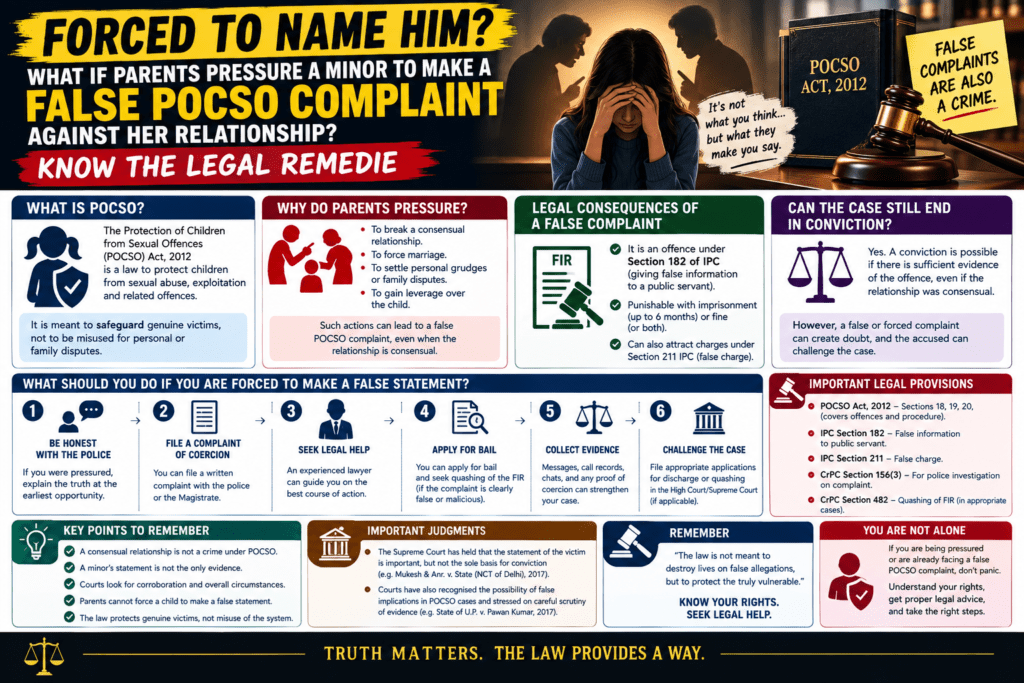
- First: The Most Important Rule — A Minor Cannot Give Legally Valid Consent to Sexual Activity Under POCSO
- What If the Relationship Was Genuine but the Parents Opposed It?
- What If the Parents Forced the Victim to Give a False Statement?
- A Change of Statement Is Important — But It Does Not Automatically Prove Tutoring
- What Happens to the Section 183 Statement?
- Can the Accused Get Bail If the Victim Says She Was Forced by Her Parents?
- What If the Victim Herself Tells the Court That Her Parents Forced Her?
- Can a False POCSO FIR Be Quashed?
- What About Section 29 POCSO?
- Can the Accused Prove That the Relationship Was Genuine?
- What If the Parents Manufactured the Allegation to Separate the Couple?
- Can the Accused File a Counter-Case Against the Parents?
- What Should the Accused Do Immediately After the FIR?
- Step 4 — Obtain the FIR and Investigation Material
- Step 5 — Prepare a “Statement Comparison Chart”
- Step 6 — Examine the Age Evidence
- Step 7 — Examine the Medical and Forensic Evidence
- What If the Victim Says She Was in a Relationship With the Accused?
- What If the Victim Initially Supports the FIR But Later Says Her Parents Forced Her?
- What If the Victim Does Not Support the Prosecution During Trial?
- Can the Victim's Statement Help the Accused Even If She Is a Minor?
- Myth vs Reality
- Important Jurisprudential Principles
- Can the High Court Quash Such a Case?
- What Is the Best Legal Strategy in Such a Case?
- Frequently Asked Questions
- Can parents force their daughter to make a false POCSO allegation?
- Can an accused challenge a POCSO FIR if the victim later says it was false?
- Does a relationship with a minor automatically mean the accused will be convicted?
- Can the victim's statement that her parents pressured her help in bail?
- Can parents be prosecuted for making a false POCSO case?
- Should the accused contact the victim after the FIR?
- Final Takeaway
- If a child below 18 has actually been subjected to conduct constituting a POCSO offence, the existence of a romantic relationship or the child's willingness does not by itself provide a defence.
- If there is credible evidence that the allegation itself was manufactured, exaggerated or induced through pressure, tutoring or coercion, the accused is entitled to challenge the prosecution case through the remedies available in law.
INTRODUCTION:
A romantic relationship involving a person below 18 can quickly become a serious criminal case when the relationship is opposed by the child’s family.
Sometimes, the allegation may be genuine and require strict legal action. But there can also be cases where the family strongly objects to the relationship and the accused alleges that the child was pressured, threatened, tutored or compelled to make allegations against the person she was actually in a relationship with.
This raises several difficult legal questions:
- What if the victim initially gives a statement against the accused because of pressure from her parents?
- What if she later tells the police or Court that the allegations were false?
- Can the accused obtain bail?
- Can the FIR be quashed?
- Can the statement recorded under Section 183 BNSS be challenged?
- What happens if the victim tells the Court that her parents forced her to make the allegations?
- Can action be taken against persons who deliberately fabricate evidence?
- Does a romantic relationship protect the accused from POCSO?
The answer requires a careful distinction between a genuine POCSO offence, a consensual relationship involving a child, and an allegation that has been falsely created or exaggerated because of family opposition.
First: The Most Important Rule — A Minor Cannot Give Legally Valid Consent to Sexual Activity Under POCSO
This point must be understood before discussing false implication.
Under the POCSO Act, a child means a person below 18 years of age.
Therefore, if the prosecution establishes that the accused committed an act falling within a POCSO offence, the fact that the child says:
“I loved him.”
or
“I voluntarily went with him.”
or
“We were in a relationship.”
does not by itself provide a complete legal defence.
The Supreme Court has repeatedly recognized that the statutory scheme of POCSO applies to sexual acts involving children irrespective of whether the child describes the relationship as consensual.
At the same time, the prosecution must still prove the ingredients of the particular offence alleged.
That distinction becomes extremely important when the allegation itself is disputed.
What If the Relationship Was Genuine but the Parents Opposed It?
This is where the factual circumstances become important.
Imagine a situation where:
- a young person and a minor girl are in a relationship;
- the family discovers the relationship;
- the family strongly opposes it;
- the girl is taken away from the accused;
- an FIR is subsequently registered;
- allegations are made against the accused;
- the accused is arrested;
- but later the girl tells the Magistrate or Court that she was in a relationship with the accused and that her earlier allegations were made because of pressure from her family.
The Court cannot simply decide the case by asking:
“Was there a relationship?”
It has to examine the specific offence alleged and the evidence supporting it.
A relationship may be relevant to the factual assessment, but it does not automatically legalise sexual conduct with a child.
What If the Parents Forced the Victim to Give a False Statement?
If there is credible evidence that the child was threatened, coerced, tutored or pressured into making a false statement, that fact can become highly relevant to the criminal proceedings.
However, simply making such an allegation in a bail application is not enough.
The defence should attempt to establish it through objective material, such as:
- subsequent statements of the victim;
- statements before a Magistrate;
- messages or communications;
- call records, where legally obtainable and relevant;
- CCTV footage;
- school or other contemporaneous records;
- statements of independent witnesses;
- evidence regarding how the victim was taken away;
- inconsistencies between different versions;
- unexplained improvements in the allegations;
- circumstances surrounding the registration of the FIR; and
- other reliable material demonstrating pressure or tutoring.
The Court will ultimately assess the credibility of the competing versions.
A Change of Statement Is Important — But It Does Not Automatically Prove Tutoring
This is an important distinction.
Suppose the victim initially makes allegations against the accused but later says:
“My parents forced me to say this.”
That later statement is obviously relevant.
But the Court will still ask:
Why should the later statement be believed?
Similarly, if the victim initially supports the allegation and later retracts it, the prosecution may argue that she was subsequently pressured by the accused or his family.
Therefore, the Court has to examine the entire chain of circumstances, rather than automatically accepting either version.
What Happens to the Section 183 Statement?
A statement recorded before a Magistrate under the earlier Section 183 BNSS framework is often extremely important in POCSO proceedings.
But it should not be misunderstood as an automatic conviction.
The evidentiary significance of a previous statement depends upon:
- who recorded it;
- the statutory provision under which it was recorded;
- whether it was voluntarily made;
- how it is proved;
- whether the maker confirms or denies it;
- contradictions between the statement and subsequent testimony; and
- the applicable rules of evidence.
If the victim later states that she was forced or tutored to make the earlier statement, the Court can examine the circumstances in which that statement was recorded.
The accused should therefore not merely argue:
“She has changed her statement.”
The stronger legal argument is:
“The prosecution’s different versions must be tested against the circumstances in which each statement was made and against the objective evidence on record.”
Can the Accused Get Bail If the Victim Says She Was Forced by Her Parents?
Yes, it can become a significant ground for bail—but it does not guarantee bail.
The Court may examine:
- the age of the victim;
- the nature of the alleged offence;
- the period of custody;
- the material collected during investigation;
- the victim’s statements;
- whether the victim supports the prosecution;
- whether there are contradictions;
- medical and forensic evidence;
- whether the accused has criminal antecedents;
- whether there is a possibility of influencing witnesses;
- whether the accused is likely to abscond; and
- the overall circumstances of the case.
If the victim herself gives a credible statement that the allegation was fabricated or that she was pressured into making it, that can materially affect the Court’s assessment of the prosecution case.
But because POCSO offences concern children, Courts ordinarily approach such matters with considerable caution.
What If the Victim Herself Tells the Court That Her Parents Forced Her?
This can become one of the most significant developments in the case.
The Court may then examine:
1. Her earlier statement
What exactly did she originally allege?
2. Her later statement
What exactly does she now say?
3. The reason for the change
Does she provide a coherent explanation?
4. Independent evidence
Does anything corroborate either version?
5. Medical and forensic evidence
Does the scientific evidence support the allegation?
6. Conduct of the parties
What happened before and after the FIR?
7. Communications
Are there messages or other contemporaneous material demonstrating a romantic relationship or family pressure?
The answer will ultimately depend on the evidence.
Can a False POCSO FIR Be Quashed?
In appropriate cases, yes, a High Court can exercise its inherent/constitutional jurisdiction to prevent abuse of the process of law, subject to the applicable procedural law and the facts of the case.
But quashing is an exceptional remedy.
The High Court generally does not conduct a mini-trial while deciding a quashing petition.
The Court ordinarily examines whether the allegations, taken at their face value, disclose an offence and whether continuation of the proceedings would amount to abuse of process or otherwise warrant interference under the governing principles.
Where the prosecution evidence itself has subsequently become demonstrably unreliable or the foundational facts necessary for the offence are absent, the defence may explore appropriate remedies at the correct procedural stage.
What About Section 29 POCSO?
This is one of the most important provisions in such cases.
Section 29 provides a statutory presumption for specified offences under POCSO.
But it is not a substitute for proving the foundational facts of the prosecution case.
The Supreme Court’s decision in Sambhubhai Raisangbhai Padhiyar v. State of Gujarat, (2025) 2 SCC 399, is important in this context.
The Court has emphasized the importance of the prosecution first establishing the foundational facts before the statutory presumption can operate.
This means that the defence should not merely say:
“Section 29 is unconstitutional” or “Section 29 does not apply.”
Instead, the legally stronger question is:
“Have the foundational facts necessary for invoking the statutory presumption actually been established?”
That can become particularly significant where the prosecution’s own evidence is seriously disputed.
Can the Accused Prove That the Relationship Was Genuine?
Yes, where relevant and legally admissible.
The defence may examine material such as:
- photographs;
- messages;
- social-media communications;
- call records, where lawfully obtained and relevant;
- travel records;
- CCTV footage;
- letters;
- emails;
- statements of independent witnesses;
- evidence showing that the parties were voluntarily meeting;
- evidence concerning the circumstances in which the girl left home; and
- other contemporaneous material.
But there is an important warning:
A romantic relationship is not itself a defence to POCSO.
It may, however, be relevant to determining:
- whether the allegations of force or coercion are credible;
- whether the prosecution version is internally consistent;
- whether the accused committed the specific offence alleged;
- whether the parties were actually in a relationship;
- whether the subsequent allegations were influenced by family circumstances; and
- whether the prosecution has established the foundational facts.
What If the Parents Manufactured the Allegation to Separate the Couple?
If the evidence ultimately establishes that persons deliberately fabricated a criminal allegation, created false evidence or knowingly set the criminal law in motion against an innocent person, separate legal consequences may potentially arise.
Depending on the precise conduct and evidence, the case may involve provisions relating to:
- giving false information;
- giving false evidence;
- fabricating evidence;
- false charges;
- witness intimidation or influence;
- obstruction of justice; or
- other applicable offences.
However, a case ending in acquittal does not automatically mean that the informant committed a crime.
This distinction is extremely important.
An acquittal means that the prosecution failed to establish guilt to the required standard. It does not automatically establish that the FIR was deliberately fabricated.
For action against the complainant or another person, there generally must be an appropriate factual and legal foundation.
Can the Accused File a Counter-Case Against the Parents?
Potentially, yes—but it should not be done merely as retaliation.
If there is credible evidence that the parents:
- knowingly fabricated allegations;
- threatened the victim;
- forced her to make a false statement;
- deliberately manufactured evidence;
- intimidated witnesses; or
- knowingly initiated false criminal proceedings,
appropriate legal remedies may be considered.
The exact remedy depends upon what actually happened and what evidence is available.
The accused should first preserve the material demonstrating the alleged coercion rather than immediately filing multiple retaliatory complaints.
What Should the Accused Do Immediately After the FIR?
Step 1 — Do Not Contact the Victim
This is extremely important.
Even if the relationship was genuine, the accused should avoid direct contact that could later be portrayed as:
- intimidation;
- inducement;
- influence;
- witness tampering; or
- an attempt to change testimony.
Step 2 — Preserve Existing Evidence
Do not delete:
- WhatsApp chats;
- SMS;
- emails;
- photographs;
- social-media conversations;
- call records already lawfully available;
- travel records; or
- other relevant material.
Deleting material after registration of an FIR can create unnecessary complications.
Step 3 — Apply for Appropriate Bail
Depending on whether arrest has occurred and the applicable procedural circumstances, the accused may consider:
- anticipatory bail;
- regular bail; or
- other appropriate interim protection.
The fact that the victim has subsequently given a statement inconsistent with the FIR may become a relevant circumstance, but the application must present the evidence carefully.
Step 4 — Obtain the FIR and Investigation Material
The defence should carefully examine:
- FIR;
- victim’s statements;
- medical examination;
- age documents;
- electronic evidence;
- seizure memos;
- forensic reports;
- statements of witnesses;
- supplementary charge-sheet, if any;
- arrest documents; and
- other investigation material.
A POCSO case should never be analysed only from the FIR.
Step 5 — Prepare a “Statement Comparison Chart”
This can be extremely useful.
Compare:
FIR → Police Statement → Magistrate Statement → Medical History → Court Testimony
Look for:
- material contradictions;
- omissions;
- improvements;
- new allegations;
- changes in dates;
- changes in locations;
- changes in the description of the alleged act;
- changes concerning force or coercion;
- changes concerning the relationship; and
- inconsistencies with objective evidence.
This is often much more useful than simply describing the case as a “false POCSO case.”
Step 6 — Examine the Age Evidence
The exact age of the victim on the alleged date of occurrence is legally crucial.
The defence should scrutinize the documents relied upon to establish age and challenge them where there is a legally sustainable basis.
The Supreme Court has continued to emphasize the importance of proper age determination in POCSO proceedings.
Step 7 — Examine the Medical and Forensic Evidence
If the allegation involves penetrative sexual assault, the defence should examine:
- medical examination;
- biological samples;
- DNA/FSL findings;
- injuries;
- timing;
- medical history; and
- other scientific evidence.
Medical evidence is not automatically conclusive either way, but inconsistencies between the allegation and objective evidence can become relevant.
What If the Victim Says She Was in a Relationship With the Accused?
This requires particularly careful handling.
The Supreme Court has dealt with cases involving relationships between young persons and allegations subsequently made when the relationship became disputed.
In a 2025 order, the Supreme Court considered a case where the prosecutrix stated that she had consented to a sexual relationship and the allegation under POCSO was made years later; the Court noted the absence of forensic evidence and considered the circumstances of the relationship.
However, this should not be interpreted as saying that a romantic relationship automatically defeats a POCSO prosecution.
The critical question remains whether the prosecution has established the specific statutory offence alleged.
What If the Victim Initially Supports the FIR But Later Says Her Parents Forced Her?
This is a classic evidentiary conflict.
The Court may ask:
Which version is reliable, and why?
Neither version automatically wins.
The defence should demonstrate, wherever possible:
- when the relationship began;
- how the family discovered it;
- what happened immediately thereafter;
- when the FIR was registered;
- what the victim said at each stage;
- whether the allegations developed progressively;
- whether objective evidence contradicts the allegations; and
- whether the subsequent explanation of parental pressure is supported by independent circumstances.
What If the Victim Does Not Support the Prosecution During Trial?
This can substantially affect the prosecution case.
But, as explained above, a hostile witness does not automatically mean acquittal.
The Supreme Court has made it clear that a witness’s testimony must be evaluated as a whole, and that false allegations can cause serious prejudice to an accused as well.
In an appropriate case, if the victim’s evidence destroys the prosecution’s central allegation and there is no reliable corroborative material, the accused may be entitled to the benefit of reasonable doubt.
Can the Victim’s Statement Help the Accused Even If She Is a Minor?
Yes, her testimony remains evidence that the Court must evaluate.
But this does not mean that the Court will automatically accept a minor’s later statement simply because it favours the accused.
The Court has to determine whether the statement is:
- voluntary;
- credible;
- consistent;
- supported by surrounding circumstances; and
- free from improper influence.
The Supreme Court has itself considered cases where the victim’s conduct and subsequent testimony were relevant in assessing whether the prosecution had proved the alleged POCSO offence.
Myth vs Reality
| Myth | Reality |
|---|---|
| “If the parents filed the FIR, it must be true.” | No. Every criminal allegation must ultimately be tested against evidence. |
| “If the girl says her parents forced her, the accused is automatically acquitted.” | No. The Court must assess the credibility of the later statement and the remaining evidence. |
| “A romantic relationship completely protects the accused from POCSO.” | No. A minor’s consent is not a complete defence to conduct that constitutes a POCSO offence. |
| “Section 29 means the accused has to prove everything immediately.” | The prosecution must first establish the foundational facts necessary for the statutory presumption. |
| “If the accused is acquitted, the parents automatically go to jail for filing a false case.” | No. Deliberate fabrication must itself be established before separate criminal consequences follow. |
| “The FIR itself proves the offence.” | No. An FIR sets the criminal law in motion; it is not by itself proof of guilt. |
| “The victim’s first statement is always final.” | No. The Court can examine subsequent statements, contradictions and the circumstances in which different statements were made. |
| “The victim’s later statement is always true because she is a minor.” | No. The Court assesses the reliability of every relevant piece of evidence. |
| “The accused should contact the victim and ask her to tell the truth.” | This can be extremely risky and may be portrayed as witness influence or intimidation. |
| “Deleting old chats is harmless.” | It can create serious evidentiary and credibility problems. Relevant material should be preserved. |
Important Jurisprudential Principles
1. POCSO protects children—but criminal liability still requires proof of the offence
The protective purpose of POCSO cannot be converted into a rule that every allegation automatically results in conviction.
The prosecution must establish the ingredients of the offence charged.
2. A romantic relationship does not automatically defeat POCSO
Where the victim was below 18, the concept of legally valid consent operates differently under POCSO.
Therefore, the defence should focus on the actual ingredients of the offence and the reliability of the prosecution evidence, rather than relying solely upon the expression “consensual relationship.”
3. Section 29 is not a substitute for foundational facts
The prosecution must first establish the necessary foundational facts before the statutory presumption can operate.
This principle is particularly important where the prosecution evidence itself is seriously disputed.
4. False implication is a legally relevant possibility—but must be proved
The Supreme Court has expressly recognized that false allegations of serious sexual offences can cause substantial prejudice and damage to an accused.
But the defence must distinguish between:
“The prosecution failed to prove the case”
and
“The prosecution deliberately fabricated a false case.”
They are not the same legal conclusion.
Can the High Court Quash Such a Case?
In an appropriate case, the High Court’s inherent or constitutional jurisdiction can be invoked where continuation of criminal proceedings would amount to an abuse of process or where the case falls within established principles for interference.
However, the High Court generally does not conduct a full-fledged appreciation of disputed evidence at the quashing stage.
Therefore, the appropriate remedy may differ depending on whether the matter is at the stage of:
FIR → Investigation → Arrest → Bail → Charge-sheet → Cognizance → Charge → Trial → Evidence → Judgment → Appeal
The strategy must change with the stage of the case.
What Is the Best Legal Strategy in Such a Case?
The strongest defence is usually evidence-based rather than allegation-based.
Instead of merely saying:
“The parents are lying.”
the defence should demonstrate:
“Here is the contemporaneous evidence showing the relationship; here are the different versions given by the prosecutrix; here are the material contradictions; here is the objective evidence inconsistent with the prosecution version; and here is the evidence explaining why the earlier allegation may have been made under pressure.”
That is a much stronger legal presentation.
Frequently Asked Questions
Can parents force their daughter to make a false POCSO allegation?
No. If a person knowingly coerces or induces another person to make false allegations or fabricate evidence, legal consequences may follow depending upon the conduct and applicable law.
Can an accused challenge a POCSO FIR if the victim later says it was false?
Yes, appropriate remedies may be considered depending upon the stage of proceedings and the evidence available. These can include bail, discharge, quashing or defence during trial.
Does a relationship with a minor automatically mean the accused will be convicted?
No. The prosecution still has to establish the ingredients of the specific offence charged. However, a minor’s consent does not by itself provide a defence to conduct constituting an offence under POCSO.
Can the victim’s statement that her parents pressured her help in bail?
Yes. If supported by credible circumstances, it can be a relevant factor in assessing the prosecution case and the bail request.
Can parents be prosecuted for making a false POCSO case?
Potentially, but an acquittal alone does not automatically establish that the parents knowingly fabricated the case. Deliberate falsehood or fabrication must have an appropriate evidentiary and legal foundation.
Should the accused contact the victim after the FIR?
Generally, the accused should exercise extreme caution and obtain legal advice before any contact. Attempts to influence a witness can create serious additional legal problems.
Final Takeaway
A POCSO case arising out of a disputed romantic relationship requires two things to be kept separate.
First:
If a child below 18 has actually been subjected to conduct constituting a POCSO offence, the existence of a romantic relationship or the child’s willingness does not by itself provide a defence.
Second:
If there is credible evidence that the allegation itself was manufactured, exaggerated or induced through pressure, tutoring or coercion, the accused is entitled to challenge the prosecution case through the remedies available in law.
The key is not simply to label a case as a “false POCSO case.”
The real legal question is:
Can the prosecution’s version withstand scrutiny when the victim’s different statements, the circumstances surrounding the FIR, age proof, medical and forensic evidence, electronic material and other objective evidence are examined together?
Where the evidence raises genuine and material doubts about the prosecution’s version, the accused can seek the protection of the criminal justice system through bail, discharge, quashing, trial remedies or appeal, as the circumstances warrant.
And where there is credible evidence of deliberate fabrication or coercion by any person, separate legal remedies may also be available—but they should be pursued on evidence, not merely as retaliation.