
Can a new law change the legal consequences of something that happened years ago?
This is one of the most important questions in statutory interpretation.
Whenever Parliament or a State Legislature introduces a new law or amends an existing law, one question immediately arises:
Does the new law apply only to future events, or can it affect transactions, rights, liabilities or proceedings connected with the past?
This is where the concepts of retrospective law and retroactive law become important.
Although the two expressions are often used interchangeably, the Supreme Court of India has explained that they are not necessarily identical concepts. The distinction becomes particularly important when a new legislation affects existing rights, pending proceedings, completed transactions, limitation periods, liabilities or criminal consequences.
The Supreme Court has repeatedly examined these principles, including in Vineeta Sharma v. Rakesh Sharma, State Bank’s Staff Union (Madras Circle) v. Union of India, Shanti Conductors Pvt. Ltd. v. Assam State Electricity Board, and Hitendra Vishnu Thakur v. State of Maharashtra.
What Does “Retrospective” Mean in Law?
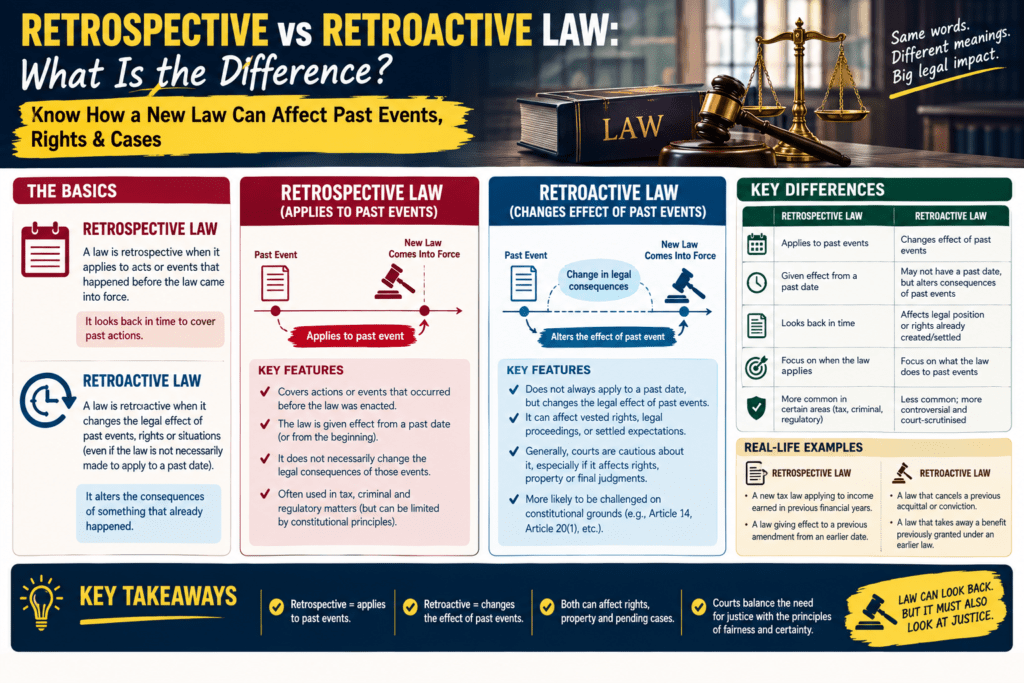
In simple terms, a law is generally described as retrospective when it operates on past events, transactions, rights or liabilities.
For example:
Suppose a law is enacted in 2026, but it provides that a particular legal consequence will apply to transactions that took place in 2024.
The law is looking backwards and attaching legal consequences to something that occurred before the law came into force.
The Supreme Court has explained that a retrospective statute may operate upon matters arising before its commencement, including where it affects rights or consequences flowing from earlier transactions.
Simple example
Imagine:
- A transaction takes place in 2024.
- A new law is enacted in 2026.
- The new law expressly states that it shall apply to transactions undertaken from 2024.
The question would then be whether the legislature intended the law to operate retrospectively and whether such retrospective operation is constitutionally permissible.
What Does “Retroactive” Mean in Law?
The expression retroactive has a slightly different legal significance.
The Supreme Court has explained that retroactivity can include the application of a new legal rule to an act or transaction that has already been completed. It has also recognised the concept of “quasi-retroactivity”, where a new rule operates upon a transaction that was already in the process of completion when the new law came into force.
In Vineeta Sharma v. Rakesh Sharma, the Supreme Court explained the distinction by stating that a retroactive statute may operate in futuro, but its operation can depend upon a character, status or event that arose in the past.
A simple illustration
Suppose:
- A person acquires a particular legal status in 2024.
- A law comes into force in 2026.
- The law operates prospectively from 2026 but uses that pre-existing status as one of the conditions for determining future rights.
That does not necessarily mean that the law is retrospectively rewriting the past event.
This distinction can be extremely important in litigation.
Retrospective vs Retroactive: What Is the Difference?
The distinction can be understood like this:
| Retrospective | Retroactive |
|---|---|
| Looks back to the past | Operates on the basis of an earlier event or status |
| May affect past transactions or rights | May operate in the future while relying upon past facts |
| Often involves attaching legal consequences to past events | Can involve a continuing or incomplete transaction |
| Can affect vested rights | Does not automatically mean that vested rights are destroyed |
| Court examines legislative intention carefully | Court examines the nature and effect of the new law |
However, the terminology should not be treated mechanically.
The Supreme Court has itself observed that the expressions “retrospective” and “retroactive” are sometimes used interchangeably, even though their underlying concepts can be distinguished.
Therefore, the actual operation and legal effect of the provision are more important than merely the label attached to it.
Why Does This Difference Matter?
This is not merely a technical difference between two legal words.
It can determine:
- whether a new amendment applies to your case;
- whether your accrued right is protected;
- whether a pending proceeding is governed by the old or new law;
- whether a new liability can be imposed;
- whether a limitation amendment applies to an existing cause of action;
- whether a new procedure applies to pending proceedings;
- whether a new law can affect completed transactions;
- whether a criminal provision can apply to an act committed before its enactment.
In other words, the temporal operation of a statute can directly affect a person’s legal rights and liabilities.
The General Rule: Laws Are Normally Prospective
One of the fundamental principles of statutory interpretation is that legislation is ordinarily presumed to operate prospectively, unless the legislature clearly indicates otherwise.
The Supreme Court has repeatedly held that a statute affecting substantive rights is ordinarily presumed to be prospective unless retrospective operation is expressly provided or necessarily intended.
This principle protects legal certainty.
A person should ordinarily be able to know the legal consequences of his conduct according to the law applicable when that conduct occurred.
Can Parliament Make a Law Retrospective?
Yes — but there are constitutional limits.
The legislature generally possesses the power to enact retrospective legislation, provided that the legislation does not violate constitutional limitations.
The mere fact that a law operates retrospectively does not automatically make it unconstitutional.
However, a retrospective law may still be challenged if, for example, it:
- violates a fundamental right;
- is manifestly arbitrary;
- violates constitutional limitations;
- improperly takes away vested rights;
- imposes impermissible criminal liability for past conduct;
- exceeds legislative competence; or
- otherwise violates the Constitution.
The Supreme Court has clarified that both prospective and retrospective laws can be tested against constitutional guarantees such as Article 14.
Retrospective Criminal Law: A Special Constitutional Protection
Criminal law stands on a particularly important footing.
Article 20(1) of the Constitution
Article 20(1) protects a person against conviction for an act which was not an offence under the law in force when the act was committed.
It also protects against a penalty greater than the penalty prescribed by law at the time of commission of the offence.
Therefore, the State cannot ordinarily enact a criminal provision today and use it to retrospectively punish conduct which was not an offence when it was committed.
The Supreme Court has emphasised that the expression “law in force” in Article 20(1) refers to the law actually operating at the relevant time and cannot be artificially converted into a retrospective law merely by deeming it to have existed earlier.
Example
Suppose an act was completely lawful in 2024.
A new statute in 2026 declares that the same act is a criminal offence.
The person cannot ordinarily be convicted under that new offence for having committed the act in 2024.
This is one of the strongest constitutional protections against retrospective criminalisation.
What About Procedural Laws?
Here the position can be different.
The Supreme Court has traditionally distinguished between:
Substantive law
Law dealing with substantive rights, liabilities and obligations.
Procedural law
Law dealing with the manner in which rights and liabilities are enforced.
A procedural amendment is generally more capable of applying to pending proceedings than an amendment which changes substantive rights.
In Hitendra Vishnu Thakur v. State of Maharashtra, the Supreme Court laid down important principles regarding retrospective operation, including that procedural provisions are generally presumed to apply retrospectively unless such interpretation is textually impossible. However, a procedural amendment should not ordinarily be applied retrospectively if doing so creates new disabilities, obligations or duties in relation to transactions that have already been completed.
Substantive Rights vs Procedural Rights
This distinction is extremely important.
Substantive right
A substantive right is a right which affects the legal position of a person.
For example:
- right to property;
- right to receive a particular benefit;
- accrued contractual rights;
- certain vested rights;
- substantive right of appeal.
Such rights are ordinarily not taken away retrospectively unless the legislature clearly intends such an effect and the Constitution permits it.
Procedural right
A procedural provision generally regulates how a case is brought, investigated, heard or decided.
Examples can include:
- forum;
- procedure for filing;
- manner of conducting proceedings;
- procedural requirements.
Such provisions are more likely to apply to pending matters.
But even here, procedure is not an unlimited category.
If an apparently procedural amendment actually creates a new disability or takes away a substantive right, the court may examine its real effect rather than simply accepting its label.
What About Limitation Laws?
Limitation provisions require particularly careful examination.
The Supreme Court has recognised that limitation is generally procedural, but an amendment affecting limitation may have substantive consequences in a particular case.
For instance, if applying a new limitation provision to a past cause of action would effectively revive an extinguished right or extinguish an existing right of action, the court may have to examine whether the provision can truly be treated as merely procedural.
Therefore:
Calling a provision “procedural” does not automatically settle the question of retrospectivity.
The court looks at its real legal effect.
What Is “Quasi-Retroactivity”?
This is another concept which is often overlooked.
The Supreme Court has referred to two broad forms of retroactivity:
True retroactivity
A new rule is applied to an act or transaction which was already completed before the new rule came into force.
Quasi-retroactivity
The transaction was already underway, but had not yet been completed when the new law came into force.
This distinction is important because pending or incomplete transactions can sometimes legitimately be subjected to the new legal regime, depending on the statutory scheme and legislative intention.
What Happens to Pending Cases When the Law Changes?
This is one of the most common practical questions.
Suppose:
2024: A person files a case.
2026: The legislature changes the law.
2026: The case is still pending.
Which law applies?
The answer is:
It depends upon the nature of the amendment.
If the amendment changes the procedure, it may ordinarily apply to pending proceedings.
If it changes a substantive right, the court will generally presume that the existing substantive right is protected unless retrospective operation is clearly intended.
The Supreme Court has repeatedly applied this distinction while dealing with amendments affecting pending proceedings.
Important Supreme Court Cases on Retrospective and Retroactive Laws
1. Vineeta Sharma v. Rakesh Sharma, (2020) 9 SCC 1
This is one of the leading authorities explaining the distinction between prospective, retrospective and retroactive operation.
The Supreme Court explained that a prospective statute operates from its enactment; a retrospective statute operates backwards; while a retroactive statute may operate in the future based upon a character, status or event that arose earlier.
Why is it important?
Because it provides a clear conceptual framework for understanding these three expressions.
2. State Bank’s Staff Union (Madras Circle) v. Union of India, (2005) 7 SCC 584
The Supreme Court discussed the concepts of true retroactivity and quasi-retroactivity.
The important distinction is whether the new rule is being applied to a transaction which was already completed or to one which was still in the process of completion.
3. Shanti Conductors Pvt. Ltd. v. Assam State Electricity Board
The Supreme Court explained that retroactivity involves applying a new rule to an act or transaction completed before the rule was promulgated.
The Court also emphasised that a statute should not be described as retroactive merely because some historical circumstance is relevant to its future operation.
4. Hitendra Vishnu Thakur v. State of Maharashtra, (1994) 4 SCC 602
This remains an important authority on the distinction between substantive and procedural law.
The Court held, inter alia, that substantive provisions are ordinarily prospective unless retrospective operation is expressly or necessarily intended, whereas procedural provisions may generally operate retrospectively, subject to important limitations.
Myth vs Reality
MYTH 1: Every retrospective law is unconstitutional.
REALITY: No.
The legislature can enact retrospective legislation, subject to constitutional limitations.
The question is not simply whether the law is retrospective. The court must examine what the law does and whether its operation is constitutionally permissible.
MYTH 2: Retrospective and retroactive mean exactly the same thing.
REALITY: Not necessarily.
The Supreme Court has recognised distinctions between the concepts, particularly between true retroactivity and quasi-retroactivity.
MYTH 3: Procedural laws can never apply to old or pending cases.
REALITY: Wrong.
Procedural amendments are generally more capable of applying to pending proceedings.
However, if the so-called procedural change creates new disabilities or affects substantive rights, the court may refuse to give it retrospective application.
MYTH 4: If a law affects an old transaction, it is automatically retrospective.
REALITY: Not always.
A law may operate prospectively while taking into account an event, status or condition that originated in the past.
The Supreme Court has specifically recognised this distinction.
MYTH 5: A new criminal law can punish conduct committed before the law came into force.
REALITY: Article 20(1) provides strong constitutional protection against this.
A person cannot ordinarily be convicted for an act which was not an offence under the law in force when the act was committed, nor subjected to a greater penalty than the one applicable at that time.
How Do Courts Decide Whether a Law Is Retrospective?
Courts generally examine several factors, including:
1. The language of the statute
Does Parliament expressly state that the provision shall operate from an earlier date?
2. Legislative intention
Even where the word “retrospective” is not expressly used, the overall scheme may reveal legislative intention.
3. Nature of the right affected
Is the amendment affecting a substantive or vested right?
4. Nature of the provision
Is it substantive, procedural or mixed?
5. Whether the transaction was complete
A completed transaction receives different treatment from an ongoing transaction.
6. Whether a new liability is being created
A new obligation imposed upon a completed transaction raises a stronger question of retrospectivity.
7. Constitutional limitations
Even if retrospective operation is intended, the provision must remain within constitutional boundaries.
Can a Retrospective Law Take Away Vested Rights?
It can happen, but this is where courts exercise careful scrutiny.
A vested or accrued substantive right is ordinarily presumed to be protected unless the legislature has clearly expressed an intention to affect it retrospectively.
The Supreme Court has repeatedly recognised the presumption against retrospective operation where substantive rights are affected.
Therefore, merely because Parliament amends a statute does not mean that every right which existed under the old law automatically disappears.
Retrospective Tax Laws
Retrospective amendments are also frequently encountered in taxation.
Tax legislation may sometimes be amended with retrospective effect to clarify or alter the legal position.
However, the retrospective amendment must still satisfy constitutional requirements.
The mere use of retrospective legislation does not place taxation laws beyond judicial review.
The court may examine:
- legislative competence;
- Article 14;
- arbitrariness;
- unreasonable retrospective burden;
- vested rights;
- legitimate statutory interpretation; and
- the actual effect of the amendment.
Why Lawyers Must Check the “Effective Date” of an Amendment
Suppose an amendment is published in 2026.
A lawyer should not immediately assume:
“The new law applies from today.”
The amendment may say:
“This provision shall be deemed to have come into force from 1 April 2024.”
In that situation, the effective date becomes critically important.
Similarly, the amendment may contain transitional provisions explaining how pending proceedings, existing rights or ongoing transactions are to be dealt with.
Therefore, when a law changes, always examine:
Date of enactment → Date of commencement → Retrospective clause → Transitional provision → Nature of right affected.
What Should You Do If a New Law Is Being Applied Retrospectively Against You?
If a new statutory provision is being applied to an earlier transaction, case or conduct, the first step is to determine exactly what has been made retrospective.
A legal challenge may involve examining:
- the original law;
- the amending legislation;
- the commencement notification;
- the retrospective clause, if any;
- transitional provisions;
- the date on which the right or liability accrued;
- whether the transaction was completed;
- whether the amendment affects substantive or procedural rights;
- whether a vested right is being affected; and
- whether the retrospective application violates any constitutional protection.
Depending upon the circumstances, the issue may be raised before the appropriate court or tribunal through the legally available proceedings.
Retrospective Law Does Not Mean “Anything From the Past Can Be Changed”
This is perhaps the most important point.
The legislature may have power to legislate retrospectively, but that power is not unlimited.
There is a difference between:
Changing the legal consequences of an existing situation
and
Punishing a person retrospectively for something which was not unlawful when done.
There is also a difference between:
Changing procedure for pending proceedings
and
Taking away an accrued substantive right.
The court therefore examines the substance and effect of the legislation rather than merely its wording.
Frequently Asked Questions
Can a new law apply to an old transaction?
Yes, if the legislation validly provides for retrospective or otherwise applicable operation. But whether it can affect accrued or vested rights depends upon the language, legislative intention, nature of the right and constitutional limitations.
Is every retrospective law illegal?
No. Retrospective legislation is not automatically unconstitutional.
Can procedural law apply to pending cases?
Generally, procedural amendments are more likely to apply to pending proceedings, subject to the nature and effect of the amendment.
Can substantive rights be taken away retrospectively?
A legislature may attempt retrospective alteration of substantive rights, but courts apply important principles concerning legislative intention, vested rights and constitutional limitations.
Can a criminal offence be created retrospectively?
Article 20(1) of the Constitution protects against conviction for an act which was not an offence when it was committed and against a greater penalty than that prescribed at that time.
What is quasi-retroactivity?
It generally refers to applying a new rule to an ongoing or incomplete transaction rather than a transaction that was already completely concluded.
Does an amendment automatically apply to pending cases?
No. The answer depends upon whether the amendment is substantive or procedural, its language, legislative intention and its effect on existing rights.
Conclusion: Retrospective or Retroactive — The Real Question Is What the Law Actually Does
The distinction between retrospective and retroactive law may appear technical, but it can have a very practical impact on litigation.
A new law may:
- change the procedure of a pending case;
- alter future consequences of an existing status;
- affect an ongoing transaction;
- modify an accrued right;
- create a new liability; or
- attempt to operate upon a completed transaction.
Each situation has to be examined separately.
The Supreme Court’s jurisprudence makes it clear that courts do not decide the issue merely by looking at labels. The language, legislative intention, nature of the provision, timing of the transaction, rights affected and constitutional limitations all matter.
Therefore, whenever a new amendment is sought to be applied to an old transaction or pending case, the right question is not simply:
“Is the law retrospective?”
The better question is:
“What past event is the new law seeking to affect, what right or liability does it change, and has the legislature validly authorised that consequence?”
That is where the real legal battle over retrospectivity begins.
Key Takeaway
Retrospective generally concerns the operation of a law upon past events, rights or transactions, whereas retroactive may describe a law operating in the future on the basis of a status, character or event originating in the past. The Supreme Court has recognised that the expressions can overlap, but their legal consequences must be determined from the actual operation and effect of the legislation.