
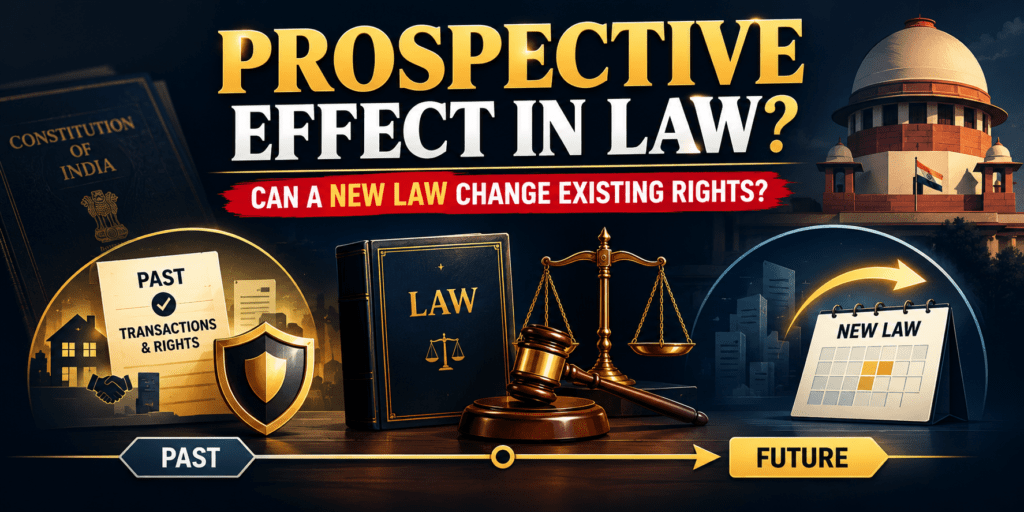
- What Is Prospective Effect in Law?
- 1. Hitendra Vishnu Thakur v. State of Maharashtra
- 1. Existing vested rights may remain protected
- 2. Future transactions may be governed by the new law
- 3. Pending proceedings may require careful examination
- 4. New liabilities ordinarily arise from the new law
- 5. Legal certainty is preserved
- 1. Objection before the Trial Court or Tribunal
- 2. Appeal
- 3. Revision
- 4. Writ Petition
- 5. Constitutional Challenge
- 6. Interim Stay
- 7. Challenge to the Interpretation
- 1. What does the statute actually say?
- 2. What is the commencement date?
- 3. Is retrospective operation expressly stated?
- 4. Does the amendment affect substantive rights?
- 5. Does it affect only procedure?
- 6. Does it create a new liability?
- 7. Does it destroy a vested right?
- 8. Is retrospective application constitutionally permissible?
- Myth 1: Every new law automatically applies to old cases.
- Myth 2: Prospective law means it can never apply to a pending case.
- Myth 3: Every retrospective law is unconstitutional.
- Myth 4: Calling something “procedural” automatically makes it retrospective.
- Myth 5: Prospective effect protects every existing expectation.
- Myth 6: A Supreme Court judgment always operates prospectively.
- Reality:
- Hitendra Vishnu Thakur v. State of Maharashtra, (1994) 4 SCC 602
- Shanti Devi v. Hukum Chand
- Garikapati Veeraya v. N. Subbiah Choudhry, AIR 1957 SC 540
- B.K. Educational Services Pvt. Ltd. v. Parag Gupta & Associates, (2019) 11 SCC 633
- Neena Aneja v. Jai Prakash Associates Ltd., (2022) 2 SCC 161
- Recent Supreme Court jurisprudence
- What does prospective effect mean in law?
- What is prospective operation of a statute?
- Is prospective law applicable to pending cases?
- What is the difference between prospective and retrospective law?
- Can Parliament make a law retrospective?
- Can a retrospective criminal law be applied?
- Does every amendment operate prospectively?
- Are procedural laws retrospective?
What Is Prospective Effect in Law?
Whenever a new law, amendment, rule or legal provision comes into force, an important question arises:
Does the new law apply only to future events, or can it also affect things that happened before the law came into force?
This is where the concept of “prospective effect” becomes important.
In simple terms, a law has prospective effect when it operates from the date it comes into force onwards and generally governs future acts, transactions, rights, liabilities or proceedings.
For example, suppose Parliament introduces a new law on 1 January 2027 which imposes a new statutory obligation on employers.
If the law operates prospectively, the new obligation will ordinarily apply to conduct or transactions falling within the law after its commencement. It will not ordinarily be used to impose a new liability upon a completed transaction merely because the transaction is connected with the past.
The Supreme Court has repeatedly recognised a presumption against retrospective operation, particularly where an amendment affects substantive or vested rights.
Prospective Effect vs Retrospective Effect — The Basic Difference
The easiest way to understand the distinction is through a timeline.
Prospective Law
Past → New Law Comes Into Force → Future
The new law generally operates from the commencement date onwards.
Retrospective Law
Past Event ← New Law Comes Into Force
The new law is intended to reach back and alter the legal consequences of something that happened earlier.
Therefore:
Prospective operation means looking forward from the date of commencement. Retrospective operation means giving the law a backward-looking effect.
However, the distinction is not always as simple as the timeline suggests. Courts examine the nature of the right affected, the language of the statute, legislative intention and whether the transaction was completed or continuing.
Why Is Prospective Effect Important?
The rule of prospective operation protects a basic principle of legal certainty.
A person ordinarily conducts his affairs according to the law existing at that time.
If a subsequent amendment could automatically change the legal consequences of everything already done, individuals could face unexpected liabilities and lose rights that had already accrued.
The Supreme Court has therefore repeatedly held that an amending law affecting substantive or vested rights is ordinarily presumed to operate prospectively unless the legislature has made its retrospective intention clear, either expressly or by necessary implication.
This principle is particularly important in:
- property disputes;
- taxation;
- contractual rights;
- civil litigation;
- limitation;
- appeals;
- criminal proceedings;
- employment matters;
- insolvency proceedings;
- regulatory legislation;
- procedural amendments; and
- statutory rights and liabilities.
What Happens When a New Law Is Prospective?
When a law operates prospectively, its legal consequences generally begin from its effective/commencement date.
For example:
Example 1 — New statutory liability
Suppose an amendment coming into force on 1 April 2027 imposes a new financial liability on a particular class of persons.
If the amendment is prospective, the new liability ordinarily cannot simply be imposed upon transactions that were completely concluded before 1 April 2027 unless the statute clearly provides otherwise.
Example 2 — New eligibility requirement
Suppose a statute changes eligibility criteria for a particular benefit.
If the amendment is prospective, a person whose entitlement had already accrued under the previous law may not automatically lose that vested entitlement merely because the eligibility criteria were subsequently changed.
Example 3 — New procedural requirement
Suppose the law changes the procedure for filing an appeal.
The position may be different because procedural amendments are generally treated differently from amendments affecting substantive rights. The Supreme Court has repeatedly recognised that procedural provisions may apply to pending matters, subject to the statutory language and the consequences of such application.
Prospective Effect Does Not Always Mean “Only New Cases”
This is an important point.
Many people assume:
“If a law is prospective, it can never apply to a pending case.”
That is not always correct.
A law may be prospective in operation but still apply to future steps in an existing proceeding, particularly where it concerns procedure rather than substantive rights.
For example, a procedural amendment may prescribe how a pending proceeding is to be conducted from the date of amendment onwards.
Therefore, the correct question is not simply:
“Is the case old or new?”
The real questions are:
- When did the right or liability accrue?
- What exactly has the new law changed?
- Is the amendment substantive or procedural?
- Has a vested right been affected?
- Does the statute expressly provide its commencement or retrospective application?
- Is retrospective operation necessarily implied?
- Would applying the new provision create a new disability or obligation relating to an already completed transaction?
What Is a Vested Right?
The concept of vested rights is closely connected with prospective operation.
A vested right is, broadly speaking, a right that has already accrued to a person under the existing law.
The Supreme Court has consistently recognised that substantive rights are ordinarily protected against retrospective alteration unless the legislative intention to affect them is sufficiently clear.
For example, a right of appeal can, in appropriate circumstances, constitute a substantive right rather than merely a procedural convenience.
Therefore, simply describing an amendment as “procedural” does not automatically answer the question.
The actual effect of the amendment must be examined.
What Is the Supreme Court’s Position on Prospective Operation?
Indian courts have developed a substantial body of jurisprudence concerning prospective and retrospective operation.
1. Hitendra Vishnu Thakur v. State of Maharashtra
One of the leading authorities is:
Hitendra Vishnu Thakur v. State of Maharashtra, (1994) 4 SCC 602.
The Supreme Court laid down important principles concerning amendments and their temporal operation.
The Court recognised, among other things, that:
- a statute affecting substantive rights is presumed to be prospective;
- retrospective operation must be supported by express language or necessary intendment;
- procedural provisions are treated differently;
- the law relating to forum and limitation is generally procedural;
- the right of action and right of appeal may be substantive;
- a litigant has vested rights in substantive law;
- procedural provisions should not ordinarily be applied retrospectively where doing so creates new disabilities, obligations or duties concerning completed transactions.
This case remains one of the principal authorities for understanding prospective operation.
2. Shanti Devi v. Hukum Chand
The Supreme Court has also emphasised that where an amendment does not expressly or impliedly indicate retrospective operation, it should not ordinarily be construed as taking away rights that had already accrued.
The principle reflects a broader rule:
A statute should not ordinarily be interpreted as retrospectively destroying an existing right unless the legislative intention is clear.
This approach promotes certainty and prevents a person from being unexpectedly deprived of an accrued legal right.
3. The Supreme Court’s Recent Position
The Supreme Court has continued to reaffirm the presumption against retrospectivity.
In its recent jurisprudence, the Court has reiterated that fresh or amending legislation is ordinarily prospective and does not affect substantive or vested rights unless retrospective operation is either expressly provided or necessarily intended.
The Court has also observed that one should not ordinarily expect statutory rights to be destroyed merely because of events that occurred before the new legislation was enacted.
Prospective Law and Procedural Law — Is There a Difference?
Yes. This is one of the most important distinctions.
The general position is:
Substantive Law
A law affecting substantive rights is ordinarily prospective unless the statute clearly provides otherwise.
Procedural Law
A procedural amendment is generally more capable of applying to pending proceedings because no person ordinarily has a vested right in a particular procedure.
But even this rule has an important qualification.
A provision described as procedural cannot automatically be applied retrospectively if its application:
- creates a new disability;
- imposes a new obligation;
- imposes a new duty concerning an already completed transaction; or
- substantially affects a vested substantive right.
The Supreme Court has reaffirmed this distinction in recent cases.
Is Every New Law Prospective?
No.
The general presumption is that legislation is prospective, but the legislature can, within constitutional limits, enact legislation with retrospective operation.
The real question is:
What did the legislature intend?
The Court examines:
- the language of the legislation;
- the commencement clause;
- the legislative scheme;
- whether retrospective operation is expressly stated;
- whether retrospective operation is necessarily implied;
- whether vested rights are affected;
- whether new liabilities are created; and
- whether constitutional limitations are attracted.
The Supreme Court has repeatedly stated that an enactment should not be given a greater retrospective operation than its language makes necessary.
Can the Legislature Make a Law Retrospective?
Yes, retrospective legislation is not automatically unconstitutional.
The legislature possesses substantial power to enact laws with retrospective effect, particularly in civil and fiscal matters.
However, retrospective legislation remains subject to the Constitution.
Depending upon the circumstances, questions may arise under:
- Article 14 — equality and non-arbitrariness;
- Article 19 — where applicable;
- Article 21 — where applicable;
- other constitutional protections;
- separation of legislative and judicial functions; and
- Article 20(1) in criminal cases.
Therefore, the correct proposition is not:
“Retrospective laws are illegal.”
The correct proposition is:
Retrospective legislation can be constitutionally permissible, but it cannot override constitutional limitations merely because the legislature has given it retrospective language.
Prospective Effect in Criminal Law
The principle becomes even more important in criminal law.
Article 20(1) of the Constitution
Article 20(1) provides constitutional protection against ex post facto criminal laws.
In simple terms, a person cannot ordinarily be:
- convicted for an act which was not an offence when it was committed; or
- subjected to a penalty greater than the penalty applicable when the offence was committed.
The Supreme Court has recognised that Article 20(1) prevents criminal liability from being imposed retrospectively in violation of its constitutional protection.
Therefore, criminal legislation must be examined with particular caution when its application to past conduct is proposed.
Prospective Effect of a Court Judgment Is Different
There is an important distinction between a statute enacted by the legislature and a judgment delivered by a constitutional court.
The Supreme Court has recently reiterated that legislation is ordinarily prospective unless retrospective operation is expressly or necessarily intended, whereas judgments of constitutional courts ordinarily operate retrospectively unless the judgment itself specifically directs prospective operation.
This distinction is extremely important.
Legislature
Presumption: Prospective operation.
Constitutional Court Judgment
General rule: The declaration of law ordinarily operates retrospectively unless the Court limits its operation prospectively.
The Court may restrict the operation of its judgment prospectively where doing so is necessary to prevent hardship, avoid unsettling settled affairs or protect persons who acted bona fide under the previous legal position.
What Is “Prospective Overruling”?
Prospective overruling is a judicial technique through which a court changes or overrules an earlier legal position but limits the operation of the new rule to the future.
This means that the Court may say, in substance:
The earlier legal position is no longer good law, but the new rule will apply only from this point onwards.
This mechanism can be particularly important where immediate retrospective application would cause substantial disruption or unfairness.
It is different from saying that the new legal principle is wrong.
The Court may change the law but control when the change takes effect.
Legal Consequences of Prospective Operation
A prospective provision can have several important consequences.
1. Existing vested rights may remain protected
If a new amendment is prospective, rights already accrued under the previous law ordinarily remain governed by the earlier legal position unless the statute clearly provides otherwise.
2. Future transactions may be governed by the new law
After the commencement date, persons must comply with the new statutory regime.
3. Pending proceedings may require careful examination
A prospective amendment does not necessarily mean that every pending case remains entirely governed by the old law.
The Court will examine whether the amendment concerns substantive rights or merely procedure.
4. New liabilities ordinarily arise from the new law
A new statutory obligation will ordinarily govern matters falling within its prospective field.
5. Legal certainty is preserved
Prospective operation prevents people from being penalised or burdened merely because the law was subsequently changed, subject to valid statutory exceptions.
What If a Court or Authority Wrongly Gives a Prospective Law Retrospective Effect?
This can be challenged.
Suppose:
- an amendment comes into force on 1 January;
- the statute contains no clear retrospective language;
- a tribunal applies it to a transaction completed several years earlier; and
- the amendment creates a new liability or destroys an accrued right.
The affected person may argue that the authority has given the amendment an impermissible retrospective operation.
The precise remedy depends upon the statute, forum and nature of the dispute.
What Are the Remedies Against Wrongful Retrospective Application?
Depending upon the facts, a person may consider:
1. Objection before the Trial Court or Tribunal
If the issue arises during pending proceedings, the party can specifically plead that the amended provision is prospective and cannot govern the earlier transaction.
2. Appeal
Where an adverse order has already been passed, the statutory appellate remedy may be invoked.
3. Revision
Where the applicable statute permits revision, the improper application of the new provision may be challenged.
4. Writ Petition
In appropriate cases, a petition under Article 226/227 before the High Court may be maintainable, particularly where a statutory authority or tribunal has acted contrary to law or exceeded its jurisdiction.
5. Constitutional Challenge
Where the legislation itself is constitutionally infirm, an appropriate constitutional challenge may be considered.
6. Interim Stay
If immediate implementation of the impugned provision is likely to cause irreversible prejudice, an interim stay may be sought, subject to the applicable principles.
7. Challenge to the Interpretation
In many cases, the issue is not that the statute itself is unconstitutional, but that the authority has incorrectly interpreted it as retrospective.
In such cases, the relief may be directed towards ensuring that the provision is applied prospectively.
How Do Courts Decide Whether a Law Is Prospective?
Courts generally examine the following factors:
1. What does the statute actually say?
The first step is to read the statutory language.
2. What is the commencement date?
The date from which the provision comes into force is extremely important.
3. Is retrospective operation expressly stated?
Words such as “shall be deemed to have come into force from…” may indicate retrospective operation.
But the complete statutory scheme must still be examined.
4. Does the amendment affect substantive rights?
If yes, there is a strong presumption against retrospective application.
5. Does it affect only procedure?
If it is genuinely procedural, it may apply to pending proceedings, subject to statutory language and consequences.
6. Does it create a new liability?
Creation of a new obligation concerning a completed transaction strongly weighs against retrospective application.
7. Does it destroy a vested right?
If so, clear legislative intent is ordinarily required.
8. Is retrospective application constitutionally permissible?
Even clear legislative language cannot override constitutional limitations.
Myth vs Reality
Myth 1: Every new law automatically applies to old cases.
Reality:
No.
Whether a new provision applies to a pending proceeding depends upon its nature, language, legislative intention and effect on existing rights.
Myth 2: Prospective law means it can never apply to a pending case.
Reality:
Not necessarily.
Procedural provisions may apply to pending proceedings even though the amendment itself operates prospectively from its commencement date. The crucial question is whether substantive rights are affected.
Myth 3: Every retrospective law is unconstitutional.
Reality:
Wrong.
Retrospective legislation can be valid, particularly in civil and fiscal fields, provided it satisfies constitutional requirements.
Myth 4: Calling something “procedural” automatically makes it retrospective.
Reality:
No.
The actual effect of the provision matters. A supposedly procedural amendment may not be applied retrospectively if it creates new disabilities or obligations relating to completed transactions.
Myth 5: Prospective effect protects every existing expectation.
Reality:
Not necessarily.
The law generally protects accrued or vested rights, not every expectation or hope of continuing under the old legal regime.
Myth 6: A Supreme Court judgment always operates prospectively.
Reality:
Not generally.
The Supreme Court has clarified that judgments of constitutional courts ordinarily operate retrospectively unless the judgment itself specifically limits its operation prospectively.
Prospective vs Retrospective vs Retroactive — Quick Comparison
| Concept | Simple Meaning | Typical Effect |
|---|---|---|
| Prospective | Operates from now onwards | Future acts/transactions |
| Retrospective | Looks back and changes legal consequences of past events | Can affect completed transactions/vested rights |
| Retroactive | Operates in the future but may depend upon a past event/status | Can regulate future consequences based on past facts |
The Supreme Court has recognised that “retrospective” and “retroactive” are not always used as perfectly interchangeable concepts. Context and the precise legal effect of the provision matter.
Why Does Prospective Effect Matter in Tax Laws?
Tax legislation frequently raises questions of prospective and retrospective operation.
Suppose a new amendment increases a statutory liability.
The crucial questions may include:
- Does the amendment apply to transactions already completed?
- Was the tax liability already crystallised?
- Does the amendment create a new liability?
- Does the statute expressly provide retrospective effect?
- Is the amendment merely clarificatory?
- Does the amendment affect an existing vested right?
These questions can significantly affect tax liability.
Therefore, merely stating that an amendment is “clarificatory” or “procedural” does not end the legal inquiry.
The Court examines the substance and effect of the provision.
Prospective Effect and Limitation Law
Limitation provisions present another important area.
Generally, limitation is considered procedural. However, the Supreme Court has cautioned that classification alone does not settle the question.
If applying a new limitation provision to a past cause of action would effectively revive an extinguished right or extinguish an existing right to sue, the consequences become much more significant. The Court has therefore emphasised that the actual effect of the amendment must be examined.
Practical Example for a Litigant
Imagine that A entered into a contract in 2024.
In 2027, Parliament introduces an amendment imposing a new statutory obligation on parties to such contracts.
The question is:
Can A automatically be subjected to the new obligation?
Not necessarily.
A court would examine:
- whether the contract was already completed;
- whether the obligation is substantive or procedural;
- the wording of the amendment;
- whether retrospective operation is expressly provided;
- whether retrospective operation is necessarily implied;
- whether A had acquired a vested right;
- whether the amendment creates a new liability; and
- whether applying it retrospectively would produce an impermissible consequence.
Thus, the mere fact that the case is being decided in 2027 does not automatically mean that the 2027 law governs every aspect of the dispute.
What Should You Do If a New Law Is Being Applied to Your Old Transaction?
If a new law is being applied to an old transaction, do not simply assume that the application is legal or illegal.
First identify:
Date of transaction → Date right accrued → Date new law enacted → Date new law commenced → Nature of amendment → Effect on right/liability
Then examine the statute carefully.
A legal objection may be available where the authority has:
- ignored the commencement provision;
- treated a prospective amendment as retrospective;
- impaired a vested right;
- created a new liability for a completed transaction;
- imposed a new disability retrospectively;
- incorrectly characterised a substantive provision as procedural; or
- applied an amendment contrary to binding Supreme Court jurisprudence.
Important Supreme Court Cases on Prospective Operation
Hitendra Vishnu Thakur v. State of Maharashtra, (1994) 4 SCC 602
A leading authority on prospective and retrospective operation, particularly the distinction between substantive and procedural provisions.
Shanti Devi v. Hukum Chand
Important for the principle that an amendment should not ordinarily be construed to affect accrued rights without clear retrospective intention.
Garikapati Veeraya v. N. Subbiah Choudhry, AIR 1957 SC 540
A leading authority concerning vested rights, particularly the right of appeal.
B.K. Educational Services Pvt. Ltd. v. Parag Gupta & Associates, (2019) 11 SCC 633
Important in understanding the application of procedural and limitation amendments and their effect on existing rights.
Neena Aneja v. Jai Prakash Associates Ltd., (2022) 2 SCC 161
An important Supreme Court decision concerning procedural changes and their application to pending matters.
Recent Supreme Court jurisprudence
The Supreme Court has continued to reaffirm the presumption against retrospectivity and the protection of substantive and vested rights.
Frequently Asked Questions — Prospective Effect in Law
What does prospective effect mean in law?
Prospective effect means that a law operates from the date it comes into force and ordinarily governs future acts, transactions, rights or liabilities.
What is prospective operation of a statute?
It means that the statute is applied from its commencement onwards rather than being used to alter the legal consequences of completed past transactions.
Is prospective law applicable to pending cases?
It can be, particularly where the new provision is procedural and governs future steps in an existing proceeding. The effect on substantive rights must, however, be examined.
What is the difference between prospective and retrospective law?
Prospective law generally operates forward from its commencement. Retrospective law reaches backward to affect legal consequences connected with past events or transactions.
Can Parliament make a law retrospective?
Yes, subject to constitutional limitations and the requirements of legislative competence and statutory interpretation.
Can a retrospective criminal law be applied?
Article 20(1) imposes constitutional restrictions against ex post facto criminal punishment, including conviction for conduct that was not an offence when committed and a greater penalty than the one applicable at that time.
Does every amendment operate prospectively?
The general presumption is prospective operation, particularly for amendments affecting substantive rights, unless retrospective operation is expressly provided or necessarily intended.
Are procedural laws retrospective?
Procedural amendments are generally more capable of applying to pending proceedings, but they cannot automatically be applied retrospectively where doing so creates new disabilities, obligations or affects vested substantive rights.
Final Takeaway
The phrase “prospective effect” may sound technical, but its basic idea is simple:
A person should ordinarily be governed by the law applicable to the legal situation when the relevant right, liability or transaction arose, unless the legislature has clearly provided otherwise.
But this is not an absolute rule.
The r