
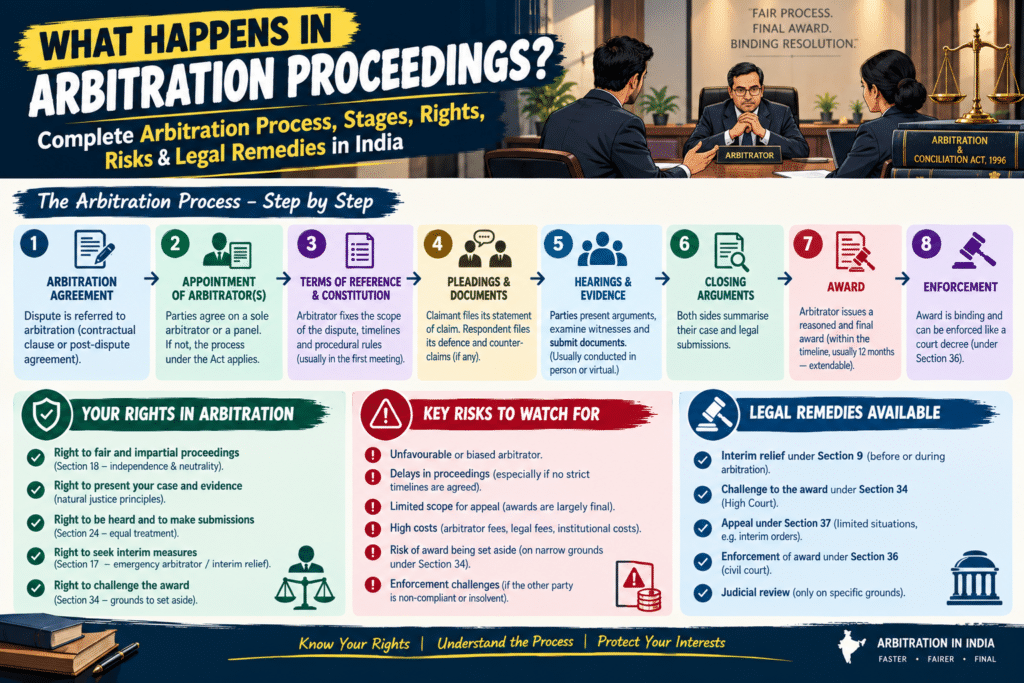
- Arbitration Proceedings in India: The Process at a Glance
- Is there a valid arbitration agreement?
- Why is this important?
- Important 2026 legal position
- Who will decide the dispute?
- Can you object to an arbitrator?
- Do not raise jurisdictional objections casually or too late.
- Yes — but not like an ordinary civil decree.
- 1. Section 34 challenge
- 2. Section 37 appeal
- 3. Stay of enforcement
- 4. Supreme Court remedy
- Delay in arbitration should not be treated as legally irrelevant.
- 1. Binding adjudication
- 2. Financial liability
- 3. Enforcement
- 4. Interest liability
- 5. Costs
- 6. Limitation consequences
- 7. Commercial consequences
- Mistake 1: Ignoring the arbitration notice
- Mistake 2: Filing a vague reply
- Mistake 3: Not checking limitation
- Mistake 4: Ignoring the arbitration clause
- Mistake 5: Raising jurisdiction objections too late
- Mistake 6: Failing to preserve evidence
- Mistake 7: Assuming Section 34 is a normal appeal
- Mistake 8: Treating arbitration as informal
- 1. TRF Ltd. v. Energo Engineering Projects Ltd.
- 2. Perkins Eastman Architects DPC v. HSCC (India) Ltd.
- 3. State of Goa v. Praveen Enterprises
- 4. Adavya Projects Pvt. Ltd. v. Vishal Structurals Pvt. Ltd.
- 5. Rohan Builders (India) Pvt. Ltd. v. Berger Paints India Ltd.
- 6. C. Velusamy v. K. Indhera
- 7. V.K. John v. S. Mukanchand Bothra & HUF
- 8. Ramesh Kumar Jain v. Bharat Aluminium Company Ltd. (BALCO)
- 1. What happens in arbitration proceedings?
- 2. How does arbitration start?
- 3. What happens after an arbitration notice?
- 4. Can I defend myself in arbitration?
- 5. Can the respondent file a counterclaim?
- 6. Can witnesses be cross-examined in arbitration?
- 7. Can an arbitrator grant interim relief?
- 8. Can I approach a Court during arbitration?
- 9. Can an arbitral award be challenged?
- 10. Can the Court reconsider all evidence?
- 11. What happens if I do not participate in arbitration?
- 12. How long does arbitration take in India?
- Need Legal Assistance in an Arbitration Matter?
Received an arbitration notice and wondering what happens next?
Or has an arbitrator already been appointed and you are unsure about the next step?
Arbitration can appear complicated because it is neither an ordinary civil suit nor a simple meeting between two parties. It is a legally binding dispute-resolution process in which an Arbitral Tribunal hears the parties, considers documents and evidence, decides the dispute and ultimately passes an arbitral award.
The process is governed principally by the Arbitration and Conciliation Act, 1996.
But what actually happens after an arbitration notice?
Who appoints the arbitrator?
When does the arbitration officially begin?
Can you file a counterclaim?
Can evidence and witnesses be examined?
Can the arbitrator grant interim relief?
How long does arbitration take?
What happens if a party does not appear?
Can the award be challenged?
Can a Court change the arbitrator’s decision?
This article explains the complete arbitration proceedings in India, step by step, in simple language.
Arbitration Proceedings in India: The Process at a Glance
In a typical domestic arbitration, the process may broadly proceed as follows:
Arbitration Agreement → Notice Invoking Arbitration → Appointment of Arbitrator → Preliminary Hearing → Statement of Claim → Statement of Defence → Counterclaim → Evidence → Cross-Examination → Oral/Written Arguments → Arbitral Award → Section 34 Challenge → Enforcement
The exact procedure can vary depending upon:
- the arbitration agreement;
- the arbitration clause;
- institutional or ad hoc arbitration;
- the applicable institutional rules;
- the directions of the Arbitral Tribunal;
- the nature and complexity of the dispute.
The Arbitration Act gives considerable procedural flexibility to the Tribunal, while requiring the parties to be treated equally and given a reasonable opportunity to present their case.
What Is Arbitration?
Arbitration is a form of Alternative Dispute Resolution (ADR) in which parties agree to have their dispute decided by an independent arbitrator or Arbitral Tribunal instead of having the dispute decided through an ordinary civil trial.
For example:
A company enters into a construction contract with another company.
A dispute arises regarding:
- unpaid bills;
- delay in completion;
- defective work;
- liquidated damages;
- termination;
- interest;
- losses or compensation.
If the contract contains an arbitration clause, the dispute may be referred to arbitration in accordance with that agreement.
The arbitrator then performs a judicial decision-making function and ultimately passes an enforceable arbitral award.
What Law Governs Arbitration Proceedings in India?
The principal legislation is the Arbitration and Conciliation Act, 1996.
Some of the most important provisions include:
| Provision | Subject |
|---|---|
| Section 5 | Limited judicial intervention |
| Section 7 | Arbitration agreement |
| Section 9 | Interim measures by Court |
| Section 11 | Appointment of arbitrators |
| Section 12 | Disclosure and challenge of arbitrator |
| Section 13 | Challenge procedure |
| Section 16 | Tribunal’s jurisdiction |
| Section 17 | Interim measures by Tribunal |
| Section 18 | Equal treatment of parties |
| Section 19 | Procedural flexibility |
| Section 21 | Commencement of arbitral proceedings |
| Section 23 | Statements of claim and defence |
| Section 24 | Hearings and written proceedings |
| Section 25 | Default of a party |
| Section 29A | Time limit for making award |
| Section 30 | Settlement |
| Section 31 | Form and contents of award |
| Section 34 | Setting aside award |
| Section 36 | Enforcement |
| Section 37 | Appealable orders |
The statutory framework therefore covers almost the entire life cycle of an arbitration—from commencement to enforcement.
Stage 1: Arbitration Clause or Arbitration Agreement
The first question is simple:
Is there a valid arbitration agreement?
Section 7 of the Arbitration and Conciliation Act deals with arbitration agreements.
The agreement may appear as a separate agreement or as an arbitration clause in a larger contract.
A typical clause may provide that disputes arising out of the contract shall be referred to arbitration.
Before commencing proceedings, parties should therefore carefully examine:
- whether an arbitration agreement exists;
- whether it is valid;
- who is bound by it;
- what disputes are covered;
- whether there is a pre-arbitration requirement;
- how the arbitrator is to be appointed;
- the seat/place of arbitration;
- applicable procedural rules.
Why is this important?
Because not every dispute can automatically be sent to arbitration merely because one party wants it.
The existence, scope and validity of the arbitration agreement can become important jurisdictional issues.
Stage 2: Notice Invoking Arbitration
The next important step is generally a notice invoking arbitration.
Section 21 provides the statutory framework regarding commencement of arbitral proceedings.
Unless otherwise agreed by the parties, arbitral proceedings in respect of a particular dispute commence when the respondent receives a request for that dispute to be referred to arbitration.
This is why an arbitration notice should never be casually ignored.
The notice may identify:
- the arbitration agreement;
- the dispute;
- the contractual background;
- the claims;
- the amount claimed;
- interest;
- proposed arbitrator;
- mechanism for appointment;
- seat/place of arbitration;
- request for reference of disputes to arbitration.
Important 2026 legal position
The Supreme Court has recently clarified that Section 21 performs an important procedural function, but it should not be mechanically treated as a provision that limits every claim that can subsequently be raised before the Tribunal.
In State of Goa v. Praveen Enterprises, and subsequently in Adavya Projects Pvt. Ltd. v. Vishal Structurals Pvt. Ltd., the Supreme Court considered the relationship between Sections 21 and 23.
The Court has clarified that the claims mentioned in a Section 21 notice do not necessarily place an absolute ceiling upon the claims that may subsequently be presented before the Tribunal.
Therefore, an arbitration notice is extremely important—but its legal effect must be understood correctly.
Stage 3: Appointment of the Arbitrator
After arbitration is invoked, the next question is:
Who will decide the dispute?
The answer depends upon the arbitration agreement.
The contract may provide for:
- a sole arbitrator;
- three arbitrators;
- appointment by mutual consent;
- appointment through an arbitral institution;
- appointment through a designated appointing authority.
Section 11 deals with appointment of arbitrators in cases where the agreed mechanism fails or the statutory requirements for Court intervention are otherwise attracted.
Can you object to an arbitrator?
Yes.
The Arbitration Act contains safeguards concerning independence and impartiality.
Section 12 requires disclosures by arbitrators, and the Act contains statutory grounds and procedures for challenging an arbitrator.
The well-known Supreme Court decisions in TRF Ltd. v. Energo Engineering Projects Ltd. and Perkins Eastman Architects DPC v. HSCC (India) Ltd. are important in understanding restrictions on unilateral appointment mechanisms.
Stage 4: Preliminary Hearing
Once the Tribunal is constituted, it generally holds a preliminary or case-management hearing.
The Tribunal may determine:
- procedural timetable;
- filing dates;
- statement of claim;
- statement of defence;
- counterclaim;
- evidence;
- discovery/production of documents;
- witness examination;
- cross-examination;
- written submissions;
- oral arguments;
- fees and costs;
- hearing dates;
- mode of hearing.
This stage is extremely important because arbitration is intended to be efficient.
A well-managed procedural timetable can prevent an arbitration from turning into a prolonged litigation exercise.
Stage 5: Statement of Claim
The claimant then presents its case before the Tribunal.
This is usually done through a Statement of Claim.
The claimant may set out:
- background facts;
- contractual relationship;
- relevant contractual clauses;
- breach committed by the respondent;
- correspondence;
- documents;
- legal grounds;
- calculation of monetary claims;
- interest;
- costs;
- reliefs sought.
The claimant must establish why it is legally entitled to the relief claimed.
For example, a claimant may seek:
- unpaid contractual amounts;
- damages;
- liquidated damages;
- interest;
- compensation;
- declaration;
- specific contractual relief;
- costs.
Stage 6: Statement of Defence
The respondent gets an opportunity to answer the Statement of Claim.
The respondent may:
- admit certain facts;
- deny allegations;
- explain the factual position;
- raise contractual defences;
- challenge jurisdiction;
- raise limitation;
- challenge maintainability;
- dispute the quantum;
- dispute liability;
- produce documents;
- raise a counterclaim.
A defence should therefore not merely say:
“The claim is false and therefore denied.”
A proper defence should address the material allegations and explain why the claimant is not entitled to the relief sought.
Stage 7: Counterclaim — Can the Respondent Also Claim Money?
Yes, where legally maintainable and within the Tribunal’s jurisdiction.
This is one of the most important aspects of arbitration proceedings.
The respondent is not necessarily limited to defending the claimant’s case.
Suppose:
- Company A claims ₹1 crore from Company B.
- Company B says Company A itself breached the contract and caused ₹60 lakh loss.
Company B may seek to raise a counterclaim, subject to the applicable arbitration agreement, pleadings, limitation and procedural requirements.
The Supreme Court has clarified that restrictions on claims, counterclaims and set-offs should be assessed primarily with reference to the statutory scheme, including Section 23, rather than treating Section 21 as an absolute jurisdictional restriction.
Stage 8: Documents and Evidence
Arbitration is not simply a discussion between two parties.
Documents and evidence can play a major role.
Depending on the case, parties may rely upon:
- contracts;
- invoices;
- purchase orders;
- emails;
- letters;
- WhatsApp communications;
- account statements;
- photographs;
- technical reports;
- expert reports;
- government records;
- site inspection reports;
- bank records;
- notices;
- minutes of meetings.
The Tribunal may prescribe the manner and schedule for production of documents.
One of the major advantages of arbitration is procedural flexibility.
Section 19 provides that the Tribunal is not strictly bound by the Code of Civil Procedure, 1908 or the Indian Evidence Act, 1872, while remaining subject to the statutory framework and principles of fairness.
This does not mean that evidence becomes irrelevant.
It means that arbitration can adopt a more flexible procedure suited to the dispute.
Stage 9: Examination and Cross-Examination of Witnesses
Depending on the nature of the case, witnesses may be examined.
A witness may give evidence through:
- oral testimony;
- affidavit/evidence statement;
- documentary evidence;
- expert evidence.
The opposite party may then cross-examine the witness.
Cross-examination can be particularly important in disputes involving:
- construction;
- technical defects;
- accounts;
- fraud allegations;
- project delays;
- quality disputes;
- measurement disputes;
- loss calculations.
In technical disputes, expert evidence can also become important.
Stage 10: Interim Relief During Arbitration
What if something needs immediate protection?
A party may approach the Court under Section 9 for interim measures in appropriate circumstances.
Examples may include:
- protection of property;
- preservation of goods;
- securing the amount in dispute;
- injunction;
- appointment of receiver;
- protection of evidence;
- other urgent protective measures permitted by law.
The Tribunal itself can also grant interim measures under Section 17 once constituted.
Therefore, a party does not necessarily have to wait until the final award if urgent protective relief is required.
Stage 11: Jurisdictional Objections — Can You Say the Arbitrator Has No Power?
Yes.
Section 16 embodies the principle of kompetenz-kompetenz, meaning that the Arbitral Tribunal can rule on its own jurisdiction, including objections concerning the existence or validity of the arbitration agreement.
A party may raise objections such as:
- no arbitration agreement exists;
- the arbitration clause is invalid;
- the dispute is outside the scope of the clause;
- the claim is beyond the Tribunal’s jurisdiction;
- the claimant has invoked arbitration contrary to the agreed procedure.
But there is an important practical point:
Do not raise jurisdictional objections casually or too late.
The Arbitration Act prescribes the stage at which certain jurisdictional objections are to be raised.
A party should therefore take legal advice immediately after receiving the claim and before filing its substantive defence.
Stage 12: Hearings and Arguments
After pleadings and evidence, the Tribunal hears the parties.
The parties may make:
- oral submissions;
- written submissions;
- submissions on law;
- submissions on facts;
- submissions on quantum;
- submissions on costs and interest.
The Tribunal may ask questions and seek clarification.
Unlike an ordinary civil court, the procedure can be tailored to the dispute.
Some arbitrations involve extensive oral hearings.
Others may be substantially document-based.
The procedure therefore depends heavily upon the complexity of the case and the directions of the Tribunal.
Stage 13: Settlement During Arbitration
An arbitration does not necessarily have to end with a contested award.
The parties may settle the dispute during the proceedings.
Section 30 recognises settlement during arbitration.
If the parties reach a settlement, the Tribunal may record it in an arbitral award on agreed terms where the statutory requirements are satisfied.
This can save:
- time;
- legal expenses;
- further hearings;
- uncertainty;
- enforcement litigation.
Therefore, settlement discussions should not automatically be considered a sign of weakness.
Sometimes, settlement is the most commercially sensible outcome.
Stage 14: Arbitral Award
Finally, the Tribunal passes its arbitral award.
The award may decide:
- liability;
- amount payable;
- interest;
- counterclaims;
- costs;
- other reliefs within the Tribunal’s jurisdiction.
Section 31 deals with the form and contents of an arbitral award.
Generally, the award should provide reasons unless the parties have agreed otherwise or the award is based on settlement.
What Happens After the Arbitral Award?
This is where another important legal stage begins.
A party dissatisfied with the award does not get an ordinary appeal on facts merely because it disagrees with the arbitrator.
The principal statutory remedy is a challenge under Section 34.
Can an Arbitral Award Be Challenged?
Yes — but not like an ordinary civil decree.
Section 34 provides limited grounds for setting aside an arbitral award.
The Court does not ordinarily sit as an appellate court over the Tribunal.
This is one of the most important principles in Indian arbitration law.
The Supreme Court has repeatedly emphasised that the Section 34 Court has a narrow supervisory jurisdiction and cannot simply reappreciate evidence or substitute its own view merely because another view is possible.
In V.K. John v. S. Mukanchand Bothra & HUF, 2026 INSC 393, the Supreme Court again emphasised that the Arbitration Act operates as a complete code and that the appropriate statutory remedy against an arbitral award is under Section 34.
What Are the Grounds for Challenging an Arbitral Award?
Depending upon the facts, grounds may include:
- invalid arbitration agreement;
- incapacity of a party;
- improper notice;
- inability to present one’s case;
- award beyond the scope of submission;
- improper composition of Tribunal;
- procedure contrary to agreement or law;
- conflict with public policy of India;
- patent illegality appearing on the face of a domestic award, within the statutory limits;
- other grounds expressly recognised under Section 34.
However, every error by an arbitrator does not justify setting aside the award.
This distinction is extremely important.
What Happens If You Lose in Arbitration?
Losing an arbitration does not necessarily mean that there is no remedy.
Depending upon the circumstances, the losing party may consider:
1. Section 34 challenge
An application may be filed to set aside the award on recognised statutory grounds.
2. Section 37 appeal
Certain orders under the Arbitration Act and certain decisions arising under Section 34 are appealable under Section 37, subject to the statutory framework.
3. Stay of enforcement
A challenge under Section 34 does not automatically result in an unconditional stay of the award’s enforcement.
A party seeking protection must consider the applicable provisions governing enforcement and stay.
4. Supreme Court remedy
Further statutory/constitutional remedies may arise depending upon the order and circumstances, but arbitration law strongly discourages treating every arbitration dispute as an ordinary multi-tier appeal.
What If the Other Party Does Not Participate?
A party should never assume:
“If I don’t attend, the arbitration will stop.”
That can be a dangerous assumption.
Section 25 deals with default of a party.
Subject to the statutory requirements, the Tribunal may proceed despite a party’s non-participation.
For example, depending on the circumstances:
- failure to file defence may have consequences;
- failure to appear may not automatically stop proceedings;
- the Tribunal may proceed with the evidence available before it.
Therefore, ignoring arbitration is usually a poor legal strategy.
How Long Do Arbitration Proceedings Take?
The duration depends on:
- complexity of the dispute;
- number of parties;
- number of claims;
- volume of documents;
- evidence;
- witnesses;
- expert evidence;
- procedural objections;
- interim applications;
- availability of arbitrators;
- institutional rules;
- Court proceedings;
- consent or cooperation of parties.
Section 29A contains a statutory framework concerning the time for making an award in applicable domestic arbitrations.
Recent Supreme Court jurisprudence has also addressed what happens when the statutory period expires.
In C. Velusamy v. K. Indhera, decided on 3 February 2026, the Supreme Court considered the power of the Court to extend the arbitral mandate under Section 29A even where the award had been rendered after expiry of the statutory period.
The Supreme Court has also recently clarified the jurisdiction of the Court competent to entertain Section 29A applications and the circumstances in which the mandate may be extended.
The practical lesson is simple:
Delay in arbitration should not be treated as legally irrelevant.
Parties should monitor the statutory timetable and seek appropriate relief where necessary.
What Are the Legal Consequences of Arbitration Proceedings?
Arbitration can have serious legal and financial consequences.
1. Binding adjudication
The Tribunal ultimately determines the disputes referred to it.
2. Financial liability
An award may direct payment of:
- principal amount;
- interest;
- damages;
- costs;
- other legally permissible relief.
3. Enforcement
Once enforceable, an arbitral award can be enforced through the statutory enforcement mechanism.
4. Interest liability
Interest can substantially increase the financial exposure in a long-running dispute.
5. Costs
A party may face substantial legal, arbitral and procedural costs.
6. Limitation consequences
The timing of invocation and commencement can have important limitation implications.
7. Commercial consequences
An arbitration dispute can affect:
- business relationships;
- bank guarantees;
- contractual payments;
- ongoing projects;
- reputation;
- cash flow.
This is why arbitration should be treated as serious litigation—not as an informal negotiation.
What Should You Do After Receiving an Arbitration Notice?
If you receive an arbitration notice, take the following steps immediately:
Step 1 — Find the arbitration clause
Read the exact contractual provision.
Step 2 — Check the dispute
Determine what dispute has actually been invoked.
Step 3 — Check limitation
Do not assume that an old claim is automatically enforceable.
Step 4 — Check the appointment mechanism
Examine whether the proposed appointment complies with the agreement and law.
Step 5 — Collect documents
Preserve:
- contracts;
- emails;
- invoices;
- correspondence;
- payment records;
- notices;
- WhatsApp messages;
- internal communications;
- technical records.
Step 6 — Identify your defence
Prepare a clear factual and legal response.
Step 7 — Consider counterclaims
Do not focus only on defending yourself. Determine whether you have independent claims against the other party.
Step 8 — Consider interim protection
If assets, evidence or contractual rights are at risk, consider appropriate relief under Sections 9 or 17.
Step 9 — Do not miss procedural deadlines
Arbitration can move quickly once the Tribunal begins issuing procedural directions.
What Are the Common Mistakes in Arbitration Proceedings?
Mistake 1: Ignoring the arbitration notice
This can expose a party to serious procedural consequences.
Mistake 2: Filing a vague reply
A weak response may fail to preserve important objections.
Mistake 3: Not checking limitation
A stale claim can sometimes be vulnerable to a limitation objection.
Mistake 4: Ignoring the arbitration clause
The wording of the clause may determine the procedure, seat and appointment mechanism.
Mistake 5: Raising jurisdiction objections too late
Procedural timing can matter.
Mistake 6: Failing to preserve evidence
Emails and documents can become critical years later.
Mistake 7: Assuming Section 34 is a normal appeal
It is not.
Mistake 8: Treating arbitration as informal
An arbitration may result in an enforceable award with serious financial consequences.
Myth vs Reality: Arbitration Proceedings
| Myth | Reality |
|---|---|
| Arbitration is just private negotiation. | Arbitration is a formal adjudicatory process resulting in an arbitral award. |
| Ignoring the notice will stop the arbitration. | The Tribunal may proceed in accordance with Section 25 and applicable procedure. |
| The arbitrator can decide anything. | The Tribunal’s jurisdiction comes from the arbitration agreement and the applicable law. |
| Every arbitrator’s decision can be appealed. | Section 34 provides a limited statutory challenge to an award. |
| Section 34 is like a civil appeal. | The Court generally does not re-hear the case as an appellate court. |
| The arbitration must always involve lengthy oral hearings. | Procedure may be tailored to the dispute. |
| A respondent can only defend itself. | A legally maintainable counterclaim may also be raised. |
| Arbitration is always faster than court litigation. | It can be efficient, but complex arbitration can also become lengthy. |
| Receiving an arbitration notice means you have lost. | It only means that a dispute has been formally invoked; the merits still have to be decided. |
| Courts have no role in arbitration. | Courts have important statutory roles, including interim relief, appointment, challenge and enforcement. |
Important Supreme Court Jurisprudence on Arbitration Proceedings
Indian arbitration law has developed substantially through Supreme Court judgments.
1. TRF Ltd. v. Energo Engineering Projects Ltd.
Important for understanding the independence and eligibility of arbitrators and appointment mechanisms.
2. Perkins Eastman Architects DPC v. HSCC (India) Ltd.
An important authority concerning unilateral appointment of arbitrators and impartiality.
3. State of Goa v. Praveen Enterprises
Important on the relationship between the claims referred to arbitration and claims subsequently raised before the Tribunal.
4. Adavya Projects Pvt. Ltd. v. Vishal Structurals Pvt. Ltd.
A significant recent authority concerning Section 21 and the commencement of arbitration, while also discussing the relationship between Sections 21 and 23.
The Supreme Court has clarified that Section 21 should not be read as an absolute restriction on claims that may subsequently be raised before the Tribunal.
5. Rohan Builders (India) Pvt. Ltd. v. Berger Paints India Ltd.
Important in the context of extension of the statutory period under Section 29A.
6. C. Velusamy v. K. Indhera
A significant 2026 Supreme Court decision concerning extension of the arbitral mandate under Section 29A.
7. V.K. John v. S. Mukanchand Bothra & HUF
The Supreme Court reiterated in 2026 that the statutory remedy under Section 34 is the appropriate route for challenging an arbitral award and emphasised the complete-code nature of the Arbitration Act.
8. Ramesh Kumar Jain v. Bharat Aluminium Company Ltd. (BALCO)
The Supreme Court reiterated the narrow scope of Section 34 and the principle that the Court does not sit as an appellate court over the arbitral award.
Can the High Court Interfere During Arbitration?
Generally, the Arbitration Act reflects a policy of minimal judicial intervention.
Section 5 itself restricts judicial intervention except where provided by the Act.
This does not mean that Courts have no role.
Courts may become involved in appropriate statutory situations, including:
- appointment of arbitrators;
- interim measures;
- certain jurisdictional matters;
- challenges to awards;
- appeals under Section 37;
- enforcement-related proceedings;
- extension of arbitral mandate.
However, parties should be cautious about trying to convert every procedural disagreement into a writ petition.
The Supreme Court has repeatedly stressed that the Arbitration Act provides a structured statutory mechanism and that judicial intervention should remain within the limits prescribed by the legislation.
Arbitration vs Court Litigation: What Is the Difference?
| Arbitration | Court Litigation |
|---|---|
| Private adjudicatory process | Public judicial process |
| Arbitrator decides dispute | Judge decides dispute |
| Procedure is comparatively flexible | CPC and procedural laws apply |
| Parties may choose arbitrator subject to law | Judge is assigned through judicial system |
| Limited Court intervention | Broader judicial supervision |
| Award challenged under Section 34 | Judgment generally challenged through appeal |
| Can be tailored to technical disputes | Formal court procedure |
| Can involve substantial arbitral fees | Court fees and litigation costs apply |
Neither mechanism is automatically better in every dispute.
The correct choice depends upon the contract, dispute, amount involved, urgency, evidence, and applicable law.
What If the Arbitration Proceedings Are Taking Too Long?
If arbitration becomes excessively delayed, the party should not simply wait indefinitely.
Possible steps may include:
- requesting procedural directions;
- seeking strict timelines;
- seeking completion of pleadings;
- requesting dates for evidence;
- seeking directions regarding pending applications;
- considering Section 29A relief where applicable;
- challenging the arbitrator’s mandate where legally justified;
- approaching the competent Court for statutory relief where available.
Recent Supreme Court decisions show that Section 29A is intended to support timely completion of arbitral proceedings, while allowing Courts to balance the need for finality with the interests of justice.
Is Arbitration Always Confidential?
Arbitration is generally regarded as a private dispute-resolution mechanism, but confidentiality should not be assumed to mean that absolutely no information can ever reach a Court or another legal forum.
For example, Court proceedings may arise concerning:
- Section 9;
- Section 11;
- Section 34;
- Section 37;
- enforcement;
- other statutory remedies.
The precise confidentiality obligations should therefore be examined with reference to the Act, institutional rules, procedural orders and the circumstances of the case.
What Happens If the Arbitration Award Is Not Paid?
If the award becomes enforceable and the losing party does not comply, the successful party can pursue enforcement in accordance with Section 36 and applicable procedural law.
Therefore, arbitration does not necessarily end when the Tribunal signs the award.
There can be a further stage:
Award → Challenge, if any → Enforcement → Recovery
This is why drafting the award, calculating interest and understanding enforcement consequences are all important.
Frequently Asked Questions About Arbitration Proceedings
1. What happens in arbitration proceedings?
Typically, the parties exchange pleadings, produce documents, lead evidence, examine witnesses where required, make arguments and receive an arbitral award.
2. How does arbitration start?
Ordinarily, arbitration is invoked according to the arbitration agreement, with Section 21 providing the statutory framework for commencement of arbitral proceedings.
3. What happens after an arbitration notice?
The recipient should examine the arbitration clause, identify the dispute, check limitation and jurisdiction, review the proposed appointment mechanism, preserve evidence and respond within the applicable timeline.
4. Can I defend myself in arbitration?
Yes, but arbitration can involve substantial legal and procedural issues. Professional legal assistance is advisable, particularly where significant financial claims are involved.
5. Can the respondent file a counterclaim?
Yes, where legally maintainable and within the Tribunal’s jurisdiction and applicable procedural framework.
6. Can witnesses be cross-examined in arbitration?
Yes. Depending upon the procedure adopted by the Tribunal, witness evidence and cross-examination may form part of the proceedings.
7. Can an arbitrator grant interim relief?
Yes. Section 17 empowers the Arbitral Tribunal to grant interim measures within the statutory framework.
8. Can I approach a Court during arbitration?
Yes, in circumstances recognised by the Arbitration Act—for example, appropriate interim relief, appointment-related proceedings and other statutory remedies.
9. Can an arbitral award be challenged?
Yes. A domestic arbitral award can be challenged under Section 34 on the statutory grounds.
10. Can the Court reconsider all evidence?
Ordinarily, no. Section 34 is not intended to function as a regular appeal on facts.
11. What happens if I do not participate in arbitration?
The Tribunal may proceed in accordance with Section 25 and the applicable procedure. Non-participation does not necessarily stop the arbitration.
12. How long does arbitration take in India?
It depends upon the nature of the dispute, pleadings, evidence, witnesses, procedural applications and statutory timelines. Section 29A provides a statutory framework concerning the time for making awards in applicable domestic arbitrations.
Final Takeaway: Arbitration Is Not Something You Should Ignore
Receiving an arbitration notice does not mean that you have lost the dispute.
But it does mean that the dispute has entered a formal legal process where deadlines, pleadings, evidence, jurisdictional objections and procedural strategy can have serious consequences.
The most important thing is to act early.
Read the arbitration clause.
Check the notice.
Check limitation.
Examine jurisdiction.
Preserve documents.
Consider counterclaims.
Protect your interests.
Do not miss procedural deadlines.
And once the award is passed, remember that the remedy is not an ordinary appeal—the statutory framework under Section 34 and Section 37 becomes critical.
Arbitration is designed to provide an efficient and legally binding method of resolving disputes. But its efficiency depends significantly upon how intelligently the proceedings are managed by the parties and their legal representatives.
Need Legal Assistance in an Arbitration Matter?
If you have received an arbitration notice, been served with a Statement of Claim, received a Section 11 petition, are facing an ongoing arbitration, need to challenge an arbitrator, require interim protection, or want to challenge an arbitral award, the matter should be examined at the earliest stage.
A timely review of the arbitration agreement, limitation, jurisdiction, pleadings, evidence and procedural strategy can materially affect the outcome of the proceedings.