
- Quick Answer: Is the Right to Protest a Fundamental Right?
- 1. What Does the Constitution Say About the Right to Protest?
- 2. Is the Right to Protest Absolute?
- 3. Can the Government or Police Stop a Peaceful Protest?
- 4. Can Police Refuse Permission for a Protest?
- 5. What Is Section 163 BNSS, and How Can It Affect a Protest?
- 6. Landmark Supreme Court Judgments on the Right to Protest
- A. Himat Lal K. Shah v. Commissioner of Police, Ahmedabad, (1973) 1 SCC 227
- B. In Re: Ramlila Maidan Incident, (2012) 5 SCC 1
- C. Mazdoor Kisan Shakti Sangathan v. Union of India, (2018) 17 SCC 324
- D. Amit Sahni v. Commissioner of Police, (2020) 10 SCC 439 — The Shaheen Bagh Case
- E. Imran Pratapgadhi v. State of Gujarat, 2025 INSC 410
- 7. Can a Person Be Arrested Merely for Participating in a Protest?
- 8. What Happens if a Protest Turns Violent?
- 9. Can the Government Ban All Protests in a Particular Area?
- 10. What Legal Remedies Are Available if the Right to Protest Is Violated?
- 11. Myth vs Reality: What Is the True Legal Position on Protests in India?
- 12. Frequently Asked Questions
- Q1. Is the right to protest a fundamental right in India?
- Q2. Which Article of the Constitution guarantees the right to protest?
- Q3. Can the police refuse permission for a peaceful protest?
- Q4. Can a peaceful protest be stopped under Section 163 BNSS?
- Q5. Can a person be arrested for raising slogans against the government?
- Q6. Can protesters block roads in the name of fundamental rights?
- Q7. Which Supreme Court judgment recognises the right to peaceful protest?
- Q8. Can a High Court direct the police to permit a protest?
- Q9. Can the government impose restrictions on protests near sensitive locations?
- Q10. Is the right to protest available to everyone?
- Conclusion: The Right to Protest Is Protected by the Constitution—but It Must Be Exercised Within the Law
Can the government stop you from protesting against a law? Can the police refuse permission for a peaceful demonstration? Can citizens be arrested merely for raising their voice against the government?
These questions go to the heart of Indian democracy. A protest is often the first way in which citizens express disagreement, demand accountability, and bring public attention to an issue that affects them. But when a protest is restricted, stopped or dispersed by the authorities, an important constitutional question arises: Is the right to protest guaranteed by the Constitution of India?
The answer is yes, the right to peaceful protest is constitutionally protected, primarily through the fundamental rights guaranteed under Article 19(1)(a) and Article 19(1)(b) of the Constitution. However, the Constitution does not expressly use the words “right to protest” as a separate, standalone fundamental right. Instead, the right is recognised through the freedoms of speech and expression and peaceful assembly without arms.
This protection is not absolute. The State can impose reasonable restrictions on constitutionally recognised grounds, and public authorities can regulate the location, timing and manner of demonstrations. However, the power to regulate a protest cannot become an arbitrary power to silence every form of dissent.
In this article, we explain the constitutional provisions, the limits of police powers, the consequences of violating protest-related restrictions, the legal remedies available to citizens, and the landmark Supreme Court judgments governing the right to protest in India.
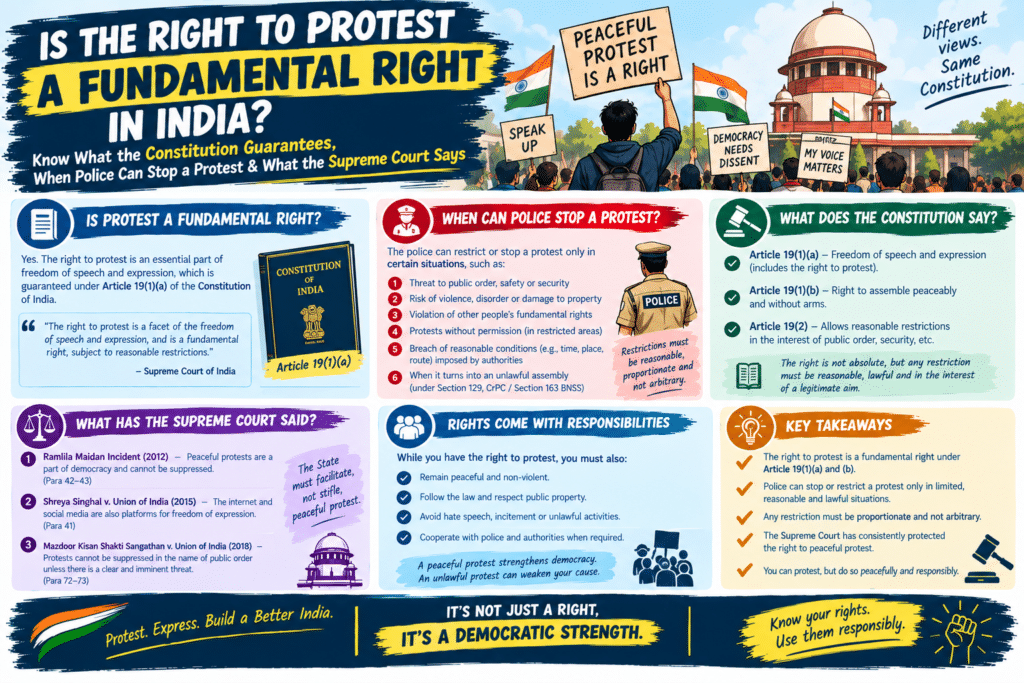
Quick Answer: Is the Right to Protest a Fundamental Right?
Yes. The right to peaceful protest is a fundamental right recognised under Articles 19(1)(a) and 19(1)(b) of the Constitution of India.
Article 19(1)(a) protects freedom of speech and expression, while Article 19(1)(b) protects the right to assemble peacefully and without arms.
Together, these provisions protect citizens who wish to express disagreement with government policies, laws, administrative decisions or other matters of public importance.
However, this right is subject to reasonable restrictions under Articles 19(2) and 19(3), respectively. A protest cannot automatically claim constitutional protection if it involves violence, unlawful obstruction, or conduct that falls outside the protection of the relevant fundamental rights.
The Supreme Court has repeatedly recognised peaceful protest as an essential part of democracy while also holding that public spaces cannot be occupied indefinitely and that the rights of protesters must be balanced against the rights of other citizens.
1. What Does the Constitution Say About the Right to Protest?
The Constitution does not expressly create a separate fundamental right titled “right to protest”. Instead, the right arises from the combined operation of several constitutional protections.
A. Article 19(1)(a): Freedom of Speech and Expression
Article 19(1)(a) guarantees citizens the right to freedom of speech and expression.
This includes the ability to communicate opinions, criticise government policies, raise public grievances and express disagreement with decisions taken by public authorities.
For example, if citizens believe that a newly enacted law adversely affects their interests, they may express their disagreement through speeches, placards, peaceful demonstrations, public meetings and other lawful forms of expression.
The government cannot ordinarily suppress an opinion merely because it is critical, unpopular or opposed to its policies. Restrictions must be justified under the Constitution.
B. Article 19(1)(b): Right to Assemble Peacefully and Without Arms
Article 19(1)(b) guarantees citizens the right to assemble peacefully and without arms.
This provision is particularly important for demonstrations, rallies, public meetings, sit-ins and other collective forms of protest.
The right allows people to gather and express a shared grievance rather than being restricted to expressing their opinions individually.
However, the constitutional protection is expressly connected with peaceful assembly without arms. Violence and other unlawful conduct cannot automatically be justified merely by describing the activity as a protest.
C. Article 19(1)(c): Right to Form Associations
Article 19(1)(c) protects the right to form associations or unions.
This freedom may support the collective organisation of campaigns, unions, student groups, civil society organisations and other bodies through which citizens pursue common objectives.
Nevertheless, the right to form an association does not automatically confer a right to occupy any public place or disregard applicable laws.
D. Article 21: Life and Personal Liberty
Article 21 may also become relevant when the State’s response to a protest affects personal liberty or bodily integrity.
For example, if a protester is detained unlawfully, subjected to excessive force, or deprived of liberty without authority of law, the constitutional protections under Article 21 may be attracted.
The precise legal issue will depend on the facts. Article 21 does not independently authorise every form of protest, but it protects individuals against unlawful State action.
2. Is the Right to Protest Absolute?
No. The right to protest is constitutionally protected, but it is not an unrestricted right.
The Constitution itself provides for reasonable restrictions on the freedoms of speech and assembly.
Article 19(2) permits reasonable restrictions on freedom of speech and expression on specified grounds, including sovereignty and integrity of India, security of the State, public order, decency or morality, and certain other constitutionally recognised interests.
Article 19(3) permits reasonable restrictions on peaceful assembly without arms in the interests of the sovereignty and integrity of India and public order.
Therefore, a restriction must have a lawful basis and must satisfy the applicable constitutional requirements.
For instance, authorities may regulate a demonstration to prevent serious traffic disruption, protect public safety, maintain public order or avoid a genuine threat of violence. But they cannot assume that every criticism of the government threatens public order.
The distinction is between reasonable regulation of a constitutional right and arbitrary suppression of that right.
A restriction that is excessive, unsupported by the circumstances or imposed for an improper purpose may be open to judicial scrutiny.
3. Can the Government or Police Stop a Peaceful Protest?
The answer depends on the legal basis for the restriction and the circumstances in which it is imposed.
Police and other competent authorities have powers to regulate public gatherings, enforce lawful prohibitory orders and take steps to prevent violence or serious disruption. Local rules may also prescribe permission requirements for processions, public meetings or demonstrations.
However, these powers must be exercised in accordance with law.
A restriction should not be treated as automatically valid merely because it has been issued by an authority. Its legality may depend on the authority’s jurisdiction, the applicable law, the reasons recorded, the nature of the perceived threat and the proportionality of the action.
For example, consider these situations:
Situation 1: A peaceful demonstration against a government policy
Citizens seek to organise a peaceful demonstration. The authorities refuse permission without providing a legally sustainable reason.
Depending on the facts and applicable rules, the refusal may be challenged on constitutional or administrative-law grounds.
Situation 2: A protest likely to cause serious obstruction or violence
The authorities receive credible information indicating a genuine risk to public order. They impose reasonable restrictions on the location, timing or manner of the gathering.
Such regulation may be lawful if it satisfies the applicable statutory and constitutional requirements.
Situation 3: A blanket prohibition on all demonstrations in an area
A complete or prolonged ban on peaceful demonstrations may raise serious constitutional concerns, particularly where it effectively prevents citizens from exercising their fundamental rights without adequate justification.
The legality of the restriction must be examined on its own facts. There is no rule that every police restriction is unlawful, nor is there a rule that every restriction is constitutionally valid.
4. Can Police Refuse Permission for a Protest?
Permission requirements depend on the applicable law, local regulations, the type of gathering and the location.
Where permission is legally required, organisers should comply with the prescribed procedure. They should identify the proposed location, date, duration, expected attendance and arrangements for maintaining peace and public safety.
If permission is refused, the organisers should obtain the refusal order or other available record and examine the reasons.
The following questions may be relevant:
- Was the authority legally empowered to refuse permission?
- Were reasons provided for the refusal?
- Is the restriction supported by a genuine public-order or safety concern?
- Could the concern be addressed through less restrictive conditions?
- Does the decision effectively prohibit peaceful dissent without sufficient justification?
- Were similarly situated gatherings treated differently without a lawful reason?
A refusal is not automatically unconstitutional merely because it prevents a protest at the particular place or time requested. Authorities may lawfully offer an alternative venue or impose reasonable conditions.
However, the availability of an alternative venue, the practical ability to communicate the protest’s message and the overall effect of the restrictions may be relevant when assessing whether the constitutional right has been meaningfully protected.
5. What Is Section 163 BNSS, and How Can It Affect a Protest?
Section 163 of the Bharatiya Nagarik Suraksha Sanhita, 2023 (BNSS) deals with the power to issue orders in urgent cases of nuisance or apprehended danger. It corresponds broadly to Section 144 of the Code of Criminal Procedure, 1973.
This provision may be invoked in appropriate circumstances to prevent obstruction, danger to human life or safety, disturbance of public tranquillity, or other legally recognised forms of harm.
Depending on the order and circumstances, it may restrict assemblies, processions or particular activities in a specified area.
However, Section 163 is not a licence to impose arbitrary or permanent restrictions on peaceful protest. The order must be examined against the statutory requirements, the circumstances relied upon and the constitutional freedoms affected.
A person who intends to organise a demonstration should therefore check whether a valid prohibitory order is in force and understand its terms before proceeding.
If the order is believed to be unlawful, the appropriate course is to seek legal advice and consider a timely challenge before the competent authority or court, rather than simply disregarding it.
6. Landmark Supreme Court Judgments on the Right to Protest
The Supreme Court has developed important principles governing peaceful assembly, dissent, public spaces and police powers.
A. Himat Lal K. Shah v. Commissioner of Police, Ahmedabad, (1973) 1 SCC 227
Legal principle: The State can regulate public meetings, but regulation cannot become arbitrary exclusion.
The case concerned the regulation of public meetings in streets and public places.
The Supreme Court recognised that public authorities may regulate the use of public streets to maintain order and protect the rights of others. However, the power to regulate public meetings cannot be exercised in an arbitrary manner that effectively destroys the freedom of assembly.
The decision is an important authority for the distinction between reasonable regulation and a complete or arbitrary denial of the right to hold public meetings.
Why this judgment matters: If permission for a peaceful protest is refused, this case may be relevant to examining whether the restriction is a lawful regulation or an unjustified denial of the right to assemble.
B. In Re: Ramlila Maidan Incident, (2012) 5 SCC 1
Legal principle: Peaceful assembly and peaceful agitation are important features of a democratic system, and State action against protesters must satisfy constitutional requirements.
The Supreme Court examined the circumstances surrounding police action at Ramlila Maidan in Delhi.
The Court discussed the importance of freedom of speech, peaceful assembly and public protest in a democracy. It also emphasised that preventive powers must be exercised carefully and in accordance with constitutional requirements.
The judgment is particularly relevant to the use of force against gatherings and the responsibility of public authorities to respect fundamental rights while maintaining public order.
Why this judgment matters: Authorities cannot justify every form of coercive action merely by referring to public order. The legality and proportionality of the action must be assessed in light of the circumstances and the applicable law.
C. Mazdoor Kisan Shakti Sangathan v. Union of India, (2018) 17 SCC 324
Legal principle: Peaceful protest is a fundamental right, but it must be balanced against the rights of other citizens.
The Supreme Court considered restrictions affecting demonstrations at Jantar Mantar and the competing concerns arising from protests in public spaces.
The Court recognised that peaceful demonstrations enable citizens to express grievances and seek attention from public authorities. At the same time, it considered the impact of protests on residents and other members of the public.
The judgment illustrates that the constitutional issue is not simply whether protests are permitted, but how the right can be exercised while respecting the rights of others.
Why this judgment matters: It supports the proposition that authorities should regulate demonstrations in a manner that balances competing rights rather than treating peaceful protest as inherently unlawful.
D. Amit Sahni v. Commissioner of Police, (2020) 10 SCC 439 — The Shaheen Bagh Case
Legal principle: Public roads and public spaces cannot be occupied indefinitely for protests.
This is one of the most widely discussed Supreme Court judgments on the right to protest.
The case arose from the prolonged occupation and blockage of the Kalindi Kunj–Shaheen Bagh stretch in Delhi during protests against the Citizenship (Amendment) Act, 2019.
The Supreme Court recognised the constitutional right to protest and express dissent. However, it held that public ways and public spaces cannot be occupied indefinitely in a manner that causes serious inconvenience to other members of the public.
The Court emphasised that peaceful protest must be conducted within the constitutional and legal framework, with due regard to the rights of commuters and other citizens.
Why this judgment matters: A person cannot claim an unlimited right to occupy a public road merely because the gathering is intended to express a political or social opinion. The location and manner of the protest remain legally relevant.
E. Imran Pratapgadhi v. State of Gujarat, 2025 INSC 410
Legal principle: Freedom of expression and dissent receive constitutional protection, and criminal proceedings affecting protected expression must be examined carefully.
In this case, the Supreme Court considered the registration of criminal proceedings arising from a poem and associated expression.
The judgment is relevant to the broader constitutional principle that expression cannot be treated as unlawful merely because it is critical, controversial or unpopular. The legal assessment must consider the actual content, context and applicable legal requirements.
Why this judgment matters: Where a protest, speech or slogan leads to criminal proceedings, the constitutional protection of expression may be relevant. However, the protection does not automatically cover threats, incitement or other conduct that independently satisfies the ingredients of an offence.
These decisions should be read together. They recognise the constitutional value of peaceful dissent while preserving the State’s ability to impose lawful and reasonable restrictions.
7. Can a Person Be Arrested Merely for Participating in a Protest?
Participation in a peaceful protest does not, by itself, automatically justify arrest.
However, a person may be arrested where the legal requirements for arrest are satisfied—for example, where there are lawful grounds relating to an alleged offence or where a valid order has been violated and the applicable law permits the action.
The important distinction is between lawful enforcement and arbitrary detention.
If the police arrest or detain a protester, the legality of the action may depend on:
- The legal grounds relied upon.
- Whether the applicable arrest and detention procedure was followed.
- Whether the person was informed of the grounds and afforded the safeguards required by law.
- Whether the action was based on individual conduct or merely on participation in peaceful dissent.
- Whether the arrest was supported by the statutory requirements applicable to the alleged offence.
The constitutional right to protest does not create immunity from all criminal laws. Equally, the mere fact that a person participated in a demonstration does not establish that the person committed an offence.
Each case must be examined on its own facts.
8. What Happens if a Protest Turns Violent?
The constitutional protection of peaceful protest does not provide a blanket defence for violence or other criminal conduct.
If participants damage property, assault others, threaten people, obstruct public authorities unlawfully or commit another offence, they may face legal consequences under the applicable criminal law.
Depending on the conduct and evidence, possible consequences may include:
- Registration of a criminal case.
- Arrest or other lawful criminal-process measures.
- Prosecution for specific offences.
- Liability for damage to public or private property under applicable law.
- Court-imposed penalties if the charges are proved.
However, legal responsibility must be determined according to the applicable law and the evidence concerning each person. A person should not automatically be treated as criminally responsible for every act committed by another participant merely because both attended the same protest.
The organisers’ liability, if any, will also depend on the law and the facts establishing their own conduct or responsibility.
9. Can the Government Ban All Protests in a Particular Area?
A restriction on protests in a particular area may be lawful in appropriate circumstances. For example, authorities may need to protect sensitive installations, maintain public safety, regulate traffic or prevent a genuine threat to public order.
However, a blanket or indefinite prohibition that effectively prevents peaceful demonstrations may raise serious constitutional concerns.
The Supreme Court’s decisions in Himat Lal K. Shah and Mazdoor Kisan Shakti Sangathan are relevant to the distinction between regulation and arbitrary exclusion.
When examining such a restriction, a court may consider:
- Whether the authority had the power to impose it.
- Whether the restriction was based on legally relevant grounds.
- Whether the restriction was reasonable and proportionate.
- Whether less restrictive measures could address the stated concern.
- Whether the restriction effectively prevents the exercise of a fundamental right.
- Whether an alternative venue or arrangement meaningfully permits peaceful dissent.
The constitutional question is not whether the State can regulate protests—it can. The question is whether the particular restriction is legally justified and proportionate to the purpose it seeks to achieve.
10. What Legal Remedies Are Available if the Right to Protest Is Violated?
If a citizen believes that the authorities have unlawfully restricted a peaceful protest, several remedies may be considered, depending on the circumstances.
A. Representation to the Competent Authority
Where permission has been refused, the organisers may submit a representation seeking reconsideration, proposing an alternative venue or offering reasonable conditions to address public-order concerns.
The representation should identify the proposed demonstration, its purpose, expected attendance, proposed arrangements and the reasons why the restriction is considered unjustified.
This may provide an opportunity to resolve the issue without immediate litigation.
B. Writ Petition under Article 226
A writ petition may be filed before the jurisdictional High Court where there is a legally sustainable challenge to State action affecting fundamental rights or other public-law rights.
Depending on the facts, the petitioner may seek:
- Quashing of an unlawful refusal of permission.
- A direction requiring the authority to reconsider the request in accordance with law.
- Protection against arbitrary or unlawful restrictions.
- Relief against unlawful detention or other unconstitutional action.
- Appropriate interim relief where urgent protection is necessary.
The precise prayer should be tailored to the challenged action. A court will not necessarily order permission for the exact venue or format requested; it may instead require a lawful, reasoned and constitutionally compliant decision.
C. Petition under Article 32 before the Supreme Court
Article 32 provides a constitutional remedy for enforcement of fundamental rights before the Supreme Court.
A petition may be considered where the facts justify direct recourse to the Supreme Court for enforcement of fundamental rights. The availability and appropriateness of this remedy depend on the circumstances.
D. Challenge to a Prohibitory Order
Where an order under Section 163 BNSS restricts a gathering, its legality may be challenged through the appropriate procedure before the competent forum.
The challenge may address the authority’s jurisdiction, the statutory basis, the reasons for the order and whether the restriction satisfies constitutional requirements.
E. Remedy Against Unlawful Arrest or Detention
Where a person has been unlawfully detained, the available remedies may include appropriate criminal-procedure remedies and, in a suitable case, a writ petition seeking relief against unlawful deprivation of liberty.
The remedy should be selected after examining the detention, the grounds asserted by the authorities and the procedural safeguards applicable to the case.
Important: Filing a petition does not automatically suspend the operation of an order restricting a protest. Where urgent relief is required, the petitioner should seek an appropriate interim order from the competent court.
11. Myth vs Reality: What Is the True Legal Position on Protests in India?
Myth 1: The Constitution does not protect the right to protest.
Reality: Peaceful protest is constitutionally protected through Articles 19(1)(a) and 19(1)(b), which protect freedom of expression and peaceful assembly without arms.
Myth 2: Every peaceful protest must be permitted at any place chosen by the organisers.
Reality: The right is subject to reasonable restrictions. Authorities may regulate the location, timing and manner of demonstrations in accordance with law.
Myth 3: The police can ban a protest simply because the government disagrees with its message.
Reality: Disagreement with the message, by itself, is not a sufficient constitutional justification for suppressing protected expression. A restriction must have a lawful basis.
Myth 4: Once a gathering is called a protest, participants cannot be arrested.
Reality: The label “protest” does not provide immunity from criminal law. Arrest must nevertheless comply with the applicable legal requirements and safeguards.
Myth 5: Blocking a public road indefinitely is protected by the right to protest.
Reality: In Amit Sahni v. Commissioner of Police, the Supreme Court held that public ways and public spaces cannot be occupied indefinitely in a manner that seriously inconveniences other citizens.
Myth 6: A police order restricting a protest can never be challenged.
Reality: A restriction may be open to judicial scrutiny if it is beyond the authority’s powers, arbitrary, unreasonable or otherwise unconstitutional.
Myth 7: The government must agree with protesters before their demonstration is protected.
Reality: Constitutional protection does not depend on whether the government agrees with the protesters’ views. The legality of a restriction must be examined under the Constitution and applicable law.
12. Frequently Asked Questions
Q1. Is the right to protest a fundamental right in India?
Yes. The right to peaceful protest is protected through Articles 19(1)(a) and 19(1)(b) of the Constitution. It remains subject to the reasonable restrictions permitted by the Constitution.
Q2. Which Article of the Constitution guarantees the right to protest?
The right is primarily derived from Article 19(1)(a), which protects freedom of speech and expression, and Article 19(1)(b), which protects peaceful assembly without arms.
Q3. Can the police refuse permission for a peaceful protest?
Permission may be refused on legally sustainable grounds under the applicable law. However, an arbitrary refusal or a restriction that unjustifiably suppresses peaceful dissent may be challenged before the competent authority or court.
Q4. Can a peaceful protest be stopped under Section 163 BNSS?
A lawful order under Section 163 BNSS may restrict a gathering in appropriate circumstances. The legality of the order depends on the statutory requirements, the circumstances and the constitutional limits on State power.
Q5. Can a person be arrested for raising slogans against the government?
Criticism of the government is not, by itself, sufficient to justify arrest. The authorities must establish a lawful basis for the action. The precise words, context, alleged offence and applicable legal requirements matter.
Q6. Can protesters block roads in the name of fundamental rights?
There is no unrestricted constitutional right to block public roads indefinitely. The Supreme Court’s decision in Amit Sahni v. Commissioner of Police makes clear that the rights of protesters must be balanced against the rights of commuters and other members of the public.
Q7. Which Supreme Court judgment recognises the right to peaceful protest?
Important decisions include Himat Lal K. Shah v. Commissioner of Police, Ahmedabad, In Re: Ramlila Maidan Incident, Mazdoor Kisan Shakti Sangathan v. Union of India and Amit Sahni v. Commissioner of Police.
Q8. Can a High Court direct the police to permit a protest?
In an appropriate case, a High Court may examine the legality of the refusal and grant suitable relief under Article 226. The precise order will depend on the facts, applicable law, public-order concerns and the constitutional requirements.
Q9. Can the government impose restrictions on protests near sensitive locations?
Yes, reasonable restrictions may be imposed where authorised by law and justified by legitimate concerns such as public safety, security or public order. Such restrictions must still comply with the applicable constitutional standards.
Q10. Is the right to protest available to everyone?
Articles 19(1)(a) and 19(1)(b) confer the relevant fundamental rights on citizens. The rights of non-citizens and the legal position in a particular case must be assessed under the applicable constitutional provisions and law.
Conclusion: The Right to Protest Is Protected by the Constitution—but It Must Be Exercised Within the Law
The right to peaceful protest is an important part of India’s constitutional democracy. It enables citizens to express disagreement, raise grievances, demand accountability and participate in public life.
Articles 19(1)(a) and 19(1)(b) provide the principal constitutional protection. The Supreme Court has repeatedly recognised that peaceful dissent must be respected, while also making clear that the right is not absolute and cannot be used to justify violence, unlawful conduct or indefinite obstruction of public spaces.
The State has the authority to regulate demonstrations, but that authority must be exercised lawfully and reasonably. A restriction imposed to protect public order is not automatically unconstitutional; equally, invoking public order does not automatically validate every restriction.
The correct legal approach is to examine the particular order, the statutory power relied upon, the circumstances and the proportionality of the restriction. Where the authorities act arbitrarily or unlawfully, constitutional remedies may be available before the competent court.
A democracy protects the right to disagree. The Constitution protects peaceful dissent, and the rule of law determines the limits within which both citizens and public authorities must act.
Legal disclaimer: This article is intended for general legal information and educational purposes only. It does not constitute legal advice. The legality of a particular protest, police restriction, arrest or prohibitory order depends on the facts, applicable law and relevant judicial precedents. Obtain professional legal advice before taking action in a specific matter.