
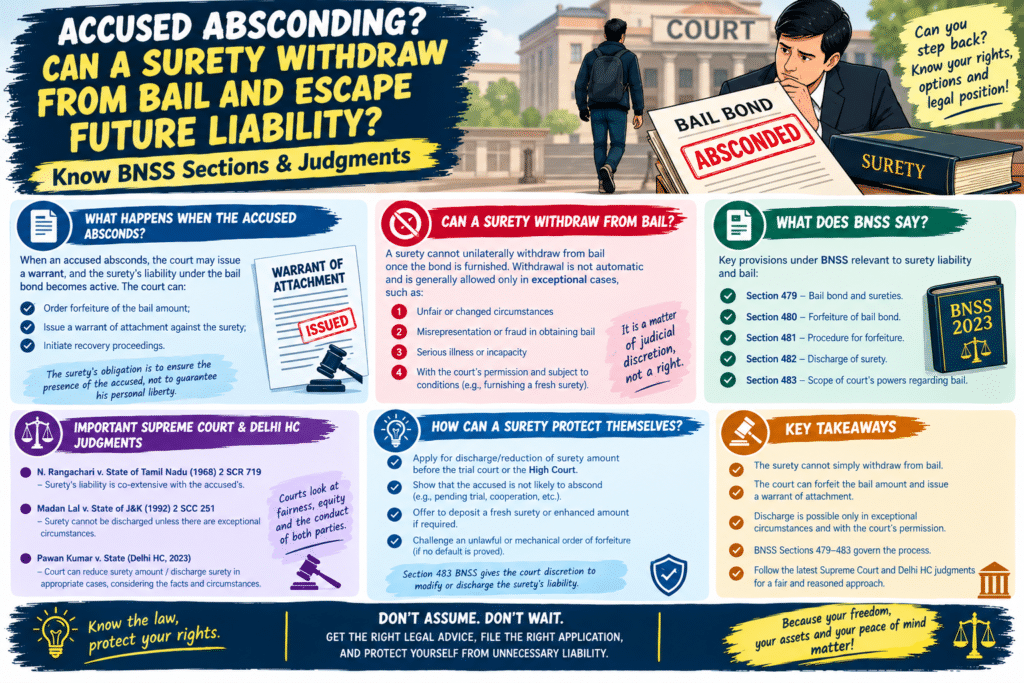
- Quick Answer: Can a Surety Seek Discharge When the Accused Is Absconding?
- 1. What Is a Surety Bond, and Why Does It Matter?
- 2. Which Provision Allows a Surety to Seek Discharge?
- 3. What Is the Difference Between Discharge of Surety and Forfeiture of the Bond?
- 4. Can the Court Compel a Surety to Remain Bound Until the Absconding Accused Is Found?
- 5. Important Judgment: Prakash v. Deepak Kumar — Madras High Court
- 6. Important Judgment: Shri Bhagwan v. State of Haryana — Punjab and Haryana High Court
- 7. Supreme Court Authority: Raghubir Singh v. State of Bihar
- 8. What If the Court Has Already Issued an Attachment or Recovery Warrant Against the Surety?
- 9. Recent Judgment: Kalaram v. State of U.P. — Allahabad High Court
- 10. What Legal Remedies Are Available to a Surety?
- 11. Practical Checklist: How to Prepare a Discharge Application
- 12. Myth vs Reality: Can a Surety Withdraw When the Accused Is Absconding?
- 13. Frequently Asked Questions
- Q1. Can a surety apply for discharge if the accused is absconding?
- Q2. Which section deals with discharge of sureties under the BNSS?
- Q3. Can the court reject a surety's application only because the accused has not been found?
- Q4. Does discharge mean the surety will not have to pay anything?
- Q5. Can a surety ask for discharge if an attachment warrant has already been issued?
- Q6. Can a surety seek discharge under Section 489 BNSS even if bail was granted by the High Court?
- Q7. What happens if the accused does not furnish fresh sureties after the existing surety is discharged?
- Q8. Can the surety's property be released from an encumbrance connected with the bond?
- Conclusion: A Surety Has a Right to Seek Discharge—Even When the Accused Has Absconded
You stood surety for someone who was released on bail. You trusted that person to attend court. But now the accused has absconded, a non-bailable warrant has been issued, and you are worried that your property or money may be at risk. Can you ask the court to discharge you as surety—even when the accused cannot be found?
This is an important question under Indian criminal procedure. A surety does not have to remain bound indefinitely against their will. At the same time, simply filing an application for discharge does not automatically release the surety from the bond or erase any liability arising from an earlier breach.
The law provides a procedure for seeking discharge, and courts have recognised that a surety should not be compelled to remain bound forever merely because the accused is absconding. However, the court must also consider the accused’s attendance, the terms of the bond and the consequences of forfeiture.
This article explains the legal position under the Bharatiya Nagarik Suraksha Sanhita, 2023 (BNSS), the corresponding provisions of the Code of Criminal Procedure, 1973 (CrPC), and important Supreme Court and High Court judgments concerning discharge of sureties when an accused is absconding.
Quick Answer: Can a Surety Seek Discharge When the Accused Is Absconding?
Yes. A surety can apply for discharge under Section 489 of the BNSS, 2023, corresponding to Section 444 of the CrPC, 1973. The important qualification is that the statutory procedure ordinarily requires the accused to be brought before the Magistrate pursuant to a warrant or to surrender voluntarily.
Where the accused has absconded and cannot be produced, the surety should still seek appropriate relief rather than assume that they must remain bound indefinitely. In Prakash v. Deepak Kumar (Madras High Court, 26 November 2018), the Court held that a surety cannot be compelled to continue against their will until the accused is found. It directed the lower court to proceed under the bond-forfeiture provisions and deal with the accused’s bond separately.
The legal position may be summarised as follows:
- A surety may apply for discharge under Section 489 BNSS.
- The Magistrate must follow the procedure prescribed by the provision, including issuing a warrant to secure the accused’s presence.
- If the accused appears or surrenders, the bond is to be discharged in accordance with Section 489(3), and the accused may be required to furnish fresh sureties.
- If the accused remains absconding, Prakash v. Deepak Kumar supports the argument that the surety should not be compelled to remain bound indefinitely; the court may proceed under the applicable forfeiture provisions.
- Discharge from the bond does not automatically extinguish liability for an earlier breach. Any forfeiture or recovery proceeding must be examined separately.
The precise relief will depend on the procedural stage, the court concerned, the terms of the bond and the applicable law.
1. What Is a Surety Bond, and Why Does It Matter?
A surety is a person who undertakes to secure the attendance of an accused person who has been released on bail.
When a court grants bail subject to a surety bond, the surety undertakes the obligation recorded in that bond. The purpose is to help ensure that the accused appears before the court when required.
However, the surety is not the accused, and the surety’s legal obligations are not identical to those of the accused.
A surety may later find that they no longer wish to continue in that role because:
- The accused has stopped attending court.
- The accused has absconded or is untraceable.
- A non-bailable warrant has been issued.
- The surety has lost contact with the accused.
- The surety wishes to sell or otherwise deal with property connected with the bond.
- The surety’s financial or personal circumstances have changed.
- The surety no longer wishes to accept the risk associated with the undertaking.
The law recognises a mechanism for seeking discharge. But the surety must use the proper procedure and should not assume that the bond has ended merely because they no longer wish to remain responsible.
2. Which Provision Allows a Surety to Seek Discharge?
Section 489 of the BNSS, 2023
Section 489 deals with the discharge of sureties. It provides that all or any sureties for the attendance and appearance of a person released on bail may apply to a Magistrate to discharge the bond, either wholly or insofar as it relates to the applicants.
The provision sets out the following procedure:
- The surety applies to the Magistrate for discharge.
- The Magistrate issues a warrant directing that the accused be brought before the court.
- If the accused appears pursuant to the warrant or surrenders voluntarily, the Magistrate directs discharge of the bond, wholly or insofar as it relates to the applicants.
- The accused is called upon to furnish other sufficient sureties.
- If the accused fails to furnish the required sureties, the Magistrate may commit the accused to jail, in accordance with the provision.
The provision therefore protects the surety’s ability to seek discharge while also safeguarding the court’s interest in securing the accused’s attendance.
What if the accused cannot be found?
This is where the issue becomes more complicated.
Section 489(3) expressly deals with discharge when the accused appears pursuant to the warrant or surrenders voluntarily. Where the accused remains absconding, the surety may face a practical difficulty: the statutory process to bring the accused before the court has not been completed.
However, the Madras High Court addressed this very problem in Prakash v. Deepak Kumar. It held that Section 444 CrPC should not be interpreted to mean that a surety can never be discharged until the accused is brought before the court. The Court recognised that the court can proceed under the bond-forfeiture provisions instead of compelling the surety to remain bound against their will.
This judgment is particularly important where the accused has absconded and a non-bailable warrant remains pending.
3. What Is the Difference Between Discharge of Surety and Forfeiture of the Bond?
These are two different legal issues and should not be confused.
Discharge of surety means seeking release from the continuing obligations under the surety bond through the prescribed legal process.
Forfeiture of bond concerns the consequences of a breach of the bond’s conditions, such as the accused’s failure to appear when required.
Under Section 491 BNSS, corresponding to Section 446 CrPC, the court may initiate proceedings where a bond is shown to have been forfeited. The court must record the grounds for the forfeiture and may call upon the person bound by the bond to pay the penalty or show cause why it should not be paid.
If sufficient cause is not shown and the penalty is not paid, the court may proceed with recovery as prescribed by law. Section 491(3) also permits the court to remit part of the penalty after recording reasons.
This distinction matters because a surety may seek discharge from future obligations while also needing to deal with a separate proceeding arising from an earlier breach.
A discharge application should therefore not be treated as an automatic defence to a penalty that has already become payable under a valid forfeiture order.
4. Can the Court Compel a Surety to Remain Bound Until the Absconding Accused Is Found?
The Madras High Court has directly addressed this issue.
In Prakash v. Deepak Kumar, the sureties sought discharge after the accused had absconded. The lower courts refused to discharge them because the accused had not appeared and a non-bailable warrant was pending.
The Madras High Court held that the surety could not be compelled to continue indefinitely against their will merely because the accused was absconding. The Court reasoned that the statutory procedure for discharge should not be interpreted in a way that permanently binds a surety.
The Court directed the lower court to initiate proceedings under Section 446 CrPC to deal with the surety bonds and to proceed against the accused separately under Section 446A CrPC.
The judgment establishes an important distinction: the court must protect its ability to secure the accused’s attendance, but it should not achieve that objective by compelling the surety to remain bound indefinitely.
The surety must nevertheless be prepared to address any lawful consequences arising from forfeiture of the bond.
5. Important Judgment: Prakash v. Deepak Kumar — Madras High Court
Decision date: 26 November 2018
Court: Madras High Court
Case: Criminal Original Petition Nos. 25382 and 25834 of 2018
This is one of the most directly relevant judgments for a surety whose accused has absconded.
Facts of the case
The petitioners had stood surety for an accused who was released on bail. They subsequently applied to the Magistrate to discharge themselves from the surety bonds.
The lower courts rejected their applications on the ground that the accused had absconded and that a non-bailable warrant was pending. The courts took the view that the sureties could not be discharged until the accused was secured.
What did the High Court hold?
The Madras High Court held that Section 444 CrPC provides the procedure for discharge of sureties, but it cannot be interpreted to mean that the surety must remain bound indefinitely until the accused is brought before the court.
The Court observed, in substance, that the surety’s bond could be dealt with through the forfeiture procedure and that the court could not compel a person to remain a surety against their willingness.
The Court set aside the orders of the lower courts and directed them to proceed under Section 446 CrPC concerning forfeiture of the surety bonds and under Section 446A CrPC concerning the accused’s bond.
Why is this judgment important?
This decision is particularly useful where:
- The accused has absconded.
- A non-bailable warrant remains pending.
- The surety has applied for discharge.
- The lower court has rejected the application solely because the accused has not been produced.
- The surety is willing to face the legal consequences of the bond but does not wish to remain bound indefinitely.
The judgment does not grant automatic immunity from the bond amount. Rather, it supports the proposition that the court should follow the lawful procedure for dealing with the surety’s bond instead of compelling indefinite continuation.
Read the judgment: Prakash v. Deepak Kumar.
6. Important Judgment: Shri Bhagwan v. State of Haryana — Punjab and Haryana High Court
Decision date: 4 March 2025
Case number: CRM-M-11701 of 2025
Neutral citation: 2025:PHHC:033713
This judgment reaffirms the statutory right of a surety to apply for discharge under Section 489 BNSS.
Facts of the case
The petitioner had stood surety for an accused and had furnished property-related security. The surety later wished to deal with the property and sought discharge from the bond.
The trial court rejected the application on the ground that the reasons were not sufficient.
What did the High Court hold?
The Punjab and Haryana High Court held that the trial court had overlooked the statutory procedure under Section 489 BNSS.
The Court explained that a surety is entitled to apply for discharge and that the Magistrate must follow the procedure prescribed by the provision. Upon the accused’s appearance, the bond is to be discharged and the accused given an opportunity to furnish fresh sureties.
The High Court set aside the rejection order and directed that the sureties be discharged in accordance with the statutory framework.
How does this judgment help a surety whose accused has absconded?
It confirms that a surety’s right to seek discharge is recognised by statute and cannot be rejected casually. However, the case concerned a surety who wished to withdraw because of a property-related difficulty; it should not be read as holding that an absconding accused’s surety must automatically be discharged without following Section 489.
For a case where the accused is untraceable, Prakash v. Deepak Kumar is the more directly relevant authority on the argument against indefinite continuation of the surety bond.
Read the judgment: Shri Bhagwan v. State of Haryana.
7. Supreme Court Authority: Raghubir Singh v. State of Bihar
Citation: (1986) 4 SCC 481
The Supreme Court discussed the statutory procedure for discharge of sureties under the CrPC.
The Court explained that a surety may apply to the Magistrate for discharge of the bond. On such an application, the court is required to issue a warrant to bring the accused before it. Upon the accused’s appearance or voluntary surrender, the court must discharge the bond in accordance with the provision and call upon the accused to furnish fresh sureties.
The Court also explained that discharge of a surety does not automatically extinguish the bail order. The accused may still take advantage of the existing bail order by furnishing an acceptable replacement surety, subject to the court’s directions and the applicable law.
Why is this judgment important?
It clarifies the statutory purpose of the discharge procedure: a surety should have a legal route to withdraw, while the court retains the ability to secure the accused’s attendance and require replacement sureties.
It is important to read this Supreme Court judgment alongside Prakash v. Deepak Kumar. The former explains the statutory procedure, while the latter directly considers the problem of a surety seeking discharge when the accused is absconding.
8. What If the Court Has Already Issued an Attachment or Recovery Warrant Against the Surety?
A surety may sometimes discover that the accused has absconded and that the court has already initiated forfeiture proceedings or issued a warrant for recovery of the bond amount.
In that situation, the surety should not assume that an application for discharge will automatically cancel the recovery proceedings.
The surety should examine the following:
- Whether the court has recorded the grounds for forfeiture.
- Whether the surety was given an opportunity to show cause against payment.
- Whether a penalty has been imposed by a separate order.
- Whether the recovery warrant is based on a valid and operative order.
- Whether the surety has grounds to challenge the forfeiture or seek remission of the penalty.
- Whether the surety can request interim protection against coercive recovery.
Section 491(3) BNSS allows the court to remit a portion of the penalty after recording reasons. This may be relevant where the surety is willing to pay a reduced amount but cannot afford the full bond penalty.
However, discharge from the bond and remission of the penalty are separate forms of relief. The application should clearly identify the relief being sought.
9. Recent Judgment: Kalaram v. State of U.P. — Allahabad High Court
Decision date: 25 March 2026
Neutral citation: 2026:AHC:61525
This judgment is relevant where the accused has absconded and the surety is facing recovery proceedings.
Facts of the case
The surety had furnished a bond for an accused who subsequently absconded. Recovery warrants were issued against the surety for the bond amount. The surety also explained that his financial circumstances had deteriorated and that he could not pay the full amount.
What did the High Court hold?
The Allahabad High Court explained that Section 491 BNSS provides the procedure for forfeiture and recovery of the surety penalty. A separate notice must be issued to the surety, and the statutory process must be followed before recovery.
The Court also considered the power to remit part of the penalty under Section 491(3) BNSS. In the circumstances of that case, it reduced the penalty from ₹1,00,000 to ₹50,000 and granted time for payment, directing that no coercive action be taken during that period.
Why does this judgment matter?
The decision demonstrates that even where the accused has absconded and recovery warrants have been issued, the surety may have grounds to seek reduction of the penalty, depending on the circumstances.
It is important to note that this judgment primarily concerns forfeiture and recovery, rather than the initial discharge application. It is therefore useful for the consequences that may follow if the court proceeds against the surety.
Read the judgment: Kalaram v. State of U.P..
10. What Legal Remedies Are Available to a Surety?
The correct remedy depends on whether the accused is merely absent, has absconded, or has already triggered forfeiture and recovery proceedings.
Remedy 1: Application under Section 489 BNSS
The surety may apply to the Magistrate for discharge of the bond.
The application should identify the surety, the accused, the relevant case, the date of the bond and the circumstances in which the surety no longer wishes to continue.
If the accused has absconded, the application should expressly explain that fact and ask the court to follow the statutory procedure to secure the accused and deal with the surety bond in accordance with law.
Remedy 2: Rely on Prakash v. Deepak Kumar where the accused remains absconding
If the lower court refuses to consider discharge solely because the accused cannot be found, the surety may rely on Prakash v. Deepak Kumar and submit that the surety cannot be compelled to remain bound indefinitely.
The precise procedural remedy against an adverse order will depend on the court concerned, the nature of the order and the applicable procedural law.
Remedy 3: Seek remission of the bond penalty
Where forfeiture proceedings have begun, the surety may seek remission of part of the penalty under Section 491(3) BNSS or Section 446(3) CrPC, as applicable.
The application should explain the financial and other relevant circumstances and request a reasoned order.
Remedy 4: Challenge an unlawful forfeiture or recovery order
If the court has failed to follow the statutory procedure, the surety may consider the appropriate challenge before the competent court.
For example, a failure to record the grounds for forfeiture or to provide the opportunity to show cause contemplated by Section 491 may be relevant, depending on the record.
Remedy 5: Seek interim protection against attachment or recovery
If property attachment or coercive recovery is imminent, the surety may consider seeking interim protection through the appropriate legal procedure.
Filing an application should not be assumed to automatically stay recovery. The surety should seek an express order where necessary.
11. Practical Checklist: How to Prepare a Discharge Application
Before approaching the court, the surety should collect the following documents and information:
- A copy of the bail order.
- A copy of the surety bond.
- Details of the case number and the court where the case is pending.
- Orders showing that the accused has failed to appear.
- Details of any non-bailable warrant or proclamation proceedings.
- Copies of any notice of forfeiture or recovery order.
- Documents concerning property security or encumbrances, if relevant.
- Any communication showing the surety’s efforts to contact the accused.
- Details of any financial hardship relevant to remission of the penalty.
The application should clearly distinguish between the request to discharge the surety from the bond and any separate request to set aside or reduce a penalty already imposed.
12. Myth vs Reality: Can a Surety Withdraw When the Accused Is Absconding?
Myth 1: Once I stand surety, I can never withdraw until the criminal case ends.
Reality: Section 489 BNSS recognises a statutory procedure for seeking discharge. A surety should use that procedure rather than assume that the undertaking is permanent.
Myth 2: If the accused is absconding, the surety must remain bound until the accused is arrested.
Reality: Prakash v. Deepak Kumar holds that a surety cannot be compelled to remain bound indefinitely against their will merely because the accused is absconding. The court must consider the proper procedure for dealing with the bond.
Myth 3: Filing an application under Section 489 BNSS automatically discharges the surety.
Reality: Filing an application is not the same as obtaining a discharge order. The court must follow the statutory procedure, and the surety should obtain an appropriate order.
Myth 4: Discharge from the bond automatically cancels an earlier penalty.
Reality: Discharge from continuing obligations and liability arising from an earlier breach are distinct issues. Forfeiture and recovery proceedings may have to be addressed separately.
Myth 5: The surety is required to pay the full bond amount in every case.
Reality: Where a penalty is imposed, Section 491(3) BNSS permits the court to remit part of it after recording reasons. Whether remission is justified depends on the circumstances.
Myth 6: The court cannot take any action against the accused once the surety is discharged.
Reality: The accused remains subject to the criminal proceedings and any warrants or other lawful orders. Discharge of the surety does not terminate the criminal case.
13. Frequently Asked Questions
Q1. Can a surety apply for discharge if the accused is absconding?
Yes. The surety can apply under Section 489 BNSS. If the accused remains absconding, the surety may rely on Prakash v. Deepak Kumar to argue that they should not be compelled to remain bound indefinitely. The court must consider the applicable statutory procedure and the facts of the case.
Q2. Which section deals with discharge of sureties under the BNSS?
Section 489 of the Bharatiya Nagarik Suraksha Sanhita, 2023 deals with discharge of sureties. Its corresponding provision under the CrPC, 1973 is Section 444.
Q3. Can the court reject a surety’s application only because the accused has not been found?
The answer depends on the facts and the procedural context. In Prakash v. Deepak Kumar, the Madras High Court held that the surety could not be compelled to remain bound indefinitely merely because the accused was absconding. The judgment supports seeking appropriate relief rather than allowing the bond to continue indefinitely without addressing the surety’s application.
Q4. Does discharge mean the surety will not have to pay anything?
Not necessarily. Discharge from continuing obligations does not automatically remove liability for an earlier breach. If the bond has been forfeited, the surety may need to contest the forfeiture or seek remission of the penalty.
Q5. Can a surety ask for discharge if an attachment warrant has already been issued?
The surety may seek appropriate relief, but the remedy depends on the stage of the proceedings. If a penalty or recovery order already exists, the surety should examine whether it can be challenged and whether remission or interim protection is required.
Q6. Can a surety seek discharge under Section 489 BNSS even if bail was granted by the High Court?
The fact that bail was granted by a superior court does not, by itself, eliminate the statutory procedure for discharge of a surety. Shri Bhagwan v. State of Haryana recognises the right to seek discharge under Section 489 BNSS. The application must nevertheless be dealt with according to the statute and the relevant facts.
Q7. What happens if the accused does not furnish fresh sureties after the existing surety is discharged?
Under Section 489(3) BNSS, if the accused fails to furnish the required sufficient sureties after the existing bond is discharged, the Magistrate may commit the accused to jail in accordance with the provision.
Q8. Can the surety’s property be released from an encumbrance connected with the bond?
The surety should seek appropriate relief from the competent court and, where required, directions to the relevant revenue or other authority. Whether and when the entry can be removed depends on the status of the bond, any forfeiture or recovery order and the terms of the court’s discharge order.
Conclusion: A Surety Has a Right to Seek Discharge—Even When the Accused Has Absconded
Standing surety is a serious legal undertaking, but it should not be understood as an obligation that necessarily continues forever against the surety’s will.
Section 489 BNSS provides the statutory mechanism for discharge of sureties. Although the provision contemplates securing the accused’s presence before the bond is discharged, Prakash v. Deepak Kumar makes an important point: the surety cannot simply be compelled to remain bound indefinitely because the accused has absconded. The court must consider the appropriate statutory procedure for dealing with the bond and the accused’s absence.
At the same time, discharge from the bond is not the same as immunity from the consequences of an earlier breach. If the bond has been forfeited, the surety may have to address the penalty, seek remission or challenge an unlawful recovery order.
The most appropriate course is therefore to file a properly supported application, place the relevant orders before the court and seek a reasoned decision on discharge and any consequential relief.
If you stood surety for an accused who has absconded, do not assume that you must remain bound indefinitely—or that filing an application alone will end your liability. Identify the stage of the proceedings and seek the remedy that the law permits.
Legal disclaimer: This article is intended for general legal information and educational purposes only. It does not constitute legal advice. The appropriate remedy depends on the terms of the surety bond, the procedural stage, the applicable statutory framework and the relevant judicial precedents. A lawyer should review the case record before any application or challenge is filed.