
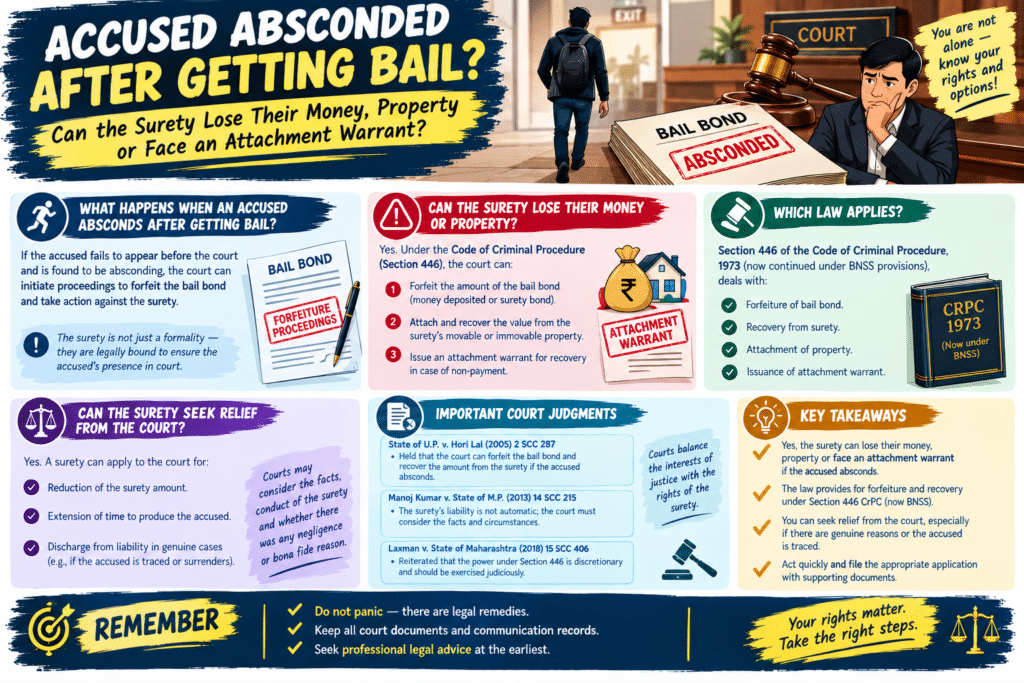
- Quick Answer: What Happens to a Surety When the Accused Absconds?
- 1. What Is the Legal Responsibility of a Surety?
- 2. Which Legal Provisions Apply When the Accused Absconds?
- 3. Can the Court Forfeit the Entire Surety Amount When the Accused Absconds?
- 4. Can the Court Issue a Warrant of Attachment Against the Surety's Property?
- 5. Does the Surety Get a Right to Be Heard Before the Amount Is Recovered?
- 6. Can a Surety Ask the Court to Reduce the Bond Amount After the Accused Absconds?
- 7. Can a Surety Be Discharged After the Accused Has Absconded?
- 8. Important Judgments on Surety Liability When the Accused Absconds
- 9. What Should a Surety Do After Receiving a Notice or Attachment Warrant?
- 10. Myth vs Reality: What Happens to a Surety When the Accused Absconds?
- 11. Frequently Asked Questions
- Q1. What happens to the surety if the accused becomes a proclaimed offender?
- Q2. Can the court recover the entire bail bond amount from the surety?
- Q3. Can the court attach the surety's property?
- Q4. Can the surety ask the court to reduce the amount?
- Q5. Can the surety be discharged even if the accused has absconded?
- Q6. Is the surety liable if the accused absconds without informing the surety?
- Q7. Can the surety challenge an order forfeiting the bond?
- Q8. Which provision deals with forfeiture of a surety bond under the BNSS?
- Q9. What if the surety cannot afford to pay the penalty?
- Conclusion: An Absconding Accused Can Put the Surety at Risk—but the Law Still Provides Remedies
The accused has disappeared. The court has issued a warrant. And now the person who stood surety is being asked to pay the bail bond amount. What happens next?
This is a situation that can cause serious financial and personal difficulty for a surety. A person may have stood surety for a friend, relative or acquaintance in good faith, believing that the accused would attend every court hearing. But if the accused absconds, stops appearing or is declared a proclaimed offender, the surety may face proceedings for forfeiture of the bail bond.
Can the court recover the entire surety amount? Can the surety’s property be attached? Is the surety required to find and produce the accused at any cost? Can the surety ask the court to reduce the amount or seek discharge from the bond?
The answer is that a surety can face financial liability when an accused absconds, but the liability and the recovery process are governed by law. The surety has a right to show cause, contest an improper recovery and request remission of the penalty in appropriate circumstances.
This article explains the legal consequences of an accused absconding after obtaining bail, the applicable provisions of the Bharatiya Nagarik Suraksha Sanhita, 2023 (BNSS), the corresponding provisions of the old Code of Criminal Procedure, 1973 (CrPC), and important judicial decisions.
Quick Answer: What Happens to a Surety When the Accused Absconds?
When an accused person absconds or fails to appear before the court, the court may initiate proceedings for forfeiture of the bail bond.
The consequences for the surety may include:
- A notice requiring the surety to explain why the bond penalty should not be recovered.
- An order forfeiting the bond and imposing a penalty.
- Recovery proceedings if the penalty is not paid and sufficient cause is not shown.
- Attachment or other lawful recovery measures, where authorised by law.
- A request by the surety for reduction or remission of the penalty.
- An application seeking discharge from the surety bond, subject to the applicable law and the stage of the proceedings.
However, the accused’s disappearance does not mean that every recovery order is automatically lawful or that the court must always recover the full amount. The court must follow the prescribed procedure, consider the surety’s explanation and exercise its statutory discretion where appropriate.
1. What Is the Legal Responsibility of a Surety?
A surety is a person who undertakes to secure the attendance of an accused person before the court in accordance with the terms of the bail bond.
When a person stands surety, the undertaking is not merely a formality. It creates a legal obligation connected with the accused’s attendance and compliance with the conditions recorded in the bond.
Under Section 485 of the BNSS, a bail bond may be executed by the accused and one or more sureties, subject to the applicable requirements.
The surety’s responsibility generally includes:
- Understanding the terms and amount of the bond.
- Undertaking the obligation recorded in the surety bond.
- Taking reasonable steps within their ability to remain in contact with the accused and encourage compliance with court directions.
- Responding to notices issued by the court concerning the bond.
- Appearing before the court when required in proceedings concerning forfeiture or recovery.
It is important to understand that a surety does not become the accused’s guarantor for the criminal offence itself. The surety’s liability arises from the undertaking given under the bail bond, particularly the obligation to secure attendance.
Nevertheless, the surety cannot simply claim that the accused acted independently and therefore the bond can never be forfeited. The consequences depend on the bond’s terms, the breach established and the applicable law.
2. Which Legal Provisions Apply When the Accused Absconds?
The relevant provisions depend on whether the matter is governed by the BNSS or remains subject to the CrPC under the applicable savings and transitional provisions.
For proceedings governed by the BNSS, the following provisions are particularly important.
A. Section 489 BNSS: Discharge of Sureties
Section 489 deals with the discharge of one or more sureties from a bail bond.
A surety may apply to the competent Magistrate to discharge the bond, either entirely or insofar as it concerns that surety. The provision contemplates bringing the accused before the court, following which the bond may be discharged and the accused may be required to furnish fresh sureties.
This provision is important because a person should not assume that standing surety means being permanently bound without any legal mechanism for discharge.
However, an application for discharge does not automatically erase liability arising from an earlier breach of the bond. If the accused has already absconded and forfeiture proceedings have commenced, the surety must separately address the consequences of the alleged breach.
B. Section 491 BNSS: Procedure When the Bond Has Been Forfeited
Section 491 is the central provision dealing with forfeiture and recovery of a bond.
Where the court is satisfied that the bond has been forfeited, it must record the grounds for that conclusion. It may then call upon the person bound by the bond to pay the penalty or show cause why it should not be paid.
If sufficient cause is not shown and the penalty is not paid, the court may proceed with recovery as if the penalty were a fine imposed under the BNSS.
The provision also permits the court, after recording its reasons, to remit any portion of the penalty and enforce payment in part only.
This is particularly significant for a surety who faces a demand for the full bond amount but has circumstances that may justify a lower penalty.
C. Section 492 BNSS: Cancellation of Bond and Bail Bond
Section 492 deals with cancellation of a bond or bail bond following forfeiture for breach of a condition.
The provision addresses the consequences for the accused’s bond and the surety’s bond, as well as the possibility of a fresh bond where the statutory conditions permit.
The surety should therefore distinguish between two separate issues:
- The consequences of the accused’s failure to appear and the resulting forfeiture.
- The procedure for recovering the penalty from the surety.
The legal consequences for the accused and the surety are connected, but they are not identical.
What if the case is governed by the old CrPC?
The corresponding provisions under the CrPC, 1973, are generally:
| Legal issue | BNSS | CrPC, 1973 |
|---|---|---|
| Discharge of sureties | Section 489 | Section 444 |
| Forfeiture and recovery of bond penalty | Section 491 | Section 446 |
| Cancellation of bond following forfeiture | Section 492 | Section 446A |
The applicable code must be checked against the date and procedural history of the case, including the savings provisions. A lawyer should not mechanically substitute the new section numbers in a case that continues to be governed by the old Code.
3. Can the Court Forfeit the Entire Surety Amount When the Accused Absconds?
Yes, the court may impose a penalty up to the amount undertaken in the bond, subject to the applicable law. But it is incorrect to assume that the court must invariably recover the entire amount in every case.
Section 491(3) BNSS expressly permits the court to remit part of the penalty after recording reasons. The corresponding provision is Section 446(3) CrPC.
For example, suppose a person furnished a surety bond of ₹1,00,000. The accused later stopped appearing before the court and could not be located.
The court may initiate forfeiture proceedings and call upon the surety to show cause. If the surety cannot establish sufficient cause to avoid the penalty altogether, the court must still consider the applicable statutory framework and whether remission of part of the amount is justified.
Depending on the circumstances, the court may direct payment of the entire penalty or remit a portion and direct payment of a reduced amount.
Relevant considerations may include:
- The amount of the bond and whether the proposed penalty is excessive in the circumstances.
- The surety’s financial position and personal circumstances.
- The reasons for the accused’s non-appearance.
- The steps taken by the surety after learning of the accused’s absence.
- The explanation offered and supporting material placed before the court.
- Any other relevant circumstances bearing on the exercise of discretion.
Important: Remission is not automatic. The surety must place relevant facts before the court and explain why full recovery would be unjustified in the circumstances.
4. Can the Court Issue a Warrant of Attachment Against the Surety’s Property?
Yes, attachment or other recovery proceedings may be initiated where the law permits recovery of a forfeited bond penalty and the prescribed conditions are satisfied.
However, the existence of an attachment warrant does not mean that the surety has no remedy. The surety may challenge an unlawful or procedurally defective recovery order before the competent court.
The legal position requires a distinction between:
Forfeiture of the bond: The court determines that the bond has been breached and records the grounds for forfeiture.
Imposition and recovery of the penalty: The court calls upon the surety to pay or show cause, considers the explanation and proceeds in accordance with law.
Execution or attachment: If recovery is legally authorised and the penalty remains unpaid, the court may adopt the prescribed recovery procedure.
A surety should carefully examine the order and the court record to determine whether the necessary steps were followed. Relevant questions include:
- Was the bond actually executed by the person against whom recovery is sought?
- What condition of the bond was allegedly breached?
- Did the court record the grounds for forfeiture?
- Was the surety called upon to pay the penalty or show cause?
- Was the surety’s reply, if any, considered?
- Does the recovery order properly identify the amount payable and the legal basis for recovery?
- Is the attachment warrant based on a valid recovery order?
An attachment warrant should not be ignored. The surety should obtain the relevant orders, file an appropriate application or challenge where maintainable, and seek interim protection if necessary.
5. Does the Surety Get a Right to Be Heard Before the Amount Is Recovered?
The statutory process under Section 491 BNSS, corresponding to Section 446 CrPC, provides an opportunity for the surety to show cause against payment of the penalty.
The distinction between recording forfeiture and recovering the penalty is important. The surety should be able to place the relevant explanation before the court at the stage contemplated by the provision.
A surety may explain, for instance, that the accused’s absence arose from circumstances beyond the surety’s control, that the surety took reasonable steps to secure attendance, or that the amount sought to be recovered is excessive and remission is justified.
Whether the explanation is sufficient depends on the evidence and the circumstances. Merely stating that the surety did not know the accused would abscond may not, by itself, be enough to avoid liability.
The surety should therefore respond promptly and support the explanation with documents, affidavits or other relevant material.
6. Can a Surety Ask the Court to Reduce the Bond Amount After the Accused Absconds?
A surety may seek remission or reduction of the penalty in appropriate circumstances.
The most directly relevant statutory provision is Section 491(3) BNSS, corresponding to Section 446(3) CrPC. It authorises the court to remit any portion of the penalty after recording reasons and to enforce payment in part only.
The application should not merely request sympathy. It should explain the legal and factual basis for reducing the amount.
For example, the surety may rely on:
- Financial hardship supported by relevant documents.
- The circumstances in which the accused stopped appearing.
- The surety’s efforts to contact the accused or inform the court.
- The extent of the breach and the circumstances surrounding it.
- Any procedural irregularity in the forfeiture or recovery proceedings.
- The disproportionate effect of full recovery in the particular case.
A surety should distinguish between a request to set aside an unlawful forfeiture and a request to remit the penalty. The first challenges the legal basis or procedure; the second asks the court to exercise its discretion to reduce the amount.
Both forms of relief may be relevant, but the grounds and legal consequences are different.
7. Can a Surety Be Discharged After the Accused Has Absconded?
A surety can seek discharge under the applicable statutory procedure, but the stage at which the application is made matters.
Under Section 489 BNSS, a surety may apply to the Magistrate for discharge of the bond. The procedure contemplates bringing the accused before the court, after which the bond may be discharged and fresh sureties required.
Where the accused has already absconded, the surety should not assume that filing an application will automatically terminate the bond or prevent forfeiture proceedings.
In particular, discharge from future obligations and liability for a past breach are separate issues. An application for discharge should therefore address the present status of the bond, the accused’s absence and any existing forfeiture or recovery orders.
If a penalty has already been imposed, the surety may need to pursue a separate challenge to that order or seek remission, depending on the facts and the available procedure.
8. Important Judgments on Surety Liability When the Accused Absconds
The following judgments are useful when examining forfeiture, recovery, attachment and the surety’s request for reduction of the penalty.
A. Ram Lal v. State of U.P., (1979) 2 SCC 192 — Supreme Court
Legal principle: The surety’s undertaking to secure the accused’s attendance is independent of the accused’s own undertaking.
In this case, the accused jumped bail and the surety bonds were forfeited. The surety argued, among other things, that the absence of a personal bond executed by the accused affected the validity of the forfeiture.
The Supreme Court rejected that contention. It explained that the surety’s undertaking to secure attendance is distinct and can be enforced independently. The surety’s liability is not necessarily dependent on the prior forfeiture of the accused’s personal bond.
Why this judgment matters: A surety should not assume that liability disappears merely because the accused’s personal bond was not separately forfeited or because the accused acted independently.
The decision also demonstrates why the precise terms of the surety bond must be examined before preparing a defence to forfeiture.
B. Devendra and Another v. State of U.P., decided on 11 January 2024 — High Court
Legal principle: A court has discretion to remit part of the bond penalty after considering the circumstances of the case.
The court considered proceedings against sureties following the accused’s abscondence and examined the statutory power to remit the penalty.
The decision recognises that the court is not invariably bound to direct recovery of the entire amount. The power to remit part of the penalty must be exercised judicially, having regard to relevant circumstances, including whether the amount is unduly excessive.
Why this judgment matters: Where the surety accepts that the accused failed to appear but seeks a reduction of the amount, the statutory power of remission is a significant point to raise.
The judgment is particularly relevant to an application seeking partial relief rather than a complete denial of liability.
C. Puran Mal Aggarwal v. State, 2002 (63) DRJ 394 — Delhi High Court
Legal principle: A surety bond may be forfeited and its amount recovered under the applicable statutory procedure even where the bond was executed before a police officer, if the legal requirements are satisfied.
The Delhi High Court examined a challenge arising from recovery proceedings against a surety after the accused was declared a proclaimed offender. The surety questioned the validity of recovery because the bond had been executed before a police officer rather than directly before the court.
The High Court rejected the challenge, explaining that the wording of the applicable provision of the 1973 Code permitted forfeiture of a qualifying bond executed before a police officer.
Why this judgment matters: The case is a caution against relying on a technical objection that the bond was taken by the police rather than the court. The actual wording of the bond and the applicable statutory provision must be examined.
The decision does not mean that every attachment or recovery order is valid. A surety may still raise genuine objections concerning compliance with the statutory procedure, the amount demanded or the exercise of the court’s discretion.
D. Yashodha v. State, 1994 (29) DRJ 319 — Delhi High Court
Legal principle: The procedure for imposing a penalty upon a surety must be examined carefully, including whether the surety received the required opportunity to show cause.
The Delhi High Court considered a case involving forfeiture of a bail bond and the imposition of a penalty upon the surety.
Why this judgment matters: Where recovery proceedings have been initiated, the surety should examine whether the court followed the procedure required by the applicable law. The judgment may be relevant when analysing whether the surety was afforded the required opportunity before the penalty was imposed.
Because this decision was delivered under the older criminal procedure framework, it should be applied with reference to the relevant statutory provisions and the facts of the present case.
9. What Should a Surety Do After Receiving a Notice or Attachment Warrant?
A surety should act promptly rather than wait for the recovery process to proceed further.
Step 1: Obtain the bail bond and relevant orders
Secure a copy of the surety bond, the order recording forfeiture, the show-cause notice, the penalty order and any attachment or recovery warrant.
Step 2: Identify the stage of the proceedings
Determine whether the court has merely issued notice, recorded forfeiture, imposed a penalty or already initiated recovery.
The remedy may differ at each stage.
Step 3: Prepare a proper reply
If a show-cause notice has been issued, respond within the time allowed. Explain the circumstances surrounding the accused’s absence and attach supporting material.
Step 4: Seek remission where justified
If full payment would be unduly harsh or disproportionate in the circumstances, consider an application under Section 491(3) BNSS or Section 446(3) CrPC, as applicable.
Step 5: Challenge an unlawful recovery order
If the forfeiture or recovery order suffers from a legal or procedural defect, consider the appropriate remedy before the competent court. The maintainability and limitation period must be checked for the particular order.
Step 6: Seek interim protection if required
Where attachment or recovery is imminent, consider seeking an appropriate stay or other interim protection. Filing an application should not be assumed to automatically suspend recovery.
Step 7: Keep proof of compliance
If the court directs payment of the penalty or a reduced amount, retain the receipt or proof of payment and obtain appropriate orders concerning the status of the bond and any pending recovery proceedings.
10. Myth vs Reality: What Happens to a Surety When the Accused Absconds?
Myth 1: If the accused absconds, the surety automatically loses the entire amount.
Reality: The court may impose a penalty up to the amount of the bond, but the surety has the statutory opportunity to show cause. The court may also remit part of the penalty for recorded reasons.
Myth 2: The surety is responsible for the accused’s criminal offence.
Reality: The surety’s liability arises from the undertaking in the bond, particularly the obligation to secure the accused’s attendance. The surety does not become criminally liable for the accused’s offence merely by standing surety.
Myth 3: The surety can ignore a court notice because the accused is the person who absconded.
Reality: Ignoring the notice may seriously prejudice the surety. A timely reply and supporting evidence are important.
Myth 4: The court can never reduce the surety amount once the accused has absconded.
Reality: Section 491(3) BNSS expressly permits remission of part of the penalty, subject to the court recording reasons.
Myth 5: A surety can automatically end all liability by filing an application for discharge.
Reality: Discharge is governed by a statutory procedure. It does not necessarily extinguish liability arising from a previous breach of the bond.
Myth 6: An attachment warrant means there is no legal remedy left.
Reality: Depending on the stage and circumstances, the surety may still be able to challenge an unlawful order, seek remission or request appropriate interim protection.
11. Frequently Asked Questions
Q1. What happens to the surety if the accused becomes a proclaimed offender?
The court may initiate proceedings to forfeit the bond and recover the penalty. The surety should respond to any notice, examine the forfeiture order and consider whether sufficient cause or grounds for remission can be established.
Q2. Can the court recover the entire bail bond amount from the surety?
The court may impose a penalty up to the amount undertaken in the bond, subject to the applicable law. However, Section 491(3) BNSS permits remission of part of the penalty for recorded reasons.
Q3. Can the court attach the surety’s property?
Attachment or other recovery measures may be available under the applicable law where a penalty has been validly imposed and the statutory conditions for recovery are met. The surety should examine the legal basis and procedural history of the recovery order.
Q4. Can the surety ask the court to reduce the amount?
Yes. The surety may seek remission of part of the penalty under Section 491(3) BNSS or Section 446(3) CrPC, as applicable. The application should set out the relevant facts and reasons supporting reduction.
Q5. Can the surety be discharged even if the accused has absconded?
A surety may apply for discharge under the applicable statutory procedure. However, discharge is not automatic, and it does not necessarily erase liability for an earlier breach of the bond.
Q6. Is the surety liable if the accused absconds without informing the surety?
The surety’s lack of knowledge may be relevant to the explanation placed before the court, but it does not automatically eliminate liability. The court will examine the bond, the circumstances and the explanation offered.
Q7. Can the surety challenge an order forfeiting the bond?
The available remedy depends on the nature and stage of the order, the procedural history and the applicable law. A surety should promptly obtain the relevant orders and seek advice on the appropriate challenge or application.
Q8. Which provision deals with forfeiture of a surety bond under the BNSS?
Section 491 BNSS deals with the procedure when a bond has been forfeited. Section 489 concerns discharge of sureties, while Section 492 deals with cancellation of a bond or bail bond following forfeiture.
Q9. What if the surety cannot afford to pay the penalty?
The surety should place the relevant financial circumstances and supporting documents before the court and consider seeking remission under Section 491(3) BNSS or Section 446(3) CrPC, as applicable. Financial hardship does not guarantee remission, but it may be relevant to the court’s discretion.
Conclusion: An Absconding Accused Can Put the Surety at Risk—but the Law Still Provides Remedies
When an accused absconds after obtaining bail, the person who stood surety may face forfeiture proceedings, a penalty and recovery measures. The surety’s undertaking is legally significant, and the accused’s failure to appear can have serious financial consequences.
However, the surety should not assume that the full bond amount must be recovered in every case or that an attachment warrant leaves no remedy. The law provides a procedure for forfeiture and recovery, an opportunity to show cause and, in appropriate circumstances, a power to remit part of the penalty.
The most important provisions to examine are Sections 489, 491 and 492 of the BNSS, or the corresponding provisions of the CrPC where applicable. The relevant judicial decisions also demonstrate the importance of examining the bond, the order of forfeiture, the notice issued to the surety and the reasons supporting the proposed recovery.
If you have stood surety for an accused who has absconded, do not ignore a court notice or attachment warrant. Obtain the relevant orders, identify the stage of the proceedings and promptly consider the appropriate legal remedy.
Legal disclaimer: This article is intended for general legal information and educational purposes and does not constitute legal advice. The applicable provisions, remedies and limitation periods depend on the facts of the case, the terms of the bond, the stage of recovery proceedings and whether the matter is governed by the BNSS or the CrPC. Consult a qualified legal professional before taking action.