
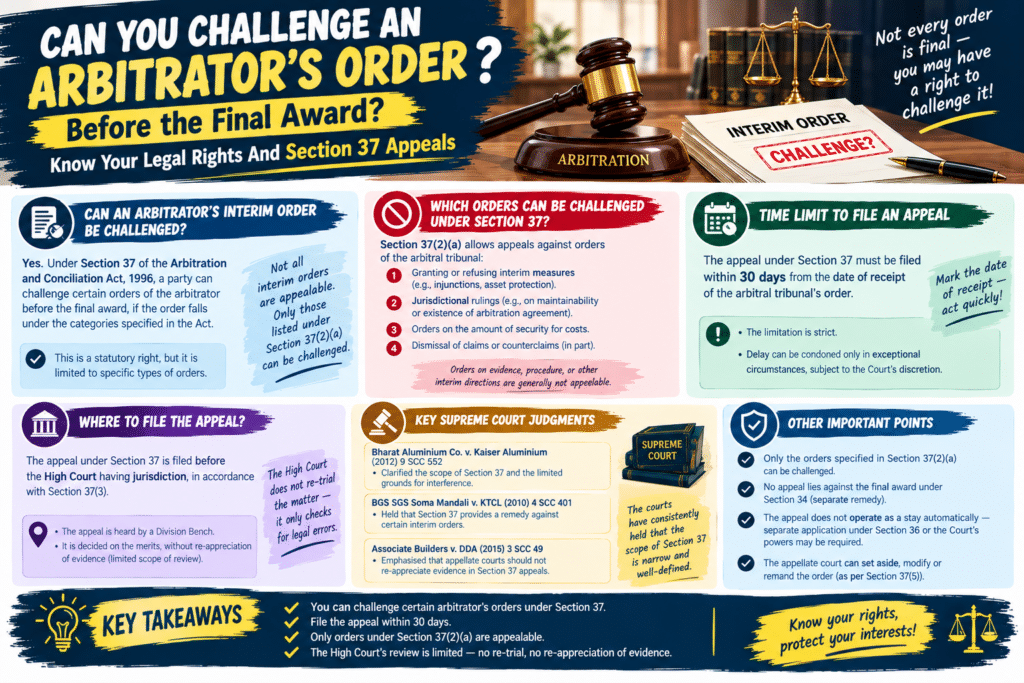
- Quick Answer: Can an Order Passed During Arbitration Be Challenged?
- 1. What Is an Interim Order Passed by an Arbitral Tribunal?
- 2. Which Section of the Arbitration Act Allows an Immediate Challenge?
- 3. Which Orders Usually Cannot Be Challenged Immediately?
- 4. Can You File a Writ Petition or an Article 227 Petition Against an Arbitrator’s Order?
- 5. What If the Arbitral Tribunal Terminates the Proceedings?
- 6. What Are the Legal Consequences of Not Challenging an Interim Order Immediately?
- 7. What Should You Do If the Arbitrator Passes an Unfavourable Order?
- 8. Myth vs Reality: Challenging an Arbitrator’s Interim Order
- 9. Frequently Asked Questions
- Q1. Can I challenge an interim order passed by an arbitrator in India?
- Q2. Can I challenge an arbitrator’s order under Section 37?
- Q3. Can an order rejecting a Section 16 jurisdictional objection be challenged immediately?
- Q4. Can I challenge an interim award before the final award?
- Q5. Can the High Court interfere with an interim order passed by an arbitrator?
- Q6. What if the arbitrator terminates the arbitration proceedings?
- Q7. Does filing an appeal automatically stay the arbitrator’s interim order?
- Q8. What is the time limit for challenging an interim order?
- Conclusion: Do Not Challenge Every Order—Choose the Correct Legal Remedy
Has the Arbitral Tribunal passed an order against you during ongoing arbitration? Do you have to wait until the final award, or can you immediately approach the court?
The answer depends on the nature of the order. Although an Arbitral Tribunal has considerable authority to manage proceedings and decide disputes, its orders are not entirely beyond judicial scrutiny. However, Indian arbitration law does not permit parties to challenge every unfavourable procedural decision immediately.
The Arbitration and Conciliation Act, 1996 provides specific remedies for certain interim orders, jurisdictional decisions and interim awards. In other situations, the aggrieved party may have to continue with the arbitration and raise the objection while challenging the final award, if the law permits.
This article explains when an order passed during arbitration can be challenged, when an immediate appeal is available, which legal remedies may be considered, and what the Supreme Court has held on this issue.
Quick Answer: Can an Order Passed During Arbitration Be Challenged?
Yes, but only in legally recognised circumstances. An order passed during arbitral proceedings is not automatically appealable merely because it adversely affects one of the parties.
The principal remedies are:
- Section 37(2)(a): Appeal where the Arbitral Tribunal accepts a specified plea that it lacks jurisdiction under Section 16(2) or Section 16(3).
- Section 37(2)(b): Appeal against an order granting or refusing an interim measure under Section 17.
- Section 34: A challenge to an arbitral award, including a genuine interim award, on the statutory grounds available under that section.
- Constitutional jurisdiction: A writ petition or petition under Article 227 may be considered only in exceptional circumstances; it is not a routine alternative to the remedies under the Act.
- Other appropriate remedies: Depending on the order, an application before the Tribunal itself or a remedy concerning termination of proceedings or the arbitrator’s mandate may need to be considered.
The exact remedy depends on what the Tribunal has actually decided, the legal effect of its order and the statutory provision under which it was passed.
1. What Is an Interim Order Passed by an Arbitral Tribunal?
An interim or interlocutory order is an order passed before the final adjudication of the dispute. It may deal with the conduct of the proceedings, protection of property, jurisdiction, evidence, procedural deadlines or other issues arising during arbitration.
For example, an Arbitral Tribunal may:
- Grant or refuse an application seeking protection of disputed property.
- Direct a party to preserve documents or assets.
- Decide whether it has jurisdiction to hear the dispute.
- Reject an application seeking additional time to file a pleading.
- Decide an application concerning the production of documents.
- Impose procedural directions or costs.
- Pass an order affecting the continuation of the arbitration.
- Decide a distinct claim or issue through an interim award.
These orders do not all have the same legal status. Some are immediately appealable, some may qualify as interim awards, and others ordinarily cannot be challenged in court until the final award is passed.
The key question is not simply whether an order was passed before the final award. It is whether the law provides a remedy against that particular order at that stage.
2. Which Section of the Arbitration Act Allows an Immediate Challenge?
Section 37(2) is the principal provision governing appeals against specified orders passed by an Arbitral Tribunal during proceedings.
A. Section 37(2)(a): When the Tribunal Accepts a Jurisdictional Objection
Section 16 allows the Arbitral Tribunal to rule on its own jurisdiction, including objections relating to the existence or validity of the arbitration agreement.
Under Section 37(2)(a), an appeal lies when the Tribunal accepts a plea under Section 16(2) or Section 16(3).
For instance, if a party argues that the Tribunal has no jurisdiction and the Tribunal accepts that objection, the aggrieved party may have a statutory appeal under Section 37(2)(a).
However, the position is different when the Tribunal rejects the jurisdictional objection and decides to continue the arbitration. The party generally cannot immediately challenge that rejection under Section 34 or Section 37. The objection ordinarily has to be raised, where legally sustainable, while challenging the final award.
This distinction is important because a jurisdictional objection may affect the entire arbitration, but the Act deliberately restricts when a court can intervene.
B. Section 37(2)(b): Orders Granting or Refusing Interim Measures
Section 17 empowers an Arbitral Tribunal to grant interim measures of protection during arbitral proceedings.
Depending on the circumstances, a party may seek an interim measure for:
- Preservation, interim custody or sale of goods that form the subject matter of the dispute.
- Securing the amount in dispute.
- Preservation or inspection of property or things relevant to the dispute.
- Interim injunctions or other protective measures.
- Appointment of a receiver.
- Other measures of protection considered just and convenient within the statutory framework.
If the Tribunal grants or refuses an interim measure under Section 17, the aggrieved party may appeal under Section 37(2)(b).
For example, suppose a company alleges that the opposing party is about to sell machinery that is central to the arbitration. If the Tribunal refuses to restrain the sale, the applicant may consider an appeal under Section 37(2)(b). Conversely, if an interim restraint is imposed against a party, that party may also consider an appeal.
However, an appeal does not guarantee relief. The appellate court will examine the legal and factual basis of the Tribunal’s order within the restricted scope applicable to such appeals.
C. Section 34: Can an Interim Order Be Challenged as an Interim Award?
Yes, in an appropriate case.
Section 2(1)(c) of the Act includes an interim award within the definition of an arbitral award. A genuine interim award may therefore be challenged under Section 34 without waiting for the final award.
However, not every order described as an “interim order”, “interim decision” or “interim award” will necessarily qualify as an award for this purpose.
The court will examine the substance and legal effect of the decision. A routine procedural direction or an ordinary interlocutory order does not become an award merely because it decides an issue important to one party.
Practical point: Before filing a Section 34 petition against an order passed during arbitration, examine whether the decision finally determines a substantive claim or issue in a manner that legally qualifies it as an arbitral award.
3. Which Orders Usually Cannot Be Challenged Immediately?
A common mistake is to assume that every adverse order passed by an arbitrator can be taken to court straightaway.
That is generally incorrect.
Orders concerning procedural directions, filing schedules, evidence, adjournments and other case-management matters are not automatically appealable under Section 37. If the order does not fall within a recognised statutory category, the party will ordinarily have to continue participating in the arbitration and preserve its objection for the appropriate later stage.
For example:
Situation 1: Rejection of a request for additional time
A party asks the Tribunal for more time to file its written submissions, but the Tribunal refuses. The refusal is not automatically appealable under Section 37 merely because it causes difficulty for that party.
Situation 2: Rejection of an application for production of documents
A party believes that certain documents are necessary for its case, but the Tribunal refuses the request. The party cannot ordinarily file a Section 37 appeal solely because it disagrees with that procedural decision.
Situation 3: Rejection of an objection to jurisdiction
A party argues that the arbitration agreement is invalid or that the Tribunal lacks jurisdiction, but the Tribunal rejects the objection and continues the proceedings. Under the Supreme Court’s ruling in MCM Worldwide Pvt. Ltd. v. Construction Industry Development Council, an independent Section 34 challenge to that pre-award rejection is not maintainable. The objection may be tested after the final award, if the statutory grounds and circumstances permit.
The legal consequences of each situation differ. The party should therefore identify the actual nature of the order before deciding whether to approach a court.
4. Can You File a Writ Petition or an Article 227 Petition Against an Arbitrator’s Order?
A party may consider whether the High Court’s constitutional jurisdiction is attracted in an exceptional case. However, a writ petition or an Article 227 petition is not a general appeal against orders passed by an Arbitral Tribunal.
The Supreme Court has repeatedly emphasised that arbitration is governed by a specific statutory scheme designed to limit unnecessary judicial interference.
Constitutional intervention may be considered only in exceptional circumstances, for example, where the statutory framework leaves no effective remedy and a serious jurisdictional or comparable legal defect is demonstrated. The threshold is high.
Where an objection can be raised through a challenge to the final award, the High Court will ordinarily be reluctant to interrupt the arbitration merely because a party disagrees with an interim ruling.
Before pursuing this route, it is important to examine:
- Whether Section 37 provides an appeal.
- Whether the order qualifies as an interim award under Section 2(1)(c).
- Whether the grievance can be raised under Section 34 after the final award.
- Whether the circumstances are sufficiently exceptional to justify constitutional intervention.
A petition filed without considering these questions may be dismissed as premature or not maintainable.
5. What If the Arbitral Tribunal Terminates the Proceedings?
An order terminating the entire arbitration is different from an order that merely decides a procedural issue while the proceedings continue.
Termination may arise in circumstances addressed by Sections 25, 30, 32 and 38 of the Act, depending on the facts. Examples may include a claimant’s failure to communicate its statement of claim without sufficient cause, a settlement, or failure to pay a required deposit.
The legal consequences can be serious because the Tribunal’s authority to adjudicate the dispute may come to an end.
In Harshbir Singh Pannu v. Jaswinder Singh, the Supreme Court examined the statutory framework governing termination and the remedial difficulties that can arise when proceedings are terminated. The appropriate course depends on the precise nature of the order, the provision invoked and whether the Tribunal’s mandate has ended.
Accordingly, a party facing termination should promptly examine whether an application for recall before the Tribunal, a remedy concerning the arbitrator’s mandate, or another legally available course is appropriate. A fresh arbitration should not be assumed to be permissible.
6. What Are the Legal Consequences of Not Challenging an Interim Order Immediately?
The consequences depend on the nature of the order.
A. The arbitration may continue
Where the order is not immediately appealable, the parties are ordinarily expected to continue participating in the proceedings. Refusing to participate simply because an adverse order has been passed may damage a party’s position.
B. The objection may be preserved for a later challenge
If the Act permits the objection to be raised against the final award, the party should preserve its legal grounds and supporting material during the proceedings.
However, an objection is not automatically available at the end merely because it was raised earlier. The challenge must still fall within the grounds and requirements of Section 34.
C. An interim measure may remain operative
An order granting an interim measure under Section 17 may remain effective unless it is varied, set aside or otherwise ceases to operate in accordance with law. A party should not disregard such an order merely because it intends to appeal.
D. Delay may affect the available remedy
Where a statutory appeal or other time-sensitive remedy is available, missing the applicable limitation period can seriously prejudice the party. The limitation period must be checked under the governing statute and applicable procedural law.
E. A challenge to the final award is not a rehearing of the entire dispute
Section 34 does not provide an unrestricted appeal on facts or law. The party must establish one or more statutory grounds for setting aside the award. It cannot assume that every unfavourable interim decision will be reopened.
7. What Should You Do If the Arbitrator Passes an Unfavourable Order?
The correct response is to identify the nature of the order before choosing a remedy.
Step 1: Obtain the complete order. Read the operative portion, reasons, date and provision under which the Tribunal acted.
Step 2: Identify the legal category. Determine whether it concerns jurisdiction under Section 16, an interim measure under Section 17, a possible interim award, termination of proceedings or a routine procedural matter.
Step 3: Check immediate appealability. If the order falls within Section 37(2), assess whether an appeal is maintainable and which court has jurisdiction.
Step 4: Consider the interim-award question. If the decision conclusively determines a distinct substantive claim or issue, examine whether it qualifies as an award capable of challenge under Section 34.
Step 5: Preserve objections and evidence. If an immediate challenge is unavailable, make appropriate submissions before the Tribunal and retain the relevant pleadings, orders and supporting material for any later remedy.
Step 6: Check limitation and interim protection. Do not assume that filing an appeal automatically suspends the operation of the impugned order. Consider whether a separate stay or protective order is required.
Step 7: Avoid unnecessary parallel litigation. Filing an appeal, a Section 34 petition and a constitutional petition simultaneously without a clear legal basis can create maintainability problems and additional costs.
8. Myth vs Reality: Challenging an Arbitrator’s Interim Order
Myth 1: Every order passed by an arbitrator can be challenged immediately.
Reality: Section 37 provides a limited list of appealable orders. Other orders ordinarily cannot be challenged immediately merely because they are adverse.
Myth 2: If the arbitrator rejects a jurisdictional objection, a Section 34 petition can be filed at once.
Reality: The Supreme Court in MCM Worldwide clarified that rejection of a jurisdictional plea under Section 16 cannot ordinarily be challenged independently under Section 34 before the final award.
Myth 3: A writ petition is always available if the Arbitration Act provides no appeal.
Reality: Constitutional intervention is exceptional. The absence of an immediate appeal does not, by itself, make a writ petition maintainable.
Myth 4: Every order called an “interim award” can be challenged under Section 34.
Reality: The substance and legal effect of the decision matter. A routine interlocutory order does not become an arbitral award merely because it is described that way.
Myth 5: If an interim order is unfair, the party can ignore it until the court decides the matter.
Reality: An operative order must not be disregarded merely because a challenge is contemplated. The party should seek appropriate legal relief.
Myth 6: If the Tribunal terminates the arbitration, a fresh arbitration can automatically be started.
Reality: Termination may have serious consequences for the arbitral reference and the Tribunal’s mandate. The correct remedy must be identified from the governing statutory provisions and the relevant case law.
9. Frequently Asked Questions
Q1. Can I challenge an interim order passed by an arbitrator in India?
Yes, in certain circumstances. An appeal may lie under Section 37(2) against specified jurisdictional rulings or orders granting or refusing interim measures under Section 17. A genuine interim award may be challenged under Section 34. Other interlocutory orders are generally not immediately appealable.
Q2. Can I challenge an arbitrator’s order under Section 37?
Only if the order falls within a category specified in Section 37. In relation to orders passed by the Tribunal, Section 37(2)(a) concerns acceptance of specified jurisdictional pleas, while Section 37(2)(b) concerns the grant or refusal of interim measures under Section 17.
Q3. Can an order rejecting a Section 16 jurisdictional objection be challenged immediately?
Ordinarily, no. Following MCM Worldwide Pvt. Ltd. v. Construction Industry Development Council (2026), the party must generally wait until the final award and, if legally justified, challenge it under Section 34.
Q4. Can I challenge an interim award before the final award?
Yes, if the decision legally qualifies as an interim award. Section 34 may be available without waiting for the final award, subject to the applicable statutory grounds and limitation period.
Q5. Can the High Court interfere with an interim order passed by an arbitrator?
The High Court’s constitutional jurisdiction is not a routine substitute for the remedies under the Arbitration Act. Intervention is exceptional, particularly where the grievance can be addressed through a statutory remedy or a later challenge to the award.
Q6. What if the arbitrator terminates the arbitration proceedings?
The remedy depends on the legal basis and effect of the termination order. The party should promptly examine the possibility of recall, the status of the arbitrator’s mandate and the principles laid down in Harshbir Singh Pannu v. Jaswinder Singh (2025).
Q7. Does filing an appeal automatically stay the arbitrator’s interim order?
No. A party should check whether a separate application for stay or other interim protection is necessary. The effect of the impugned order must be assessed independently.
Q8. What is the time limit for challenging an interim order?
There is no single limitation period applicable to every kind of order. The applicable deadline depends on the remedy being pursued, the relevant statutory provision and the governing procedural law. It should be verified immediately after the order is received.
Conclusion: Do Not Challenge Every Order—Choose the Correct Legal Remedy
An adverse order passed during arbitration can affect the course of the dispute, but that does not mean every order can be challenged immediately before a court.
The Arbitration and Conciliation Act, 1996 seeks to balance procedural fairness with the need to prevent arbitration from becoming a series of interim court battles. Section 37 permits appeals against specified orders, Section 34 provides a limited mechanism for challenging arbitral awards, and constitutional intervention remains exceptional.
The first step is therefore to identify the nature of the order, the statutory provision under which it was passed and its legal effect. A correctly chosen remedy can protect a party’s rights; an incorrectly filed challenge may be dismissed without examination of the underlying grievance.
If an Arbitral Tribunal has passed an adverse order in your matter, obtain the complete order and assess the available remedy promptly. The distinction between an appealable interim order, an interim award and an ordinary procedural direction can determine the entire course of the next legal step.