
Disclaimer!

This Website is owned and operated by Law Offices of Zuber Ali and is made available strictly for educational, informational, and public legal awareness purposes. All content published on this Website, including but not limited to blog posts, case summaries, full texts or excerpts of judgments, legal articles, explanations, commentaries, and any other material, is provided solely to promote general understanding of legal principles and developments in Indian law among the public.
The information and materials available on this Website do not constitute legal advice, professional opinion, or any form of legal services. Nothing contained on this Website is intended to create, nor should it be construed as creating, any attorney-client relationship, lawyer-client relationship, or any other professional relationship between the user and the owner/operator of this Website or any person associated with it. Users are strongly advised not to rely upon or act on the basis of any content available on this Website without seeking specific advice from a qualified and competent legal professional who is duly enrolled and authorized to practice law.
We make reasonable efforts to ensure that the information on this Website is accurate and up-to-date at the time of publication. However, We do not provide any warranty, express or implied, as to the completeness, accuracy, reliability, suitability, or timeliness of the content. Laws, rules, regulations, and judicial pronouncements are dynamic and subject to amendments, clarifications, interpretations, and reversals. Accordingly, We shall not be responsible or liable for any errors, omissions, inaccuracies, or for any consequences arising from the use of, or reliance upon, any information provided on this Website.
To the maximum extent permitted under applicable Indian law, including but not limited to the Information Technology Act, 2000 and other relevant statutes, We expressly disclaim all liability for any direct, indirect, incidental, consequential, special, punitive, or exemplary damages arising out of or in any way connected with the access to, use of, or inability to use this Website or any content therein. This includes, without limitation, any loss, damage, injury, or harm, whether financial, legal, or otherwise, suffered by any user or third party due to decisions or actions taken based on the material available on this Website.
This Website may occasionally contain links to external websites, government portals, databases, or third-party resources. We do not endorse, control, monitor, or assume any responsibility for the accuracy, privacy practices, or content of such external sources. Any access to or use of such third-party resources is entirely at the user’s own risk.
By accessing, browsing, or using this Website in any manner, you expressly acknowledge that you have read, understood, and voluntarily agreed to this Disclaimer. You further agree that your use of this Website is at your sole risk and that you will not hold Us liable for any issues arising from such use. If you do not agree with any part of this Disclaimer, you must immediately cease accessing or using this Website.

Uncategorized

Sued Under Order 37 CPC? Don’t Ignore It! Here’s How ‘Leave to Defend’ Can Save You From an Immediate Decree

Introduction Imagine opening your door one morning and finding a court summons waiting for you. It says that a Summary Suit under Order XXXVII of the Code of Civil Procedure, 1908 has been filed against you for ₹50 lakh. Your first reaction may be: “I’ll simply file my written statement and defend myself.” Unfortunately, that’s […]
Sued Under Order 37 CPC? Don’t Ignore It! Here’s How ‘Leave to Defend’ Can Save You From an Immediate Decree Read More »

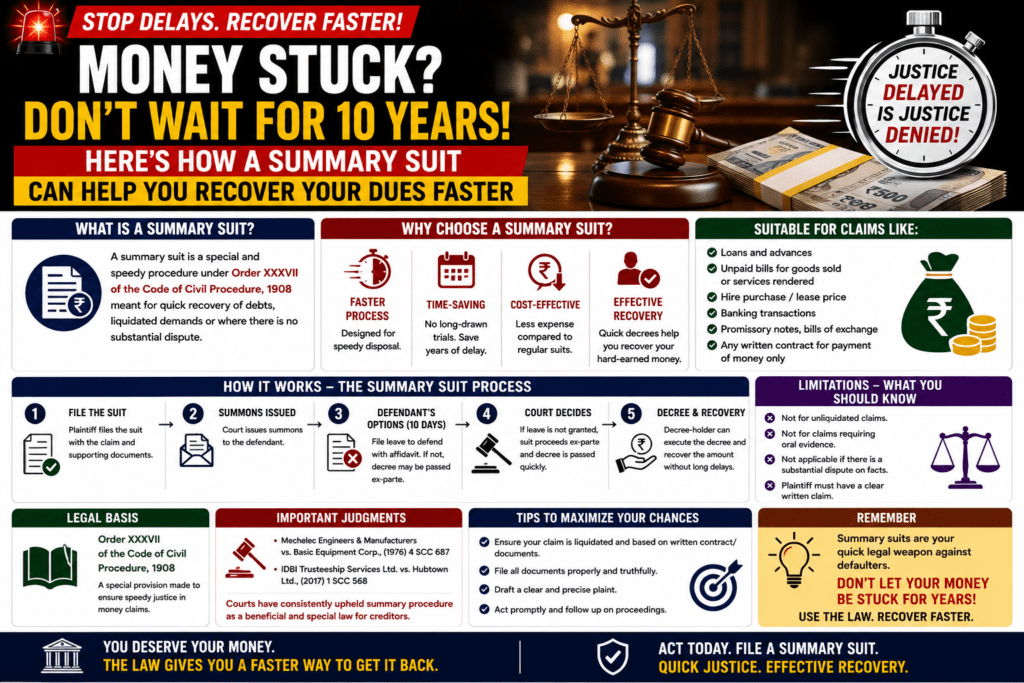
Money Stuck? Don’t Wait for 10 Years! Here’s How a Summary Suit Can Help You Recover Your Dues Faster

Introduction Suppose you lent someone ₹10 lakh. Or you supplied goods to a company. Or you received a cheque that later bounced. You have all the documents proving your claim. Yet, when you approach the court, you are told that an ordinary civil suit may take several years. This is exactly why the law provides

Money Stuck? Don’t Wait for 10 Years! Here’s How a Summary Suit Can Help You Recover Your Dues Faster Read More »

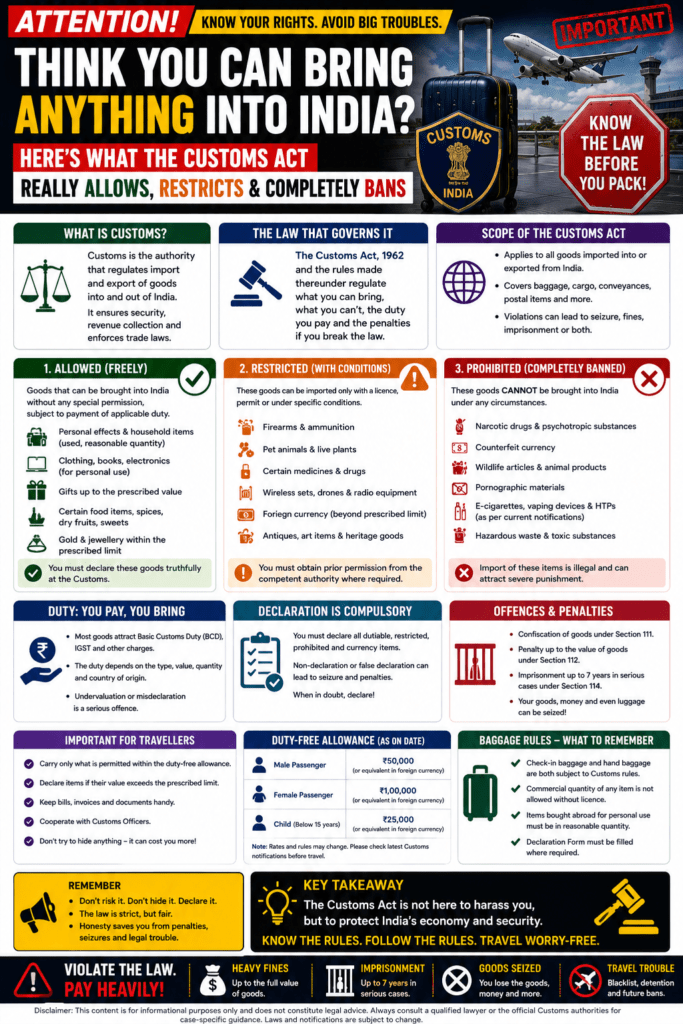
Think You Can Bring Anything Into India? Here’s What the Customs Act Really Allows, Restricts & Completely Bans

Introduction Imagine returning to India after an international trip. You have bought a new iPhone, a luxury watch, some gold jewellery, chocolates, cosmetics, medicines, and a few expensive gifts for your family. As you walk towards the airport exit, a Customs Officer stops you and asks: “Do you have anything to declare?” Most people immediately

Think You Can Bring Anything Into India? Here’s What the Customs Act Really Allows, Restricts & Completely Bans Read More »

Customs Seized Your Goods at the Airport? Don’t Panic! Here’s How to Get Them Back Legally

Introduction You have just landed at an international airport. As you collect your luggage and approach the exit, a Customs Officer stops you for inspection. A few minutes later, you are told: “These goods are being seized and may be confiscated under the Customs Act.” For most people, this is shocking. Many immediately assume that

Customs Seized Your Goods at the Airport? Don’t Panic! Here’s How to Get Them Back Legally Read More »

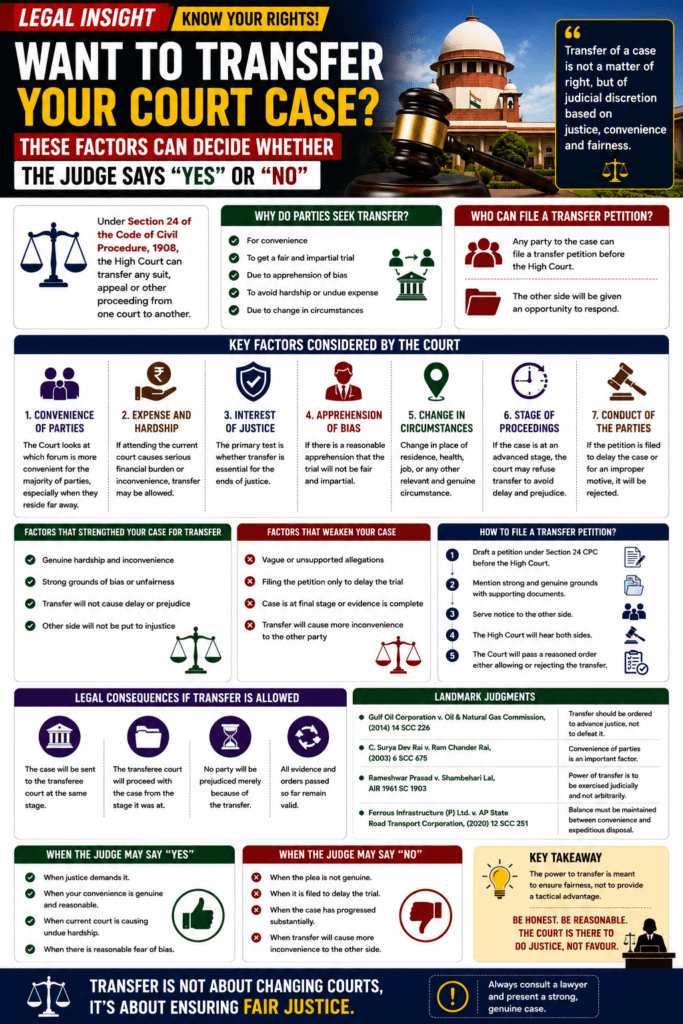
Want to Transfer Your Court Case? These Factors May Decide Whether the Judge Says “Yes” or “No”

Introduction Many people believe that if they are unhappy with a court or find it inconvenient to attend hearings, they can simply ask for their case to be transferred. The law is not that simple. A transfer petition is not granted merely because one party prefers another court. Indian courts treat the power to transfer

Want to Transfer Your Court Case? These Factors May Decide Whether the Judge Says “Yes” or “No” Read More »

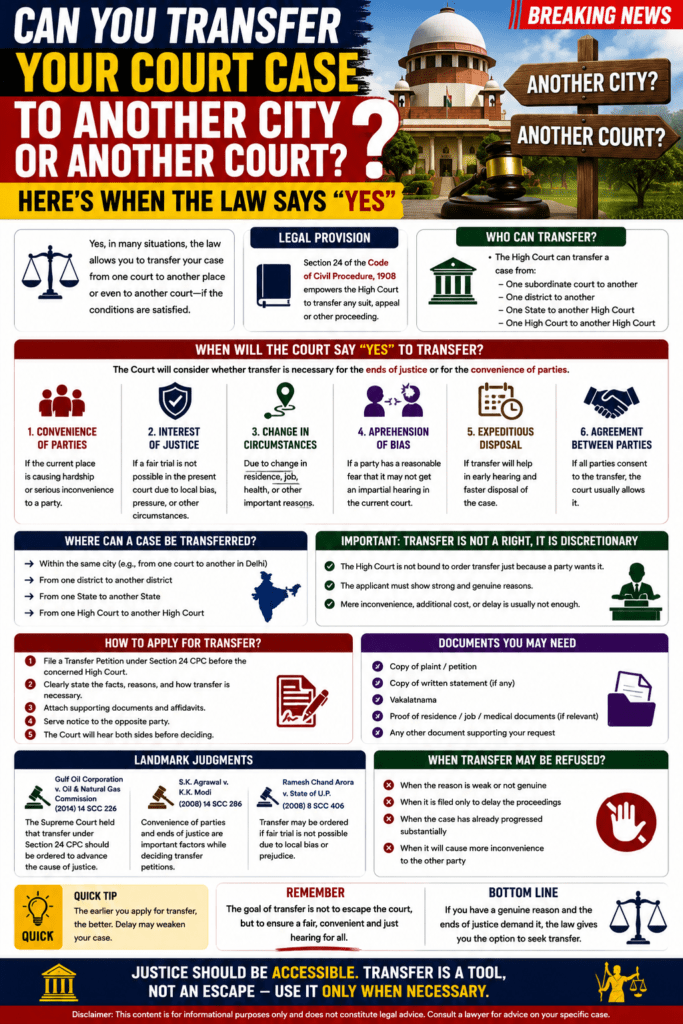
Can You Transfer Your Court Case to Another City or Another Court? Here’s When the Law Says “Yes”

Introduction Imagine this. You live in Delhi, but someone has filed a case against you in Chennai. Or perhaps your matrimonial case is pending hundreds of kilometres away, making every hearing expensive and stressful. Or maybe you genuinely believe that you cannot receive a fair trial before a particular court. The first question that naturally

Can You Transfer Your Court Case to Another City or Another Court? Here’s When the Law Says “Yes” Read More »

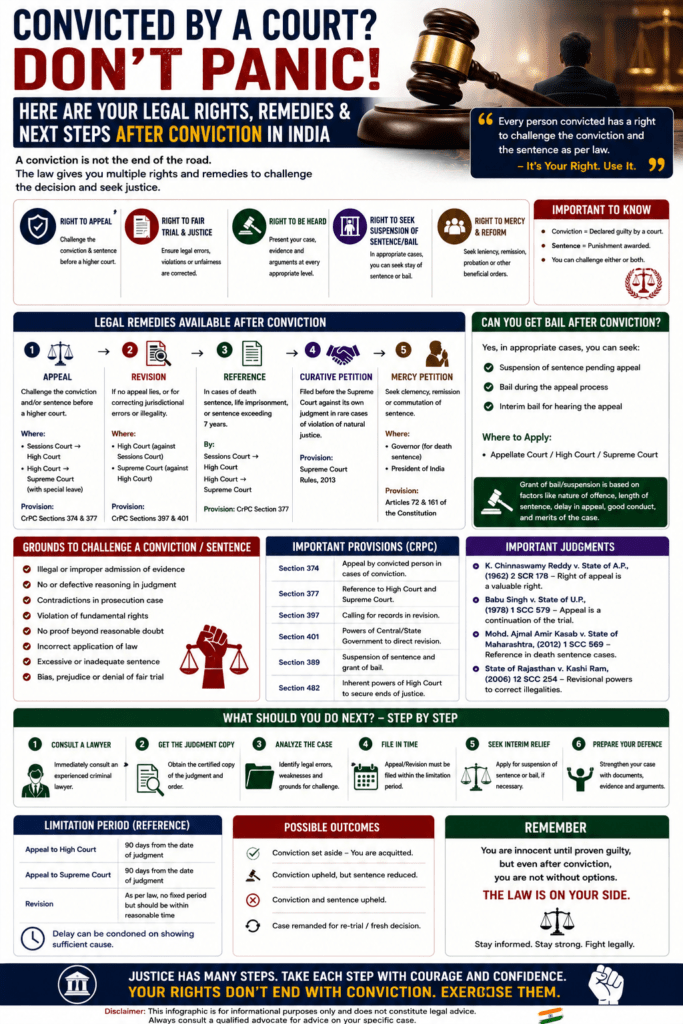
Convicted by a Court? Don’t Panic! Here Are Your Legal Rights, Remedies & Next Steps After Conviction in India

Introduction Imagine that after years of facing a criminal trial, the judge pronounces: “The accused is convicted.” For most people, this is one of the most frightening moments of their lives. Many assume that the case is over, that there is nothing left to do, or that they will immediately be taken to prison. That

Convicted by a Court? Don’t Panic! Here Are Your Legal Rights, Remedies & Next Steps After Conviction in India Read More »

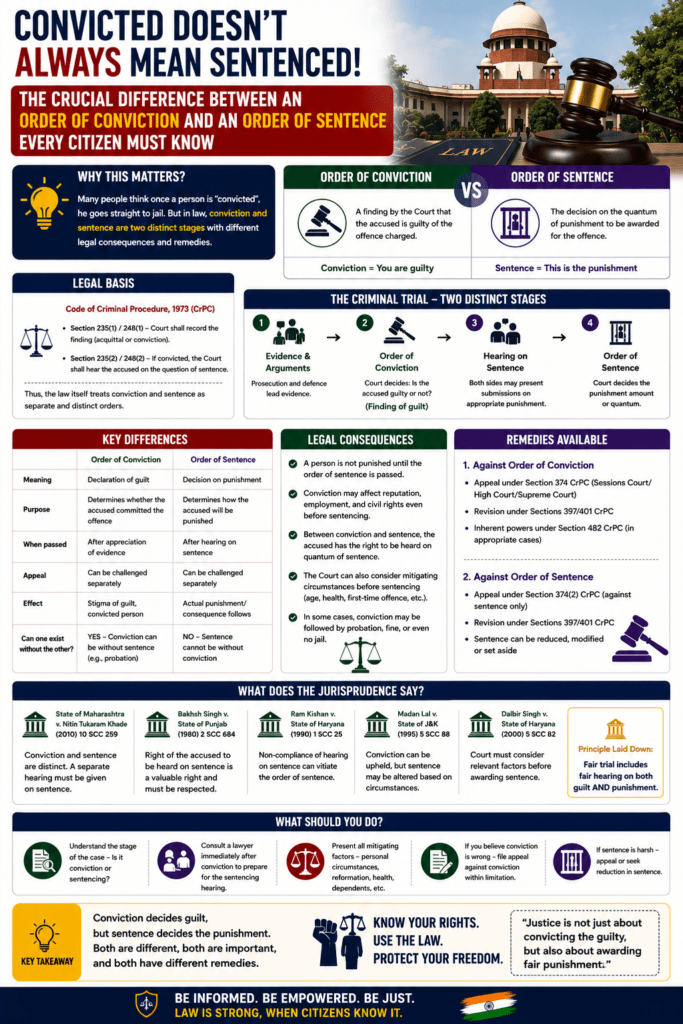
Convicted Doesn’t Always Mean Sentenced! The Crucial Difference Between an Order of Conviction and an Order of Sentence Every Citizen Must Know

Introduction Many people think that once a judge says, “The accused is convicted,” the person is immediately sent to prison. That is not always correct. One of the most misunderstood concepts in criminal law is the difference between an Order of Conviction and an Order of Sentence. Although these two orders are closely connected, they

Convicted Doesn’t Always Mean Sentenced! The Crucial Difference Between an Order of Conviction and an Order of Sentence Every Citizen Must Know Read More »

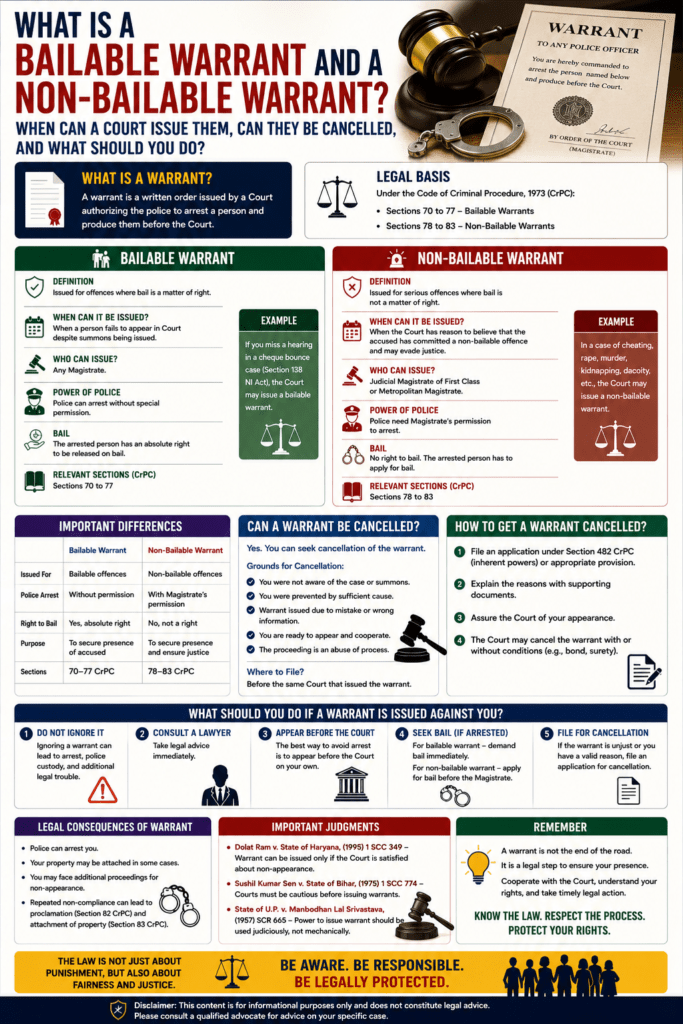
What Is a Bailable Warrant and a Non-Bailable Warrant? When Can a Court Issue Them, Can They Be Cancelled, and What Should You Do?

Introduction Imagine waking up one morning and learning that a court has issued a warrant against you. The first question most people ask is: “Will I be arrested immediately?” The answer depends on what type of warrant has been issued. Many people believe that every warrant means immediate jail or that a non-bailable warrant (NBW)

What Is a Bailable Warrant and a Non-Bailable Warrant? When Can a Court Issue Them, Can They Be Cancelled, and What Should You Do? Read More »

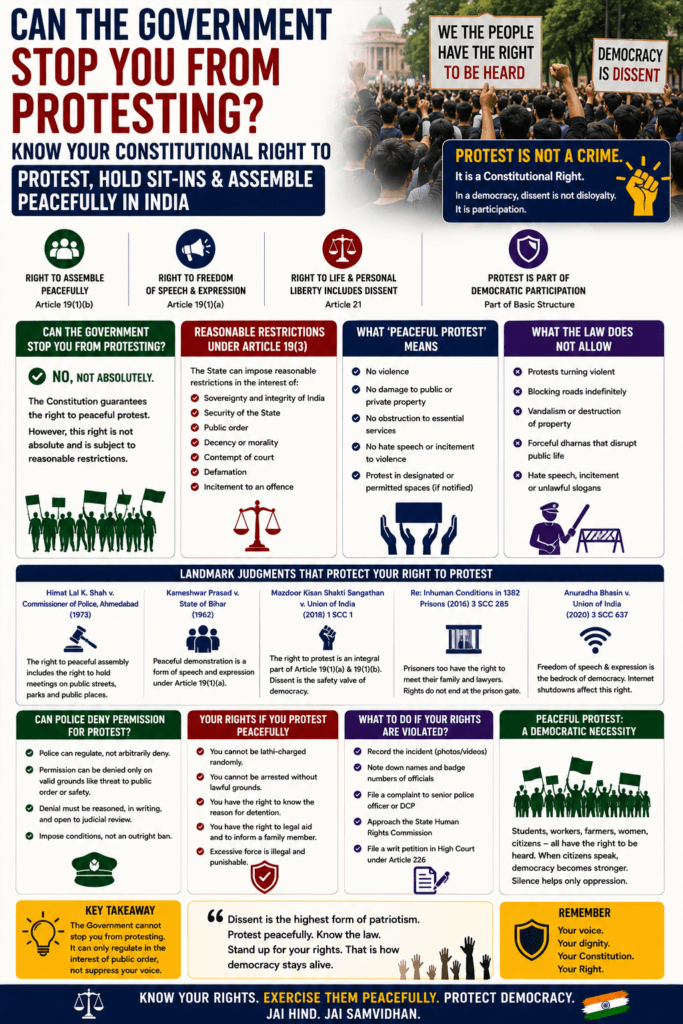
Can the Government Stop You From Protesting? Know Your Constitutional Right to Protest, Hold Sit-Ins & Assemble Peacefully in India

Introduction Whenever citizens protest against a government decision, a university policy, rising prices, unemployment, or any public issue, one question repeatedly arises: “Do citizens actually have a legal right to protest?” Many people believe that: These assumptions are only partly true. The Indian Constitution recognises the right to peaceful protest as an essential feature of

Can the Government Stop You From Protesting? Know Your Constitutional Right to Protest, Hold Sit-Ins & Assemble Peacefully in India Read More »