
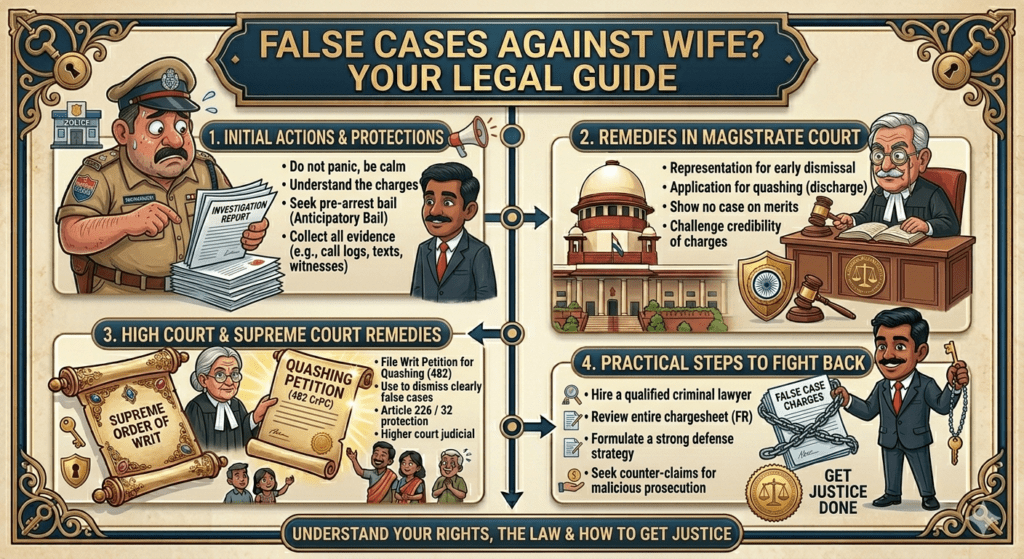
- Introduction
- What Is a False Case?
- What Types of False Cases May Be Filed?
- What Should You Do Immediately?
- What Are the Legal Remedies Available?
- 1. Defend the Case on Merits
- 2. Seek Dismissal of Baseless Proceedings
- 3. Petition for Quashing of Criminal Proceedings
- 4. Proceedings for Perjury
- 5. Defamation
- 6. Claim for Malicious Prosecution
- 7. Seek Appropriate Relief in Connected Proceedings
- Can the Wife File a Case Against the Husband?
- What If the Court Finds the Husband's Case to Be False?
- Jurisprudence Behind These Remedies
- Practical Tips
- Myth vs Reality
- Frequently Asked Questions (FAQs)
- Key Takeaways
- Conclusion
Introduction
Marriage is built on trust, respect, and companionship. Unfortunately, when matrimonial disputes arise, emotions sometimes lead to legal battles. In some situations, a husband may file false criminal complaints, fabricated civil cases, or make baseless allegations to pressure, harass, or gain an advantage in matrimonial proceedings.
At the same time, it is equally important to remember that many legal actions initiated by husbands are genuine and based on real disputes. A case is not considered false merely because the husband ultimately loses the case or the court dismisses it.
If you believe that your husband has deliberately filed a false or malicious case against you, Indian law provides several remedies to protect your rights.
This guide explains the legal remedies available to a wife facing false litigation, the legal principles involved, practical steps to take, and answers to common questions in simple language.
What Is a False Case?
A false case is one where allegations are intentionally fabricated, knowingly false, or maliciously made to harass another person.
A weak case, an unsuccessful case, or a case dismissed for lack of sufficient evidence is not automatically a false case.
The question whether a case is false depends upon the evidence and the findings of the competent court.
What Types of False Cases May Be Filed?
Depending on the circumstances, a husband may initiate:
- false criminal complaints;
- false allegations affecting reputation;
- false divorce proceedings based on fabricated grounds;
- false property-related disputes;
- false child custody allegations;
- false complaints before public authorities.
Each type of proceeding has its own legal procedure and evidentiary requirements.
What Should You Do Immediately?
If you receive notice of a case or complaint:
1. Stay Calm
Receiving a legal notice or complaint does not mean that the allegations are true.
Every person has the right to defend themselves before an independent court.
2. Consult an Experienced Lawyer
Take legal advice as early as possible.
An advocate can explain the allegations, evaluate the evidence, and help formulate an appropriate legal strategy.
3. Preserve All Evidence
Keep copies of:
- WhatsApp chats;
- emails;
- photographs;
- videos;
- financial records;
- bank statements;
- travel records;
- medical records;
- social media communications;
- witness details.
Electronic evidence often plays a decisive role in matrimonial litigation.
4. Avoid Emotional Reactions
Do not threaten, abuse, or publicly defame your husband.
Respond only through lawful and appropriate legal channels.
What Are the Legal Remedies Available?
Depending on the facts, several remedies may be available.
1. Defend the Case on Merits
Every allegation must be proved by evidence.
You have the right to:
- file a written reply;
- produce documentary evidence;
- cross-examine witnesses;
- challenge false statements;
- examine defence witnesses where necessary.
2. Seek Dismissal of Baseless Proceedings
If the complaint or suit does not disclose a legally sustainable cause of action or is otherwise not maintainable, you may seek its dismissal in accordance with the applicable law.
The court will examine the pleadings and legal requirements before granting such relief.
3. Petition for Quashing of Criminal Proceedings
Where a criminal complaint is frivolous, malicious, or fails to disclose the commission of an offence even if the allegations are accepted at face value, the High Court may exercise its inherent jurisdiction to quash the proceedings in appropriate cases.
This power is exercised sparingly and only when the legal requirements are satisfied.
4. Proceedings for Perjury
If a person knowingly gives false evidence or intentionally makes false statements on oath before a court, proceedings relating to perjury may arise, subject to the statutory procedure and satisfaction of the legal requirements.
Not every inconsistency or unsuccessful allegation amounts to perjury.
5. Defamation
If false allegations unlawfully damage your reputation, remedies under the law relating to defamation may be available.
Whether such a remedy succeeds depends upon proof of the essential legal ingredients.
6. Claim for Malicious Prosecution
In appropriate cases, where proceedings have been initiated maliciously and without reasonable or probable cause, civil remedies for malicious prosecution may be available after satisfying the legal requirements recognised by law.
7. Seek Appropriate Relief in Connected Proceedings
If the husband has initiated multiple proceedings with the object of harassment or abuse of process, the wife may seek appropriate relief before the competent court in accordance with law.
Each remedy depends upon the facts and nature of the proceedings.
Can the Wife File a Case Against the Husband?
Yes.
If the husband commits an independent offence recognised by law—such as criminal intimidation, forgery, defamation, or knowingly giving false evidence—the wife may pursue remedies available under the applicable legal provisions.
The availability of such remedies depends on the facts and legal requirements.
What If the Court Finds the Husband’s Case to Be False?
Where a competent court concludes, on the basis of evidence, that the proceedings were false, malicious, or an abuse of the legal process, several legal consequences may follow, depending on the circumstances.
These may include:
- dismissal of the proceedings;
- adverse findings against the party making false allegations;
- proceedings permissible under law for false evidence or other offences, where applicable;
- civil remedies such as defamation or malicious prosecution, where the legal requirements are established.
Each case depends upon its own facts.
Jurisprudence Behind These Remedies
Indian law seeks to balance two equally important objectives.
1. Access to Justice
Every person has the right to approach a court for genuine legal grievances.
2. Protection Against Abuse of Process
Courts discourage litigation that is malicious, frivolous, or intended solely to harass another person.
3. Fair Trial
Every litigant is entitled to a fair opportunity to present evidence and contest allegations.
4. Rule of Law
Judicial decisions are based on evidence, legal principles, and due process—not assumptions or public opinion.
Practical Tips
- Never ignore court notices or summons.
- Preserve all electronic and documentary evidence.
- Attend court proceedings regularly.
- Follow your lawyer’s advice.
- Avoid social media discussions about the pending case.
- Maintain dignity and composure throughout the litigation.
Myth vs Reality
| Myth | Reality |
|---|---|
| If my husband files a case, I will automatically lose. | False. Every allegation must be proved before a competent court. |
| A dismissed case automatically means the husband committed an offence. | Incorrect. Dismissal does not automatically establish malicious intent. Separate legal requirements apply for further action. |
| A wife has no remedy against false litigation. | Wrong. Depending on the facts, remedies such as defence on merits, quashing, defamation, perjury, and malicious prosecution may be available. |
| Posting everything on social media will strengthen my case. | False. Courts decide cases on admissible evidence, not online narratives. |
| Every case filed by a husband is false. | Wrong. Many matrimonial disputes involve genuine legal issues. Each case must be examined independently on its own evidence. |
Frequently Asked Questions (FAQs)
What should I do first if my husband files a false case?
Consult an experienced lawyer immediately, preserve all evidence, and prepare an appropriate legal defence.
Can a false criminal complaint be quashed?
Yes. In appropriate cases, the High Court may quash criminal proceedings if the legal requirements for exercising its inherent jurisdiction are satisfied.
Can I claim compensation?
Compensation is not automatic. Depending on the facts and applicable law, civil remedies such as malicious prosecution or defamation may be available.
Can I file a defamation case against my husband?
If the legal ingredients of defamation are established, appropriate remedies may be available. Each case depends on its facts and evidence.
Does dismissal of the husband’s case automatically prove that it was false?
No. A dismissal only means that the court did not grant the relief sought or found the evidence insufficient. It does not automatically establish malicious intent.
Key Takeaways
- A legal notice or complaint does not establish guilt.
- Every litigant has the right to a fair hearing and due process.
- Legal remedies may include defending the case on merits, seeking dismissal or quashing where legally permissible, and, in appropriate cases, pursuing defamation, perjury, or malicious prosecution.
- Preserve evidence, respond lawfully, and avoid emotional reactions.
- Courts protect genuine claims while also preventing abuse of the judicial process.
Conclusion
False litigation can cause emotional, financial, and social hardship. However, the legal system is designed to ensure that every allegation is tested against evidence and legal principles. If you believe that your husband has filed a false case against you, the law provides meaningful remedies—but they must be pursued carefully, patiently, and through proper legal procedures.
By understanding your rights, preserving evidence, obtaining timely legal advice, and responding strategically, you can effectively defend yourself while upholding the rule of law.
The best response to a false case is not fear or retaliation—it is a strong legal strategy backed by credible evidence and confidence in the justice system.