
Introduction
Imagine this situation.
An FIR is registered against you. A few days later, the complainant tells you:
“Don’t worry. I’ll ask the police to cancel the FIR.”
Or perhaps the Investigating Officer says:
“We will cancel the FIR ourselves.”
This raises an important legal question:
- Can the police themselves quash an FIR?
- Can the complainant withdraw an FIR?
- Does only the High Court have the power to quash an FIR?
- What happens if the police find that the allegations are false?
These questions create confusion because people often use the words cancel, close, and quash interchangeably, even though they have very different legal meanings.
The short answer is this:
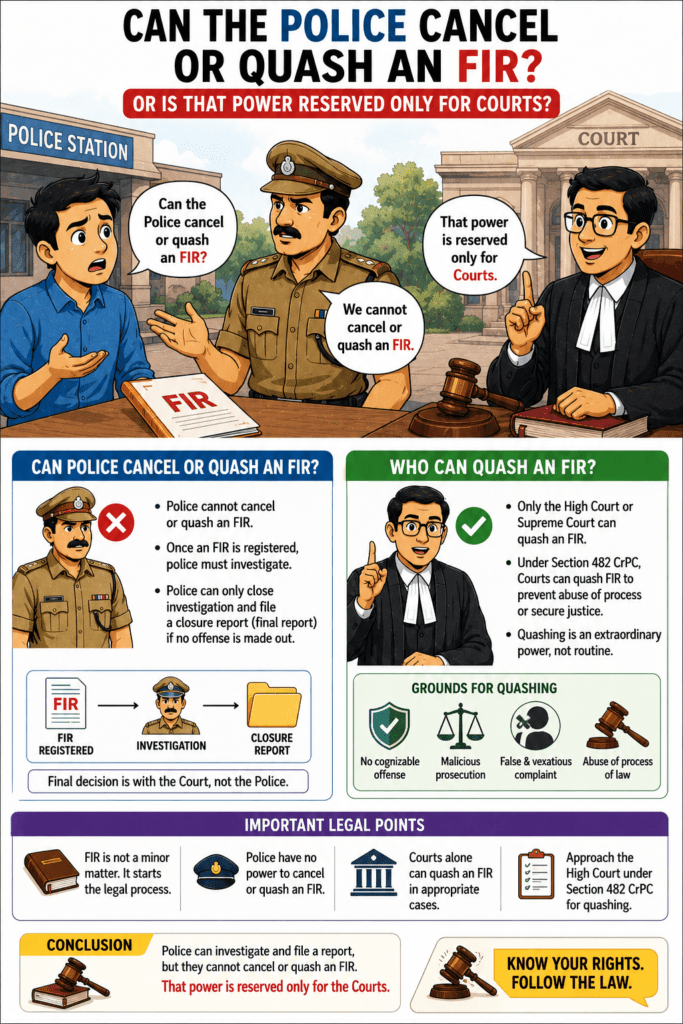
The police do not have the power to “quash” an FIR. The power to quash criminal proceedings is vested in the High Court. However, the police do have the power to investigate an FIR and, if the evidence does not support the allegations, submit an appropriate final report before the Magistrate.
Understanding this distinction is extremely important.
What Is an FIR?
An FIR (First Information Report) is the first formal information recorded by the police regarding the commission of a cognizable offence.
Registration of an FIR only sets the criminal law into motion.
It does not prove that the accused is guilty.
After registration, the police must investigate the allegations fairly and impartially.
Can the Police Quash an FIR?
No.
The police cannot quash an FIR.
Quashing is a judicial power exercised by the High Court in appropriate cases under its inherent jurisdiction preserved by Section 528 of the Bharatiya Nagarik Suraksha Sanhita, 2023 (BNSS).
Only the High Court can quash an FIR or criminal proceedings when the legal requirements are satisfied.
The police have no authority to pass an order stating that an FIR stands “quashed.”
Then What Powers Do the Police Have?
Although the police cannot quash an FIR, they have important statutory powers during investigation.
They can:
- investigate the allegations;
- collect documents and evidence;
- examine witnesses;
- record statements;
- arrest where legally justified;
- seize property where authorised by law;
- conclude the investigation and submit a final report to the Magistrate.
Their role is investigative—not adjudicatory.
What Happens If the Police Find the Complaint to Be False?
If, after a fair investigation, the police conclude that:
- no offence is made out;
- the allegations are false;
- there is insufficient evidence; or
- the accused should not be prosecuted,
they may submit an appropriate final report (often referred to in practice as a cancellation report or closure report, depending on the nature of the conclusion) before the jurisdictional Magistrate.
However, the police cannot themselves terminate the criminal proceedings.
The final decision rests with the Magistrate.
Does the Magistrate Have to Accept the Police Report?
No.
The Magistrate is not bound by the opinion of the police.
After examining the report and the material collected during investigation, the Magistrate may:
- accept the final report;
- reject the report;
- direct further investigation where permissible;
- take cognizance of the offence if the legal requirements are satisfied.
Thus, even if the police recommend closure, the matter does not automatically end.
What Is the Difference Between Quashing and a Closure Report?
Many people confuse these two concepts.
Quashing
Quashing is a judicial remedy.
The High Court exercises this extraordinary power in appropriate cases to prevent abuse of the process of law or to secure the ends of justice.
If an FIR is quashed, the criminal proceedings ordinarily come to an end.
Closure / Cancellation Report
A closure or cancellation report is the opinion of the Investigating Officer after completing the investigation.
It is not a judicial order.
The Magistrate independently decides whether to accept or reject it.
Can the Complainant Withdraw an FIR?
The answer depends upon the nature of the offence.
If the offence is compoundable, it may be settled in accordance with law, subject to the applicable legal requirements.
However, for non-compoundable offences, the complainant cannot simply withdraw the FIR by giving a letter to the police.
In appropriate cases involving settlement, parties may approach the High Court for quashing of the proceedings if the law permits.
Can the Police Delete the FIR From Their Records?
No.
Once an FIR is registered, the police cannot simply erase it from official records because the complainant changes his or her mind or because an officer believes the allegations are incorrect.
The investigation must proceed in accordance with law, and the outcome must be placed before the competent court where required.
When Can the High Court Quash an FIR?
The High Court may consider quashing criminal proceedings in appropriate cases, such as:
- where the allegations do not disclose the commission of any offence even if accepted at face value;
- where the proceedings are manifestly frivolous or malicious;
- where continuation of the prosecution would amount to an abuse of the process of law;
- where a lawful compromise justifies quashing in accordance with settled legal principles;
- where intervention is necessary to secure the ends of justice.
Quashing is an extraordinary remedy and is exercised sparingly.
Jurisprudence Behind Quashing of FIR
The law relating to quashing is based on several important principles.
1. Separation of Powers
The police investigate offences.
The courts decide legal rights and criminal liability.
This distinction ensures fairness and prevents arbitrary exercise of power.
2. Fair Investigation
The police must conduct an impartial investigation, irrespective of whether the allegations appear true or false at the outset.
3. Judicial Oversight
The Magistrate and the High Court supervise different stages of the criminal process to ensure that investigations and prosecutions comply with the law.
4. Protection Against Abuse of Process
The inherent jurisdiction of the High Court exists to prevent misuse of criminal law and to ensure that justice is not defeated by frivolous or malicious prosecutions.
What Should You Do If a False FIR Has Been Registered?
Depending on the facts, you may consider:
- consulting an experienced criminal lawyer;
- applying for anticipatory bail if there is a reasonable apprehension of arrest;
- cooperating with the investigation;
- preserving documentary and electronic evidence;
- challenging the FIR before the High Court where legally justified;
- seeking discharge or other remedies available at the appropriate stage of the proceedings.
The appropriate course depends on the facts of each case.
Practical Tips
- Never assume that the police can “cancel” an FIR merely because the complainant has changed their mind.
- Do not rely on verbal assurances from investigating officers.
- Obtain copies of relevant orders and reports.
- Participate in the investigation when lawfully required.
- Seek legal advice before signing any compromise or statement.
Myth vs Reality
| Myth | Reality |
|---|---|
| The police can quash an FIR whenever they believe it is false. | False. The police can investigate and submit a final report, but they cannot quash an FIR. |
| If the complainant withdraws the complaint, the FIR automatically ends. | Incorrect. The effect depends on the nature of the offence and the applicable legal procedure. |
| A cancellation report is the same as quashing. | Wrong. A cancellation or closure report is the police’s opinion after investigation, whereas quashing is a judicial order passed by the High Court. |
| The Magistrate must accept the police’s recommendation. | False. The Magistrate independently examines the report and may accept or reject it in accordance with law. |
| Every false FIR will automatically be quashed by the High Court. | Incorrect. Quashing is an extraordinary discretionary remedy granted only when the legal requirements are satisfied. |
Frequently Asked Questions (FAQs)
Can the police quash an FIR?
No. The police do not possess the power to quash an FIR. Quashing is a judicial function exercised by the High Court.
Can the police file a cancellation or closure report?
Yes. After investigation, the police may submit an appropriate final report before the Magistrate if they conclude that no case is made out or there is insufficient evidence.
Who has the final authority after a closure report is filed?
The jurisdictional Magistrate decides whether to accept, reject, or otherwise deal with the report in accordance with law.
Can the complainant withdraw an FIR?
It depends on the nature of the offence. Compoundable offences may be settled in accordance with law, while non-compoundable offences generally cannot be withdrawn merely by informing the police.
Which court can quash an FIR?
The High Court may exercise its inherent jurisdiction under Section 528 of the Bharatiya Nagarik Suraksha Sanhita, 2023 to quash criminal proceedings in appropriate cases.
Key Takeaways
- The police cannot quash an FIR.
- Quashing is a judicial power exercised by the High Court.
- The police can investigate and submit a final report after completing the investigation.
- The Magistrate independently decides whether to accept or reject the police report.
- A closure report and quashing are two distinct legal concepts.
- If you believe an FIR is false or legally unsustainable, appropriate remedies such as bail, defence during investigation, or a petition for quashing may be available depending on the facts.
Conclusion
One of the most common misconceptions in criminal law is that the police can “cancel” or “quash” an FIR. In reality, the police perform an investigative function—they collect evidence, assess the facts, and submit their conclusions to the court. They do not possess the judicial authority to erase an FIR or terminate criminal proceedings on their own.
The power to quash criminal proceedings is reserved for the High Court, while the Magistrate exercises independent judicial oversight over the investigation and the final report submitted by the police. Understanding the distinction between investigation, closure, cancellation, and quashing is essential for anyone involved in criminal proceedings.
Knowing who has the power to investigate, who has the power to decide, and who has the power to quash can make the difference between confusion and an effective legal strategy.