
- Introduction
- What Is an FIR?
- What Is an NCR?
- What Is the Difference Between Cognizable and Non-Cognizable Offences?
- FIR vs NCR – Quick Comparison
- Is an FIR More Powerful Than an NCR?
- Can the Police Refuse to Register an FIR?
- Can an NCR Become an FIR?
- Can the Police Investigate an NCR?
- Can a Magistrate Order Investigation in an NCR?
- Which One Gives Better Legal Protection?
- What Should You Do If the Police Register Only an NCR?
- Jurisprudence Behind FIR and NCR
- Practical Tips
- Myth vs Reality
- Frequently Asked Questions (FAQs)
- Key Takeaways
- Conclusion
Introduction
You visit a police station to report an incident. Instead of registering an FIR, the police record an NCR (Non-Cognizable Report).
Naturally, several questions arise:
- What is an NCR?
- Why didn’t the police register an FIR?
- Is an NCR weaker than an FIR?
- Can the police investigate after registering an NCR?
- Which one offers better legal protection?
- Can an NCR later become an FIR?
These are among the most frequently asked questions in criminal law.
Many people wrongly believe that an NCR has no legal value or that every complaint must result in an FIR. Both assumptions are incorrect.
The type of report depends on the nature of the offence, not on the wishes of the complainant or the police.
This guide explains the complete legal difference between an FIR and an NCR under the Bharatiya Nagarik Suraksha Sanhita, 2023 (BNSS) in simple language.
What Is an FIR?
An FIR (First Information Report) is recorded when information discloses the commission of a cognizable offence.
A cognizable offence is one in which the police have statutory authority to:
- register the FIR;
- investigate the case without prior permission from the Magistrate;
- exercise powers such as arrest where authorised by law.
The registration of an FIR formally sets the criminal justice process in motion.
Under the BNSS, the registration of information relating to cognizable offences is governed by Section 173.
What Is an NCR?
An NCR (Non-Cognizable Report) is recorded when the complaint relates to a non-cognizable offence.
In such cases:
- the police record the information;
- they generally refer the complainant to the Magistrate;
- they cannot ordinarily investigate the matter without the Magistrate’s permission.
The procedure relating to non-cognizable offences is governed by Section 174 of the BNSS.
What Is the Difference Between Cognizable and Non-Cognizable Offences?
The distinction is fundamental.
Cognizable Offences
These are generally more serious offences.
The police may investigate without obtaining prior permission from the Magistrate.
Examples include offences such as:
- murder;
- rape;
- kidnapping;
- robbery;
- serious cheating;
- offences specifically classified as cognizable by law.
Non-Cognizable Offences
These are generally less serious offences.
The police cannot ordinarily investigate them without the Magistrate’s permission.
Examples may include certain offences involving simple hurt, defamation, public nuisance, or minor mischief, depending upon the classification under the relevant law.
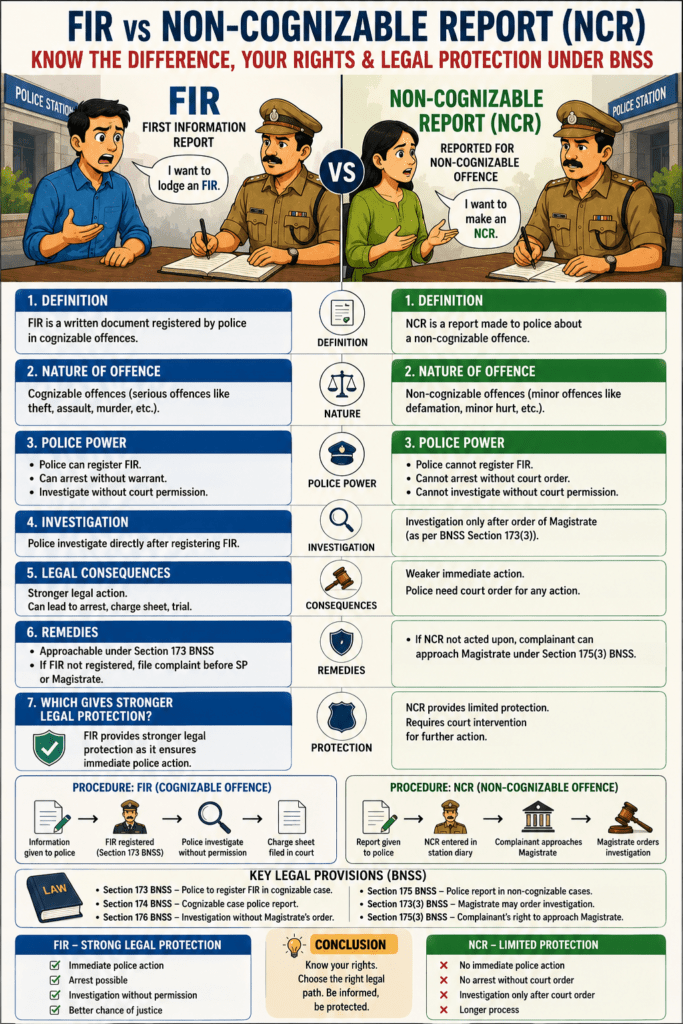
FIR vs NCR – Quick Comparison
| Feature | FIR | NCR |
|---|---|---|
| Nature of offence | Cognizable | Non-cognizable |
| Relevant BNSS provision | Section 173 | Section 174 |
| Police investigation | Can begin without prior Magistrate’s permission | Generally requires the Magistrate’s permission |
| Power to arrest | May be exercised where authorised by law | No arrest merely because an NCR is registered; any further action must comply with law |
| Seriousness | Generally relates to more serious offences | Generally relates to less serious offences |
| Judicial involvement | Usually after investigation progresses | Magistrate’s permission is ordinarily required before investigation |
Is an FIR More Powerful Than an NCR?
In practical terms, yes.
An FIR generally enables the police to begin an investigation immediately, without first seeking permission from the Magistrate.
However, this does not mean that an NCR is unimportant.
An NCR is an official police record of your complaint and can become significant if:
- new facts emerge;
- additional offences are disclosed;
- the matter escalates; or
- the Magistrate authorises an investigation.
The effectiveness of either process ultimately depends on the facts and evidence.
Can the Police Refuse to Register an FIR?
If the information clearly discloses a cognizable offence, the police are generally required to register an FIR.
If they refuse, the complainant may pursue remedies available under the BNSS, including approaching higher police authorities or the competent Magistrate.
However, if the complaint discloses only a non-cognizable offence, the police are justified in recording an NCR instead of an FIR.
Can an NCR Become an FIR?
Yes.
If, during the course of events, it appears that the facts disclose a cognizable offence, the police may proceed in accordance with the BNSS by registering an FIR and undertaking the investigation as permitted by law.
This often happens when new evidence comes to light or the legal nature of the offence changes.
Can the Police Investigate an NCR?
Not ordinarily.
In cases involving non-cognizable offences, the police generally require the permission of the Magistrate before commencing an investigation.
This requirement acts as a safeguard against unnecessary criminal investigations in less serious matters.
Can a Magistrate Order Investigation in an NCR?
Yes.
Upon receiving the complaint, the Magistrate may authorise an investigation in accordance with the BNSS.
Once such permission is granted, the police may investigate within the scope of that order.
Which One Gives Better Legal Protection?
This is perhaps the most searched question.
The answer depends on the nature of the offence.
If the facts disclose a cognizable offence, an FIR provides a more immediate investigative mechanism because the police can act without waiting for prior judicial permission.
If the matter involves a non-cognizable offence, the law deliberately requires judicial oversight before investigation. This is intended to balance individual rights with the need to prevent unnecessary criminal proceedings.
Therefore, the appropriate remedy is not determined by which process is “stronger,” but by which one the law requires on the facts of the case.
What Should You Do If the Police Register Only an NCR?
If you believe that your complaint actually discloses a cognizable offence:
- Obtain a copy of the NCR.
- Carefully review the offences recorded.
- Submit a representation to the senior police authorities.
- Preserve all evidence and documents.
- Approach the competent Magistrate if appropriate legal remedies are required.
Legal advice should be obtained before initiating further proceedings.
Jurisprudence Behind FIR and NCR
The distinction between FIRs and NCRs reflects important principles of criminal jurisprudence.
1. Serious Offences Require Immediate Action
Where the allegations disclose a serious cognizable offence, the police are empowered to act promptly to protect society and preserve evidence.
2. Judicial Oversight in Minor Matters
For non-cognizable offences, the law requires the Magistrate’s permission before investigation, thereby protecting individuals from unnecessary criminal investigations.
3. Balance Between Liberty and Investigation
The BNSS seeks to strike a balance between effective law enforcement and the protection of individual rights.
4. Rule of Law
Whether an FIR or an NCR is registered depends upon the legal classification of the offence—not on the personal preference of the complainant or the investigating officer.
Practical Tips
- Always obtain a copy of the FIR or NCR.
- Read the offences mentioned in the document carefully.
- Preserve all evidence from the beginning.
- Do not assume that an NCR has no legal value.
- If you believe an FIR should have been registered, seek legal advice promptly.
- Cooperate with lawful investigation and court proceedings.
Myth vs Reality
| Myth | Reality |
| Every complaint must result in an FIR. | False. An FIR is registered only when the information discloses a cognizable offence. |
| An NCR is useless. | Wrong. An NCR is an official police record and may lead to further legal action where appropriate. |
| The police can investigate every NCR immediately. | Incorrect. Investigation into a non-cognizable offence generally requires the Magistrate’s permission. |
| An FIR guarantees conviction. | False. An FIR merely initiates the criminal process; guilt must be proved before a competent court. |
| If the police register an NCR, nothing more can happen. | Wrong. An NCR may later lead to further proceedings if the law and facts so require. |
Frequently Asked Questions (FAQs)
Which is stronger—an FIR or an NCR?
An FIR generally enables immediate investigation into cognizable offences. However, the correct procedure depends on the legal nature of the offence, not on which process appears stronger.
Can the police convert an NCR into an FIR?
Yes. If the facts subsequently disclose a cognizable offence, the police may register an FIR in accordance with the BNSS.
Can I challenge the registration of an NCR instead of an FIR?
Yes. If you believe that your complaint clearly discloses a cognizable offence, you may pursue the remedies available under the BNSS before the appropriate authorities or the competent Magistrate.
Can the police investigate an NCR without the Magistrate’s permission?
Ordinarily, no. Investigation into a non-cognizable offence generally requires prior permission from the Magistrate.
Is an NCR a criminal case?
An NCR records information relating to a non-cognizable offence. It is an official police record, but it does not by itself authorise a full police investigation without the procedure prescribed by law.
Key Takeaways
- An FIR relates to cognizable offences and is governed by Section 173 of the BNSS.
- An NCR relates to non-cognizable offences and is governed by Section 174 of the BNSS.
- The police may ordinarily investigate a cognizable offence immediately after registering an FIR.
- Investigation into a non-cognizable offence generally requires the Magistrate’s permission.
- Neither an FIR nor an NCR determines guilt—the courts decide criminal liability based on evidence.
- The choice between an FIR and an NCR depends on the legal classification of the offence, not on the preference of the parties.
Conclusion
One of the biggest misconceptions in criminal law is that an FIR is always “better” than an NCR. In reality, both serve different legal purposes. An FIR is the correct procedure for cognizable offences, allowing the police to begin an immediate investigation. An NCR, on the other hand, is the legally prescribed route for non-cognizable offences, ensuring that judicial oversight is maintained before a police investigation begins.
Understanding this distinction helps citizens know their rights, challenge incorrect police action where necessary, and choose the appropriate legal remedy.
The real question is not whether an FIR or an NCR is more powerful—it is whether the law requires an FIR or an NCR on the facts of your case. Knowing that difference can protect your rights and prevent costly legal mistakes.