
- Introduction
- Is the Police Always Required to Register an FIR?
- What Is a Cognizable Offence?
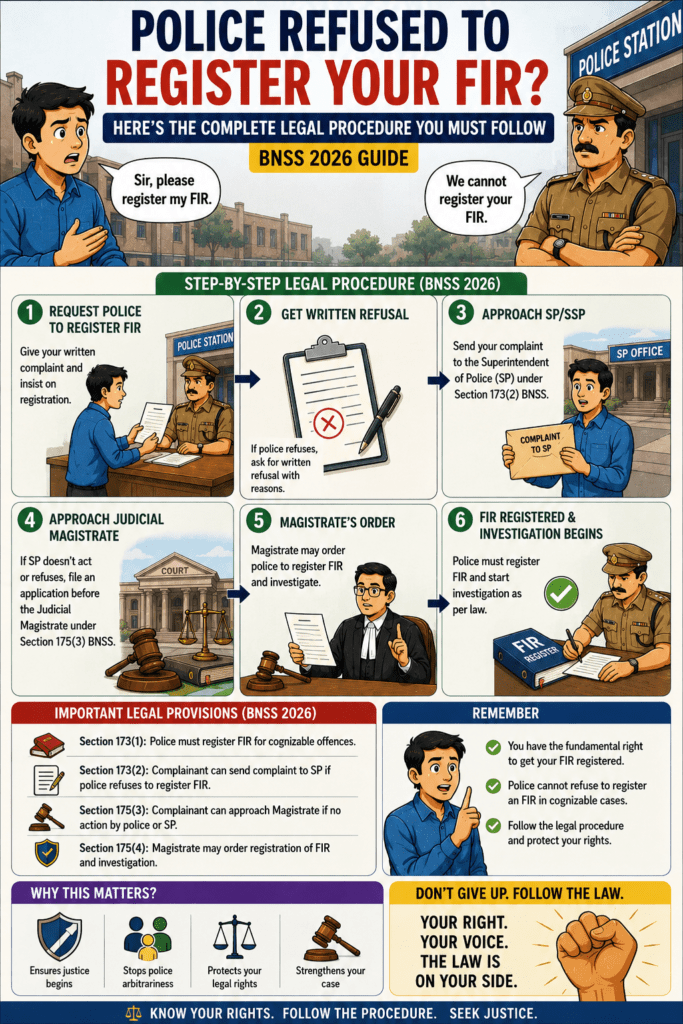
- What Should You Do If the Police Refuse to Register the FIR?
- Step 1: Give the Complaint in Writing
- Step 2: Approach the Superintendent of Police (SP)
- Step 3: Approach the Jurisdictional Magistrate
- Step 4: Cooperate With the Investigation
- Can You Directly Go to the High Court?
- Can the Police Conduct a Preliminary Inquiry Instead of Registering an FIR?
- What If the Police Say It Is a Civil Dispute?
- What Happens After an FIR Is Registered?
- Can Police Be Held Accountable for Wrongfully Refusing an FIR?
- Jurisprudence Behind Mandatory Registration of FIR
- Practical Tips
- Myth vs Reality
- Frequently Asked Questions (FAQs)
- Key Takeaways
- Landmark Judicial Principle
- Conclusion
Introduction
Imagine this.
You visit the police station after becoming the victim of a crime. You explain everything to the officer on duty, expecting an FIR to be registered.
Instead, you hear:
- “This is a civil dispute.”
- “Come tomorrow.”
- “We’ll look into it first.”
- “No FIR can be registered.”
- “Go settle the matter privately.”
Many people believe that once the police refuse to register an FIR, the matter ends.
That is completely incorrect.
Indian law provides a clear legal procedure when the police refuse to register an FIR relating to a cognizable offence.
This article explains your legal rights, the correct procedure under the Bharatiya Nagarik Suraksha Sanhita, 2023 (BNSS), and the remedies available in simple language.
Is the Police Always Required to Register an FIR?
No.
The police are required to register an FIR only when the information discloses the commission of a cognizable offence.
If the complaint relates only to a non-cognizable offence, the police may record a Non-Cognizable Report (NCR) instead and follow the procedure prescribed by law.
Therefore, the first question is not whether the police refused the FIR—but whether your complaint actually discloses a cognizable offence.
What Is a Cognizable Offence?
A cognizable offence is one in which the police may investigate without prior permission from the Magistrate.
Examples generally include:
- murder;
- rape;
- kidnapping;
- robbery;
- serious cheating;
- offences specifically classified as cognizable under the law.
Registration of such information is governed by Section 173 of the Bharatiya Nagarik Suraksha Sanhita, 2023.
What Should You Do If the Police Refuse to Register the FIR?
The BNSS provides a step-by-step statutory remedy.
Follow the hierarchy below.
Step 1: Give the Complaint in Writing
Always submit your complaint in writing.
Include:
- date and time of the incident;
- place of occurrence;
- complete facts;
- names of witnesses, if known;
- documents and evidence available.
Keep a copy for your records.
Step 2: Approach the Superintendent of Police (SP)
If the officer in charge of the police station refuses to register the FIR, you may send your complaint to the Superintendent of Police (SP).
This can generally be done by:
- registered post;
- speed post;
- official online portal (where available);
- email, if accepted by the concerned police authority.
If the SP is satisfied that the information discloses a cognizable offence, appropriate directions may be issued for registration and investigation in accordance with law.
Step 3: Approach the Jurisdictional Magistrate
If the FIR is still not registered, you may approach the competent Judicial Magistrate.
Under Section 175(3) of the BNSS, the Magistrate has the power to direct investigation in appropriate cases.
This is one of the most important statutory safeguards available to citizens.
Step 4: Cooperate With the Investigation
If the Magistrate directs investigation or the FIR is subsequently registered, cooperate fully with the investigating agency.
Provide all available documents, electronic records, and witness details.
Can You Directly Go to the High Court?
In many cases, the statutory remedies under the BNSS should ordinarily be exhausted first.
The High Court exercises extraordinary jurisdiction and generally expects litigants to avail the remedies specifically provided by law unless exceptional circumstances justify direct intervention.
Legal advice should be obtained to determine the appropriate course in each case.
Can the Police Conduct a Preliminary Inquiry Instead of Registering an FIR?
In certain categories of cases, a limited preliminary inquiry may be permissible to determine whether the information actually discloses a cognizable offence.
However, such an inquiry cannot be used as a device to indefinitely delay or avoid the registration of an FIR where the law requires one.
The purpose is only to clarify whether a cognizable offence is made out—not to conduct a full investigation before registration.
What If the Police Say It Is a Civil Dispute?
Merely describing a matter as a “civil dispute” does not automatically exclude criminal liability.
Many disputes involve both civil and criminal consequences.
The real question is whether the facts disclose the ingredients of a cognizable criminal offence.
If they do, the police cannot refuse registration solely by labelling the matter as civil.
What Happens After an FIR Is Registered?
Registration of an FIR does not mean that the accused is guilty.
It only begins the criminal investigation.
The police must:
- collect evidence;
- examine witnesses;
- record statements;
- conduct investigation fairly and impartially;
- submit the appropriate report before the competent court.
Can Police Be Held Accountable for Wrongfully Refusing an FIR?
The law expects police officers to discharge their statutory duties fairly and in accordance with the BNSS.
If an officer unlawfully refuses to register an FIR despite the disclosure of a cognizable offence, the complainant may pursue the remedies provided under the law, including approaching higher police authorities or the competent Magistrate.
Depending on the facts, departmental or other legal consequences may also arise.
Jurisprudence Behind Mandatory Registration of FIR
The legal framework is founded on important constitutional and criminal law principles.
1. Access to Justice
Victims of cognizable offences must have an effective mechanism to invoke the criminal justice system.
2. Rule of Law
Police officers cannot decide whether a person deserves justice based on personal opinions or convenience.
Their powers must be exercised strictly in accordance with the law.
3. Fair Investigation
Prompt registration of an FIR helps preserve evidence, identify offenders, and ensure an impartial investigation.
4. Judicial Oversight
The Magistrate’s power under Section 175(3) BNSS ensures that police inaction does not deprive citizens of their legal rights.
Practical Tips
- Submit a detailed written complaint.
- Preserve proof of submission.
- Keep copies of all communications.
- Collect photographs, videos, and electronic evidence.
- Avoid exaggerating or suppressing facts.
- Follow the statutory hierarchy of remedies.
- Consult a lawyer if the matter involves serious offences.
Myth vs Reality
| Myth | Reality |
|---|---|
| The police can refuse every FIR they don’t believe. | False. If the information discloses a cognizable offence, the law generally requires registration of an FIR. |
| If the SHO refuses my complaint, I have no remedy. | Wrong. You may approach the Superintendent of Police and, thereafter, the competent Magistrate under the BNSS. |
| Every complaint must become an FIR. | Incorrect. Only complaints disclosing cognizable offences require registration as FIRs. Non-cognizable matters follow a different legal procedure. |
| Calling a dispute “civil” automatically prevents an FIR. | False. A dispute may have both civil and criminal aspects. The legal classification depends on the facts and the applicable law. |
| Registration of an FIR means the accused is guilty. | Wrong. An FIR only initiates the criminal investigation. Guilt is determined by the court after evaluating the evidence. |
Frequently Asked Questions (FAQs)
What should I do first if the police refuse to register my FIR?
Submit a written complaint and retain proof of submission. If the refusal continues, approach the Superintendent of Police and, if necessary, the competent Magistrate.
Can I approach the Magistrate directly?
Yes. Under Section 175(3) BNSS, the Magistrate may direct investigation in appropriate cases.
Can the police refuse every complaint?
No. If the information clearly discloses a cognizable offence, the police are generally required to register an FIR.
What if the police register only an NCR?
If you believe that your complaint actually discloses a cognizable offence, you may challenge the decision through the remedies available under the BNSS.
Does an FIR guarantee arrest?
No. Registration of an FIR does not automatically require the arrest of the accused. Arrest must satisfy the legal requirements prescribed by law.
Key Takeaways
- An FIR is required where information discloses a cognizable offence.
- Registration of cognizable offences is governed by Section 173 BNSS.
- If the SHO refuses to register the FIR, approach the Superintendent of Police.
- If the matter remains unresolved, approach the Jurisdictional Magistrate under Section 175(3) BNSS.
- The High Court is an extraordinary forum and is not ordinarily the first statutory remedy.
- Preserve evidence and maintain records of every complaint submitted.
Landmark Judicial Principle
The Supreme Court has consistently held that when information clearly discloses the commission of a cognizable offence, registration of an FIR is mandatory. This principle was authoritatively laid down in Lalita Kumari v. Government of Uttar Pradesh (2014) 2 SCC 1, where the Court also clarified the limited circumstances in which a preliminary inquiry may be conducted before registration.
This judgment remains one of the most important decisions governing FIR registration and continues to guide the application of the BNSS.
Conclusion
A police officer’s refusal to register an FIR does not bring your legal remedies to an end. The BNSS provides a clear statutory pathway: first approach the Superintendent of Police, and if necessary, seek directions from the Jurisdictional Magistrate under Section 175(3). These safeguards exist to ensure that genuine victims of cognizable offences are not denied access to the criminal justice system.
Understanding the distinction between an FIR, an NCR, and the remedies available when an FIR is refused empowers citizens to protect their rights effectively.
The law does not expect you to stop at the police station door. If your complaint discloses a cognizable offence, the BNSS gives you a clear legal path to ensure that justice begins with the registration of an FIR.