
- 1. MCD Has Passed a Demolition Order. What Should You Do First?
- 2. What Is a Demolition Order Under Section 343 DMC Act?
- 3. The First Question: When Did You Receive the Demolition Order?
- 4. Can You Appeal Against an MCD Demolition Order?
- 5. Where Is the Appeal Against the MCD Demolition Order Filed?
- 6. Does Filing an Appeal Automatically Stop Demolition?
- 7. What Can the ATMCD Do?
- 8. What Should the Stay Application Say?
- 9. What If Demolition Is Only a Few Days Away?
- 10. What If You Never Received the Demolition Order?
- 11. Can Lack of Notice Be a Ground to Challenge Demolition?
- 12. What If You Received the Notice But Could Not Reply?
- 13. What If You Filed a Reply But MCD Did Not Consider It?
- 14. Can a Non-Speaking Demolition Order Be Challenged?
- 15. What If Only One Portion Is Allegedly Unauthorised?
- 16. What If MCD Says the Entire Building Is Unauthorised?
- 17. What Documents Should You Attach With the Appeal?
- 18. What Are the Main Grounds for Challenging an MCD Demolition Order?
- 1. Violation of natural justice
- 2. Non-service of notice
- 3. Incorrect property identification
- 4. Construction is authorised
- 5. Incorrect factual finding
- 6. Reply ignored
- 7. Absence of reasons
- 8. Excessive action
- 9. Lack of jurisdiction
- 10. Statutory protection
- 11. Procedural irregularity
- 12. Violation of binding judicial directions
- 19. Can You Seek Regularisation Instead of Demolition?
- 20. What If You Have Already Filed a Regularisation Application?
- 21. Can MCD Seal the Property After Passing a Demolition Order?
- 22. What If You Receive a Vacation Notice Under Section 349?
- 23. Can You Approach the Delhi High Court Instead of the ATMCD?
- 24. When Can the High Court Become Particularly Important?
- 25. What If the ATMCD Has Not Heard the Stay Application?
- 26. What Happens If You Do Nothing?
- 27. Can You Stop MCD Officials Physically From Demolishing the Property?
- 28. What Did the Supreme Court Say About Demolition of Structures?
- 29. Important Principle: Municipal Power Is Not Unlimited Power
- 30. What Is the Importance of the Supreme Court's 2024 Demolition Safeguards?
- 31. Recent Delhi High Court Approach: Appeal First, Protection Where Necessary
- 32. What If Demolition Has Already Taken Place?
- 33. What If the Demolition Was Carried Out Despite a Stay Order?
- 34. What Is the Importance of the MCD Demolition File?
- 35. What If MCD's Inspection Report Is Factually Wrong?
- 36. Can Old Photographs Help?
- 37. Can Google/Satellite Images Be Used?
- 38. What About Property Tax, Electricity and Water Records?
- 39. What If the Property Was Purchased After the Construction?
- 40. What If MCD Has Already Issued a Demolition Order to the Previous Owner?
- 41. Can a Civil Suit Be Filed Against the Demolition Order?
- 42. What About a Writ Petition Under Article 226?
- 43. What Should a Good Legal Strategy Look Like?
- 44. A Simple Emergency Checklist
- 45. Myth vs Reality
- Myth 1: "Once MCD passes a demolition order, nothing can be done."
- Myth 2: "Filing the appeal automatically stops demolition."
- Myth 3: "I can directly file a civil suit."
- Myth 4: "If MCD demolished my neighbour's house, it can demolish mine in exactly the same way."
- Myth 5: "Property tax proves that the construction is legal."
- Myth 6: "Electricity connection proves authorised construction."
- Myth 7: "An old construction can never be demolished."
- Myth 8: "If MCD did not hear me, the construction automatically becomes legal."
- Myth 9: "If only one floor is unauthorised, the entire building can automatically be demolished."
- 46. Frequently Asked Questions
- What should I do if MCD passes a demolition order?
- Can I stop MCD demolition?
- Where can I challenge an MCD demolition order?
- Can I approach Delhi High Court against MCD demolition?
- Does filing an ATMCD appeal automatically stay demolition?
- What if I never received the demolition order?
- What if MCD has issued a vacation notice?
- Can MCD seal the property?
- Can MCD demolish the entire property?
- Does property tax make unauthorised construction legal?
- Does an electricity connection prove construction is authorised?
- Can old photographs help my case?
- What happens if I ignore the demolition order?
- 47. The Most Important Lesson: Act Before the Demolition Happens
- 48. Final Takeaway
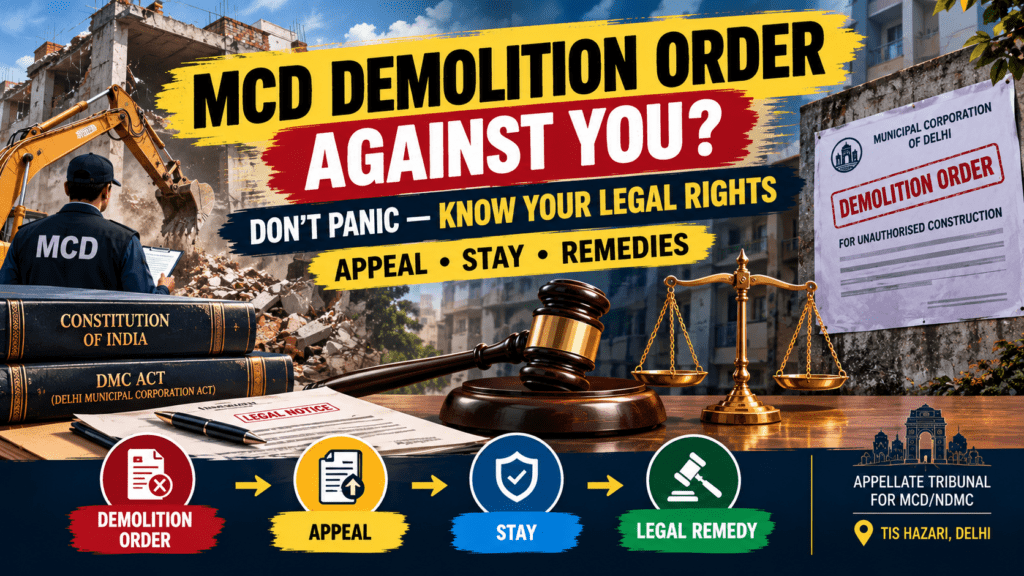
MCD has passed a demolition order against your property. What should you do now? Can the demolition be stopped? Where should you appeal? Can you approach the Delhi High Court? What if you never received the notice? What if MCD is threatening immediate demolition?
A demolition order from the Municipal Corporation of Delhi (MCD) can be extremely serious.
For a property owner, the order may mean that a portion of the property—or in some cases the entire structure—could be subjected to demolition.
But receiving a demolition order does not mean that the legal fight is necessarily over.
The Delhi Municipal Corporation Act, 1957 (DMC Act) provides a statutory appellate mechanism against demolition orders. In appropriate cases, the affected person can also seek interim protection and, depending upon the circumstances, invoke the writ jurisdiction of the Delhi High Court.
The most important thing is:
Do not ignore an MCD demolition order. Act immediately.
Delay can make the situation considerably more difficult, particularly where MCD has already issued a vacation notice or fixed a date for demolition.
This article explains what to do after receiving an MCD demolition order, the limitation and appeal mechanism, how to seek a stay, when the Delhi High Court can be approached, important legal grounds, consequences of non-compliance, and the jurisprudence governing demolition proceedings.
1. MCD Has Passed a Demolition Order. What Should You Do First?
The first step is not to panic and not to start arguing with municipal officials at the site.
The first step is to obtain and examine the complete municipal record.
Immediately identify:
- date of the demolition order;
- provision under which it has been passed;
- date of service;
- property number;
- portion alleged to be unauthorised;
- nature of alleged construction;
- date of alleged construction, if mentioned;
- show-cause notice;
- inspection report;
- photographs;
- booking report;
- your reply;
- documents submitted by you;
- hearing details;
- reasons recorded by MCD;
- time given for compliance;
- whether a sealing order has also been passed;
- whether a vacation notice under Section 349 has been issued; and
- whether any previous demolition proceedings existed.
Do not wait for the demolition team to arrive before taking legal advice.
2. What Is a Demolition Order Under Section 343 DMC Act?
The principal provision governing demolition of unauthorised construction is Section 343 of the DMC Act.
Broadly, where construction has been carried out without the required sanction, contrary to sanction, or in contravention of the DMC Act or applicable bye-laws, the Commissioner can direct demolition in accordance with the statutory procedure.
Importantly, Section 343 provides that a demolition order should not ordinarily be made without giving the person concerned a reasonable opportunity of showing cause why the demolition order should not be made.
Therefore, when challenging a demolition order, the lawyer should examine both:
Is the construction actually unauthorised?
and
Was the demolition order passed in accordance with law?
Both questions can be important.
3. The First Question: When Did You Receive the Demolition Order?
This is extremely important.
Do not simply look at the date printed on the demolition order.
You should identify:
Date of order
When did MCD actually pass the order?
Date of service
When was the order communicated to you?
Date of knowledge
When did you actually come to know about the order, particularly if you dispute service?
Date fixed for compliance
How much time has MCD granted?
Date of proposed demolition
Has MCD already scheduled demolition?
These dates can become critical when determining the appropriate remedy and limitation.
4. Can You Appeal Against an MCD Demolition Order?
Yes.
The DMC Act provides a statutory appellate remedy before the Appellate Tribunal, MCD (ATMCD).
Section 343(2) provides for an appeal against a demolition order to the Appellate Tribunal.
The DMC Act also establishes the Appellate Tribunal under Section 347A, while Section 347B contains the wider statutory framework concerning appeals against specified orders and notices.
Therefore, where an MCD demolition order has been passed against you, the ATMCD is ordinarily the first statutory forum to examine the challenge.
5. Where Is the Appeal Against the MCD Demolition Order Filed?
The appeal is filed before the:
Appellate Tribunal, MCD (ATMCD)
The Tribunal is the specialised statutory appellate forum dealing with appeals arising from specified municipal orders.
This is important because the DMC Act has created a specific mechanism for challenging demolition orders.
The Delhi High Court has, in recent matters, directed persons aggrieved by an already-passed demolition order to avail the statutory remedy before the ATMCD. In one October 2025 order, the High Court granted four weeks’ limited protection so that the petitioner could approach the ATMCD.
6. Does Filing an Appeal Automatically Stop Demolition?
Do not assume that it does.
This is one of the biggest mistakes property owners make.
Filing an appeal and obtaining a stay are two different things.
If MCD is proposing to execute the demolition order, the appellant should ordinarily seek appropriate interim protection/stay before the competent forum.
The Delhi High Court has also dealt with situations where an appeal was pending before the ATMCD but the petitioner did not have an effective stay and coercive action had already been partly undertaken.
Therefore, a practical rule is:
If demolition is imminent, do not merely file the appeal. File and press the application for interim stay/protection as well.
7. What Can the ATMCD Do?
The statutory Tribunal is not merely a place to submit papers.
Under the DMC Act, the Appellate Tribunal has powers in relation to appeals under the Act and possesses powers comparable to those of a Civil Court for specified procedural matters, including:
- summoning witnesses;
- enforcing attendance;
- examining persons on oath;
- discovery and inspection of documents;
- receiving evidence on affidavit;
- requisitioning public records; and
- issuing commissions in appropriate cases.
This makes the Tribunal an important forum for challenging the factual and legal foundation of a demolition order.
8. What Should the Stay Application Say?
A stay application should not merely say:
“Demolition will cause irreparable loss.”
It should explain why the demolition order itself requires protection pending adjudication.
Depending upon the facts, grounds may include:
- demolition is imminent;
- the demolition order is under challenge;
- the appellant has a prima facie case;
- no reasonable opportunity was granted;
- the notice was not properly served;
- the reply was not considered;
- the alleged unauthorised portion has not been identified;
- the inspection report is factually incorrect;
- the construction is sanctioned;
- the construction is protected by applicable law;
- the demolition order is non-speaking;
- the order travels beyond the alleged violation;
- the appellant will suffer irreversible injury if demolition occurs;
- the appeal would become practically meaningless if demolition is completed before adjudication.
The relief should be framed specifically.
For example:
Stay the operation and execution of the demolition order pending disposal of the appeal.
9. What If Demolition Is Only a Few Days Away?
Then the matter becomes urgent.
A practical sequence can be:
Demolition order
↓
Immediately obtain complete record
↓
Prepare statutory appeal
↓
File stay application
↓
Seek urgent listing
↓
Press for interim protection
↓
Serve MCD
↓
Obtain written order of protection
↓
Communicate the stay order to the concerned municipal officers/police authorities, wherever necessary
The Delhi High Court has itself, in appropriate cases, granted short periods of protection to allow an affected person to approach the ATMCD.
10. What If You Never Received the Demolition Order?
This can become an important issue.
Suppose MCD says:
“Demolition order was passed six months ago.”
But the owner says:
“I never received it. I came to know about it only when I received the vacation notice.”
The question then becomes:
- Was the demolition order served?
- How was it served?
- At what address?
- On whom?
- Was it affixed?
- Is there proof of service?
- When did the owner obtain knowledge?
A recent Delhi High Court order illustrates the practical importance of this issue: where the petitioner stated that only the vacation notice had been received and the demolition order had not, the Court directed MCD to supply a copy of the demolition order and then required the petitioner to pursue the statutory ATMCD remedy.
Therefore:
If you dispute service, do not merely state “I did not receive it.” Establish the factual circumstances of non-service and the date of first knowledge.
11. Can Lack of Notice Be a Ground to Challenge Demolition?
Yes, depending upon the facts.
Section 343 incorporates a requirement of reasonable opportunity before a demolition order is made.
Therefore, the following may become relevant:
- no show-cause notice;
- defective service;
- notice served on wrong person;
- inadequate time;
- reply not accepted;
- reply ignored;
- documents not considered;
- hearing not granted where required;
- demolition order passed mechanically.
However, every technical defect will not necessarily result in the demolition order being quashed.
The court or Tribunal will examine the nature and seriousness of the procedural violation and the prejudice caused.
12. What If You Received the Notice But Could Not Reply?
This situation requires careful handling.
Do not simply say:
“I could not reply, therefore the demolition order is automatically invalid.”
Instead, explain:
- why the reply could not be filed;
- whether the notice was properly served;
- whether sufficient time was given;
- whether the circumstances prevented effective response;
- whether documents were unavailable;
- whether there was a genuine reason for non-response; and
- whether the authority proceeded mechanically.
The objective should be to demonstrate that the statutory opportunity was not meaningful in the circumstances.
13. What If You Filed a Reply But MCD Did Not Consider It?
This can be a stronger procedural ground.
Suppose your reply specifically states:
- the construction is sanctioned;
- the alleged deviation does not exist;
- the construction predates the alleged violation;
- the property is protected under a particular law; or
- the inspection report is incorrect.
If the demolition order simply ignores these submissions and gives no meaningful consideration to them, the order may be vulnerable to challenge depending upon the circumstances.
A demolition proceeding is not merely:
Notice → demolition
The authority is expected to consider the response in accordance with the statutory scheme.
14. Can a Non-Speaking Demolition Order Be Challenged?
Potentially, yes.
A demolition order should contain the statutory basis and a brief statement of reasons as contemplated under Section 343.
Therefore, an order that merely states:
“Unauthorised construction exists. Demolish.”
without adequately identifying the alleged violation may raise serious questions.
A proper challenge can ask:
- What exactly is unauthorised?
- Which floor?
- Which room?
- What area?
- What deviation?
- Which sanctioned plan?
- Which bye-law?
- What evidence?
- What happened to the owner’s reply?
The more serious the consequence, the more important it becomes to understand the reasoning supporting the action.
15. What If Only One Portion Is Allegedly Unauthorised?
This is another important issue.
Suppose MCD alleges:
“One additional room is unauthorised.”
But the demolition order appears to threaten the entire building.
The affected person should immediately examine:
- what portion is actually alleged to be unauthorised;
- what portion is sanctioned;
- whether the demolition order identifies the offending portion;
- whether structural demolition of the authorised portion is necessary;
- whether partial demolition is legally and technically possible; and
- whether the order is excessive in relation to the alleged violation.
The question is not simply whether some violation exists.
The extent of enforcement action also matters.
16. What If MCD Says the Entire Building Is Unauthorised?
That is a substantially different case.
Where the entire structure is alleged to be unauthorised, the owner cannot simply rely on the argument:
“Only one portion should be demolished.”
The actual legal status of the entire structure must then be examined.
The defence may involve:
- sanctioned plans;
- old municipal records;
- regularisation;
- protection under special legislation;
- construction history;
- property records;
- previous municipal proceedings;
- court orders; and
- other evidence.
The exact factual and statutory position will determine the appropriate remedy.
17. What Documents Should You Attach With the Appeal?
A strong appeal should be document-driven.
Depending upon the case, consider collecting:
Property documents
- Sale deed
- Conveyance deed
- Lease deed
- Allotment letter
- Mutation documents
- Possession documents
Building documents
- Sanctioned building plan
- Building permit
- Completion certificate
- Occupancy certificate
- Revised plan
- Regularisation documents
MCD documents
- Show-cause notice
- Inspection report
- Booking report
- Demolition order
- Sealing order
- Vacation notice
- Photographs
- Correspondence
- Replies
- Hearing documents
Evidence concerning age of construction
- Old photographs
- Electricity records
- Water records
- Property-tax records
- Previous sale documents
- Previous inspection reports
- RTI material
- Other contemporaneous records
Court documents
- Previous court orders
- Previous ATMCD orders
- Stay orders
- Orders passed in connected proceedings
18. What Are the Main Grounds for Challenging an MCD Demolition Order?
Every case is different, but commonly examined grounds include:
1. Violation of natural justice
No meaningful opportunity to show cause was provided.
2. Non-service of notice
The notice/demolition order was never properly served.
3. Incorrect property identification
The order concerns the wrong property, floor or portion.
4. Construction is authorised
The alleged construction falls within the sanctioned plan or applicable permission.
5. Incorrect factual finding
MCD’s inspection report does not accurately describe the property.
6. Reply ignored
The authority failed to consider the owner’s explanation and documents.
7. Absence of reasons
The demolition order does not adequately disclose the basis of the decision.
8. Excessive action
The order goes beyond the alleged unauthorised construction.
9. Lack of jurisdiction
The order was passed by an officer without the necessary statutory authority.
10. Statutory protection
The construction may fall within a statutory protection, regularisation scheme or applicable notification.
11. Procedural irregularity
The statutory procedure was not followed.
12. Violation of binding judicial directions
The municipal authority acted contrary to an existing court order.
19. Can You Seek Regularisation Instead of Demolition?
In appropriate cases, regularisation may be relevant, but it should not be assumed that every unauthorised construction can be regularised.
The answer depends upon:
- the nature of construction;
- applicable building regulations;
- planning norms;
- date of construction;
- applicable regularisation scheme;
- land status;
- permissible deviations;
- structural safety; and
- other statutory conditions.
If regularisation is legally available, the existence and status of such an application can become relevant to the proceedings.
But:
Filing a regularisation application does not automatically make an unauthorised construction legal or automatically stay demolition.
Appropriate legal protection may still be required.
20. What If You Have Already Filed a Regularisation Application?
This situation requires careful examination.
You should determine:
- whether the application is legally maintainable;
- whether it has been accepted;
- whether it is pending;
- whether additional documents have been sought;
- whether the construction is eligible for regularisation;
- whether any interim protection exists; and
- whether MCD is nevertheless proceeding with demolition.
The mere pendency of an application may not, by itself, prevent enforcement.
21. Can MCD Seal the Property After Passing a Demolition Order?
Yes.
Section 345A of the DMC Act provides a statutory mechanism for sealing unauthorised construction/premises in specified circumstances.
Recent Delhi proceedings illustrate that demolition and sealing orders may operate together and may be challenged through the statutory appellate framework.
Therefore, if you receive both:
Demolition Order + Sealing Order
both should be examined.
22. What If You Receive a Vacation Notice Under Section 349?
Do not ignore it.
A Section 349 notice can be particularly serious because it may indicate that MCD is moving towards actual execution of the demolition action and requires occupants to vacate.
A person receiving a vacation notice should immediately check:
- the underlying demolition order;
- whether an appeal has been filed;
- whether a stay exists;
- whether the demolition order was served;
- whether the vacation notice is legally sustainable;
- whether the property has been correctly identified; and
- whether any pending proceedings affect execution.
Recent Delhi High Court proceedings demonstrate situations where a vacation notice was issued while an appeal concerning demolition/sealing remained pending before the ATMCD.
23. Can You Approach the Delhi High Court Instead of the ATMCD?
The answer is fact-specific.
Article 226 gives the Delhi High Court broad constitutional writ jurisdiction.
However, where the DMC Act provides an effective statutory appeal against the demolition order, the existence of that alternate remedy is an important consideration.
Therefore, a writ petition should not ordinarily be treated as a simple substitute for the statutory appeal.
The Delhi High Court has recently directed petitioners with demolition orders to approach the ATMCD and, in appropriate circumstances, has granted limited interim protection to enable them to do so.
24. When Can the High Court Become Particularly Important?
A writ petition may become relevant in circumstances involving, depending upon the facts:
- violation of natural justice;
- complete absence of jurisdiction;
- serious procedural illegality;
- failure to follow mandatory statutory requirements;
- arbitrary exercise of statutory power;
- violation of fundamental/legal rights;
- failure of the statutory forum to provide effective relief in exceptional circumstances;
- imminent irreversible action;
- challenge to the legality of the statutory process itself; or
- circumstances recognised by constitutional jurisprudence as warranting writ intervention despite an alternate remedy.
However, the precise facts matter.
The existence of an alternate remedy remains a significant consideration.
25. What If the ATMCD Has Not Heard the Stay Application?
This can create a practical problem.
Imagine:
- demolition order passed;
- appeal filed;
- stay application filed;
- MCD threatens demolition;
- stay application is not being heard for some reason.
The affected person may then have to seek appropriate urgent relief before the competent constitutional court, depending upon the circumstances.
The Delhi High Court has dealt with cases where an ATMCD stay application had not been taken up and coercive action was apprehended.
The important point is:
The remedy must be capable of protecting the property before the demolition becomes irreversible.
26. What Happens If You Do Nothing?
Ignoring a demolition order can have serious consequences.
Depending upon the statutory circumstances, MCD may proceed with execution of the demolition order.
The DMC Act also provides for recovery of expenses incurred in carrying out demolition as arrears of tax in the circumstances specified by the statute.
Other consequences may include:
- demolition;
- sealing;
- vacation of premises;
- recovery proceedings;
- further municipal action; and
- possible criminal proceedings where the statutory ingredients of an offence are made out.
Therefore:
Silence is not a legal strategy when a demolition order has already been passed.
27. Can You Stop MCD Officials Physically From Demolishing the Property?
You should not attempt to physically obstruct lawful municipal action.
If the demolition order is disputed, the proper response is:
Legal challenge + interim protection.
Not:
Physical confrontation + obstruction.
If a stay order is obtained, preserve and communicate the written judicial/Tribunal order through proper channels.
28. What Did the Supreme Court Say About Demolition of Structures?
The Supreme Court’s landmark judgment in:
In Re: Directions in the Matter of Demolition of Structures, 2024 INSC 866
is now an important part of demolition jurisprudence.
The Court examined demolition action from the perspective of:
- rule of law;
- natural justice;
- constitutional safeguards;
- executive accountability;
- right to shelter; and
- limits on arbitrary State action.
The judgment is particularly significant because it emphasises that executive authorities exercising demolition powers must remain within the framework of law and cannot convert demolition into an extra-legal form of punishment.
This jurisprudence is important when examining a demolition order not merely as a municipal document, but as an exercise of State power affecting property and residence.
29. Important Principle: Municipal Power Is Not Unlimited Power
The MCD has statutory powers.
But statutory power must be exercised:
within the statute → according to procedure → for the statutory purpose → on relevant material → subject to judicial review.
The fact that MCD has the power to demolish unauthorised construction does not mean that every demolition order is automatically lawful.
At the same time, the fact that a demolition order has procedural defects does not automatically mean that an unauthorised construction becomes legal.
The court may, depending upon the facts:
- quash the order;
- stay its operation;
- remit the matter;
- direct fresh consideration;
- protect the property temporarily; or
- decline relief where the violation is established and no legal protection exists.
30. What Is the Importance of the Supreme Court’s 2024 Demolition Safeguards?
The Supreme Court’s judgment is important because demolition can create consequences which are irreversible or extremely difficult to reverse.
Once a building is demolished:
- reconstruction may be expensive;
- possession may be disrupted;
- residents may be displaced;
- third-party rights may arise;
- structural evidence may disappear; and
- the appeal itself may become practically difficult.
This is why interim protection can be crucial where a genuine legal challenge exists.
The Supreme Court’s jurisprudence therefore strengthens the importance of procedural fairness and accountable exercise of demolition powers.
31. Recent Delhi High Court Approach: Appeal First, Protection Where Necessary
Recent Delhi High Court orders demonstrate a practical approach.
Where a demolition order has already been passed and is appealable before the ATMCD, the High Court may direct the affected person to pursue the statutory remedy.
At the same time, in suitable circumstances, the Court may grant a short period of protection to enable the person to approach the Tribunal.
In another recent matter, the Delhi High Court noted that demolition and sealing orders were appealable before the ATMCD and granted six weeks’ protection to permit the petitioner to pursue that remedy.
This highlights an important practical lesson:
If you are approaching the High Court, explain not only why the demolition order is legally vulnerable, but also why immediate protection is necessary.
32. What If Demolition Has Already Taken Place?
The situation becomes more complicated.
Once demolition has been completed, the remedy may no longer be capable of restoring the property to its previous physical condition immediately.
The legal strategy may then involve:
- challenging the underlying order;
- challenging the legality of the demolition action;
- seeking restoration where legally possible;
- seeking compensation in appropriate circumstances;
- challenging violation of court orders;
- examining municipal responsibility; and
- pursuing other remedies available on the facts.
The best legal strategy is therefore often preventive rather than compensatory.
If demolition is imminent, seek protection before the structure is destroyed.
33. What If the Demolition Was Carried Out Despite a Stay Order?
This is a substantially more serious situation.
If there was a valid judicial/Tribunal stay specifically protecting the property and municipal action was nevertheless taken, the affected person should immediately preserve:
- certified copy of the stay order;
- proof of communication;
- date/time of demolition;
- photographs/videos;
- names/designations of officials, if lawfully recorded;
- municipal demolition report;
- police records;
- photographs before and after demolition;
- CCTV footage, where available; and
- all contemporaneous correspondence.
Depending upon the facts, appropriate proceedings may include remedies concerning non-compliance with the judicial order.
34. What Is the Importance of the MCD Demolition File?
Very high.
In many cases, the visible demolition order is only the final document.
The actual decision-making record may contain:
- inspection reports;
- photographs;
- measurements;
- booking reports;
- notices;
- service reports;
- replies;
- file notings;
- recommendations;
- approval;
- sanctioned plans;
- correspondence; and
- internal municipal communications.
Obtaining and examining the underlying record can reveal whether the order is factually and procedurally sustainable.
35. What If MCD’s Inspection Report Is Factually Wrong?
Then challenge the factual foundation.
For example, MCD alleges:
“New construction has been raised on the third floor.”
But you have:
- photographs from 2010;
- electricity records from 2012;
- old sale documents;
- previous municipal records; and
- photographs showing the structure existed much earlier.
These documents may become relevant to demonstrate that the factual basis of the municipal action requires reconsideration.
The correct approach is not merely to say:
“MCD is wrong.”
Instead:
Identify the exact allegation → identify the evidence relied upon by MCD → produce contrary evidence → explain the inconsistency → seek appropriate relief.
36. Can Old Photographs Help?
Yes.
Old photographs can sometimes be valuable evidence concerning the existence and physical condition of a structure at a particular point in time.
However, their evidentiary value depends upon:
- authenticity;
- date;
- source;
- identification of the property;
- metadata, where available;
- surrounding documentary evidence.
Therefore, photographs should ideally be supported by other contemporaneous records.
37. Can Google/Satellite Images Be Used?
They may be useful as supporting material, particularly for showing the apparent existence of structures at different points in time.
But they should not automatically be treated as conclusive proof.
Their usefulness depends upon:
- date of imagery;
- resolution;
- identification of the property;
- reliability;
- availability of original source data.
They are best used along with municipal records and other documentary evidence.
38. What About Property Tax, Electricity and Water Records?
These records can be useful as supporting evidence, particularly when establishing the historical occupation or existence of a structure.
But remember:
Electricity connection ≠ building sanction.
Water connection ≠ building sanction.
Property-tax assessment ≠ building sanction.
These documents may support factual arguments but do not automatically legalise unauthorised construction.
39. What If the Property Was Purchased After the Construction?
A purchaser should not assume that purchasing the property automatically cleanses earlier building violations.
If the property already contained unauthorised construction, municipal proceedings may still affect the present owner.
The purchaser should therefore investigate:
- sanctioned plan;
- municipal records;
- existing notices;
- demolition orders;
- sealing orders;
- court proceedings;
- regularisation;
- property status.
This is why municipal due diligence before purchasing property is extremely important.
40. What If MCD Has Already Issued a Demolition Order to the Previous Owner?
The present owner should immediately obtain the complete municipal record.
The key questions are:
- Was the previous owner served?
- When?
- Was the order appealed?
- Did it attain finality?
- Was the present owner a party to any proceedings?
- When did the present owner acquire the property?
- Does the order concern the same construction?
- Was any subsequent construction made?
- Does any statutory protection apply?
The answer may determine whether the present owner can challenge the action and on what grounds.
41. Can a Civil Suit Be Filed Against the Demolition Order?
This is an area where caution is necessary.
Section 347E of the DMC Act provides a statutory bar concerning suits and proceedings in respect of orders or notices which are appealable under Sections 343 or 347B, subject to the statutory framework.
Therefore, a person should not mechanically file an ordinary civil suit merely because MCD has passed a demolition order.
The correct appellate/writ remedy should first be examined.
42. What About a Writ Petition Under Article 226?
Article 226 provides the Delhi High Court with constitutional jurisdiction.
But the existence of an alternate statutory remedy is important.
A writ petition should therefore be drafted carefully where it is being invoked despite an available statutory appeal.
The petition should clearly demonstrate the exceptional circumstances justifying writ intervention, rather than simply reproducing the grounds that could have been raised before the Tribunal.
43. What Should a Good Legal Strategy Look Like?
A good demolition challenge should answer five questions:
Question 1
Is the construction actually unauthorised?
Question 2
What exactly is alleged to be unauthorised?
Question 3
Was the statutory procedure followed?
Question 4
What legal remedy is available and within what time?
Question 5
How can demolition be prevented before the dispute is finally decided?
The fifth question is often the most urgent.
44. A Simple Emergency Checklist
If you receive an MCD demolition order today:
DO
✔ Obtain a certified/complete copy of the order.
✔ Check the date of service.
✔ Obtain the show-cause notice.
✔ Obtain the inspection report.
✔ Collect the sanctioned plan.
✔ Collect old photographs.
✔ Preserve municipal correspondence.
✔ Check whether a sealing/vacation order has also been passed.
✔ Examine the statutory appeal limitation immediately.
✔ Prepare an appeal before the ATMCD where maintainable.
✔ File an application for interim stay where necessary.
✔ Seek urgent protection if demolition is imminent.
DON’T
✘ Ignore the demolition order.
✘ Assume that filing an appeal automatically stays demolition.
✘ Break a municipal seal.
✘ Physically obstruct municipal officials.
✘ Destroy or alter the disputed construction after proceedings begin.
✘ Rely only on oral assurances from officials.
✘ Assume that property tax makes construction legal.
✘ Wait until the demolition team arrives before approaching the legal forum.
45. Myth vs Reality
Myth 1: “Once MCD passes a demolition order, nothing can be done.”
Reality:
A statutory appeal is available in appropriate cases, and interim protection may be sought.
Myth 2: “Filing the appeal automatically stops demolition.”
Reality:
Do not assume an automatic stay. Seek specific interim protection.
Myth 3: “I can directly file a civil suit.”
Reality:
Section 347E creates a statutory bar concerning orders/notices appealable under the DMC Act. The correct statutory remedy must be examined.
Myth 4: “If MCD demolished my neighbour’s house, it can demolish mine in exactly the same way.”
Reality:
Each property must be examined on its own facts, construction, documents, notices and legal status.
Myth 5: “Property tax proves that the construction is legal.”
Reality:
Tax assessment does not itself constitute building sanction.
Myth 6: “Electricity connection proves authorised construction.”
Reality:
An electricity connection does not by itself establish building approval.
Myth 7: “An old construction can never be demolished.”
Reality:
Age alone does not automatically legalise construction. Applicable protection or regularisation provisions must be examined.
Myth 8: “If MCD did not hear me, the construction automatically becomes legal.”
Reality:
A procedural defect and the legality of the construction are separate questions. A court may require fresh consideration rather than permanently legalising the construction.
Myth 9: “If only one floor is unauthorised, the entire building can automatically be demolished.”
Reality:
The extent of demolition must be examined against the actual violation and the applicable statutory framework.
46. Frequently Asked Questions
What should I do if MCD passes a demolition order?
Immediately obtain the complete record, examine the limitation for appeal, prepare the statutory appeal before the ATMCD where maintainable and seek interim protection if demolition is threatened.
Can I stop MCD demolition?
Potentially, depending upon the facts. An appeal and appropriate stay application may provide interim protection. In exceptional cases, constitutional remedies may also be considered.
Where can I challenge an MCD demolition order?
Ordinarily, the statutory appellate remedy lies before the Appellate Tribunal, MCD, subject to the particular provision under which the order has been passed.
Can I approach Delhi High Court against MCD demolition?
Yes, a writ petition may be maintainable in appropriate circumstances, but the availability of a statutory appeal is an important consideration.
Does filing an ATMCD appeal automatically stay demolition?
Do not assume so. Seek an express interim stay/protection.
What if I never received the demolition order?
Raise the issue immediately and establish when and how you first obtained knowledge. Service can become important to the maintainability and limitation issues.
What if MCD has issued a vacation notice?
Treat it as urgent. Examine the underlying demolition order and seek appropriate protection immediately.
Can MCD seal the property?
Yes, Section 345A provides for sealing in specified circumstances.
Can MCD demolish the entire property?
It depends upon the nature and extent of the unauthorised construction and the statutory order. The legality of the extent of demolition can itself be examined.
Does property tax make unauthorised construction legal?
No.
Does an electricity connection prove construction is authorised?
No.
Can old photographs help my case?
They can be useful supporting evidence concerning the existence and condition of construction at an earlier date, subject to proof and the overall evidence.
What happens if I ignore the demolition order?
MCD may proceed with enforcement in accordance with the statute, and demolition expenses may also become recoverable in the manner provided by law.
47. The Most Important Lesson: Act Before the Demolition Happens
An MCD demolition order is serious—but the most important legal window is often before execution.
Once the structure is demolished, the dispute changes completely.
Before demolition, you can ask:
“Should this structure be demolished?”
After demolition, the litigation may become:
“What remedy remains after the structure has already been demolished?”
That is why timely legal action matters.
The immediate legal exercise should generally be:
Read the order → obtain the record → identify the statutory remedy → prepare the appeal → seek interim protection → challenge the factual and legal basis of the order.
The DMC Act provides the statutory framework for appeals, while recent Delhi High Court orders show that courts may direct affected persons towards the ATMCD and, in suitable cases, grant limited protection to enable them to pursue that remedy.
48. Final Takeaway
If MCD has passed a demolition order against you, do not assume that the property is already lost.
But equally, do not assume that simply filing a case will protect the property.
The law requires a careful examination of:
- the demolition order;
- the show-cause notice;
- service;
- the inspection report;
- sanctioned building plan;
- alleged deviations;
- owner’s reply;
- reasons recorded by MCD;
- statutory appeal;
- interim stay;
- sealing proceedings;
- vacation notice;
- regularisation/protection, if applicable;
- and the constitutional principles governing State demolition.
The central legal question is ultimately two-fold:
Is the construction legally liable to demolition?
and
Has MCD exercised its demolition power in the manner prescribed by law?
A property owner facing demolition should therefore act quickly, document everything, use the correct statutory remedy and seek interim protection before irreversible action takes place.