
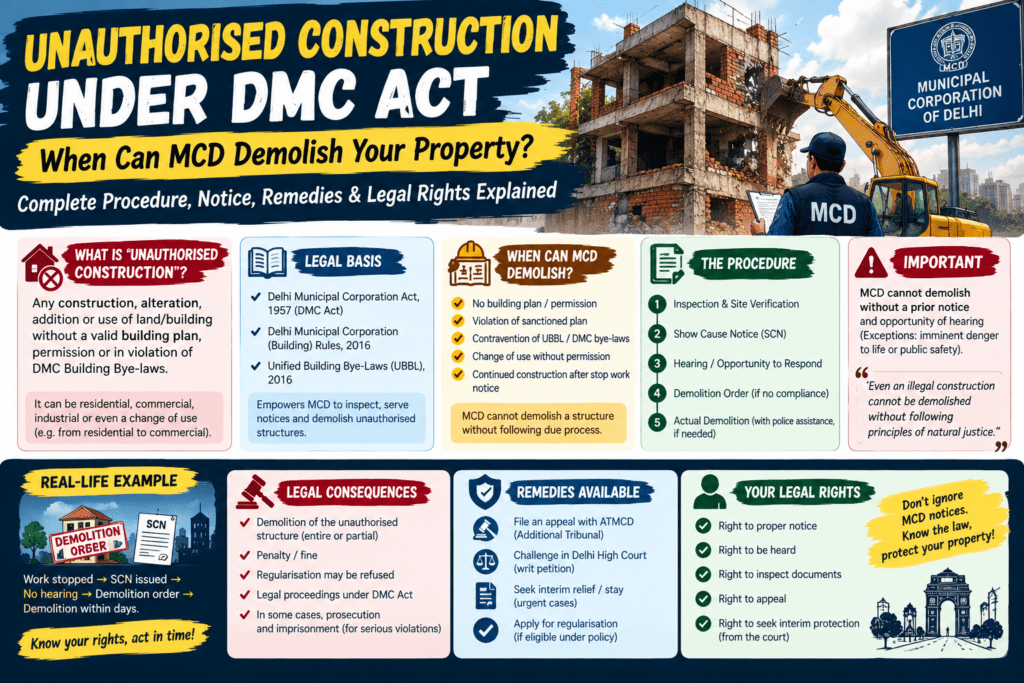
- 1. What Is Unauthorised Construction Under the DMC Act?
- 2. Does Every Construction Require Permission?
- 3. What Is the Difference Between Illegal Construction and Unauthorised Construction?
- 4. Which Provision Gives MCD the Power to Demolish?
- 5. Can MCD Directly Demolish a Property Without Giving Notice?
- 6. What Does a Section 343 Show-Cause Notice Mean?
- 7. MCD's 2024 SOP: How Is the Demolition Process Supposed to Work?
- 8. What Is Section 344 of the DMC Act?
- 9. What Is Section 345 of the DMC Act?
- 10. What Is Section 345A? Can MCD Seal a Property?
- 11. Can a Sealed Property Be Opened by the Owner?
- 12. Can MCD Demolish the Entire Building for One Unauthorised Floor?
- 13. What Happens If the Owner Does Not Comply With a Demolition Order?
- 14. What Is a Vacation Notice Under Section 349?
- 15. Can a New Owner Be Affected by an Old Demolition Order?
- 16. What Is the Remedy Against a Demolition Order?
- 17. Can You Approach the High Court Directly Against a Demolition Order?
- 18. What About Section 347B?
- 19. What Is Section 347E? Why Is It Important?
- 20. What If the Person Never Received the Show-Cause Notice?
- 21. What If the Demolition Order Does Not Give Reasons?
- 22. Can MCD Demolish First and Hear the Owner Later?
- 23. What Did the Supreme Court Say About Demolition Proceedings?
- 24. Demolition Cannot Become a Substitute for Criminal Punishment
- 25. Can MCD Take Criminal Action for Unauthorised Construction?
- 26. Does Ownership Prove That Construction Is Legal?
- 27. What About Electricity, Water and Property Tax?
- 28. Does Property Tax Assessment Legalise Unauthorised Construction?
- 29. Can Long-Standing Unauthorised Construction Be Demolished?
- 30. What Is the Role of the Delhi Laws (Special Provisions) Legislation?
- 31. What Is the Importance of the Sanctioned Building Plan?
- 32. What If MCD's Inspection Report Is Wrong?
- 33. Can a Demolition Order Be Challenged on the Ground of No Hearing?
- 34. Can the MCD Demolish a Property While an Appeal Is Pending?
- 35. What Documents Should You Collect Immediately After Receiving a Demolition Notice?
- 36. What Are the Most Common Legal Grounds Against a Demolition Order?
- Ground 1 — No reasonable opportunity
- Ground 2 — Improper service
- Ground 3 — Mechanical order
- Ground 4 — Wrong identification
- Ground 5 — No sanctioned-plan comparison
- Ground 6 — Construction is authorised
- Ground 7 — Repair rather than construction
- Ground 8 — Protection under special legislation
- Ground 9 — Excessive demolition
- Ground 10 — Lack of reasons
- Ground 11 — Jurisdictional defect
- Ground 12 — Violation of natural justice
- 37. What Did the Delhi High Court Say About the MCD's Demolition Process?
- 38. Important Case Laws on Unauthorised Construction Under the DMC Act
- 1. In Re: Directions in the Matter of Demolition of Structures, 2024 INSC 866
- 2. Jamia Arabia Nizamia Welfare Education Society v. DDA & Ors.
- 3. Imran Khan v. Municipal Corporation of Delhi
- 4. Laxmi Rawat v. Municipal Corporation of Delhi
- 5. Mehrasons Jewellers Pvt. Ltd. v. Municipal Corporation of Delhi
- 39. The Complete MCD Demolition Process — In One Simple Flow
- 40. Myth vs Reality
- Myth 1: "I own the property, so MCD cannot demolish it."
- Myth 2: "I have been paying property tax, so my construction is legal."
- Myth 3: "MCD can demolish my house without giving me any opportunity."
- Myth 4: "Once I file an appeal, demolition automatically stops."
- Myth 5: "A construction is 20 years old, so it cannot be demolished."
- Myth 6: "MCD can demolish the entire building even if only one room is unauthorised."
- Myth 7: "A demolition notice is the same as a demolition order."
- Myth 8: "MCD can never seal a property before passing a demolition order."
- 41. What Should You Do If MCD Serves a Demolition Notice?
- 42. What Should a Lawyer Examine in an MCD Demolition Case?
- 43. Can Courts Protect a Property From Demolition?
- 44. What Is the Difference Between Challenging the Construction and Challenging the Procedure?
- 45. The Key Legal Principle
- 46. Frequently Asked Questions
- Can MCD demolish an unauthorised construction?
- What section of the DMC Act deals with demolition?
- What section deals with sealing?
- What section deals with stoppage of construction?
- What section deals with alteration?
- What section deals with vacation of premises?
- Where can a demolition order be challenged?
- Can I approach the Delhi High Court?
- Can MCD demolish without giving notice?
- Does paying property tax make construction legal?
- Does an electricity connection prove that construction is authorised?
- Can old construction be demolished?
- Can MCD seal before demolition?
- 47. Conclusion: Unauthorised Construction and Demolition Law Is Not Just About "Illegal Construction"
Can MCD demolish a house without notice? What is an unauthorised construction? Can one extra floor lead to demolition? What is a Section 343 demolition notice? Can MCD seal a property? Where can you challenge a demolition order?
These are some of the most common questions faced by property owners in Delhi.
Construction of a building in Delhi is not governed merely by ownership of the land or property. Even if a person is the lawful owner of a property, the construction raised upon it must comply with the Delhi Municipal Corporation Act, 1957 (DMC Act), applicable building bye-laws, sanctioned building plans, planning regulations and other applicable laws.
Where construction is raised without the required sanction, beyond the sanctioned plan, or in violation of applicable building laws, the Municipal Corporation of Delhi (MCD) can initiate statutory action.
But there is an equally important principle:
The existence of alleged unauthorised construction does not mean that MCD can demolish a property in any manner it chooses.
The DMC Act prescribes a statutory procedure. The affected person is entitled to notice and an opportunity to show cause before a demolition order is passed. There is also a statutory appellate remedy against a demolition order.
This article explains the law relating to unauthorised construction under the DMC Act, including Sections 332, 343, 344, 345, 345A, 347B, 347E and 349, the demolition procedure, sealing, vacation notices, criminal consequences, remedies before the Appellate Tribunal and High Court, and the important Supreme Court jurisprudence governing demolitions.
1. What Is Unauthorised Construction Under the DMC Act?
The expression “unauthorised construction” is generally used for construction or building activity which is not authorised under the applicable statutory framework.
Under Section 332 of the DMC Act, no person can erect or commence to erect a building, or execute specified works, without the previous sanction of the Commissioner and otherwise than in accordance with the relevant provisions of the DMC Act and building bye-laws.
Therefore, broadly speaking, construction may become unauthorised where it is:
- constructed without the required sanction;
- constructed contrary to the sanctioned building plan;
- constructed in violation of building bye-laws;
- constructed beyond permissible coverage or height;
- constructed by adding unauthorised floors;
- constructed in violation of setback requirements;
- constructed by covering an area which was required to remain open;
- constructed without the permission required for the particular work;
- structurally altered in a manner requiring sanction but without obtaining it; or
- otherwise carried out contrary to the statutory building regime.
Section 332 is therefore the starting point for understanding unauthorised construction.
2. Does Every Construction Require Permission?
No—not every minor repair or ordinary maintenance activity necessarily requires the same kind of sanction.
The DMC Act itself distinguishes between different types of building works.
For example, Section 334 deals with applications for additions to, or certain alterations and repairs of, buildings.
The important question is therefore not simply:
“Did the owner do construction?”
The real question is:
“What exactly was constructed or altered, and did that particular work require prior sanction under the applicable law?”
This distinction can become extremely important in litigation.
A person may argue that the work was merely:
- repair;
- renovation;
- replacement;
- maintenance;
- internal alteration; or
- work falling within an exemption.
Whether that defence succeeds depends upon the nature and extent of the work and the applicable building regulations.
3. What Is the Difference Between Illegal Construction and Unauthorised Construction?
The expressions are frequently used interchangeably, but they can have different contexts.
Unauthorised construction generally refers to construction which lacks the required statutory sanction or violates the sanctioned plan/building regulations.
Illegal construction is a broader expression and may include construction carried out in violation of statutory provisions, planning laws, building regulations or other legal restrictions.
For practical purposes, however, MCD proceedings commonly proceed on the basis that the construction is unauthorised under the DMC Act and applicable building regulations.
4. Which Provision Gives MCD the Power to Demolish?
The principal provision is Section 343 of the DMC Act.
Section 343 empowers the Commissioner to order demolition where erection of a building or execution of work:
- has commenced;
- is being carried on; or
- has been completed,
and the work has been carried out:
- without the required sanction;
- contrary to the sanction;
- in violation of conditions attached to the sanction; or
- in contravention of the DMC Act or applicable bye-laws.
The statutory provision requires the demolition order to specify a period for compliance, which ordinarily cannot be less than five days and more than fifteen days from delivery of the demolition order with a brief statement of reasons.
Therefore, Section 343 is the principal demolition provision under the DMC Act.
5. Can MCD Directly Demolish a Property Without Giving Notice?
Ordinarily, no.
This is one of the most important protections available to a property owner.
The first proviso to Section 343(1) expressly provides that:
no demolition order shall be made unless the person concerned has been given a reasonable opportunity of showing cause why the demolition order should not be made.
In simple terms:
Show-cause notice → opportunity to reply → consideration of response → demolition order, if warranted.
The requirement is not merely a procedural formality. It is an important aspect of natural justice.
The person affected should have a meaningful opportunity to place material before the competent authority.
6. What Does a Section 343 Show-Cause Notice Mean?
A Section 343 notice generally informs the owner/occupier/builder about the alleged unauthorised construction and calls upon the concerned person to explain why demolition action should not be taken.
Depending upon the circumstances, the notice may identify:
- the property;
- the alleged unauthorised portion;
- the nature of construction;
- the applicable provision;
- the alleged deviation from the sanctioned plan;
- the relevant building violation; and
- the time within which a reply is required.
The recipient should not ignore such a notice.
A detailed response may be crucial because the authority is required to consider the explanation before passing the final demolition order.
7. MCD’s 2024 SOP: How Is the Demolition Process Supposed to Work?
The MCD issued a Standard Operating Procedure for Demolition and Sealing against Unauthorised Constructions on 29 January 2024.
The Delhi High Court subsequently reproduced the SOP in its judgment in Jamia Arabia Nizamia Welfare Education Society v. DDA & Ors.
According to the SOP, once unauthorised construction is detected:
Step 1 — Detection and inspection
The Junior Engineer prepares an inspection record/FIR relating to the alleged unauthorised construction and records the details necessary for identification of the property, including geo-coordinates.
Step 2 — Submission to superior officer
The inspection report is placed before the Assistant Engineer.
Step 3 — Show-cause notice
A notice under Sections 344(1) and 343 is issued to the owner/occupier/builder.
The SOP provides for an opportunity to submit a reply within the prescribed period.
Step 4 — Action under Section 344
Where construction is continuing, action can be taken to stop the construction.
Step 5 — Consideration of reply
After expiry of the notice period, the competent officer considers the response and the material on record.
Step 6 — Demolition order
Where the authority concludes that demolition is warranted, a demolition order under Section 343 is passed.
Step 7 — Voluntary compliance
The owner/builder/occupier is given time to remove the unauthorised construction.
Step 8 — Failure to comply
If the demolition order is not complied with, the file may be processed for execution of demolition action by MCD.
Step 9 — Sealing proceedings
The SOP also contemplates simultaneous action under Section 345A for sealing.
Step 10 — Police assistance
Where required, assistance from the police authorities may be sought for execution of demolition/sealing action.
The Delhi High Court reproduced these steps from the MCD’s SOP in detail.
8. What Is Section 344 of the DMC Act?
Section 344 deals with stoppage of buildings or works in certain cases.
Its practical significance is greatest where construction is still going on.
The object is to prevent an unauthorised structure from becoming larger while the statutory proceedings are being undertaken.
Therefore, the MCD may take action to stop ongoing construction rather than waiting until the entire building or additional floor has been completed.
This is why receiving a notice during construction should be treated seriously.
9. What Is Section 345 of the DMC Act?
Section 345 empowers the Commissioner to require alteration of a building or work in appropriate circumstances.
This is significant because every building violation does not necessarily translate into a direction to demolish the entire property.
Depending upon the nature of the violation and the statutory framework, the authority may require alteration or removal of the offending work.
Therefore, the exact nature and extent of the alleged violation matter.
10. What Is Section 345A? Can MCD Seal a Property?
Yes.
Section 345A of the DMC Act gives the Commissioner power to order sealing of an unauthorised construction.
Importantly, Section 345A is not merely a substitute for demolition.
The provision allows sealing of:
- the unauthorised erection/work; or
- the premises in which such work is being carried out or has been completed.
The statutory provision expressly permits sealing before or after an order under Section 343 or an order under Section 344.
The Supreme Court/Delhi courts have therefore recognised that sealing under Section 345A is not necessarily dependent upon a prior demolition order.
11. Can a Sealed Property Be Opened by the Owner?
No.
A seal affixed under Section 345A cannot simply be removed by the owner or occupier.
The statutory scheme permits removal of the seal pursuant to the authority contemplated under Section 345A or an order of the appropriate appellate forum.
Breaking or tampering with a municipal seal can lead to further legal consequences.
Therefore:
Never remove a municipal seal merely because you believe the sealing order is illegal.
The proper course is to challenge the order before the competent forum.
12. Can MCD Demolish the Entire Building for One Unauthorised Floor?
Not automatically.
The extent of demolition has to correspond with the statutory violation and the demolition order.
If only a particular portion is found unauthorised, the legality of demolishing unrelated authorised portions can become a serious issue.
At the same time, where the entire structure itself is unauthorised, the consequences can obviously be much more extensive.
The MCD’s 30 August 2024 corrigendum to its SOP states that where an entire building is unauthorised, complete demolition may be undertaken, including its load-bearing elements, subject to necessary safety measures.
Thus, the crucial question is:
What portion of the property has actually been found unauthorised?
13. What Happens If the Owner Does Not Comply With a Demolition Order?
Section 343(6) provides the answer.
Where:
- no appeal has been filed against the demolition order; or
- the demolition order has been confirmed in the appellate proceedings,
and the person does not comply within the prescribed period, the Commissioner may himself cause the unauthorised work to be demolished.
The expenses incurred for demolition can be recovered from the concerned person as an arrear of tax under the DMC Act.
Therefore, ignoring a demolition order can create two separate problems:
Demolition of the structure + recovery of demolition expenses.
14. What Is a Vacation Notice Under Section 349?
Sometimes demolition cannot safely be executed while people are occupying the premises.
In such circumstances, MCD may issue a vacation notice under Section 349.
The purpose is to require occupants to vacate the premises so that demolition/sealing action can be undertaken.
A vacation notice is therefore conceptually different from the original demolition order.
This distinction is legally important.
The demolition order determines the statutory basis for demolition, whereas a subsequent vacation notice may facilitate execution of the demolition action.
The Delhi courts have specifically considered the distinction between demolition orders and Section 349 vacation notices.
15. Can a New Owner Be Affected by an Old Demolition Order?
Yes, this can become a complicated issue.
Suppose:
- A constructs an unauthorised floor;
- MCD passes a demolition order;
- A sells the property to B;
- B later receives a vacation/demolition notice.
The subsequent purchaser cannot automatically assume that the old demolition proceedings disappeared merely because ownership changed.
The purchaser must examine:
- whether any demolition order existed;
- whether it was served;
- whether it was challenged;
- whether the order became final;
- whether the construction was protected under any special legislation;
- whether the purchaser had knowledge;
- whether the present structure is the same structure covered by the earlier proceedings; and
- whether subsequent construction has occurred.
A purchaser should therefore conduct a municipal due-diligence search before purchasing property.
16. What Is the Remedy Against a Demolition Order?
The DMC Act provides a specific appellate mechanism.
Under Section 343(2), a person aggrieved by a demolition order may appeal to the Appellate Tribunal, MCD (ATMCD) within the period specified in the demolition order.
The Tribunal can also grant a stay of enforcement of the demolition order under Section 343(3), subject to the statutory requirements and conditions applicable to the case.
This is therefore one of the most important practical remedies available to an owner.
17. Can You Approach the High Court Directly Against a Demolition Order?
A writ petition under Article 226 of the Constitution may be maintainable in appropriate circumstances.
However, the existence of a statutory appellate remedy is extremely important.
The courts ordinarily expect the person aggrieved by an appealable municipal order to pursue the statutory remedy.
The Delhi courts have repeatedly emphasised the availability of the remedy before the MCD Appellate Tribunal in challenges to demolition orders.
For example, in Punita Bhardwaj v. Municipal Corporation of Delhi & Ors., the Delhi High Court dealt with a challenge to a demolition order and observed that the order was assailable before the Appellate Tribunal under the DMC Act.
That does not mean that Article 226 can never be invoked.
A writ court may intervene in appropriate cases involving, for example:
- complete absence of jurisdiction;
- violation of natural justice;
- no meaningful opportunity of hearing;
- action contrary to fundamental legal safeguards;
- patent procedural illegality;
- exceptional circumstances;
- arbitrary exercise of statutory power; or
- other circumstances recognised by constitutional jurisprudence.
But the existence of the alternate remedy remains a major consideration.
18. What About Section 347B?
Section 347B provides an appellate mechanism for several categories of orders and notices under the DMC Act.
These include, among others:
- orders relating to building sanctions;
- orders requiring stoppage of work;
- orders requiring alteration;
- orders directing sealing under Section 345A;
- certain planned-development orders and notices.
The provision therefore becomes important in determining whether a particular municipal order is appealable before the Appellate Tribunal.
The precise provision under which the impugned order has been passed should always be identified before selecting the remedy.
19. What Is Section 347E? Why Is It Important?
Section 347E contains a bar on the jurisdiction of civil courts in respect of certain orders/notices which are appealable under Sections 343 or 347B.
In simple terms:
If the DMC Act provides a specific appellate remedy against the municipal order, an ordinary civil suit cannot ordinarily be used as a substitute for that statutory appeal.
The Delhi District Court has applied this principle in cases involving demolition proceedings.
Therefore, filing a civil suit for a declaration and injunction against an appealable demolition order may face a serious maintainability objection.
20. What If the Person Never Received the Show-Cause Notice?
This can be a significant legal ground.
Section 343 itself requires a reasonable opportunity of showing cause before a demolition order is made.
Therefore, questions of service can become critical:
- Was the notice actually served?
- Upon whom?
- At what address?
- Was it affixed?
- Was the person in occupation?
- Was the owner given a meaningful opportunity?
- Was the reply considered?
- Was the demolition order communicated?
A person challenging demolition action should preserve evidence concerning service, including:
- postal records;
- photographs;
- notices;
- emails;
- municipal communications;
- RTI responses;
- inspection reports; and
- copies of the complete municipal file.
21. What If the Demolition Order Does Not Give Reasons?
A demolition order should not be treated as an empty formality.
Section 343 contemplates that the demolition order should contain a brief statement of reasons.
A proper challenge can therefore examine:
- whether the alleged violation has been identified;
- whether the authority considered the reply;
- whether documents relied upon by the owner were considered;
- whether the sanctioned plan was examined;
- whether the extent of violation has been identified;
- whether the order records reasons; and
- whether the order mechanically directs demolition.
The question is not simply whether an order exists.
The question is whether the statutory power has been exercised in accordance with law.
22. Can MCD Demolish First and Hear the Owner Later?
Ordinarily, Section 343 does not permit the normal demolition process to bypass the requirement of reasonable opportunity.
The statutory scheme specifically says that no demolition order shall be made unless the concerned person has been given a reasonable opportunity to show cause.
However, the precise legal position can depend upon the statutory provision invoked, the nature of the structure, urgency, public land/encroachment issues, court orders and the facts of the particular case.
Therefore, a blanket statement that “MCD can never demolish without notice” would be legally inaccurate.
The better statement is:
Where Section 343 demolition proceedings are invoked against a person, the statutory requirement of reasonable opportunity under Section 343 must ordinarily be respected.
23. What Did the Supreme Court Say About Demolition Proceedings?
One of the most important recent developments is the Supreme Court’s judgment in:
In Re: Directions in the Matter of Demolition of Structures, 2024 INSC 866
The Supreme Court examined the constitutional and legal safeguards surrounding demolition of structures.
The Court dealt with principles including:
- rule of law;
- separation of powers;
- public accountability;
- natural justice;
- right to shelter;
- protection against arbitrary State action; and
- limits on demolition as a form of collective punishment.
The Court issued directions concerning the manner in which demolition action should be undertaken.
The judgment is particularly important because it makes clear that municipal enforcement powers are statutory powers and cannot become a mechanism for arbitrary punishment.
This judgment should be read carefully in every serious demolition case.
24. Demolition Cannot Become a Substitute for Criminal Punishment
A particularly important constitutional principle is that the municipal power to remove an unauthorised structure cannot ordinarily be converted into a punishment for an unrelated allegation.
The Supreme Court’s 2024 demolition judgment specifically examined the danger of demolition being used as a form of collective punishment.
Municipal demolition must therefore have a legal connection with the building violation for which the statutory power is exercised.
This distinction becomes especially important where demolition action is sought against a property because of allegations concerning the conduct of an occupant.
25. Can MCD Take Criminal Action for Unauthorised Construction?
Yes.
Unauthorised construction is not necessarily only a civil/municipal issue.
Section 332 prohibits construction without the required sanction, and contravention may attract penal consequences under the DMC Act.
The Act also contains provisions concerning cognizable offences and prosecution.
For example, Section 466A provides for specified offences, including offences relating to Section 332 and certain other building provisions, to be treated as cognizable for specified purposes, subject to the statutory conditions.
Recent Delhi criminal decisions have also dealt with prosecution under Sections 332/461/466A of the DMC Act in cases concerning alleged unauthorised construction.
Thus:
Unauthorised construction can potentially result in both municipal action and criminal prosecution.
26. Does Ownership Prove That Construction Is Legal?
No.
A registered sale deed may establish ownership rights, but ownership by itself does not establish that every construction on the property is authorised.
A property owner may therefore have:
valid title + unauthorised construction.
These are legally distinct questions.
The municipal authority is concerned with whether the construction complies with the applicable building/planning regime.
27. What About Electricity, Water and Property Tax?
Payment of:
- property tax;
- electricity bills;
- water charges;
- house tax; or
- other municipal charges
does not, by itself, amount to statutory approval of unauthorised construction.
Similarly, the existence of an electricity meter does not automatically prove that the construction is sanctioned.
The legality of construction has to be determined with reference to the applicable planning and building laws.
28. Does Property Tax Assessment Legalise Unauthorised Construction?
No.
This is a common misunderstanding.
Municipal assessment for tax purposes and sanction of construction are legally distinct matters.
Payment of property tax cannot ordinarily be treated as a building sanction.
29. Can Long-Standing Unauthorised Construction Be Demolished?
The mere passage of time does not automatically convert unauthorised construction into authorised construction.
However, in Delhi, the position can become complicated because of:
- special protection legislation;
- regularisation schemes;
- cut-off dates;
- applicable policies;
- sanctioned/revised plans;
- regularisation proceedings; and
- specific judicial or statutory protection.
Therefore, the correct question is not merely:
“How old is the construction?”
It is:
“Was the construction protected by any applicable law, scheme, notification, regularisation order or court order?”
30. What Is the Role of the Delhi Laws (Special Provisions) Legislation?
Delhi has, from time to time, had special legislation dealing with unauthorised constructions, encroachments, sealing and related issues.
However, such legislation should not be misunderstood as a blanket declaration that every old unauthorised construction is legal.
Protection under a special statute is subject to:
- the language of the statute;
- the relevant cut-off date;
- exclusions;
- nature of land;
- subsequent construction;
- misuse or change of status; and
- other statutory conditions.
In Jamia Arabia Nizamia Welfare Education Society v. DDA & Ors., the Delhi High Court considered claims of protection under the National Capital Territory of Delhi Laws (Special Provisions) Act and also examined the effect of subsequent unauthorised construction.
31. What Is the Importance of the Sanctioned Building Plan?
Extremely important.
In many demolition disputes, the central document is the sanctioned building plan.
The Court/Tribunal may need to compare:
Sanctioned Plan
versus
Actual Construction
The dispute may then concern:
- number of floors;
- ground coverage;
- FAR;
- setbacks;
- height;
- balconies;
- projections;
- basement;
- staircase;
- rooms;
- structural additions;
- roof construction;
- common areas;
- parking;
- open spaces; or
- change in use.
Therefore, a person facing demolition should obtain the sanctioned plan and compare it with the municipal inspection report.
32. What If MCD’s Inspection Report Is Wrong?
This can become a substantive defence.
For example, if MCD alleges:
“Third floor has been newly constructed.”
but the owner produces:
- old photographs;
- sanctioned plans;
- previous municipal records;
- sale documents;
- electricity records;
- old assessment records;
- photographs;
- satellite imagery;
- structural reports; or
- other reliable material,
the alleged factual foundation of the demolition order can be challenged.
The dispute may then turn on whether MCD actually established:
- what construction exists;
- when it was constructed;
- whether it is sanctioned;
- whether it violates the applicable law; and
- whether the particular owner/person is responsible for it.
Recent Delhi criminal decisions demonstrate the importance of proving the specific nature of the alleged unauthorised construction and connecting it with the person accused.
33. Can a Demolition Order Be Challenged on the Ground of No Hearing?
Yes, depending on the facts.
A strong challenge may arise where:
- no show-cause notice was served;
- notice was served at an incorrect address;
- notice was issued to a previous owner without addressing the present affected person in circumstances where law requires otherwise;
- reply was submitted but not considered;
- documents were ignored;
- hearing was merely mechanical;
- order was predetermined;
- reasons are absent; or
- the authority failed to consider the actual nature of the construction.
The statutory requirement under Section 343 of a reasonable opportunity is central to such a challenge.
34. Can the MCD Demolish a Property While an Appeal Is Pending?
The answer depends upon the orders passed in the appellate proceedings.
Merely filing an appeal should not be casually assumed to mean that every demolition action is automatically stayed.
The safer course is to seek an express interim stay from the Appellate Tribunal.
Section 343(3) specifically empowers the Appellate Tribunal to stay enforcement of the demolition order subject to the statutory framework.
Therefore:
Appeal ≠ automatically assume stay.
Appeal + effective stay order = protection against enforcement, subject to the terms of the stay.
35. What Documents Should You Collect Immediately After Receiving a Demolition Notice?
A person facing MCD action should generally collect:
Property documents
- sale deed;
- conveyance deed;
- lease deed;
- mutation documents;
- allotment documents;
- possession documents.
Building documents
- sanctioned building plan;
- completion certificate, if available;
- occupancy certificate, where applicable;
- previous sanction orders;
- revised building plans;
- regularisation documents.
Municipal documents
- Section 343 notice;
- Section 344 notice;
- Section 345A sealing notice;
- demolition order;
- vacation notice under Section 349;
- inspection report;
- photographs;
- booking report;
- file notings, where obtainable;
- previous correspondence.
Supporting evidence
- old photographs;
- electricity records;
- water records;
- property-tax documents;
- affidavits;
- structural reports;
- previous court orders;
- previous municipal orders;
- RTI responses.
These documents can become crucial in the appellate or writ proceedings.
36. What Are the Most Common Legal Grounds Against a Demolition Order?
Depending on the facts, a challenge may involve:
Ground 1 — No reasonable opportunity
The demolition order was passed without the opportunity mandated under Section 343.
Ground 2 — Improper service
The notice was never legally or effectively served.
Ground 3 — Mechanical order
The authority merely reproduced allegations without examining the reply.
Ground 4 — Wrong identification
The wrong property, floor, portion or owner has been proceeded against.
Ground 5 — No sanctioned-plan comparison
The authority failed to establish the alleged deviation from the sanctioned plan.
Ground 6 — Construction is authorised
The disputed construction falls within the sanctioned plan or applicable permission.
Ground 7 — Repair rather than construction
The work was repair/maintenance of a nature which did not require the alleged sanction, depending upon applicable regulations.
Ground 8 — Protection under special legislation
The construction is protected under an applicable statutory scheme or notification.
Ground 9 — Excessive demolition
The demolition order extends beyond the alleged unauthorised portion.
Ground 10 — Lack of reasons
The order does not adequately disclose the basis of the conclusion.
Ground 11 — Jurisdictional defect
The officer who passed the order lacked the statutory authority in the circumstances.
Ground 12 — Violation of natural justice
The affected person’s material documents or submissions were not considered.
37. What Did the Delhi High Court Say About the MCD’s Demolition Process?
The Delhi High Court has repeatedly emphasised that municipal authorities must follow the statutory framework.
In Jamia Arabia Nizamia Welfare Education Society v. DDA & Ors., the Court was dealing with allegations of large-scale illegal and unauthorised construction and examined the MCD’s enforcement mechanism in considerable detail.
The Court reproduced the MCD’s 2024 SOP, including the inspection, show-cause notice, demolition order, sealing, police assistance and execution stages.
The case also demonstrates that where there are serious allegations of large-scale unauthorised construction and administrative inaction, courts can examine not only the individual structure but also the functioning and accountability of the concerned authorities.
38. Important Case Laws on Unauthorised Construction Under the DMC Act
1. In Re: Directions in the Matter of Demolition of Structures, 2024 INSC 866
Supreme Court of India — 13 November 2024
This is one of the most important recent judgments concerning demolition.
The Supreme Court examined:
- rule of law;
- natural justice;
- right to shelter;
- public accountability;
- constitutional safeguards; and
- limits on demolition action.
The Court issued detailed directions governing demolition proceedings.
Why it matters:
Municipal demolition is not an unrestricted executive power. Statutory procedure and constitutional safeguards remain relevant.
2. Jamia Arabia Nizamia Welfare Education Society v. DDA & Ors.
Delhi High Court — 13 November 2024
The Court dealt with unauthorised construction and encroachment and reproduced the MCD’s SOP for demolition and sealing.
The case is particularly useful for understanding the practical enforcement process followed by MCD.
The Court’s record sets out the sequence beginning with detection, inspection and show-cause notice and continuing through demolition and sealing.
3. Imran Khan v. Municipal Corporation of Delhi
Delhi Appellate Tribunal — 6 February 2026
The case involved demolition and sealing proceedings relating to alleged unauthorised construction.
The record sets out a sequence involving:
- Section 344/343 show-cause notice;
- demolition order;
- Section 345A sealing notice/order;
- Section 349 vacation notice;
- execution of demolition; and
- recovery of demolition charges.
It provides a useful practical illustration of how the different provisions operate together.
4. Laxmi Rawat v. Municipal Corporation of Delhi
District Court, Delhi — 8 October 2024
The Court examined the relationship between Sections 343, 347B, 347E and a Section 349 vacation notice.
The judgment is useful for understanding the statutory appeal structure and the bar on civil-court proceedings in respect of appealable municipal orders.
5. Mehrasons Jewellers Pvt. Ltd. v. Municipal Corporation of Delhi
The Appellate Tribunal explained the relationship between:
- Section 332;
- Section 343;
- show-cause proceedings; and
- the statutory right of appeal.
The decision recognises the requirement of an opportunity before passing a demolition order under Section 343.
39. The Complete MCD Demolition Process — In One Simple Flow
For a typical Section 343 proceeding, the process can broadly be understood as:
Alleged unauthorised construction
↓
Inspection / booking
↓
Show-cause notice
↓
Opportunity to reply
↓
Consideration of reply
↓
Demolition order under Section 343
↓
Time to comply
↓
Appeal before Appellate Tribunal, if aggrieved
↓
Application for interim protection/stay, where appropriate
↓
If no effective challenge/protection and order remains operative
↓
MCD may execute demolition
↓
Recovery of demolition expenses
Alongside this, depending upon the circumstances:
Section 344 — Stoppage of work
Section 345 — Alteration
Section 345A — Sealing
Section 349 — Vacation
Criminal prosecution — where statutory ingredients are made out
40. Myth vs Reality
Myth 1: “I own the property, so MCD cannot demolish it.”
Reality:
Ownership does not automatically authorise every construction on the property.
Myth 2: “I have been paying property tax, so my construction is legal.”
Reality:
Property-tax assessment does not by itself amount to building sanction.
Myth 3: “MCD can demolish my house without giving me any opportunity.”
Reality:
Section 343 expressly requires a reasonable opportunity to show cause before a demolition order is made in the ordinary Section 343 process.
Myth 4: “Once I file an appeal, demolition automatically stops.”
Reality:
Do not assume that merely filing an appeal creates an automatic stay. Appropriate interim protection should be sought.
Myth 5: “A construction is 20 years old, so it cannot be demolished.”
Reality:
Age alone does not automatically legalise unauthorised construction. Applicable protection/regularisation laws must be examined.
Myth 6: “MCD can demolish the entire building even if only one room is unauthorised.”
Reality:
The extent of demolition must be examined against the statutory violation and the demolition order. Where the entire structure is unauthorised, however, the consequences may extend to the whole structure.
Myth 7: “A demolition notice is the same as a demolition order.”
Reality:
A show-cause notice gives an opportunity to respond. A demolition order is the subsequent statutory determination directing demolition.
Myth 8: “MCD can never seal a property before passing a demolition order.”
Reality:
Section 345A expressly contemplates sealing before or after an order under Section 343 or Section 344.
41. What Should You Do If MCD Serves a Demolition Notice?
Do not ignore it.
A practical approach is:
Step 1
Read the notice carefully.
Identify the provision invoked—343, 344, 345A, 349 or another provision.
Step 2
Obtain the complete municipal record.
Step 3
Check the sanctioned building plan.
Step 4
Identify exactly what MCD alleges is unauthorised.
Step 5
Prepare a detailed factual reply.
Step 6
Attach documentary evidence.
Step 7
If a demolition order has already been passed, immediately examine the limitation for statutory appeal.
Step 8
Consider seeking interim protection/stay before the competent forum.
Step 9
If the case involves serious jurisdictional or natural-justice violations, examine whether constitutional writ jurisdiction can appropriately be invoked.
Step 10
Do not break a municipal seal or obstruct lawful enforcement action.
42. What Should a Lawyer Examine in an MCD Demolition Case?
A proper legal examination should include:
A. Jurisdiction
- Which authority passed the order?
- Was that authority competent?
B. Property
- Correct property number?
- Correct floor?
- Correct portion?
C. Construction
- What exactly is alleged to be unauthorised?
D. Sanction
- What was sanctioned?
- What was actually constructed?
E. Procedure
- Was notice served?
- Was reasonable opportunity given?
F. Reply
- Was the reply considered?
G. Reasons
- Does the demolition order contain reasons?
H. Protection
- Does any special legislation or regularisation scheme apply?
I. Limitation
- When was the order communicated?
- When does the statutory appeal period run?
J. Interim protection
- Is immediate stay required to prevent irreversible demolition?
These questions often determine the strategy of the case.
43. Can Courts Protect a Property From Demolition?
Yes, in appropriate cases.
Depending upon the facts and forum, courts/tribunals may:
- stay demolition;
- stay sealing;
- direct consideration of a representation;
- direct the authority to decide a pending statutory issue;
- protect the property for a limited period;
- require compliance with natural justice;
- set aside an order suffering from legal defects;
- remit the matter for fresh consideration; or
- pass other appropriate directions.
However, relief is fact-specific.
A court does not ordinarily legalise an unauthorised construction merely because demolition proceedings suffer from a procedural defect.
The result may instead be:
“Follow the correct legal procedure and decide the matter afresh.”
44. What Is the Difference Between Challenging the Construction and Challenging the Procedure?
This distinction is extremely important.
A person may argue:
Substantive challenge
“The construction is not unauthorised.”
For example:
- it is sanctioned;
- it falls within permissible limits;
- it is protected;
- the alleged deviation does not exist.
Or:
Procedural challenge
“Even if there is an allegation, the statutory procedure was not followed.”
For example:
- no notice;
- improper service;
- no hearing;
- reply ignored;
- wrong authority;
- no reasons;
- excessive demolition.
The strongest cases may involve both substantive and procedural grounds.
45. The Key Legal Principle
The law on unauthorised construction therefore operates on two parallel principles:
Principle 1 — Unauthorised construction cannot claim immunity merely because it exists.
Municipal authorities have statutory powers to stop, seal, alter and demolish unauthorised construction.
Principle 2 — Municipal enforcement must itself remain within the law.
The authority must exercise its power in accordance with:
- the DMC Act;
- applicable building regulations;
- principles of natural justice;
- statutory appellate remedies;
- constitutional safeguards; and
- judicial directions.
The Supreme Court’s 2024 demolition judgment has reinforced the broader constitutional importance of this distinction.
46. Frequently Asked Questions
Can MCD demolish an unauthorised construction?
Yes. Section 343 empowers the Commissioner to order demolition of construction raised without or contrary to the required sanction or in violation of the DMC Act/by-laws, subject to the statutory procedure.
What section of the DMC Act deals with demolition?
Primarily Section 343.
What section deals with sealing?
Section 345A.
What section deals with stoppage of construction?
Section 344.
What section deals with alteration?
Section 345.
What section deals with vacation of premises?
Section 349.
Where can a demolition order be challenged?
Ordinarily, an aggrieved person can invoke the statutory appellate remedy before the Appellate Tribunal in accordance with Section 343 and the applicable provisions of the DMC Act.
Can I approach the Delhi High Court?
A writ petition under Article 226 may be maintainable in appropriate cases, but the existence of a statutory alternate remedy is an important consideration.
Can MCD demolish without giving notice?
The ordinary Section 343 process requires a reasonable opportunity to show cause before a demolition order is made.
Does paying property tax make construction legal?
No.
Does an electricity connection prove that construction is authorised?
No.
Can old construction be demolished?
Potentially yes, unless the construction is protected by applicable law, scheme, regularisation or other legal protection.
Can MCD seal before demolition?
Yes. Section 345A expressly permits sealing before or after specified orders under Sections 343/344.
47. Conclusion: Unauthorised Construction and Demolition Law Is Not Just About “Illegal Construction”
The law relating to unauthorised construction in Delhi is a combination of municipal enforcement and procedural safeguards.
On one side, the MCD has substantial statutory powers to:
- stop construction;
- order alteration;
- seal premises;
- order demolition;
- execute demolition; and
- recover demolition expenses.
On the other side, the property owner or affected person has legal rights relating to:
- notice;
- reasonable opportunity;
- consideration of the reply;
- reasoned statutory action;
- appellate remedy;
- interim protection; and
- constitutional judicial review in appropriate cases.
The most important point is therefore simple:
Unauthorised construction does not acquire legality merely because it has existed for years, but the existence of an alleged unauthorised construction also does not give the municipal authority an unrestricted power to demolish without following the law.
Every demolition case must therefore be examined from both sides:
Is the construction actually unauthorised?
and
Was the statutory power to demolish exercised lawfully?
That is where the DMC Act, building bye-laws, sanctioned plans, municipal records, principles of natural justice, statutory appeals and constitutional jurisprudence all come together.