
Disclaimer!

This Website is owned and operated by Law Offices of Zuber Ali and is made available strictly for educational, informational, and public legal awareness purposes. All content published on this Website, including but not limited to blog posts, case summaries, full texts or excerpts of judgments, legal articles, explanations, commentaries, and any other material, is provided solely to promote general understanding of legal principles and developments in Indian law among the public.
The information and materials available on this Website do not constitute legal advice, professional opinion, or any form of legal services. Nothing contained on this Website is intended to create, nor should it be construed as creating, any attorney-client relationship, lawyer-client relationship, or any other professional relationship between the user and the owner/operator of this Website or any person associated with it. Users are strongly advised not to rely upon or act on the basis of any content available on this Website without seeking specific advice from a qualified and competent legal professional who is duly enrolled and authorized to practice law.
We make reasonable efforts to ensure that the information on this Website is accurate and up-to-date at the time of publication. However, We do not provide any warranty, express or implied, as to the completeness, accuracy, reliability, suitability, or timeliness of the content. Laws, rules, regulations, and judicial pronouncements are dynamic and subject to amendments, clarifications, interpretations, and reversals. Accordingly, We shall not be responsible or liable for any errors, omissions, inaccuracies, or for any consequences arising from the use of, or reliance upon, any information provided on this Website.
To the maximum extent permitted under applicable Indian law, including but not limited to the Information Technology Act, 2000 and other relevant statutes, We expressly disclaim all liability for any direct, indirect, incidental, consequential, special, punitive, or exemplary damages arising out of or in any way connected with the access to, use of, or inability to use this Website or any content therein. This includes, without limitation, any loss, damage, injury, or harm, whether financial, legal, or otherwise, suffered by any user or third party due to decisions or actions taken based on the material available on this Website.
This Website may occasionally contain links to external websites, government portals, databases, or third-party resources. We do not endorse, control, monitor, or assume any responsibility for the accuracy, privacy practices, or content of such external sources. Any access to or use of such third-party resources is entirely at the user’s own risk.
By accessing, browsing, or using this Website in any manner, you expressly acknowledge that you have read, understood, and voluntarily agreed to this Disclaimer. You further agree that your use of this Website is at your sole risk and that you will not hold Us liable for any issues arising from such use. If you do not agree with any part of this Disclaimer, you must immediately cease accessing or using this Website.

Uncategorized

Can You Get Bail Due to Long Incarceration? Supreme Court’s View on Prolonged Jail and the Right to Liberty

Introduction Imagine spending years in jail without being convicted of any offence. No judgment. No finding of guilt. No sentence. Just waiting for your trial to conclude. Unfortunately, this is a reality for thousands of undertrial prisoners across India. Criminal trials often take several years due to overloaded courts, lengthy investigations, and procedural delays. As […]

Can You Get Bail Due to Long Incarceration? Supreme Court’s View on Prolonged Jail and the Right to Liberty Read More »

Section 483 BNSS Explained: How the High Court and Sessions Court Grant Bail in India (Complete Legal Guide 2026)

Introduction Arrest is often one of the most stressful experiences a person can face. The moment someone is taken into custody, the immediate concern of the accused and his family is usually one question: “How can bail be obtained?” While Magistrates possess powers to grant bail in many cases, the law also gives extensive powers

Section 483 BNSS Explained: How the High Court and Sessions Court Grant Bail in India (Complete Legal Guide 2026) Read More »

Bail in India: Understanding Your Right to Liberty Under the Bharatiya Nagarik Suraksha Sanhita, 2023

Introduction Imagine being arrested for an offence and spending weeks, months, or even years in jail before a court determines whether you are guilty or innocent. Such a situation would not only affect your freedom but also your family, career, reputation, and future. To prevent unnecessary detention and protect individual liberty, the law provides a

Bail in India: Understanding Your Right to Liberty Under the Bharatiya Nagarik Suraksha Sanhita, 2023 Read More »

Cheque Bounce Cases in India: Complete Legal Guide Under Section 138 of the Negotiable Instruments Act

Introduction Despite the rise of digital payments, cheques continue to be widely used in business transactions, loans, property dealings, and personal financial arrangements. A cheque is often considered a symbol of trust and financial commitment. However, when a cheque issued by a person is dishonoured or “bounced” by the bank, it can lead to serious

Cheque Bounce Cases in India: Complete Legal Guide Under Section 138 of the Negotiable Instruments Act Read More »

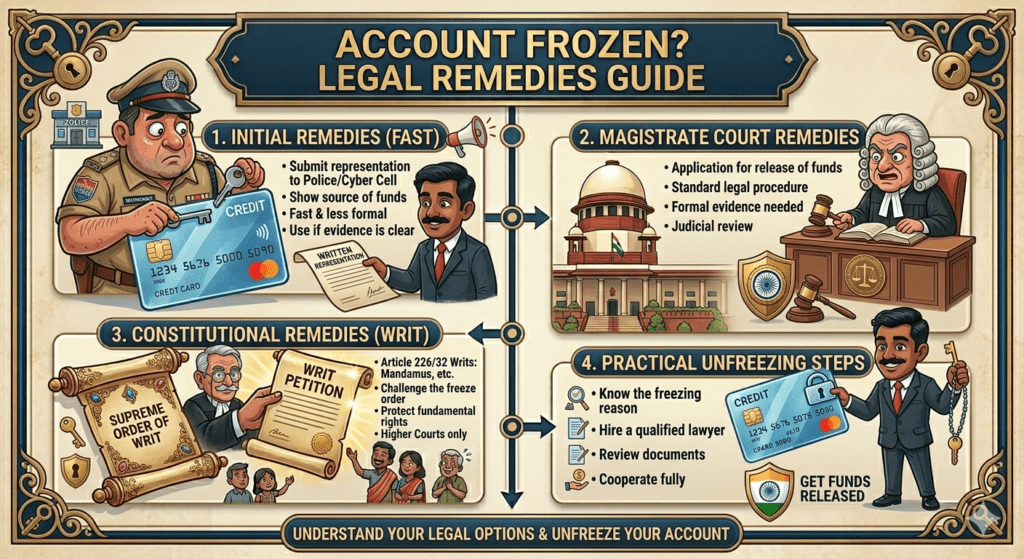
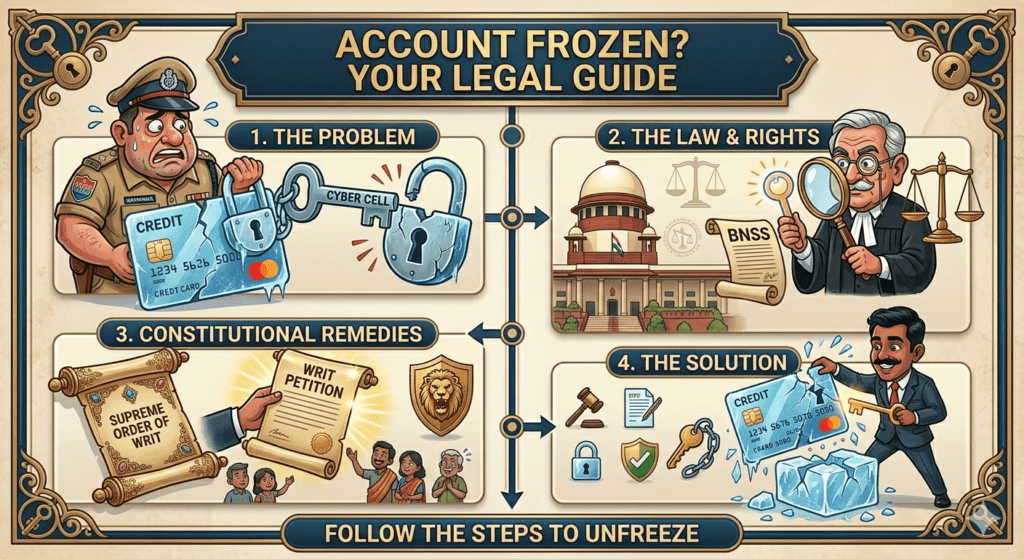
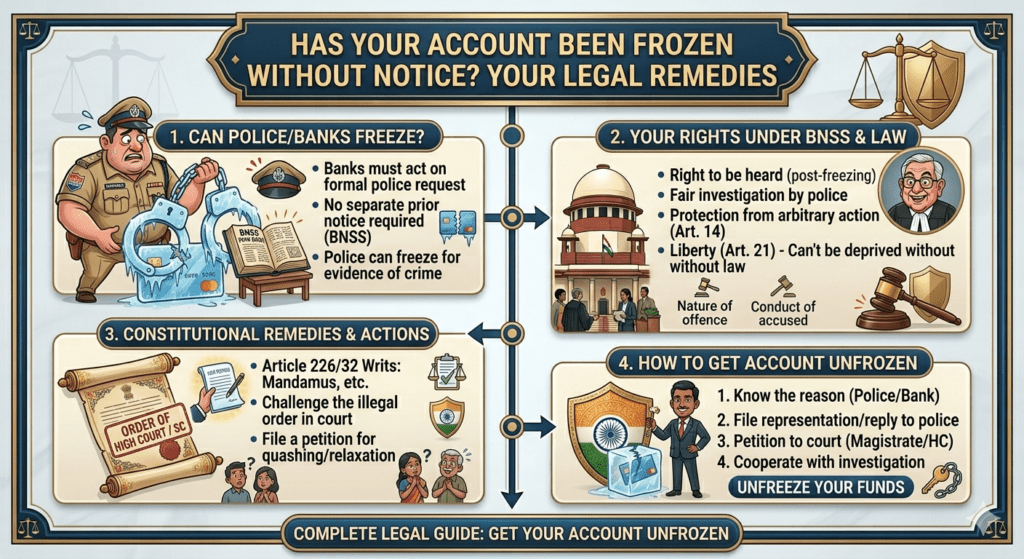
Cyber Crime Complaint of ₹1,100, Bank Account Frozen: Gujarat High Court Protects Citizens from Arbitrary Account Freezes

In a significant judgment safeguarding the rights of ordinary bank account holders, the Gujarat High Court has ruled that authorities cannot freeze an entire bank account merely because a small disputed amount is under investigation in a cybercrime case. The Court emphasized that while investigating agencies have the power to freeze bank accounts during criminal

Cyber Crime Complaint of ₹1,100, Bank Account Frozen: Gujarat High Court Protects Citizens from Arbitrary Account Freezes Read More »

23 Years Later, Can a Criminal Case Still Be Filed? Supreme Court Draws the Line Against Delayed and Vindictive Prosecution

A Landmark Judgment on Delay, Abuse of Criminal Law, and Civil-Criminal Disputes The Supreme Court of India has delivered an important judgment that will have a significant impact on cases where criminal proceedings are initiated after an extraordinary delay, particularly when civil disputes between the parties have been pending for years. In Nazibul Rahim Khan

23 Years Later, Can a Criminal Case Still Be Filed? Supreme Court Draws the Line Against Delayed and Vindictive Prosecution Read More »

Supreme Court Cracks Down on Delayed Judgments: New Rules Promise Faster Justice for Litigants

Introduction In a significant step towards ensuring speedy justice and strengthening public confidence in the judicial system, the Supreme Court of India has issued a comprehensive set of binding directions to all High Courts across the country regarding the timely pronouncement of judgments. The directions were issued by a Bench comprising Hon’ble Chief Justice of

Supreme Court Cracks Down on Delayed Judgments: New Rules Promise Faster Justice for Litigants Read More »

Supreme Court Flags Misuse of POCSO in Matrimonial Disputes: A Strong Warning Against False Criminal Cases

In a significant judgment, the Supreme Court of India has expressed serious concern over the increasing misuse of the Protection of Children from Sexual Offences (POCSO) Act in matrimonial and personal disputes. The Court observed that in some cases, criminal law is being used not as a tool for justice but as a weapon of

Supreme Court Flags Misuse of POCSO in Matrimonial Disputes: A Strong Warning Against False Criminal Cases Read More »

chatgpt image jun 7, 2026, 03 23 03 pm

Cheque Bounce Cases: Supreme Court Clarifies When Office Bearers Can Be Prosecuted

Supreme Court Draws the Line Between Mere Designation and Actual Responsibility Introduction In a significant judgment delivered on 26 May 2026 in M/s Mansi Finance (Chennai) Ltd. v. M. Lalitha & Others, the Supreme Court of India clarified an important question relating to cheque bounce cases: Can every office bearer of a society or company

Cheque Bounce Cases: Supreme Court Clarifies When Office Bearers Can Be Prosecuted Read More »

supreme court rules secretly recorded calls

Supreme Court Rules Secretly Recorded Calls Between Spouses Are Admissible in Divorce Cases

Case Title – Vibhor Garg v. Neha (SLP(C) No. 21195/2021) In a landmark judgment that could significantly impact matrimonial litigation across India, the Supreme Court has held that secretly recorded telephone conversations between spouses can be admitted as evidence in matrimonial proceedings. The Court set aside a judgment of the Punjab and Haryana High Court

Supreme Court Rules Secretly Recorded Calls Between Spouses Are Admissible in Divorce Cases Read More »